RESPIRATIONDr. Faraz A. Bokhari
If you cant breathe, nothing else matters!(American Lung Association)
IntroductionWhy respire?Gas exchangeHost defense (barrier b/w outside and inside)Metabolism (produces/metabolizes compounds)Gas exchangePulmonary ventilationDiffusion of O2 and CO2 b/w alveoli and bloodTransport of O2 and CO2 in blood and body fluids to & from body's tissue cellsRegulation of ventilation
Physiological AnatomyUpper airwayAll structures from nose to the vocal cords, including sinuses and the larynxConditioning of inspired airLower airwayTrachea, airways & alveoli
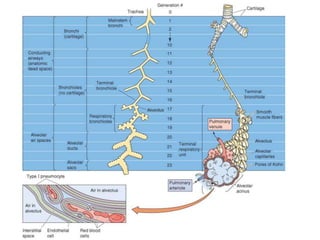
The Airway Tree:Conducting zoneConsists of trachea and first 16 generations of airway branchesFirst four generations are subjected to changes in -ve and +ve pressures, & contain a considerable amount of cartilage       (to prevent airway collapse)Cartilage present up to lobar and segmental bronchiDisappears in bronchiolesBronchioles are suspended by elastic tissue of lung parenchymaThis elasticity keeps them patentBlood supply: Bronchial vesselsNo gas exchange
The Airway Tree:Respiratory zoneComposed of last seven generations Consists of respiratory bronchioles, alveolar ducts and alveoliBlood supply: pulmonary circulationPulmonary circulation receives all of CO
The Airway Tree:Respiratory zoneAdult lungs contain 300 to 500 million alveoliCombined internal surface area: 75 m2Represents one of the largest biological membranes in the bodyWith age number and size increases till adolescence!after adolescence, alveoli only increase in size  Smoking induced damage can be reversed in a limited way only!
Physiological AnatomyLung are covered by the visceralpleura and are encased by the parietal pleuraPotential space b/w these 2 layersLayer of fluid allows for smooth gliding of lung as it expands in the chestPressure within this space is normally kept negativePneumothoraxHemothorax
Lung-Chest Wall Interaction
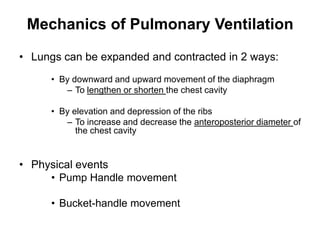
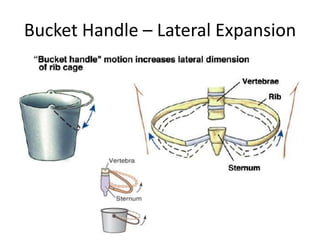
Mechanics of Pulmonary VentilationLungs can be expanded and contracted in 2 ways: By downward and upward movement of the diaphragmTo lengthen or shorten the chest cavityBy elevation and depression of the ribs To increase and decrease the anteroposterior diameter of the chest cavityPhysical eventsPump Handle movementBucket-handle movement
Pump Handle – AP Diameter
Bucket Handle – Lateral Expansion
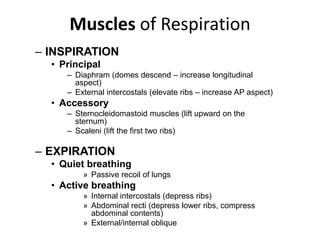
Muscles of RespirationINSPIRATIONPrincipalDiaphram (domes descend – increase longitudinal aspect)External intercostals (elevate ribs – increase AP aspect)Accessory Sternocleidomastoid muscles (lift upward on the sternum)Scaleni (lift the first two ribs)EXPIRATIONQuiet breathingPassive recoil of lungsActive breathingInternal intercostals (depress ribs)Abdominal recti (depress lower ribs, compress abdominal contents)External/internal oblique
Inspiratory Sequence – General Concept
Quiet Inspiratory Sequence -General Concept
Quiet Expiratory Sequence -General Concept
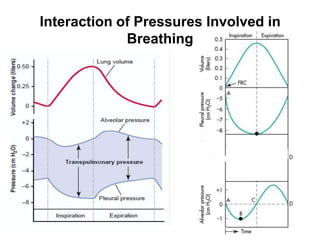
Pressures Involved in BreathingBarometric pressure (Pb)Intrapleural pressure (Pip)Alveolar pressure (Palv)Transpulmonary pressure (Ptp)
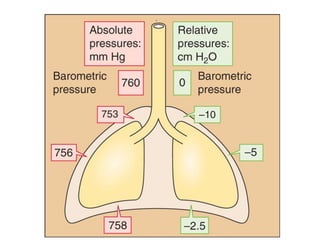
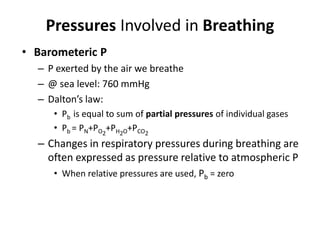
Pressures Involved in BreathingBarometeric PP exerted by the air we breathe@ sea level: 760 mmHgDalton’s law:Pb  is equal to sum of partial pressures of individual gasesPb = PN+PO2+PH2O+PCO2Changes in respiratory pressures during breathing are often expressed as pressure relative to atmospheric PWhen relative pressures are used, Pb = zero
Partial pressures and percentages of Respiratory Gases at Sea Level (PB = 760 mm Hg)
Pressures Involved in BreathingIntrapleural PressureLess than PbSince the 2 elastic recoils are oppositePip in fact is intrathoracic pressureIn upright subject:Greatest vacuum (least Pip) – lung apexLowest vacuum (highest Pip) – lung baseAverage (Resting) value = -5 cm water
Pressures Involved in BreathingAlveolar pressure (Palv)Pressure inside the alveoliDecreases during inspirationAtmospheric air fills in Transpulmonary pressure (Ptp)Distending pressurePtp = Palv – Pip
Interaction of Pressures Involved in Breathing
Pneumothorax
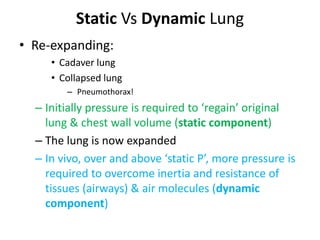
Static Vs Dynamic LungRe-expanding:Cadaver lungCollapsed lung  Pneumothorax!Initially pressure is required to ‘regain’ original lung & chest wall volume (static component)The lung is now expandedIn vivo, over and above ‘static P’, more pressure is required to overcome inertia and resistance of tissues (airways) & air molecules (dynamic component)
Static Vs Dynamic LungPtp = Palv – PipPip = (-Ptp) + PalvThus, Pip has 2 aspects*:Transpulmonary pressure (Ptp) – Static componentAlveolar pressure (Palv) – Dynamic componentCompliance (dV/dP) variesStatic complianceChange in volume for a given change in Ptp with zero gas flowDynamic complianceMeasurements made by monitoring TD usedWhile intra thoracic pressure (Pip) measured during the instance of zero air flow occurring at the end inspiritory and expiratory levels with each breath
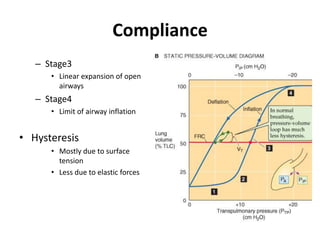
Compliance*Extent to which lungs will expand for each unit increase in PtpC=dV/dPStages of compliance:Stage1 [Stable VL): Less volume change for pressure changeSurface tension makes it difficult to open an airwayStage2 (airway start opening):Stepwise decreases in PIP beyond -8 - produce dV dV first small, then larger
ComplianceStage3Linear expansion of open airwaysStage4Limit of airway inflationHysteresisMostly due to surface tensionLess due to elastic forces
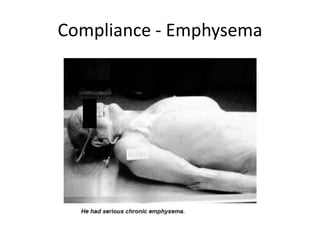
Compliance Vs ElastanceCompliance is a measure of distensibilityElastance is a measure of elastic recoilThese both oppose each other!Compliancedecreases as Elastanceincreases:Pulmonary fibrosis (restrictive lung disease)Pulmonary hypertension/congestionDecreased surfactant – increased surface tension (prematurity, artificial ventilation)Complianceincreases as ElastancedecreasesNormal ageing (alteration in elastic tissue)Asthma (unknown reason)Emphysema* (obstructive lung disease)
Compliance - Emphysema
Compliance & Surface TensionELASTIC FORCES of the lungs:(1) Lung tissue elastic forces          (elastin& collagen fibers)(2) Elastic forces caused by surface tension		   (Tension created by fluid-air interface)Lung tissue elastic forces (air-filled lung) I/3of totalSurface tension forces - 2/3
SurfactantSurface active agentGreatly reduces surface tension of waterSecreted by Type II alveolar epithelial cellsMost important components:DipalmitoylphosphatidylcholineSurfactant apoproteins Calcium ionsPremature babies lack surfactant
Lung-Thoracic CageComplianceThoracic cage has its own compliance!Compliance (lung-cage): 110 ml/cm waterCompliance (lung): 200 ml/cm waterWhen the lungs are expanded to high volumes/ compressed to low volumes -  checked by chest compliance limitations

Upload respiration1

  • 1.
  • 2.
    If you cantbreathe, nothing else matters!(American Lung Association)
  • 3.
    IntroductionWhy respire?Gas exchangeHostdefense (barrier b/w outside and inside)Metabolism (produces/metabolizes compounds)Gas exchangePulmonary ventilationDiffusion of O2 and CO2 b/w alveoli and bloodTransport of O2 and CO2 in blood and body fluids to & from body's tissue cellsRegulation of ventilation
  • 4.
    Physiological AnatomyUpper airwayAllstructures from nose to the vocal cords, including sinuses and the larynxConditioning of inspired airLower airwayTrachea, airways & alveoli
  • 7.
    The Airway Tree:ConductingzoneConsists of trachea and first 16 generations of airway branchesFirst four generations are subjected to changes in -ve and +ve pressures, & contain a considerable amount of cartilage (to prevent airway collapse)Cartilage present up to lobar and segmental bronchiDisappears in bronchiolesBronchioles are suspended by elastic tissue of lung parenchymaThis elasticity keeps them patentBlood supply: Bronchial vesselsNo gas exchange
  • 8.
    The Airway Tree:RespiratoryzoneComposed of last seven generations Consists of respiratory bronchioles, alveolar ducts and alveoliBlood supply: pulmonary circulationPulmonary circulation receives all of CO
  • 9.
    The Airway Tree:RespiratoryzoneAdult lungs contain 300 to 500 million alveoliCombined internal surface area: 75 m2Represents one of the largest biological membranes in the bodyWith age number and size increases till adolescence!after adolescence, alveoli only increase in size Smoking induced damage can be reversed in a limited way only!
  • 10.
    Physiological AnatomyLung arecovered by the visceralpleura and are encased by the parietal pleuraPotential space b/w these 2 layersLayer of fluid allows for smooth gliding of lung as it expands in the chestPressure within this space is normally kept negativePneumothoraxHemothorax
  • 11.
  • 13.
    Mechanics of PulmonaryVentilationLungs can be expanded and contracted in 2 ways: By downward and upward movement of the diaphragmTo lengthen or shorten the chest cavityBy elevation and depression of the ribs To increase and decrease the anteroposterior diameter of the chest cavityPhysical eventsPump Handle movementBucket-handle movement
  • 14.
    Pump Handle –AP Diameter
  • 15.
    Bucket Handle –Lateral Expansion
  • 16.
    Muscles of RespirationINSPIRATIONPrincipalDiaphram(domes descend – increase longitudinal aspect)External intercostals (elevate ribs – increase AP aspect)Accessory Sternocleidomastoid muscles (lift upward on the sternum)Scaleni (lift the first two ribs)EXPIRATIONQuiet breathingPassive recoil of lungsActive breathingInternal intercostals (depress ribs)Abdominal recti (depress lower ribs, compress abdominal contents)External/internal oblique
  • 17.
  • 18.
  • 19.
  • 20.
    Pressures Involved inBreathingBarometric pressure (Pb)Intrapleural pressure (Pip)Alveolar pressure (Palv)Transpulmonary pressure (Ptp)
  • 21.
    Pressures Involved inBreathingBarometeric PP exerted by the air we breathe@ sea level: 760 mmHgDalton’s law:Pb is equal to sum of partial pressures of individual gasesPb = PN+PO2+PH2O+PCO2Changes in respiratory pressures during breathing are often expressed as pressure relative to atmospheric PWhen relative pressures are used, Pb = zero
  • 22.
    Partial pressures andpercentages of Respiratory Gases at Sea Level (PB = 760 mm Hg)
  • 23.
    Pressures Involved inBreathingIntrapleural PressureLess than PbSince the 2 elastic recoils are oppositePip in fact is intrathoracic pressureIn upright subject:Greatest vacuum (least Pip) – lung apexLowest vacuum (highest Pip) – lung baseAverage (Resting) value = -5 cm water
  • 24.
    Pressures Involved inBreathingAlveolar pressure (Palv)Pressure inside the alveoliDecreases during inspirationAtmospheric air fills in Transpulmonary pressure (Ptp)Distending pressurePtp = Palv – Pip
  • 25.
    Interaction of PressuresInvolved in Breathing
  • 26.
  • 27.
    Static Vs DynamicLungRe-expanding:Cadaver lungCollapsed lung Pneumothorax!Initially pressure is required to ‘regain’ original lung & chest wall volume (static component)The lung is now expandedIn vivo, over and above ‘static P’, more pressure is required to overcome inertia and resistance of tissues (airways) & air molecules (dynamic component)
  • 28.
    Static Vs DynamicLungPtp = Palv – PipPip = (-Ptp) + PalvThus, Pip has 2 aspects*:Transpulmonary pressure (Ptp) – Static componentAlveolar pressure (Palv) – Dynamic componentCompliance (dV/dP) variesStatic complianceChange in volume for a given change in Ptp with zero gas flowDynamic complianceMeasurements made by monitoring TD usedWhile intra thoracic pressure (Pip) measured during the instance of zero air flow occurring at the end inspiritory and expiratory levels with each breath
  • 29.
    Compliance*Extent to whichlungs will expand for each unit increase in PtpC=dV/dPStages of compliance:Stage1 [Stable VL): Less volume change for pressure changeSurface tension makes it difficult to open an airwayStage2 (airway start opening):Stepwise decreases in PIP beyond -8 - produce dV dV first small, then larger
  • 30.
    ComplianceStage3Linear expansion ofopen airwaysStage4Limit of airway inflationHysteresisMostly due to surface tensionLess due to elastic forces
  • 31.
    Compliance Vs ElastanceComplianceis a measure of distensibilityElastance is a measure of elastic recoilThese both oppose each other!Compliancedecreases as Elastanceincreases:Pulmonary fibrosis (restrictive lung disease)Pulmonary hypertension/congestionDecreased surfactant – increased surface tension (prematurity, artificial ventilation)Complianceincreases as ElastancedecreasesNormal ageing (alteration in elastic tissue)Asthma (unknown reason)Emphysema* (obstructive lung disease)
  • 32.
  • 33.
    Compliance & SurfaceTensionELASTIC FORCES of the lungs:(1) Lung tissue elastic forces (elastin& collagen fibers)(2) Elastic forces caused by surface tension (Tension created by fluid-air interface)Lung tissue elastic forces (air-filled lung) I/3of totalSurface tension forces - 2/3
  • 34.
    SurfactantSurface active agentGreatlyreduces surface tension of waterSecreted by Type II alveolar epithelial cellsMost important components:DipalmitoylphosphatidylcholineSurfactant apoproteins Calcium ionsPremature babies lack surfactant
  • 35.
    Lung-Thoracic CageComplianceThoracic cagehas its own compliance!Compliance (lung-cage): 110 ml/cm waterCompliance (lung): 200 ml/cm waterWhen the lungs are expanded to high volumes/ compressed to low volumes - checked by chest compliance limitations

Editor's Notes

  • #5 The lungs are a remarkable feat of engineering. They receive the entire right ventricular cardiac output and they are called upon at birth to function without cessation. The lungs are contained in a space with a volume of approximately 4 L, but they have a surface area for gas exchange that is the size of a tennis court (∼85 m2). This large surface area is comprised of myriads of independently functioning respiratory units. Unlike the heart, but similar to the kidneys, the lungs demonstrate functional unity; that is, each unit is structurally identical and functions just like every other unit. a marathon runner who staggers across the 26-mile finish line in less than 3 hours or someone who swims the English Channel in record time is rarely limited by the amount of oxygen taken up by the lungs. The reason is that gas exchange can increase more than 20-fold to meet the body's energy demands. These examples of human activity not only underscore the functional capacity of the lungs but also illustrate the important role respiration plays in our extraordinary adaptability.
  • #12 Explain Pip, Palv and Ptp (transpulmonary)
  • #13 Values after a quiet expiration
  • #27 Explain static & dynamic lung components..
  • #29 *The component which only causes change in volume is refered to as static component. E,g. transpulmonary P and compliance determine lung volume only……whereas the parameter that causes air flow is refered to as dynamic component. E.g. alveolar pressure (Palv)The key message in Figure 26-15 is that during inspiration, the negative shift in PIP has two effects. Thebody invests some of the energy represented by %PIP into transiently making PA more negative (dynamiccomponent). The result is that air flows into the lungs, and VL increases. But this investment in PA is onlytransient. Throughout inspiration, the body invests an increasingly greater fraction of its energy in makingPTP more positive (static component). The result is that the body maintains the new, higher VL. By the endof inspiration, the body invests all of the energy represented by %PIP into maintaining VL and none intofurther expansion. The situation is not unlike that faced by Julius Caesar as he, with finite resources,conquered Gaul. At first, he invested all of his resources in expanding his territory at the expense of thefeisty Belgians. But as the conquered territory grew, he was forced to invest an increasingly greater fractionof his resources in maintaining the newly conquered territory. In the end, he necessarily invested all of hisresources into maintaining his territory, and was unable to expand further.
  • #30 Ptp = Palv – Pip
  • #31 What would happen if, having inflated the lungs to TLC, we allowed PIP to increase to 0 cm H2O onceagain? Obviously, the VL would decrease. However, the lungs follow a different path during deflation (seeFig. 26-5B, upper blue curve). The difference between the inflation and the deflation paths is known ashysteresis, and it exists because a greater pressure difference is required to open a previously closedairway than to keep an open airway from closing. As an example, the horizontal line in Figure 26-5B showsthat inflating collapsed lungs to FRC requires a PIP of -12 cm H2O, whereas maintaining previously inflatedlungs at FRC requires a PIP of only -5 cm H2O. During normal respiration, the lungs exhibit much lesshysteresis, and the hysteresis loop (see Fig. 26-5B, green loop) lies close to the deflation limb of the blueloop.Green small compliance curves – Dynamic Compliance
  • #32 *In emphysema, the situation is reversed. The disease process, a common consequence of cigarettesmoking, destroys pulmonary tissue and makes the lungs rather floppy. An important part of the diseaseprocess is the destruction of the extracellular matrix, including elastin, by elastase released frommacrophages Normal mice that are exposed to cigarette smoke develop emphysema rapidly, whereas thedisease does not develop in "smoker" mice lacking the macrophage elastase gene. The same increase inPTP that produces a 500-ml VL increase in normal lungs produces a substantially larger VL increase inlungs with emphysema. In other words, static compliance is much greater (i.e., much less elastic recoil). Because it requires work to inflate the lungs against their elastic recoil, one might think that a littleemphysema might be a good thing. Although it is true that patients with emphysema exert less effort toinflate their lungs, the cigarette smoker pays a terrible price for this small advantage: The destruction ofpulmonary architecture also makes emphysematous airways more prone to collapse during expiration,drastically increasing airway resistance. Hence in emphysema, static compliance increases – since volume is increasing; but dynamic compliance decreases – decreased airflow.