

Author(s): Louis D’Alecy, 2009

License: Unless otherwise noted, this material is made available under the terms of the
Creative Commons Attribution–Non-commercial–Share Alike 3.0 License:
http://creativecommons.org/licenses/by-nc-sa/3.0/

We have reviewed this material in accordance with U.S. Copyright Law and have tried to maximize your ability to use,
share, and adapt it. The citation key on the following slide provides information about how you may share and adapt this
material.

Copyright holders of content included in this material should contact open.michigan@umich.edu with any questions,
corrections, or clarification regarding the use of content.

For more information about how to cite these materials visit http://open.umich.edu/education/about/terms-of-use.

Any medical information in this material is intended to inform and educate and is not a tool for self-diagnosis or a
replacement for medical evaluation, advice, diagnosis or treatment by a healthcare professional. Please speak to your
physician if you have questions about your medical condition.

Viewer discretion is advised: Some medical content is graphic and may not be suitable for all viewers.
Citation Key
                          for more information see: http://open.umich.edu/wiki/CitationPolicy


Use + Share + Adapt
  { Content the copyright holder, author, or law permits you to use, share and adapt. }
               Public Domain – Government: Works that are produced by the U.S. Government. (USC 17 § 105)
               Public Domain – Expired: Works that are no longer protected due to an expired copyright term.
               Public Domain – Self Dedicated: Works that a copyright holder has dedicated to the public domain.

               Creative Commons – Zero Waiver

               Creative Commons – Attribution License
               Creative Commons – Attribution Share Alike License
               Creative Commons – Attribution Noncommercial License
               Creative Commons – Attribution Noncommercial Share Alike License
               GNU – Free Documentation License

Make Your Own Assessment
  { Content Open.Michigan believes can be used, shared, and adapted because it is ineligible for copyright. }
               Public Domain – Ineligible: Works that are ineligible for copyright protection in the U.S. (USC 17 § 102(b)) *laws in
               your jurisdiction may differ
   { Content Open.Michigan has used under a Fair Use determination. }
               Fair Use: Use of works that is determined to be Fair consistent with the U.S. Copyright Act. (USC 17 § 107) *laws in
               your jurisdiction may differ
               Our determination DOES NOT mean that all uses of this 3rd-party content are Fair Uses and we DO NOT guarantee
               that your use of the content is Fair.
               To use this content you should do your own independent analysis to determine whether or not your use will be Fair.
Alveolar Ventilation II

            M1 – Cardiovascular/Respiratory
                      Sequence
                 Louis D Alecy, Ph.D.

Fall 2008
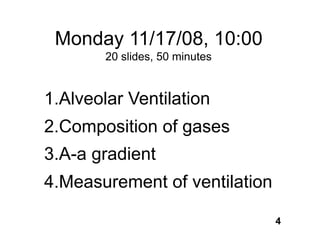
Monday 11/17/08, 10:00
        20 slides, 50 minutes


1.Alveolar Ventilation
2.Composition of gases
3.A-a gradient
4.Measurement of ventilation

                                4
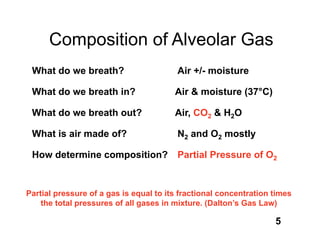
Composition of Alveolar Gas
 What do we breath?                      Air +/- moisture

 What do we breath in?                  Air & moisture (37°C)

 What do we breath out?                 Air, CO2 & H2O

 What is air made of?                    N2 and O2 mostly

 How determine composition? Partial Pressure of O2


Partial pressure of a gas is equal to its fractional concentration times
    the total pressures of all gases in mixture. (Dalton’s Gas Law)

                                                                   5
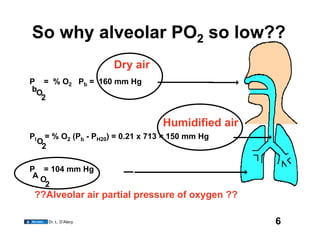
So why alveolar PO2 so low??
                         Dry air
P = % O2 Pb = 160 mm Hg
bO
  2


                                     Humidified air
PI     = % O2 (Pb - PH20) = 0.21 x 713 = 150 mm Hg
     O
      2

P = 104 mm Hg
 AO
   2
 ??Alveolar air partial pressure of oxygen ??

        Dr. L. D’Alecy                                6
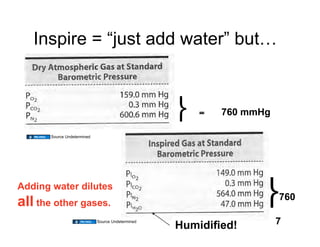
Inspire = “just add water” but…


                                                      =   760 mmHg

       Source Undetermined


Adding water dilutes
                                                                     760
all the other gases.
                             Source Undetermined
                                                   Humidified!        7
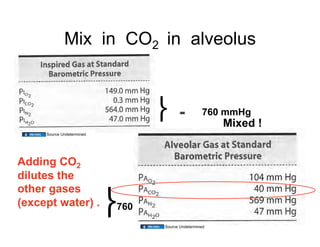
Mix in CO2 in alveolus


                                        =         760 mmHg
                                                       Mixed !
     Source Undetermined


Adding CO2
dilutes the
other gases
(except water) .           760
                                 Source Undetermined
                                                                 8
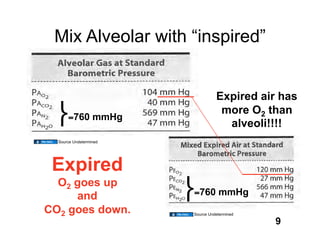
Mix Alveolar with “inspired”


                                  Expired air has
                                   more O2 than
      =760 mmHg
                                    alveoli!!!!
  Source Undetermined


 Expired
  O2 goes up
     and                =760 mmHg
CO2 goes down.          Source Undetermined

                                              9
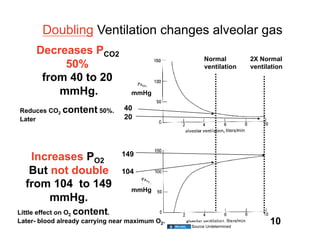
Doubling Ventilation changes alveolar gas
     Decreases PCO2
                                                       Normal          2X Normal
          50%                                          ventilation     ventilation
      from 40 to 20
         mmHg.                     mmHg

Reduces CO2 content 50%.         40
Later                            20


                                149
   Increases PO2
   But not double               104
  from 104 to 149                  mmHg
       mmHg.
Little effect on O2 content.
Later- blood already carrying near maximum O2.
                                                 Source Undetermined
                                                                             10
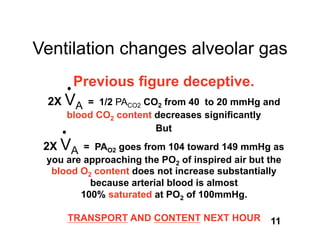
Ventilation changes alveolar gas
      Previous figure deceptive.
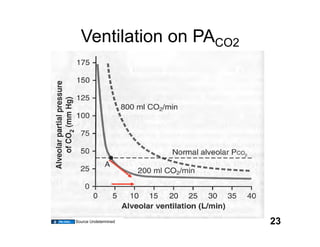
 2X VA = 1/2 PACO2 CO2 from 40 to 20 mmHg and
     blood CO2 content decreases significantly
                       But
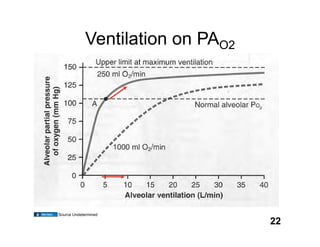
 2X VA = PAO2 goes from 104 toward 149 mmHg as
 you are approaching the PO2 of inspired air but the
  blood O2 content does not increase substantially
          because arterial blood is almost
        100% saturated at PO2 of 100mmHg.

     TRANSPORT AND CONTENT NEXT HOUR             11
Main Functions of Respiratory System


1. Delivers oxygen to blood
2. Eliminates carbon dioxide from blood
3. Regulates blood pH

      But how do you know if it working?


                                           12
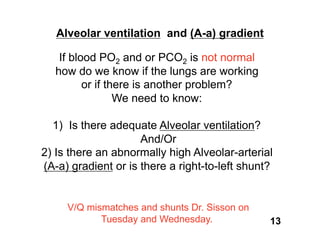
Alveolar ventilation and (A-a) gradient

   If blood PO2 and or PCO2 is not normal
  how do we know if the lungs are working
         or if there is another problem?
                 We need to know:

  1) Is there adequate Alveolar ventilation?
                     And/Or
2) Is there an abnormally high Alveolar-arterial
(A-a) gradient or is there a right-to-left shunt?


     V/Q mismatches and shunts Dr. Sisson on
            Tuesday and Wednesday.              13
Normal (A-a) gradient = 10 mmHg
     Alveolar O2 > Arterial O2
                        Why?
-anatomic shunts (or physiologic shunts, 2-5%):
  some venous blood gets directly into arterial
  circulation as in bronchial veins, pleural veins,
  thebesian veins (coronary).

-true (absolute) shunts: (non-ventilated alveoli)

- “shunt-like states” (V/Q mismatches) (later)

- heart defects (patent foramen oval)
                                                 14
The Alveolar-arterial Gradient
 How do we know if the lungs working?
      Is the oxygen getting to the Alveoli
                   and then
                into the blood?
                 Need to know:

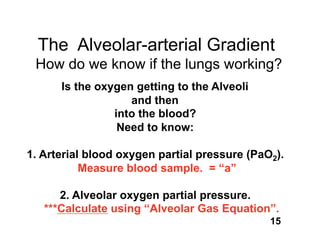
1. Arterial blood oxygen partial pressure (PaO2).
           Measure blood sample. = “a”

      2. Alveolar oxygen partial pressure.
   ***Calculate using “Alveolar Gas Equation”.
                                              15
Alveolar Gas Equation
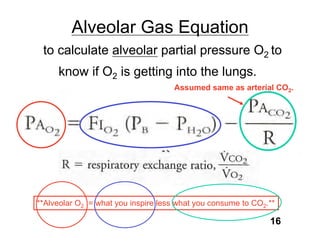
 to calculate alveolar partial pressure O2 to
     know if O2 is getting into the lungs.
                                    Assumed same as arterial CO2.


**Alveolar O2 = what you inspire less what you consume to CO2.**

                                                              16
How to Assess Alveolar Ventilation? 1of 4
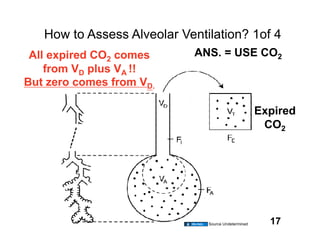
 All expired CO2 comes      ANS. = USE CO2
    from VD plus VA !!
But zero comes from VD.

                                                     Expired
                                                      CO2


                               Source Undetermined     17
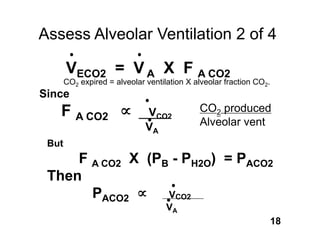
Assess Alveolar Ventilation 2 of 4

       VECO2 = V A X F A CO2
       CO2 expired = alveolar ventilation X alveolar fraction CO2.
Since
   F A CO2                    VCO2           CO2 produced
                              VA             Alveolar vent
 But
     F A CO2 X (PB - PH2O) = PACO2
 Then
       PACO2      VCO2
                                    VA
                                                                     18
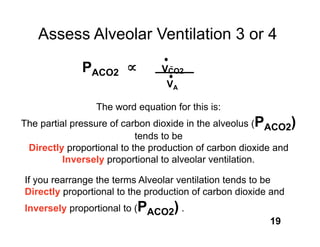
Assess Alveolar Ventilation 3 or 4

             PACO2              VCO2
                                 VA

                The word equation for this is:
The partial pressure of carbon dioxide in the alveolus (PACO2)
                           tends to be
 Directly proportional to the production of carbon dioxide and
          Inversely proportional to alveolar ventilation.

If you rearrange the terms Alveolar ventilation tends to be
Directly proportional to the production of carbon dioxide and
Inversely proportional to (PACO2) .
                                                         19
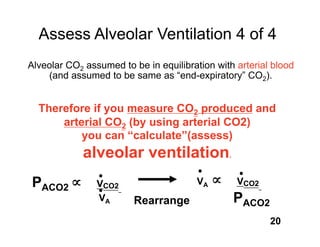
Assess Alveolar Ventilation 4 of 4
Alveolar CO2 assumed to be in equilibration with arterial blood
    (and assumed to be same as “end-expiratory” CO2).


  Therefore if you measure CO2 produced and
      arterial CO2 (by using arterial CO2)
          you can “calculate”(assess)
             alveolar ventilation.
PACO2           VCO2                    VA       VCO2
                VA       Rearrange              PACO2
                                                         20
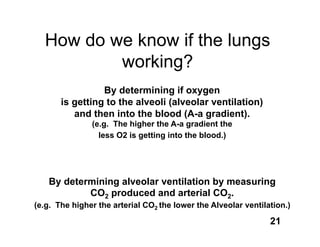
How do we know if the lungs
          working?
                 By determining if oxygen
       is getting to the alveoli (alveolar ventilation)
          and then into the blood (A-a gradient).
               (e.g. The higher the A-a gradient the
                 less O2 is getting into the blood.)


   By determining alveolar ventilation by measuring
           CO2 produced and arterial CO2.
(e.g. The higher the arterial CO2 the lower the Alveolar ventilation.)

                                                                21
Ventilation on PAO2


Source Undetermined

                                  22
Ventilation on PACO2


Source Undetermined      23
Additional Source Information
                           for more information see: http://open.umich.edu/wiki/CitationPolicy

Slide 6: Dr. L. D’Alecy
Slide 7: Source Undetermined; Source Undetermined
Slide 8: Source Undetermined; Source Undetermined
Slide 9: Source Undetermined; Source Undetermined
Slide 10: Source Undetermined
Slide 17: Source Undetermined
Slide 22: Source Undetermined
Slide 23: Source Undetermined

11.17.08(b): Alveolar Ventilation II

  • 1.
    Author(s): Louis D’Alecy,2009 License: Unless otherwise noted, this material is made available under the terms of the Creative Commons Attribution–Non-commercial–Share Alike 3.0 License: http://creativecommons.org/licenses/by-nc-sa/3.0/ We have reviewed this material in accordance with U.S. Copyright Law and have tried to maximize your ability to use, share, and adapt it. The citation key on the following slide provides information about how you may share and adapt this material. Copyright holders of content included in this material should contact open.michigan@umich.edu with any questions, corrections, or clarification regarding the use of content. For more information about how to cite these materials visit http://open.umich.edu/education/about/terms-of-use. Any medical information in this material is intended to inform and educate and is not a tool for self-diagnosis or a replacement for medical evaluation, advice, diagnosis or treatment by a healthcare professional. Please speak to your physician if you have questions about your medical condition. Viewer discretion is advised: Some medical content is graphic and may not be suitable for all viewers.
  • 2.
    Citation Key for more information see: http://open.umich.edu/wiki/CitationPolicy Use + Share + Adapt { Content the copyright holder, author, or law permits you to use, share and adapt. } Public Domain – Government: Works that are produced by the U.S. Government. (USC 17 § 105) Public Domain – Expired: Works that are no longer protected due to an expired copyright term. Public Domain – Self Dedicated: Works that a copyright holder has dedicated to the public domain. Creative Commons – Zero Waiver Creative Commons – Attribution License Creative Commons – Attribution Share Alike License Creative Commons – Attribution Noncommercial License Creative Commons – Attribution Noncommercial Share Alike License GNU – Free Documentation License Make Your Own Assessment { Content Open.Michigan believes can be used, shared, and adapted because it is ineligible for copyright. } Public Domain – Ineligible: Works that are ineligible for copyright protection in the U.S. (USC 17 § 102(b)) *laws in your jurisdiction may differ { Content Open.Michigan has used under a Fair Use determination. } Fair Use: Use of works that is determined to be Fair consistent with the U.S. Copyright Act. (USC 17 § 107) *laws in your jurisdiction may differ Our determination DOES NOT mean that all uses of this 3rd-party content are Fair Uses and we DO NOT guarantee that your use of the content is Fair. To use this content you should do your own independent analysis to determine whether or not your use will be Fair.
  • 3.
    Alveolar Ventilation II M1 – Cardiovascular/Respiratory Sequence Louis D Alecy, Ph.D. Fall 2008
  • 4.
    Monday 11/17/08, 10:00 20 slides, 50 minutes 1.Alveolar Ventilation 2.Composition of gases 3.A-a gradient 4.Measurement of ventilation 4
  • 5.
    Composition of AlveolarGas What do we breath? Air +/- moisture What do we breath in? Air & moisture (37°C) What do we breath out? Air, CO2 & H2O What is air made of? N2 and O2 mostly How determine composition? Partial Pressure of O2 Partial pressure of a gas is equal to its fractional concentration times the total pressures of all gases in mixture. (Dalton’s Gas Law) 5
  • 6.
    So why alveolarPO2 so low?? Dry air P = % O2 Pb = 160 mm Hg bO 2 Humidified air PI = % O2 (Pb - PH20) = 0.21 x 713 = 150 mm Hg O 2 P = 104 mm Hg AO 2 ??Alveolar air partial pressure of oxygen ?? Dr. L. D’Alecy 6
  • 7.
    Inspire = “justadd water” but… = 760 mmHg Source Undetermined Adding water dilutes 760 all the other gases. Source Undetermined Humidified! 7
  • 8.
    Mix in CO2in alveolus = 760 mmHg Mixed ! Source Undetermined Adding CO2 dilutes the other gases (except water) . 760 Source Undetermined 8
  • 9.
    Mix Alveolar with“inspired” Expired air has more O2 than =760 mmHg alveoli!!!! Source Undetermined Expired O2 goes up and =760 mmHg CO2 goes down. Source Undetermined 9
  • 10.
    Doubling Ventilation changesalveolar gas Decreases PCO2 Normal 2X Normal 50% ventilation ventilation from 40 to 20 mmHg. mmHg Reduces CO2 content 50%. 40 Later 20 149 Increases PO2 But not double 104 from 104 to 149 mmHg mmHg. Little effect on O2 content. Later- blood already carrying near maximum O2. Source Undetermined 10
  • 11.
    Ventilation changes alveolargas Previous figure deceptive. 2X VA = 1/2 PACO2 CO2 from 40 to 20 mmHg and blood CO2 content decreases significantly But 2X VA = PAO2 goes from 104 toward 149 mmHg as you are approaching the PO2 of inspired air but the blood O2 content does not increase substantially because arterial blood is almost 100% saturated at PO2 of 100mmHg. TRANSPORT AND CONTENT NEXT HOUR 11
  • 12.
    Main Functions ofRespiratory System 1. Delivers oxygen to blood 2. Eliminates carbon dioxide from blood 3. Regulates blood pH But how do you know if it working? 12
  • 13.
    Alveolar ventilation and(A-a) gradient If blood PO2 and or PCO2 is not normal how do we know if the lungs are working or if there is another problem? We need to know: 1) Is there adequate Alveolar ventilation? And/Or 2) Is there an abnormally high Alveolar-arterial (A-a) gradient or is there a right-to-left shunt? V/Q mismatches and shunts Dr. Sisson on Tuesday and Wednesday. 13
  • 14.
    Normal (A-a) gradient= 10 mmHg Alveolar O2 > Arterial O2 Why? -anatomic shunts (or physiologic shunts, 2-5%): some venous blood gets directly into arterial circulation as in bronchial veins, pleural veins, thebesian veins (coronary). -true (absolute) shunts: (non-ventilated alveoli) - “shunt-like states” (V/Q mismatches) (later) - heart defects (patent foramen oval) 14
  • 15.
    The Alveolar-arterial Gradient How do we know if the lungs working? Is the oxygen getting to the Alveoli and then into the blood? Need to know: 1. Arterial blood oxygen partial pressure (PaO2). Measure blood sample. = “a” 2. Alveolar oxygen partial pressure. ***Calculate using “Alveolar Gas Equation”. 15
  • 16.
    Alveolar Gas Equation to calculate alveolar partial pressure O2 to know if O2 is getting into the lungs. Assumed same as arterial CO2. **Alveolar O2 = what you inspire less what you consume to CO2.** 16
  • 17.
    How to AssessAlveolar Ventilation? 1of 4 All expired CO2 comes ANS. = USE CO2 from VD plus VA !! But zero comes from VD. Expired CO2 Source Undetermined 17
  • 18.
    Assess Alveolar Ventilation2 of 4 VECO2 = V A X F A CO2 CO2 expired = alveolar ventilation X alveolar fraction CO2. Since F A CO2 VCO2 CO2 produced VA Alveolar vent But F A CO2 X (PB - PH2O) = PACO2 Then PACO2 VCO2 VA 18
  • 19.
    Assess Alveolar Ventilation3 or 4 PACO2 VCO2 VA The word equation for this is: The partial pressure of carbon dioxide in the alveolus (PACO2) tends to be Directly proportional to the production of carbon dioxide and Inversely proportional to alveolar ventilation. If you rearrange the terms Alveolar ventilation tends to be Directly proportional to the production of carbon dioxide and Inversely proportional to (PACO2) . 19
  • 20.
    Assess Alveolar Ventilation4 of 4 Alveolar CO2 assumed to be in equilibration with arterial blood (and assumed to be same as “end-expiratory” CO2). Therefore if you measure CO2 produced and arterial CO2 (by using arterial CO2) you can “calculate”(assess) alveolar ventilation. PACO2 VCO2 VA VCO2 VA Rearrange PACO2 20
  • 21.
    How do weknow if the lungs working? By determining if oxygen is getting to the alveoli (alveolar ventilation) and then into the blood (A-a gradient). (e.g. The higher the A-a gradient the less O2 is getting into the blood.) By determining alveolar ventilation by measuring CO2 produced and arterial CO2. (e.g. The higher the arterial CO2 the lower the Alveolar ventilation.) 21
  • 22.
  • 23.
  • 24.
    Additional Source Information for more information see: http://open.umich.edu/wiki/CitationPolicy Slide 6: Dr. L. D’Alecy Slide 7: Source Undetermined; Source Undetermined Slide 8: Source Undetermined; Source Undetermined Slide 9: Source Undetermined; Source Undetermined Slide 10: Source Undetermined Slide 17: Source Undetermined Slide 22: Source Undetermined Slide 23: Source Undetermined