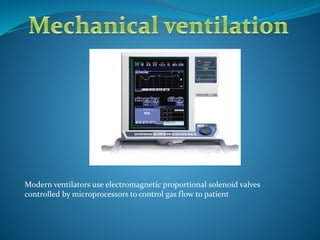
Modern ventilators use electromagnetic proportional solenoid valves
controlled by microprocessors to control gas flow to patient
FIO2
FiO2 is the fraction of inspired oxygen. It is the
percentatge of oxygen delivered on inspiration.
Ranges from 21% to 100%.
The oxygen analysers In the inspiratory limb is used to
ensure the accuracy of
FiO2 delivered
Tidal volume (TV or VT)
 Measured volume with each breath
 Normal tidal volume should be kept at
 6 – 8 ml/kg of patients ideal body weight
 Minute volume (MV)
MV is the total volume inspired or expires over a minute
It is the product of tidal volume (TV) and respiratory rate (RR) or
frequency
MV = TV x RR
Respiratory rate
 Number of breaths per minute
Ratio of the duration of inspiration to expiration.
Inspiratory time (Ti) is commonly set at a third of the
total inspiratory expiratory cycle (1:3).
The mechanism by which the operator adjusts the
inspiratory time in AC mode is by controlling the
inspiratory flow rate.
Increase in inspiratory flow rate will decrease
inspiratory time
Inspiratory expiratory ratio
Peep
 Positive end expiratory pressure is the positive pressure applied at the end of
expiration during mechanical ventilation.
 The use of PEEP improves gas exchange by recruiting collapsed alveoli and
thereby improving functional residual capacity.
 PEEP also helps in redistributing lung water from the alveolar space into the
pulmonary circulation and improving ventilation perfusion mismatch.
 All these contributes to reduction in dead space ventilation and thereby
improving PaO2.
 PEEP increases intra-thoracic pressure resulting in decreased venous return to
the right heart and increasing the right ventricular after load (the force needed
to eject blood from right ventricle) .
AUTO PEEP
 Auto PEEP is the actual pressure difference between the
higher pressure and the baseline pressure (set PEEP level or
0) at the end of full expiration
 It is measured by pressing the expiratory hold button on
the ventilator.
Peak airway pressure
 Pressure needed initially to assure the flow of gas
down the airways and open up the alveoli.
 Depends upon resistance and compliance
PLATEAU PRESSURE
 Pressure required to hold the lungs and chest wall open when there is no air flow during
the inspiratory cycle
 Measured at the end of a full inspiration during a breath hold (no air flow)
How to measure Plateau pressure
1. Switch to volume controlled mode ventilation
2. Press the end-inspiratory hold button
3. The machine will display plateau pressure. It is automatically done by the ventilator by
sensing the pressure which is required to keep the alveoli open at the end of inspiration
when there is no airflow which will be generally 10-15cm H2O less than Peak airway
pressure.
With decreased compliance, the plateau pressure will increase.
RESISTANCE
 Degree of easiness to move gases down the airways
 High resistance --- difficult to move gases in and out
 Low resistance --- easy to move gases in and out.
 Measured using the difference between peak airway
pressure and plateau pressure.
COMPLIANCE
 Degree of easiness to distend the alveoli, lungs and
chest wall.
 High compliance --- easy to distend the alveoli
 Low compliance ---- hard to distend the alveoli
 Compliance is measured with plateau pressure
RECRUITMENT
 Ventilation strategy whereby the non ventilated alveoli are opened by
progressively introducing higher pressures over a short period. The aim is
reinflate atelectatic alveoli without distending the normal lung units.
Techniques
1. PEEP is increased in increments of 5cm H2O from a baseline PEEP to 35cm
H2O reducing tidal volume to limit peak inspiratory pressure to 35cm H2O.
CPAP is maintained for 30s.
2. Intermittent higher tidal volume in pressure controlled ventilation applied
with escalating PEEP and constant driving pressure: peak pressure of 45cm
H2O, I:E ratio of 1:2 and PEEP level of 16cm H2O for 2min.
Sustained inflation by application of CPAP at 30-40cm H20 for 40s.
Weaning
 Weaning is the process when the support of the ventilator is gradually
decreased to re-establish spontaneous breathing. Readiness for
weaning is evaluated by assessing level of consciousness, adequacy of
oxygen and ventilation, spontaneous breathing strength etc.
Anatomic dead space
 Anatomic Dead space is the portion of the respiratory
system not involved in gas exchange.
It is divided into alveolar and airway dead space.
 Airway dead space is also called tracheal dead space as it is the
part of the respiratory system (mainly trachea) where tidal
volume remains in the conducting passages at the end of
inspiration and therefore does not participate in gas exchange.
 Alveolar dead space is a measurement of the ventilated alveoli
without adequate blood flow for gas exchange. It is negligible in
healthy individuals.

Mechanical ventilation

  • 1.
    Modern ventilators useelectromagnetic proportional solenoid valves controlled by microprocessors to control gas flow to patient
  • 2.
    FIO2 FiO2 is thefraction of inspired oxygen. It is the percentatge of oxygen delivered on inspiration. Ranges from 21% to 100%. The oxygen analysers In the inspiratory limb is used to ensure the accuracy of FiO2 delivered
  • 3.
    Tidal volume (TVor VT)  Measured volume with each breath  Normal tidal volume should be kept at  6 – 8 ml/kg of patients ideal body weight
  • 4.
     Minute volume(MV) MV is the total volume inspired or expires over a minute It is the product of tidal volume (TV) and respiratory rate (RR) or frequency MV = TV x RR
  • 5.
    Respiratory rate  Numberof breaths per minute
  • 6.
    Ratio of theduration of inspiration to expiration. Inspiratory time (Ti) is commonly set at a third of the total inspiratory expiratory cycle (1:3). The mechanism by which the operator adjusts the inspiratory time in AC mode is by controlling the inspiratory flow rate. Increase in inspiratory flow rate will decrease inspiratory time Inspiratory expiratory ratio
  • 7.
    Peep  Positive endexpiratory pressure is the positive pressure applied at the end of expiration during mechanical ventilation.  The use of PEEP improves gas exchange by recruiting collapsed alveoli and thereby improving functional residual capacity.  PEEP also helps in redistributing lung water from the alveolar space into the pulmonary circulation and improving ventilation perfusion mismatch.  All these contributes to reduction in dead space ventilation and thereby improving PaO2.  PEEP increases intra-thoracic pressure resulting in decreased venous return to the right heart and increasing the right ventricular after load (the force needed to eject blood from right ventricle) .
  • 8.
    AUTO PEEP  AutoPEEP is the actual pressure difference between the higher pressure and the baseline pressure (set PEEP level or 0) at the end of full expiration  It is measured by pressing the expiratory hold button on the ventilator.
  • 9.
    Peak airway pressure Pressure needed initially to assure the flow of gas down the airways and open up the alveoli.  Depends upon resistance and compliance
  • 10.
    PLATEAU PRESSURE  Pressurerequired to hold the lungs and chest wall open when there is no air flow during the inspiratory cycle  Measured at the end of a full inspiration during a breath hold (no air flow) How to measure Plateau pressure 1. Switch to volume controlled mode ventilation 2. Press the end-inspiratory hold button 3. The machine will display plateau pressure. It is automatically done by the ventilator by sensing the pressure which is required to keep the alveoli open at the end of inspiration when there is no airflow which will be generally 10-15cm H2O less than Peak airway pressure. With decreased compliance, the plateau pressure will increase.
  • 11.
    RESISTANCE  Degree ofeasiness to move gases down the airways  High resistance --- difficult to move gases in and out  Low resistance --- easy to move gases in and out.  Measured using the difference between peak airway pressure and plateau pressure.
  • 12.
    COMPLIANCE  Degree ofeasiness to distend the alveoli, lungs and chest wall.  High compliance --- easy to distend the alveoli  Low compliance ---- hard to distend the alveoli  Compliance is measured with plateau pressure
  • 13.
    RECRUITMENT  Ventilation strategywhereby the non ventilated alveoli are opened by progressively introducing higher pressures over a short period. The aim is reinflate atelectatic alveoli without distending the normal lung units. Techniques 1. PEEP is increased in increments of 5cm H2O from a baseline PEEP to 35cm H2O reducing tidal volume to limit peak inspiratory pressure to 35cm H2O. CPAP is maintained for 30s. 2. Intermittent higher tidal volume in pressure controlled ventilation applied with escalating PEEP and constant driving pressure: peak pressure of 45cm H2O, I:E ratio of 1:2 and PEEP level of 16cm H2O for 2min. Sustained inflation by application of CPAP at 30-40cm H20 for 40s.
  • 14.
    Weaning  Weaning isthe process when the support of the ventilator is gradually decreased to re-establish spontaneous breathing. Readiness for weaning is evaluated by assessing level of consciousness, adequacy of oxygen and ventilation, spontaneous breathing strength etc.
  • 15.
    Anatomic dead space Anatomic Dead space is the portion of the respiratory system not involved in gas exchange. It is divided into alveolar and airway dead space.  Airway dead space is also called tracheal dead space as it is the part of the respiratory system (mainly trachea) where tidal volume remains in the conducting passages at the end of inspiration and therefore does not participate in gas exchange.  Alveolar dead space is a measurement of the ventilated alveoli without adequate blood flow for gas exchange. It is negligible in healthy individuals.