RESPIRATION External respiration  (Lungs): Pulmonary ventilation Gas exchange (lungs # blood # tissues) Gas transport Internal respiration   (Mitochondria): - O2 utilization.
Non respiratory functions of the lungs Acid base balance ACE (Activation : ATI  ATII). Airway protection Vapor loss VR help Vocalization
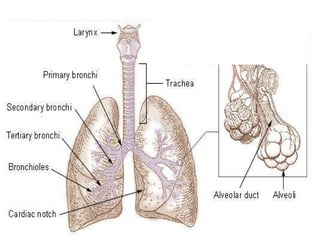
Conducting & Respiratory Zones
Pneumocytes Types
Visceral & parietal pleura
Boyle’s Law
Pulmonary Pressures Diaphragm
Pulmonary Pressures
 
Importance of Negative IPP Lung expansion Venous & lymph return IPP become +ve in: - Pneumothorax - Valsalva manouver
Pneumothorax
Respiratory Muscles Abdominal  ms
Mechanism of Inspiration
Mechanism of Respiration Pause   Recoil  Distention Lungs  +++ _ _ _ IAP Rushes out Rushes in Air  Less - ve More - ve IPP _ _ _ +++  Thorax Passive  Active Process  Expiration  Inspiration
Surfactant Lipoprotein (phospholipid, apoproteins & Ca++). produced by alveolar type II cells. ST so prevents:  -  collapse of small alveoli in expiration. - pulmonary edema.
Surfactant deficiency RDS 100 % O2 inhalation. Occlusion of pulmonary artery or major bronchus. Smoking. Hyperinsulinism e.g baby of diabetic mother. Myxedema (hypothyroidism). Hypocorticism
Physical Properties of the Lungs Elasticity. Surface tension. Compliance (Distensibility). 
Lung Compliance   Definition  change in lung volume/change in distending pressure: C=   V/  P  ml/cm H2O Types : #  Static C  ( lungs only, 200). #  Dynamic   C (lungs + thoracic wall, 110)
Static Lung Compliance 200 ml / cmH2O Hysteresis loop Surfactant conc.  during deflation  Inflation  Deflation
Static Lung Compliance
Lung Compliance obesity Poliomyelitis RDS Edema Emphysema Congestion Atheletes  Lung fibrosis Aging  - - - - - - - - - - - - - - ++++++++
Breath Work During inspiration or forced expiration. 3 parts: 1- Elastic work (or compliance). 2- Air resistance work (medium bronchi). 3- Tissue resistance work (viscosity). Air way resistance 1/a diameter of bronchi. Breath work increases in :  Surfactant  Compliance  &  Airway resistance.
Factors affecting bronchi diameters Histamine,adenosine VIP Chemicals Cold  Warm  Temp. Max. at 6 AM Max. at 6 PM Circadian rhythm Expiration  Inspiration (Lung expansion) Respiration - - - - - - - - - - - - -   ++++++++++  PCO2 Parasymp. (Muscarinic R) Symp. (B2 receptors). ANS Bronchoconstriction  Bronchodilation Factors
Pulmonary Ventilation it is the air exchange (atmosphere & alveoli). Normally: air vol. in insp. = air vol. in exp. Spirometer measures lung volumes & capacities. High volumes in tall  people, high altitude low volumes in female, pregnancy, short  & smokers
 
The amount of air remaining in the lungs at the end of a maximum expiration.  1200 ml (30% TLC) during rest (  in exercise). in  aging & obstructive lung diseases. Measured by  Helium  dilution method  ( NOT  spirometer). Residual Volume
Helium Dilution Method RV = FRC – ERV TLC= FRC + IC
Continuous gas exchange in between breathes. Prevent alveolar collapse. D of asthma & emphysema ( 70%). Medicolegal importance: lost in pneumothorax but minimal air w is sufficient for floatation of lung in water & absent in stillbirth. RV Significance
Vital Capacity Max. vol. of air can be expired after max. inspiration. Measured by spirometer. 4600 ml ( 2 - 2.5 L/m2). Index of pulmonary function & physical  fitness.
Factors Affecting VC Chest/ lung diseases ______ Pathological  Recumbency  Standing  Pregnancy Athelets Females Males  Physiological   - - - - - - - - - - +++++++++
Dead Space The part of res. system with no gas exchange. TYPES:  Anatomical DS Alveolar DS  Physiological DS :Anatomical + Alveolar  DS Normally: Physiological = Anatomical DS Lung diseases:  Physiological > Anatomical  DS
DS Importance Warms,filters & moistens inspired air. Causes difference in composition between expired air & alveolar air (more CO2 & less O2). Shallow rapid breath  hypoxic hypoxia.
DS Measurement Anatomical  DS : Fowler method (single breath N2 test). Physiological DS:Bohr equation. 150 – 167 ml. ANS can +++  or - - - -  DS
Pulmonary Ventilation Tests Pulmonary ventilation ( minute respiratory volume): RR X TV Alveolar ventilation: RR X (TV – DS)
Pulmonary Function Tests Pulmonary function tests Static lung   volumes Dynamic lung   volumes
Dynamic lung volumes Volume/unite time Maximum breathing capacity Breathing reserve Timed vital capacity Maximum flow rate
Maximum breathing capacity (Maximum ventilatory volume) Max. vol. of air inspired/expired using the deepest & fastest respiratory effort /min. Males:  80-180 L /min Females:  60-120 L /min Spirometer is used for 15 sec. to avoid fatigue & resp. alkalosis. Then X 4. Better index for physical fitness than VC.
Breathing Reserve BR = MBC -  MV BR/MBC > 90 %. Dyspnic index : BR/MBC < 70 %. Max. velocity of expired air. 10 L/m (by peak flowmeter). --- in obstructive lung diseases . Maximum flow rate
Timed vital capacity  (Forced expiratory volume) % vol. of expired air at end of 1 st  sec. FEV1 (FEV/FVC) = 80 %. Measured by spirometer. Differentiates between restrictive & obstructive lung diseases.
FVC > 80 % Normal   < 80 % FEV1/FVC ratio > 80 % Restrictive   < 80 % Obstructive
Spirometer Tests Normal:70 % Small air ways obstruction <70 % FVC > 80 % Normal   < 80 % FEV1/FVC ratio > 80 % Restrictive   < 80 % Obstructive Forced expiratory flow FEF 25% FEF 50% FEF 75%
Is the Obstruction Fixed or Reversible? In some obstructive airways diseases, a part or all of the obstruction will be reversible with bronchodilators .   Therefore in all cases where the technician notes obstruction, two inhalations of a bronchodilator will be given to the subject .   An improvement of 12% in the FEV 1  or FVC is considered a significant response with an increase of at least 200ml .   Asthma is considered the prototypical disease reactive to bronchodilators .   However, more  &quot; fixed &quot;  types of obstruction such as emphysema and chronic bronchitis may also show reversibility .   In addition, because asthma is a variable disease, at times pulmonary function tests may appear entirely normal .   One will therefore make the diagnosis by clinical history or attempt to provoke obstruction using a  &quot; bronchoprovocational &quot;  agent such as methacholine or cold air which can illicit bronchoconstriction which might not otherwise be seen .


Respiration part 1

  • 1.
  • 2.
    RESPIRATION External respiration (Lungs): Pulmonary ventilation Gas exchange (lungs # blood # tissues) Gas transport Internal respiration (Mitochondria): - O2 utilization.
  • 3.
    Non respiratory functionsof the lungs Acid base balance ACE (Activation : ATI ATII). Airway protection Vapor loss VR help Vocalization
  • 4.
  • 5.
  • 6.
  • 7.
  • 8.
  • 9.
  • 10.
  • 11.
    Importance of NegativeIPP Lung expansion Venous & lymph return IPP become +ve in: - Pneumothorax - Valsalva manouver
  • 12.
  • 13.
  • 14.
  • 15.
    Mechanism of RespirationPause Recoil Distention Lungs +++ _ _ _ IAP Rushes out Rushes in Air Less - ve More - ve IPP _ _ _ +++ Thorax Passive Active Process Expiration Inspiration
  • 16.
    Surfactant Lipoprotein (phospholipid,apoproteins & Ca++). produced by alveolar type II cells. ST so prevents: - collapse of small alveoli in expiration. - pulmonary edema.
  • 17.
    Surfactant deficiency RDS100 % O2 inhalation. Occlusion of pulmonary artery or major bronchus. Smoking. Hyperinsulinism e.g baby of diabetic mother. Myxedema (hypothyroidism). Hypocorticism
  • 18.
    Physical Properties ofthe Lungs Elasticity. Surface tension. Compliance (Distensibility). 
  • 19.
    Lung Compliance Definition change in lung volume/change in distending pressure: C=  V/  P ml/cm H2O Types : # Static C ( lungs only, 200). # Dynamic C (lungs + thoracic wall, 110)
  • 20.
    Static Lung Compliance200 ml / cmH2O Hysteresis loop Surfactant conc. during deflation Inflation Deflation
  • 21.
  • 22.
    Lung Compliance obesityPoliomyelitis RDS Edema Emphysema Congestion Atheletes Lung fibrosis Aging - - - - - - - - - - - - - - ++++++++
  • 23.
    Breath Work Duringinspiration or forced expiration. 3 parts: 1- Elastic work (or compliance). 2- Air resistance work (medium bronchi). 3- Tissue resistance work (viscosity). Air way resistance 1/a diameter of bronchi. Breath work increases in : Surfactant Compliance & Airway resistance.
  • 24.
    Factors affecting bronchidiameters Histamine,adenosine VIP Chemicals Cold Warm Temp. Max. at 6 AM Max. at 6 PM Circadian rhythm Expiration Inspiration (Lung expansion) Respiration - - - - - - - - - - - - - ++++++++++ PCO2 Parasymp. (Muscarinic R) Symp. (B2 receptors). ANS Bronchoconstriction Bronchodilation Factors
  • 25.
    Pulmonary Ventilation itis the air exchange (atmosphere & alveoli). Normally: air vol. in insp. = air vol. in exp. Spirometer measures lung volumes & capacities. High volumes in tall people, high altitude low volumes in female, pregnancy, short & smokers
  • 26.
  • 27.
    The amount ofair remaining in the lungs at the end of a maximum expiration. 1200 ml (30% TLC) during rest ( in exercise). in aging & obstructive lung diseases. Measured by Helium dilution method ( NOT spirometer). Residual Volume
  • 28.
    Helium Dilution MethodRV = FRC – ERV TLC= FRC + IC
  • 29.
    Continuous gas exchangein between breathes. Prevent alveolar collapse. D of asthma & emphysema ( 70%). Medicolegal importance: lost in pneumothorax but minimal air w is sufficient for floatation of lung in water & absent in stillbirth. RV Significance
  • 30.
    Vital Capacity Max.vol. of air can be expired after max. inspiration. Measured by spirometer. 4600 ml ( 2 - 2.5 L/m2). Index of pulmonary function & physical fitness.
  • 31.
    Factors Affecting VCChest/ lung diseases ______ Pathological Recumbency Standing Pregnancy Athelets Females Males Physiological - - - - - - - - - - +++++++++
  • 32.
    Dead Space Thepart of res. system with no gas exchange. TYPES: Anatomical DS Alveolar DS Physiological DS :Anatomical + Alveolar DS Normally: Physiological = Anatomical DS Lung diseases: Physiological > Anatomical DS
  • 33.
    DS Importance Warms,filters& moistens inspired air. Causes difference in composition between expired air & alveolar air (more CO2 & less O2). Shallow rapid breath hypoxic hypoxia.
  • 34.
    DS Measurement Anatomical DS : Fowler method (single breath N2 test). Physiological DS:Bohr equation. 150 – 167 ml. ANS can +++ or - - - - DS
  • 35.
    Pulmonary Ventilation TestsPulmonary ventilation ( minute respiratory volume): RR X TV Alveolar ventilation: RR X (TV – DS)
  • 36.
    Pulmonary Function TestsPulmonary function tests Static lung volumes Dynamic lung volumes
  • 37.
    Dynamic lung volumesVolume/unite time Maximum breathing capacity Breathing reserve Timed vital capacity Maximum flow rate
  • 38.
    Maximum breathing capacity(Maximum ventilatory volume) Max. vol. of air inspired/expired using the deepest & fastest respiratory effort /min. Males: 80-180 L /min Females: 60-120 L /min Spirometer is used for 15 sec. to avoid fatigue & resp. alkalosis. Then X 4. Better index for physical fitness than VC.
  • 39.
    Breathing Reserve BR= MBC - MV BR/MBC > 90 %. Dyspnic index : BR/MBC < 70 %. Max. velocity of expired air. 10 L/m (by peak flowmeter). --- in obstructive lung diseases . Maximum flow rate
  • 40.
    Timed vital capacity (Forced expiratory volume) % vol. of expired air at end of 1 st sec. FEV1 (FEV/FVC) = 80 %. Measured by spirometer. Differentiates between restrictive & obstructive lung diseases.
  • 41.
    FVC > 80% Normal < 80 % FEV1/FVC ratio > 80 % Restrictive < 80 % Obstructive
  • 42.
    Spirometer Tests Normal:70% Small air ways obstruction <70 % FVC > 80 % Normal < 80 % FEV1/FVC ratio > 80 % Restrictive < 80 % Obstructive Forced expiratory flow FEF 25% FEF 50% FEF 75%
  • 43.
    Is the ObstructionFixed or Reversible? In some obstructive airways diseases, a part or all of the obstruction will be reversible with bronchodilators .   Therefore in all cases where the technician notes obstruction, two inhalations of a bronchodilator will be given to the subject .   An improvement of 12% in the FEV 1  or FVC is considered a significant response with an increase of at least 200ml .   Asthma is considered the prototypical disease reactive to bronchodilators .   However, more &quot; fixed &quot; types of obstruction such as emphysema and chronic bronchitis may also show reversibility .   In addition, because asthma is a variable disease, at times pulmonary function tests may appear entirely normal .   One will therefore make the diagnosis by clinical history or attempt to provoke obstruction using a &quot; bronchoprovocational &quot; agent such as methacholine or cold air which can illicit bronchoconstriction which might not otherwise be seen .
  • 44.
  • 45.
  • 46.

Editor's Notes

  • #2 Cartilage &amp; smooth muscle . Graps like clusters
  • #3 O2 utilization = cellular ventilation : ins &amp; expiration
  • #5 Gas exchange
  • #6 Flat cells + capillary = resp. mem 0.2 u, 100m2
  • #8 Dec volume ………………..&gt; inc pressure
  • #10 760, 759, 761
  • #11 Recoil due tosurface tension &amp; elasticity : the attractive force Bn molecules
  • #13 Normal lt lung : capillaries
  • #14 Diaphragm 75 % of resp. drive
  • #17 Reduces attractive forces of hydrogen bonding by becoming interspersed between H 2 0 molecules
  • #18 L / S ratio from amniotic fluid: licithin/ shyngomyeline :2-2.5
  • #19 100 x more distensible than a balloon.
  • #21 Recoil by elasticity 1/3 &amp; ST 2/3
  • #22 No ST so recoil by elsticity only
  • #23 ++++ C : difficult expiration
  • #24 No work in normal exp. Due to elstic recoil of lungs. Forced expiration in exercise or asthma
  • #26 High altitude has less Po2 i.e less diffusion, so large lungs means large area 4 diffusion. 10 % less in females.
  • #27 Best of 3 trials RV = 20 % TLC.
  • #28 More with age: closure of smalll airways.
  • #30 When he is born and takes a deep breath, his Eustachian tubes open and air enters through them to the middle ear . So if you find a small bubble in the middle ear, you can be quite sure, the baby was born alive . On the contrary if you find just jelly like material in the middle ear, the baby was most probably born dead . 
  • #37 To detect physical fitness . Static : RV- ERV- VC-TLC –VP RATIO- COMPLIANCE- DS
  • #42 Obstructive lung disease : asthma &amp; COPD ( reduced diameter + damage of tissues like emphysema) Prediction FEV1 : FEV1 OF PATIENT DIVIDED BY that of normal population of same character (age ,sex …etc..) In obstructive: FEV1 much reduced than FVC ( DIFFICULT expiration &gt; inspiration). But in restrictive, both FVC &amp; FEV1 are reduced in equal proportionate.
  • #43 FEF - Forced Expiratory Flow - Forced expiratory Flow is a measure of how much air can be expired from the lungs . It is a flow rate measurement . It is measured as liters / second or liters / minute . The FVC expiratory curve is divided into quartiles and therefore there is a FEF that exists for each quartile . The quartiles are expressed as FEF25%, FEF50%, and FEF75% of FVC . FEF25% - This measurement describes the amount of air that was forcibly expelled in the first 25% of the total forced vital capacity test. FEV 1 &lt; 65-80 %  mild obstruction FEV 1 &lt; 50-65% moderate obstruction FEV 1 &lt; 50%  severe obstruction       .