Cerebral Cortex
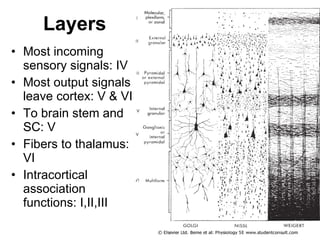
Layers Most incoming sensory signals: IV Most output signals leave cortex: V & VI To brain stem and SC: V Fibers to thalamus: VI Intracortical association functions: I,II,III
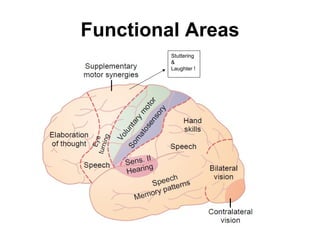
Functional Areas Stuttering & Laughter !
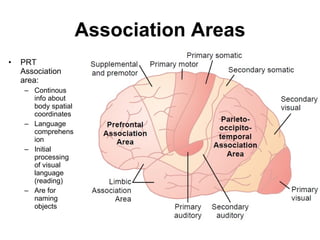
Association Areas PRT Association area: Continous info about body spatial coordinates Language comprehension Initial processing of visual language (reading) Are for naming objects
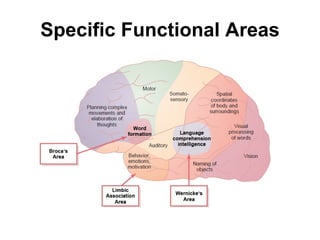
Specific Functional Areas
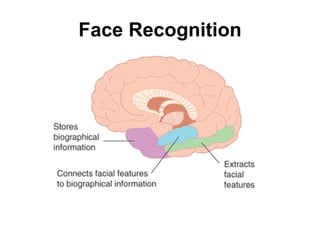
Face Recognition
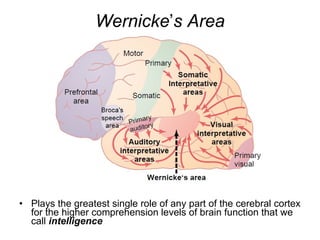
Wernicke ’ s Area Plays the greatest single role of any part of the cerebral cortex for the higher comprehension levels of brain function that we call  intelligence
Cerebral  Dominance?   Dominant & nondominant hemispheres Categorical hemisphere  Sequential-analytic processes Language  Analytical reasoning  Representational hemisphere  Visuospatial relations Identification of objects by their form Recognition of faces Recognition of musical themes
Lesions of Representational & Categorical Hemispheres    Lesions of  categorical  hemisphere:  Language disorders Disturbed about their disability and often depressed  Lesions of  representational  hemisphere: No language disorders Sometimes unconcerned and even euphoric! Astereognosis —the inability to identify objects by feeling them Lesions of inferior parietal lobule cause  unilateral inattention  and  neglect   Inability to tell a story or make a joke
Language Language is one of the fundamental bases of human intelligence and a key part of human culture Areas concerned: Wernicke's area  connected via  Arcuate fasciculus  to  Broca's area   2 nd  language Broca’s area concerned is different from that associated with native language Children learning 2 languages simultaneously have the same Broca’s area dealing with both languages
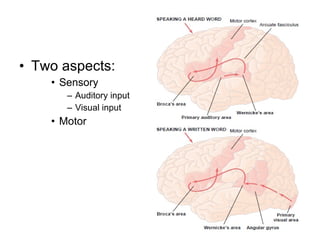
Two aspects: Sensory Auditory input Visual input  Motor
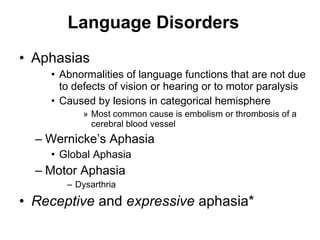
Language Disorders Aphasias Abnormalities of language functions that are not due to defects of vision or hearing or to motor paralysis Caused by lesions in categorical hemisphere Most common cause is embolism or thrombosis of a cerebral blood vessel  Wernicke’s Aphasia Global Aphasia Motor Aphasia Dysarthria  Receptive  and  expressive  aphasia*
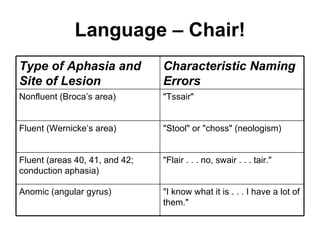
Language – Chair! "I know what it is . . . I have a lot of them."  Anomic (angular gyrus)  "Flair . . . no, swair . . . tair." Fluent (areas 40, 41, and 42; conduction aphasia) "Stool" or "choss" (neologism) Fluent (Wernicke’s area) "Tssair" Nonfluent (Broca’s area) Characteristic Naming Errors  Type of Aphasia and Site of Lesion
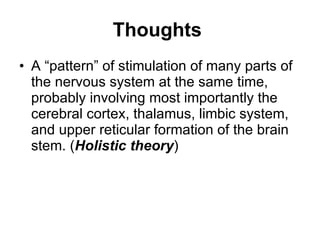
Thoughts   A “pattern” of stimulation of many parts of the nervous system at the same time, probably involving most importantly the cerebral cortex, thalamus, limbic system, and upper reticular formation of the brain stem. ( Holistic theory )
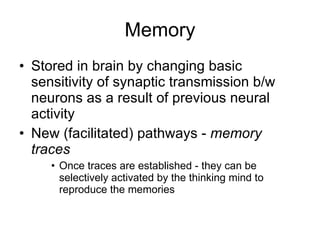
Memory Stored in brain by changing basic sensitivity of synaptic transmission b/w neurons as a result of previous neural activity New (facilitated) pathways -  memory traces   Once traces are established - they can be selectively activated by the thinking mind to reproduce the memories
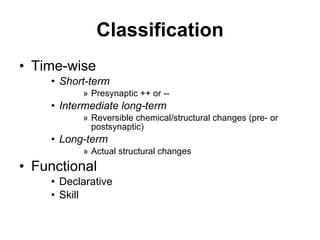
Classification Time-wise Short-term Presynaptic ++ or -- Intermediate long-term Reversible chemical/structural changes (pre- or postsynaptic) Long-term Actual structural changes Functional  Declarative Skill
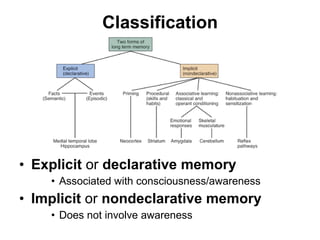
Classification Explicit  or  declarative memory  Associated with consciousness/awareness Implicit  or  nondeclarative memory   Does not involve awareness
Hippocampus Storage of memories Lesion causes:  Anterograde &  Retrograde amnesia Cannot  establish new declarative memories Can  establish skill (reflexive) memories
Strangeness & Familiarity  Some parts of  temporal lobes  causes a change in interpretation of one's surroundings déjà vu phenomenon!


Cerebral cortex

  • 1.
  • 2.
    Layers Most incomingsensory signals: IV Most output signals leave cortex: V & VI To brain stem and SC: V Fibers to thalamus: VI Intracortical association functions: I,II,III
  • 3.
  • 4.
    Association Areas PRTAssociation area: Continous info about body spatial coordinates Language comprehension Initial processing of visual language (reading) Are for naming objects
  • 5.
  • 6.
  • 7.
    Wernicke ’ sArea Plays the greatest single role of any part of the cerebral cortex for the higher comprehension levels of brain function that we call intelligence
  • 8.
    Cerebral Dominance? Dominant & nondominant hemispheres Categorical hemisphere Sequential-analytic processes Language Analytical reasoning Representational hemisphere Visuospatial relations Identification of objects by their form Recognition of faces Recognition of musical themes
  • 9.
    Lesions of Representational& Categorical Hemispheres   Lesions of categorical hemisphere: Language disorders Disturbed about their disability and often depressed Lesions of representational hemisphere: No language disorders Sometimes unconcerned and even euphoric! Astereognosis —the inability to identify objects by feeling them Lesions of inferior parietal lobule cause unilateral inattention and neglect Inability to tell a story or make a joke
  • 10.
    Language Language isone of the fundamental bases of human intelligence and a key part of human culture Areas concerned: Wernicke's area connected via Arcuate fasciculus to Broca's area 2 nd language Broca’s area concerned is different from that associated with native language Children learning 2 languages simultaneously have the same Broca’s area dealing with both languages
  • 11.
    Two aspects: SensoryAuditory input Visual input Motor
  • 12.
    Language Disorders AphasiasAbnormalities of language functions that are not due to defects of vision or hearing or to motor paralysis Caused by lesions in categorical hemisphere Most common cause is embolism or thrombosis of a cerebral blood vessel Wernicke’s Aphasia Global Aphasia Motor Aphasia Dysarthria Receptive and expressive aphasia*
  • 13.
    Language – Chair!"I know what it is . . . I have a lot of them." Anomic (angular gyrus) "Flair . . . no, swair . . . tair." Fluent (areas 40, 41, and 42; conduction aphasia) "Stool" or "choss" (neologism) Fluent (Wernicke’s area) "Tssair" Nonfluent (Broca’s area) Characteristic Naming Errors Type of Aphasia and Site of Lesion
  • 14.
    Thoughts A “pattern” of stimulation of many parts of the nervous system at the same time, probably involving most importantly the cerebral cortex, thalamus, limbic system, and upper reticular formation of the brain stem. ( Holistic theory )
  • 15.
    Memory Stored inbrain by changing basic sensitivity of synaptic transmission b/w neurons as a result of previous neural activity New (facilitated) pathways - memory traces Once traces are established - they can be selectively activated by the thinking mind to reproduce the memories
  • 16.
    Classification Time-wise Short-termPresynaptic ++ or -- Intermediate long-term Reversible chemical/structural changes (pre- or postsynaptic) Long-term Actual structural changes Functional Declarative Skill
  • 17.
    Classification Explicit or declarative memory Associated with consciousness/awareness Implicit or nondeclarative memory Does not involve awareness
  • 18.
    Hippocampus Storage ofmemories Lesion causes: Anterograde & Retrograde amnesia Cannot establish new declarative memories Can establish skill (reflexive) memories
  • 19.
    Strangeness & Familiarity Some parts of temporal lobes causes a change in interpretation of one's surroundings déjà vu phenomenon!
  • 20.
  • 21.
  • 22.
  • 23.

Editor's Notes

  • #8 Mention angular gyrus - dyslexia
  • #13 * Berne p209-210