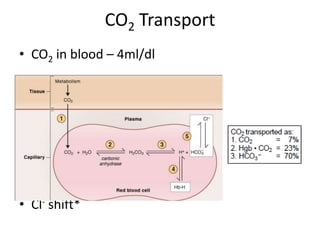
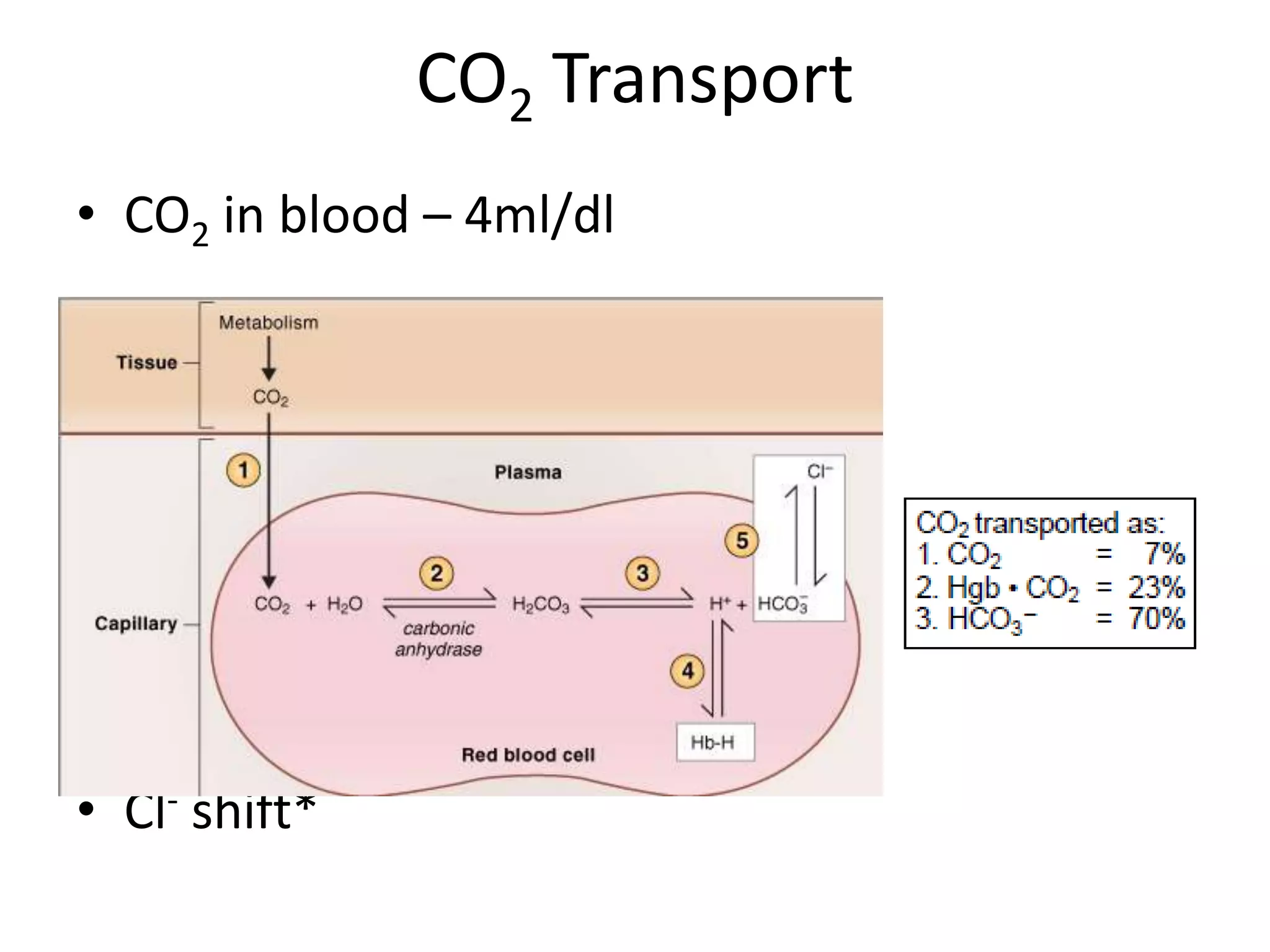
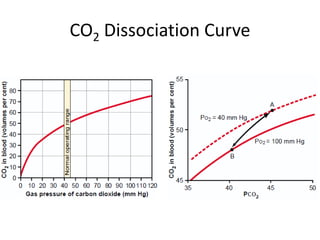
CO2 TransportCO2 in blood – 4ml/dlCl- shift*
CO2 Dissociation Curve
Regulation of Respiration
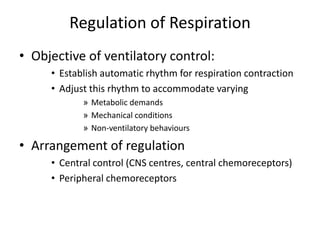
Regulation of RespirationObjective of ventilatory control:Establish automatic rhythm for respiration contractionAdjust this rhythm to accommodate varyingMetabolic demandsMechanical conditionsNon-ventilatory behavioursArrangement of regulationCentral control (CNS centres, central chemoreceptors)Peripheral chemoreceptors
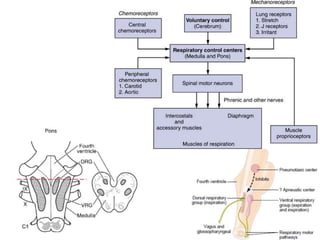
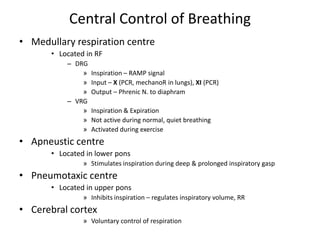
Central Control of BreathingMedullary respiration centreLocated in RFDRGInspiration – RAMP signalInput – X (PCR, mechanoR in lungs), XI (PCR)Output – Phrenic N. to diaphramVRGInspiration & ExpirationNot active during normal, quiet breathingActivated during exerciseApneustic centreLocated in lower ponsStimulates inspiration during deep & prolonged inspiratory gaspPneumotaxic centreLocated in upper ponsInhibits inspiration – regulates inspiratory volume, RRCerebral cortexVoluntary control of respiration
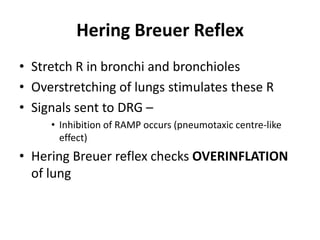
Hering Breuer ReflexStretch R in bronchi and bronchiolesOverstretching of lungs stimulates these RSignals sent to DRG – Inhibition of RAMP occurs (pneumotaxic centre-like effect)Hering Breuer reflex checks OVERINFLATION of lung
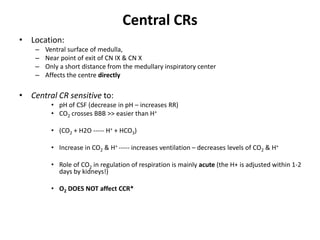
Central CRsLocation:Ventral surface of medulla, Near point of exit of CN IX & CN X Only a short distance from the medullary inspiratory centerAffects the centre directlyCentral CR sensitive to: pH of CSF (decrease in pH – increases RR)CO2 crosses BBB >> easier than H+(CO2 + H2O ----- H+ + HCO3)Increase in CO2 & H+ ----- increases ventilation – decreases levels of CO2 & H+Role of CO2 in regulation of respiration is mainly acute (the H+ is adjusted within 1-2 days by kidneys!)O2 DOES NOT affect CCR*
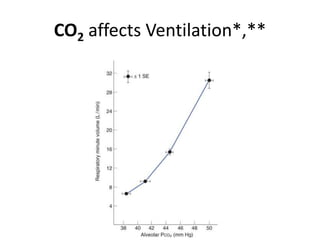
CO2 affects Ventilation*,**
Acid–Base Balance affects VentilationRespiratory response in Metabolic Acidosis E.g due to accumulation of acid ketone bodies DMResponse: Pronounced respiratory stimulation (Kussmaul breathing) 	The hyperventilation decreases alveolar PCO2 ("blows off CO2") Thus produces a compensatory fall in blood [H+]Respiratory response in Metabolic AlkalosisE.g: protracted vomiting with loss of HCl from bodyResponse:Ventilation is depressed Arterial PCO 2 rises, raising the [H+]toward normal
Acid–Base Balance affects VentilationRespiratory AcidosisCan occur when Pco2 rises via:Direct inhibition of respiratory centres (sedatives, anesthetics)Weakening of respiratory muscles (polio, MS, ALS)Decreased CO2 exchange in pulmonary blood (COPD) Renal adjustment of H+/HCO3- corrects for thisRespiratory Alkalosis*Can occur when Pco2 decreases via:Hypoxemia causes hyperventilation (pneumonia, high altitude)Direct ++ of resp. centers  (salicylate poisoning)Psychogenic Renal adjustment of H+/HCO3- corrects for this
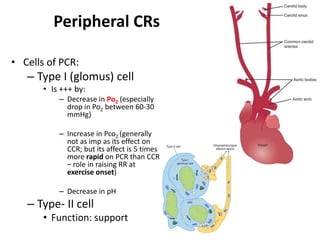
Peripheral CRsCells of PCR:Type I (glomus) cellIs +++ by:Decrease in Po2 (especially drop in Po2 between 60-30 mmHg)Increase in Pco2 (generally not as imp as its effect on CCR; but its affect is 5 times more rapid on PCR than CCR – role in raising RR at exercise onset)Decrease in pHType- II cellFunction: support
Peripheral CRsBlood flow  to each carotid body is VERY high!!* Hence O2 needs are met largely by dissolved O2 alone Therefore, the receptors are NOT +++ in conditions such as anemia or CO poisoning** Powerful stimulation is also produced by cyanide, which prevents O2 utilization at the tissue level Infusion of K+ increases discharge rate in CR afferentsPlasma K+ level is increased during exercise, the increase may contribute to exercise-induced hyperpnea.
Po2, Pco2, H+Scenarios In Respiration Control Changing Po2 (Pco2 & H+ = constant)Po2 below 100 mmHg profoundly influences respiration controlChanging Po2 (Pco2 & H+ = fluctuating)Decreasing Po2increases RRIncreasing RR – increased CO2 blow-off – decreasing Pco2 – which inhibits RRAcclimatization:Decreased sensitivities of CNS resp. centres to CO2
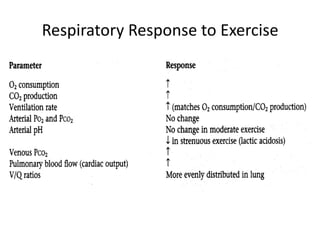
Respiratory Response to Exercise
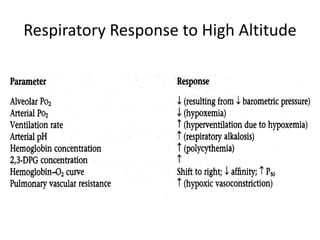
Respiratory Response to High Altitude

Resp upload3

  • 1.
    CO2 TransportCO2 inblood – 4ml/dlCl- shift*
  • 2.
  • 3.
  • 4.
    Regulation of RespirationObjectiveof ventilatory control:Establish automatic rhythm for respiration contractionAdjust this rhythm to accommodate varyingMetabolic demandsMechanical conditionsNon-ventilatory behavioursArrangement of regulationCentral control (CNS centres, central chemoreceptors)Peripheral chemoreceptors
  • 6.
    Central Control ofBreathingMedullary respiration centreLocated in RFDRGInspiration – RAMP signalInput – X (PCR, mechanoR in lungs), XI (PCR)Output – Phrenic N. to diaphramVRGInspiration & ExpirationNot active during normal, quiet breathingActivated during exerciseApneustic centreLocated in lower ponsStimulates inspiration during deep & prolonged inspiratory gaspPneumotaxic centreLocated in upper ponsInhibits inspiration – regulates inspiratory volume, RRCerebral cortexVoluntary control of respiration
  • 7.
    Hering Breuer ReflexStretchR in bronchi and bronchiolesOverstretching of lungs stimulates these RSignals sent to DRG – Inhibition of RAMP occurs (pneumotaxic centre-like effect)Hering Breuer reflex checks OVERINFLATION of lung
  • 8.
    Central CRsLocation:Ventral surfaceof medulla, Near point of exit of CN IX & CN X Only a short distance from the medullary inspiratory centerAffects the centre directlyCentral CR sensitive to: pH of CSF (decrease in pH – increases RR)CO2 crosses BBB >> easier than H+(CO2 + H2O ----- H+ + HCO3)Increase in CO2 & H+ ----- increases ventilation – decreases levels of CO2 & H+Role of CO2 in regulation of respiration is mainly acute (the H+ is adjusted within 1-2 days by kidneys!)O2 DOES NOT affect CCR*
  • 9.
  • 10.
    Acid–Base Balance affectsVentilationRespiratory response in Metabolic Acidosis E.g due to accumulation of acid ketone bodies DMResponse: Pronounced respiratory stimulation (Kussmaul breathing) The hyperventilation decreases alveolar PCO2 ("blows off CO2") Thus produces a compensatory fall in blood [H+]Respiratory response in Metabolic AlkalosisE.g: protracted vomiting with loss of HCl from bodyResponse:Ventilation is depressed Arterial PCO 2 rises, raising the [H+]toward normal
  • 11.
    Acid–Base Balance affectsVentilationRespiratory AcidosisCan occur when Pco2 rises via:Direct inhibition of respiratory centres (sedatives, anesthetics)Weakening of respiratory muscles (polio, MS, ALS)Decreased CO2 exchange in pulmonary blood (COPD) Renal adjustment of H+/HCO3- corrects for thisRespiratory Alkalosis*Can occur when Pco2 decreases via:Hypoxemia causes hyperventilation (pneumonia, high altitude)Direct ++ of resp. centers (salicylate poisoning)Psychogenic Renal adjustment of H+/HCO3- corrects for this
  • 12.
    Peripheral CRsCells ofPCR:Type I (glomus) cellIs +++ by:Decrease in Po2 (especially drop in Po2 between 60-30 mmHg)Increase in Pco2 (generally not as imp as its effect on CCR; but its affect is 5 times more rapid on PCR than CCR – role in raising RR at exercise onset)Decrease in pHType- II cellFunction: support
  • 13.
    Peripheral CRsBlood flow to each carotid body is VERY high!!* Hence O2 needs are met largely by dissolved O2 alone Therefore, the receptors are NOT +++ in conditions such as anemia or CO poisoning** Powerful stimulation is also produced by cyanide, which prevents O2 utilization at the tissue level Infusion of K+ increases discharge rate in CR afferentsPlasma K+ level is increased during exercise, the increase may contribute to exercise-induced hyperpnea.
  • 14.
    Po2, Pco2, H+ScenariosIn Respiration Control Changing Po2 (Pco2 & H+ = constant)Po2 below 100 mmHg profoundly influences respiration controlChanging Po2 (Pco2 & H+ = fluctuating)Decreasing Po2increases RRIncreasing RR – increased CO2 blow-off – decreasing Pco2 – which inhibits RRAcclimatization:Decreased sensitivities of CNS resp. centres to CO2
  • 15.
  • 16.

Editor's Notes

  • #2 *hematocrit of venous blood is normally 3% greater than that of the arterial blood. In the lungs, the Cl– moves out of the cells and they shrink
  • #7 Apneustic Center : Apneusis is an abnormal breathing pattern with prolonged inspiratory gasps, followed by brief expiratory movement. Stimulation of the apneustic center in the lower pons produces this breathing pattern in experimental subjects. Stimulation of these neurons apparently excites the inspiratory center in the medulla, prolonging the period of action potentials in the phrenic nerve, and thereby prolonging the contraction of the diaphragm. Pneumotaxic Center : The pneumotaxic center turns off inspiration, limiting the burst of action potentials in the phrenic nerve. In effect, the pneumotaxic center, located in the upper pons, limits the size of the tidal volume, and secondarily, it regulates the respiratory rate. A normal breathing rhythm persists in the absence of this center.
  • #9 *(as its levels are maintained even with fluctuating Palvo2 while CO2 levels fluctuate appropriately)
  • #10 *Responses of normal subjects to inhaling O2 and approximately 2, 4, and 6% CO2. The relatively linear increase in respiratory minute volume in response to increased CO2 is due to an increase in both the depth and rate of respiration.**Of course, this linearity has an upper limit. When the PCO 2 of the inspired gas is close to the alveolar PCO 2, elimination of CO2 becomes difficult. When the CO2 content of the inspired gas is more than 7%, the alveolar and arterial PCO 2 begin to rise abruptly in spite of hyperventilation. The resultant accumulation of CO2 in the body (hypercapnia) depresses the central nervous system, including the respiratory center, and produces headache, confusion, and eventually coma (CO2narcosis).
  • #12 *mediated via peripheral CR
  • #13 Ventilatory Response to Oxygen LackWhen the O2 content of the inspired air is decreased, respiratory minute volume is increased. The stimulation is slight when the PO2 of the inspired air is more than 60 mm Hg, and marked stimulation of respiration occurs only at lower PO2 values (Figure 37–9). However, any decline in arterial PO2 below 100 mm Hg produces increased discharge in the nerves from the carotid and aortic chemoreceptors. There are two reasons why this increase in impulse traffic does not increase ventilation to any extent in normal individuals until the PO2 is less than 60 mm Hg. Because Hb is a weaker acid than HbO2, there is a slight decrease in the H+ concentration of arterial blood when the arterial PO2 falls and hemoglobin becomes less saturated with O2. The fall in H+ concentration tends to inhibit respiration. In addition, any increase in ventilation that does occur lowers the alveolar PCO2, and this also tends to inhibit respiration. Therefore, the stimulatory effects of hypoxia on ventilation are not clearly manifest until they become strong enough to override the counterbalancing inhibitory effects of a decline in arterial H+ concentration and PCO2.
  • #14 *in each 2-mg carotid body is about 0.04 mL/min, or 2000 mL/100 g of tissue/min compared with a blood flow 54 mL or 420 mL per 100 g/min in the brain and kidneys, respectively. **in which the amount of dissolved O2 in the blood reaching the receptors is generally normal, even though the combined O2 in the blood is markedly decreased.