Designing and Conducting
Qualitative Research
Introduction
•Research Design is always about making decision
amongst several options
•It involves the methodology and procedures a
researcher uses to conduct scientific enquiry.
•The purpose of the research, the orientation of the
researcher are some of the key factors that guide the
research design.
Ontology (belief about reality)
Epistemology (philosophies or research approaches)
Methodology (procedures by which researchers go about their
work discovering & analysing knowledge in a systematic
way)
Methods (techniques that are used for conduction of research
Research
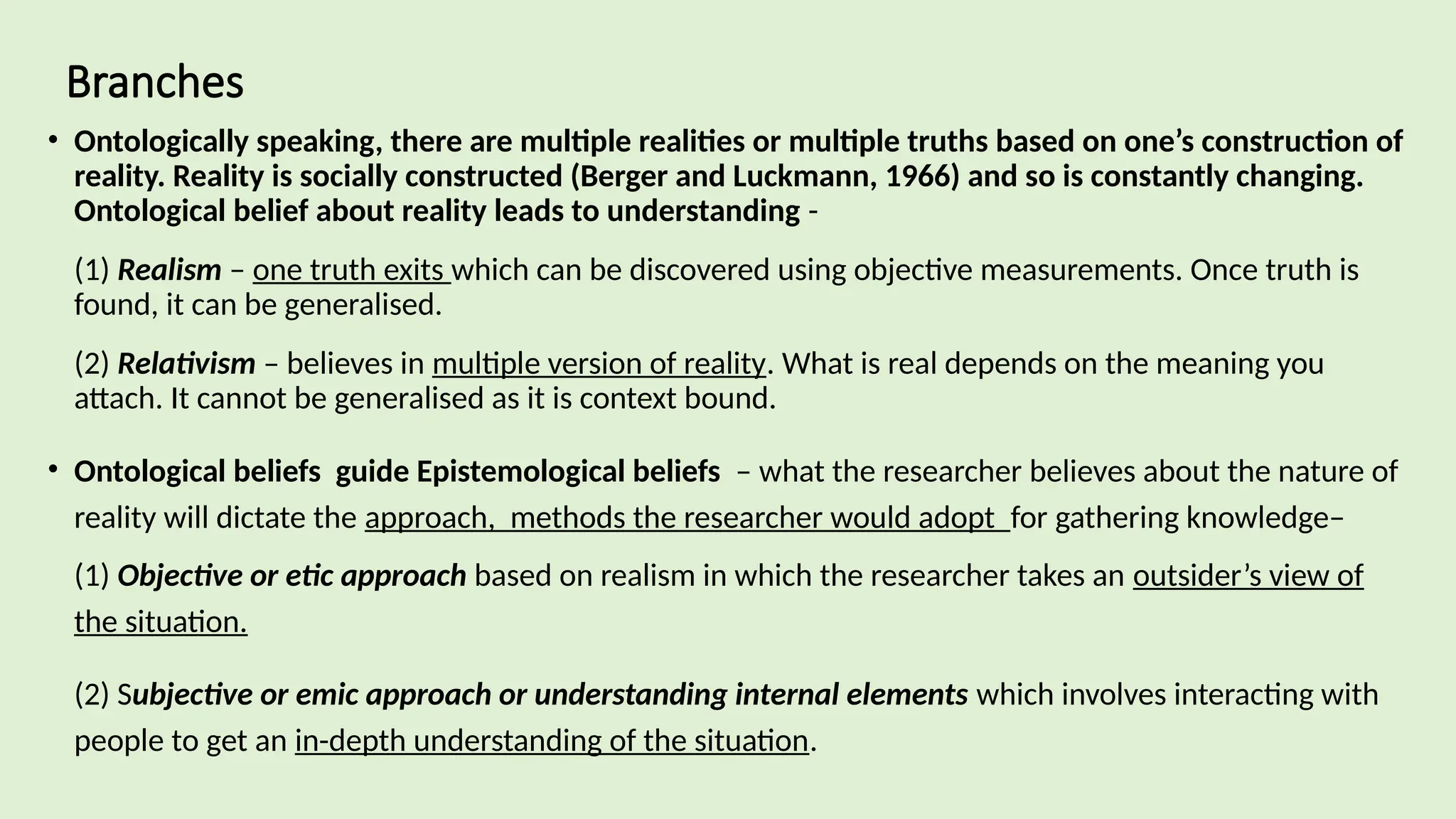
Branches
• Ontologically speaking, there are multiple realities or multiple truths based on one’s construction of
reality. Reality is socially constructed (Berger and Luckmann, 1966) and so is constantly changing.
Ontological belief about reality leads to understanding -
(1) Realism – one truth exits which can be discovered using objective measurements. Once truth is
found, it can be generalised.
(2) Relativism – believes in multiple version of reality. What is real depends on the meaning you
attach. It cannot be generalised as it is context bound.
• Ontological beliefs guide Epistemological beliefs – what the researcher believes about the nature of
reality will dictate the approach, methods the researcher would adopt for gathering knowledge–
(1) Objective or etic approach based on realism in which the researcher takes an outsider’s view of
the situation.
(2) Subjective or emic approach or understanding internal elements which involves interacting with
people to get an in-depth understanding of the situation.
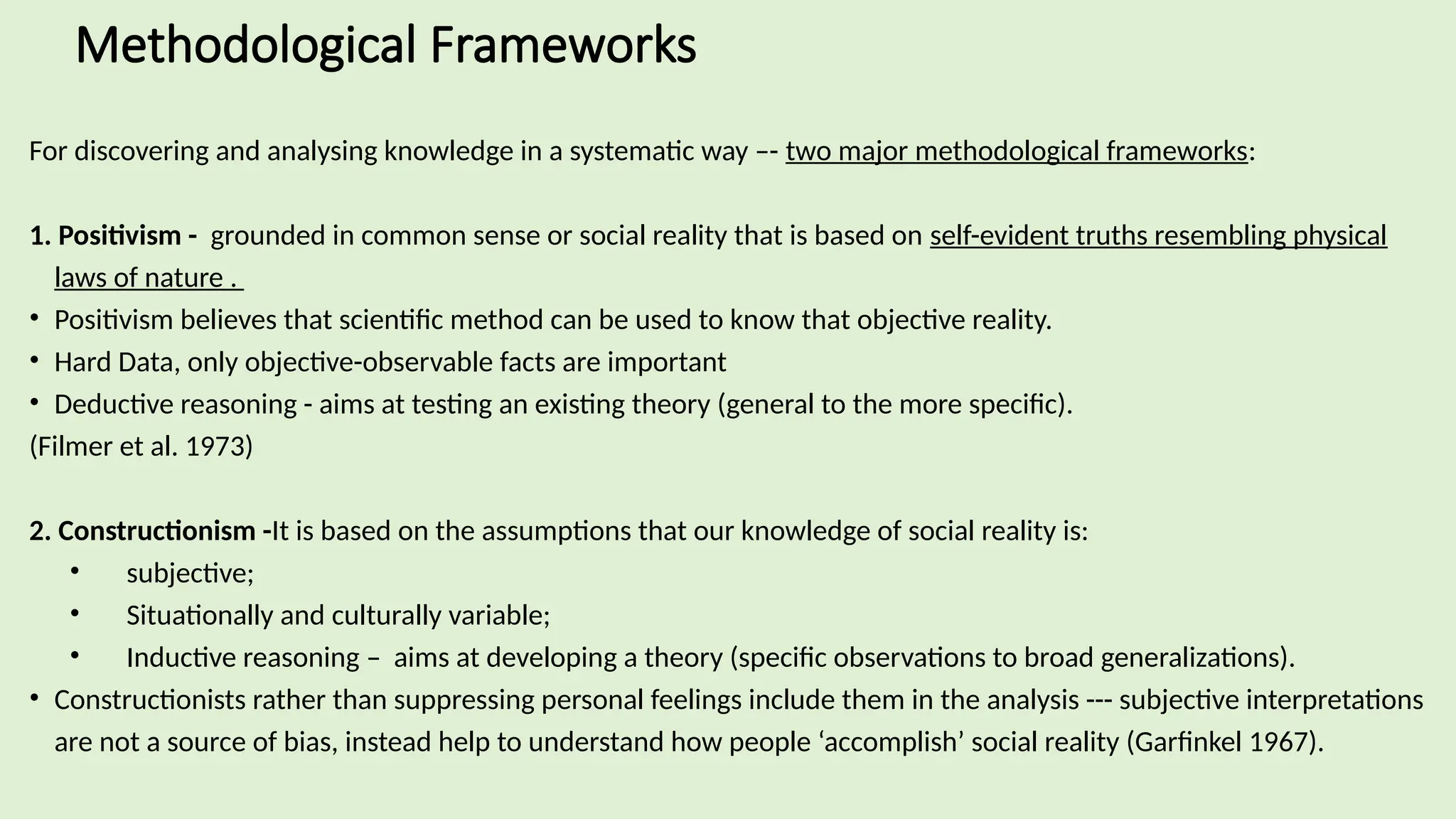
Methodological Frameworks
For discovering and analysing knowledge in a systematic way –- two major methodological frameworks:
1. Positivism - grounded in common sense or social reality that is based on self-evident truths resembling physical
laws of nature .
• Positivism believes that scientific method can be used to know that objective reality.
• Hard Data, only objective-observable facts are important
• Deductive reasoning - aims at testing an existing theory (general to the more specific).
(Filmer et al. 1973)
2. Constructionism -It is based on the assumptions that our knowledge of social reality is:
• subjective;
• Situationally and culturally variable;
• Inductive reasoning – aims at developing a theory (specific observations to broad generalizations).
• Constructionists rather than suppressing personal feelings include them in the analysis --- subjective interpretations
are not a source of bias, instead help to understand how people ‘accomplish’ social reality (Garfinkel 1967).
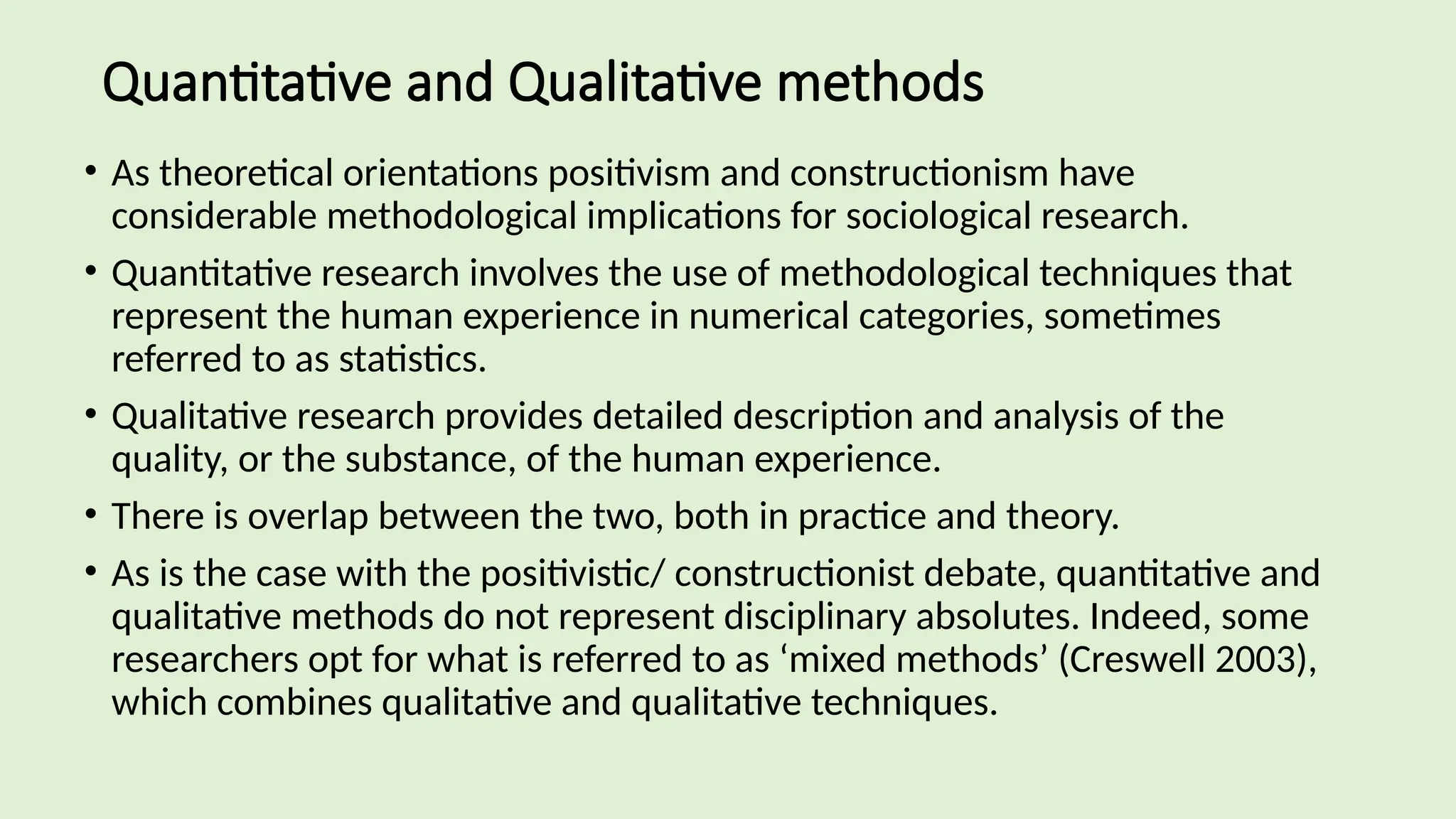
Quantitative and Qualitative methods
• As theoretical orientations positivism and constructionism have
considerable methodological implications for sociological research.
• Quantitative research involves the use of methodological techniques that
represent the human experience in numerical categories, sometimes
referred to as statistics.
• Qualitative research provides detailed description and analysis of the
quality, or the substance, of the human experience.
• There is overlap between the two, both in practice and theory.
• As is the case with the positivistic/ constructionist debate, quantitative and
qualitative methods do not represent disciplinary absolutes. Indeed, some
researchers opt for what is referred to as ‘mixed methods’ (Creswell 2003),
which combines qualitative and qualitative techniques.
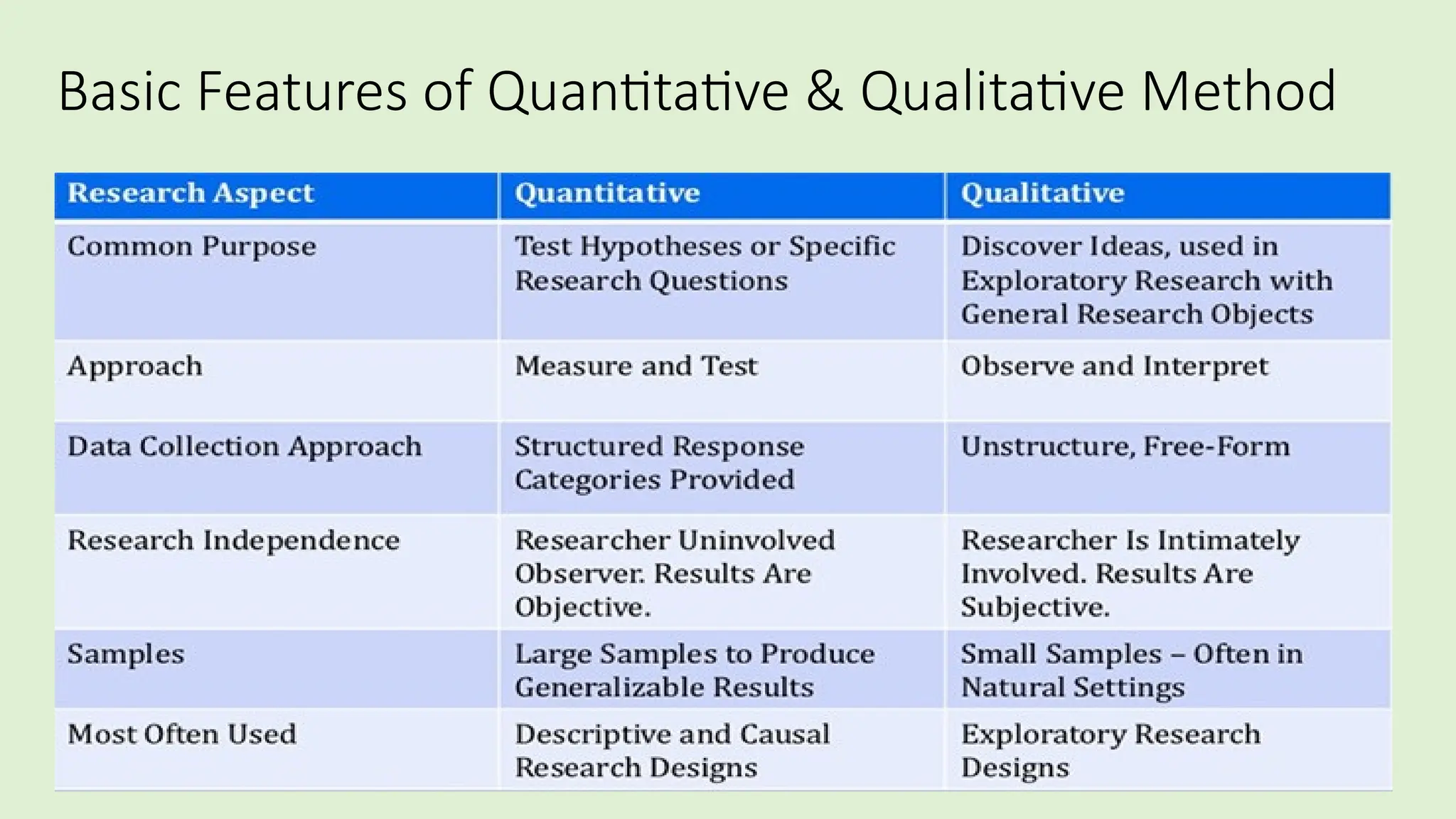
Basic Features of Quantitative & Qualitative Method
When is a Qualitative Approach needed??
• Little is known or present understanding is inadequate
• Making sense of complex situations or social processes
• Learn from participants about their experiences (beliefs, motivations,
opinions)
• Construct a hypothesis/theory from data
• Understand phenomena deeply and in detail
what is qualitative research?
• It’s a not a single approach, but rather a very broad systematic collection,
organization and interpretation of data collection and research.
• There is no one way to conduct qualitative research.
• It is complicated -the wrong question can lead to useless data. A well-
formed question is the key to good research and often leads to more
research and more questions.
• Qualitative data requires deep interpretation and the many methods of
doing that.
Traditions in Qualitative Methodology -
1. Ethnography
• Anthropological origin
• Studies a cultural group in a natural setting by living in that situation over a prolonged period of
time.
• Holistic study of people, culture, societies, social relations, social processes, behaviour in
situ
• Rather than relying on interviews or surveys, researcher experiences the environment first hand,
and sometimes as a "participant observer”
• Bronislaw Malinowski (1884 – 1942) -Argonauts of the Western Pacific
• Ruth Benedict (1887 – 1948) – Patterns of Culture (1934)
• Margaret Mead (1901-1978) - Coming of Age in Samoa (1928)
Traditions in Qualitative Methodology –
2. Phenomenology
• Understand and describe a specific phenomenon in- depth and reach at the essence of
participants' lived experience of the phenomenon.
• Rely on the participants' own perspectives to provide insight into their motivations.
• Combination of methods, such as conducting interviews, reading documents, watching
videos, or visiting places and events, to understand the meaning participants place on
whatever's being examined.
• Example- To study of a company’s lockdown. While a quantitative study can find out
what problems the workers are facing, a phenomenological study would aim to better
understand the experiences of the workers.
• Edmund Husserl - 1859 – 1938 - Logical Investigations
• Jean Paul Sartre - 1905-1980
Traditions in Qualitative Methodology –
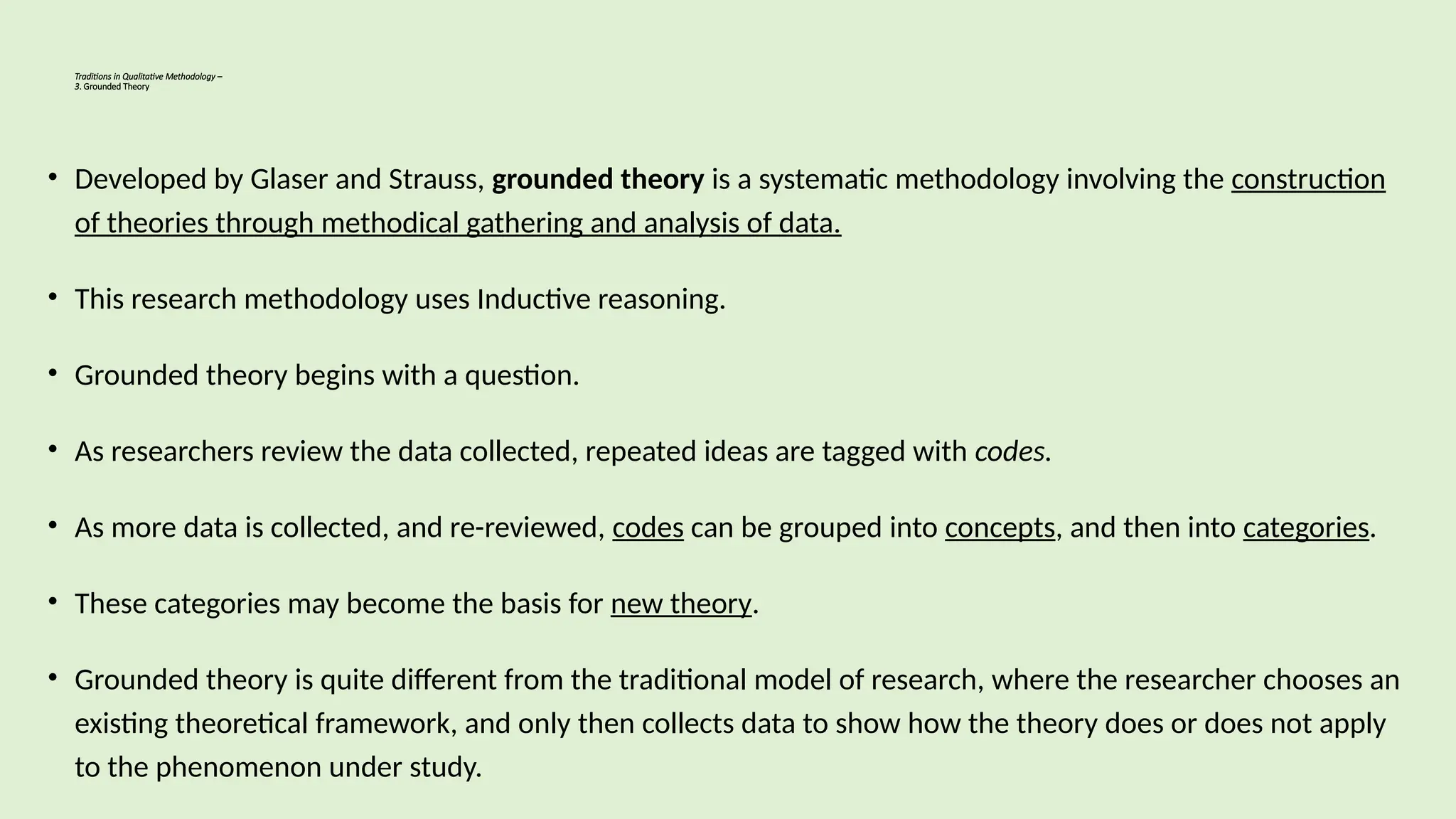
3. Grounded Theory
• Developed by Glaser and Strauss, grounded theory is a systematic methodology involving the construction
of theories through methodical gathering and analysis of data.
• This research methodology uses Inductive reasoning.
• Grounded theory begins with a question.
• As researchers review the data collected, repeated ideas are tagged with codes.
• As more data is collected, and re-reviewed, codes can be grouped into concepts, and then into categories.
• These categories may become the basis for new theory.
• Grounded theory is quite different from the traditional model of research, where the researcher chooses an
existing theoretical framework, and only then collects data to show how the theory does or does not apply
to the phenomenon under study.
4. Case Studies
• In-depth study of a single case
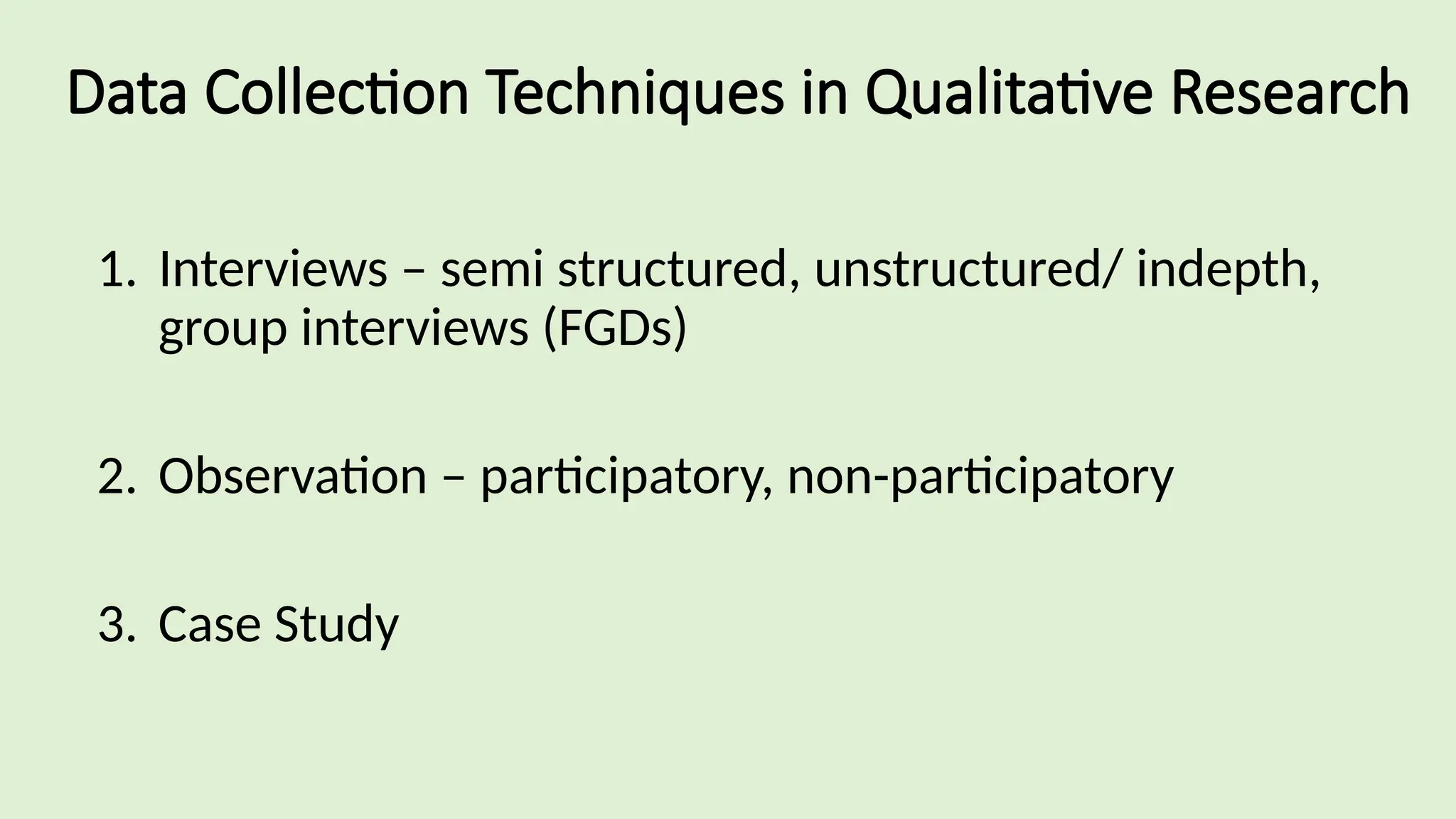
Data Collection Techniques in Qualitative Research
1. Interviews – semi structured, unstructured/ indepth,
group interviews (FGDs)
2. Observation – participatory, non-participatory
3. Case Study
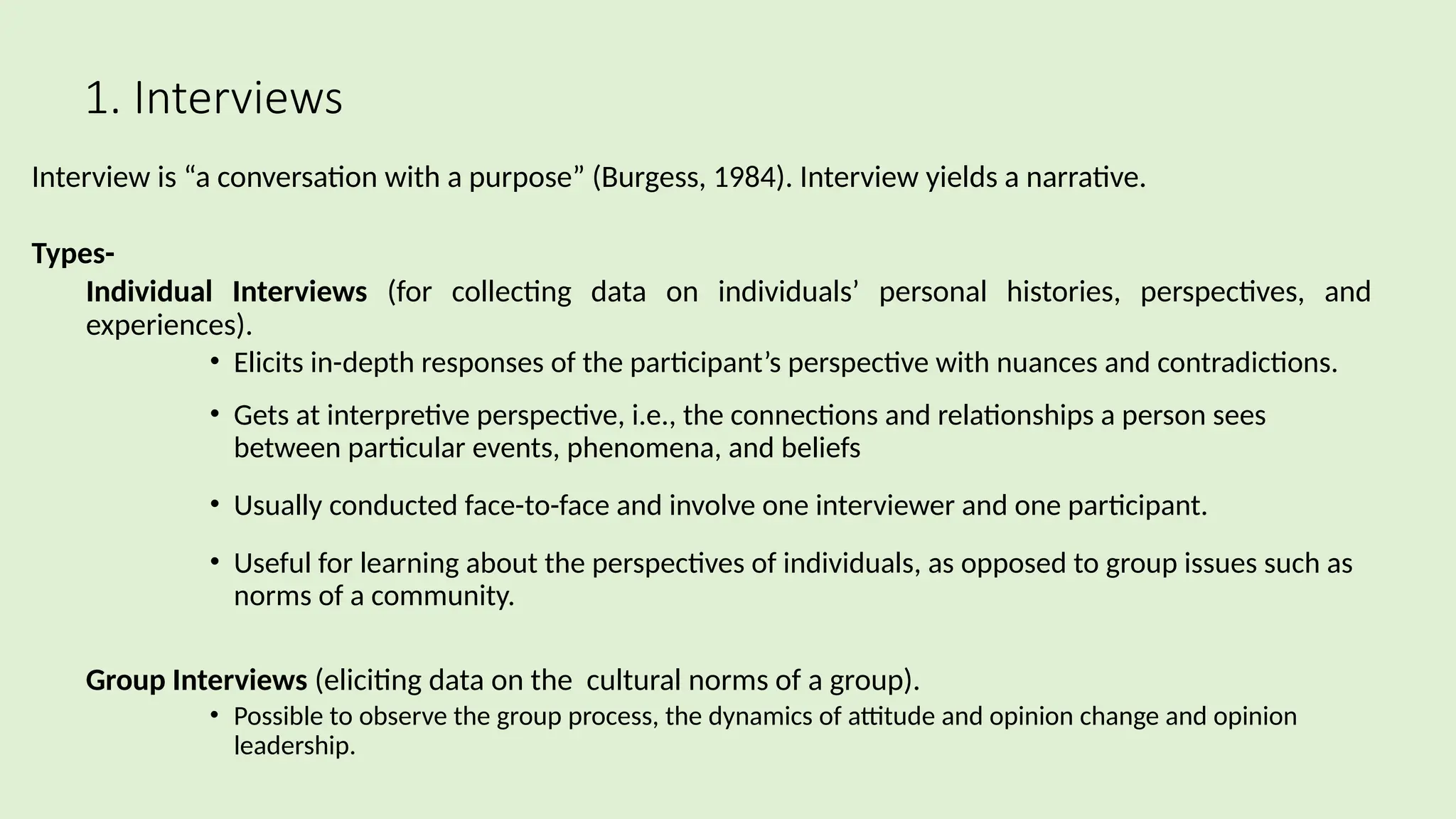
1. Interviews
Interview is “a conversation with a purpose” (Burgess, 1984). Interview yields a narrative.
Types-
 Individual Interviews (for collecting data on individuals’ personal histories, perspectives, and
experiences).
• Elicits in-depth responses of the participant’s perspective with nuances and contradictions.
• Gets at interpretive perspective, i.e., the connections and relationships a person sees
between particular events, phenomena, and beliefs
• Usually conducted face-to-face and involve one interviewer and one participant.
• Useful for learning about the perspectives of individuals, as opposed to group issues such as
norms of a community.
 Group Interviews (eliciting data on the cultural norms of a group).
• Possible to observe the group process, the dynamics of attitude and opinion change and opinion
leadership.
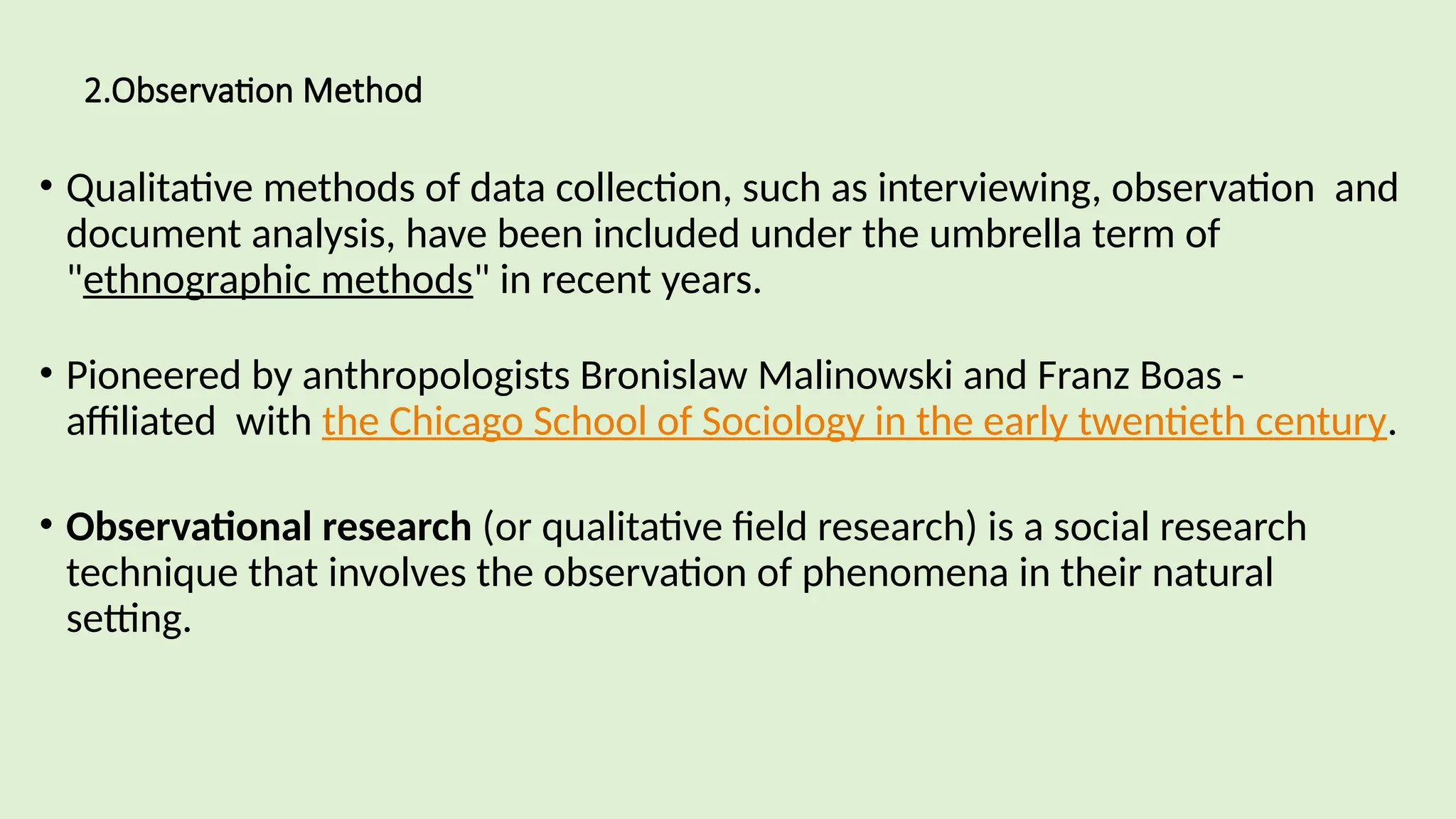
2.Observation Method
• Qualitative methods of data collection, such as interviewing, observation and
document analysis, have been included under the umbrella term of
"ethnographic methods" in recent years.
• Pioneered by anthropologists Bronislaw Malinowski and Franz Boas -
affiliated with the Chicago School of Sociology in the early twentieth century.
• Observational research (or qualitative field research) is a social research
technique that involves the observation of phenomena in their natural
setting.
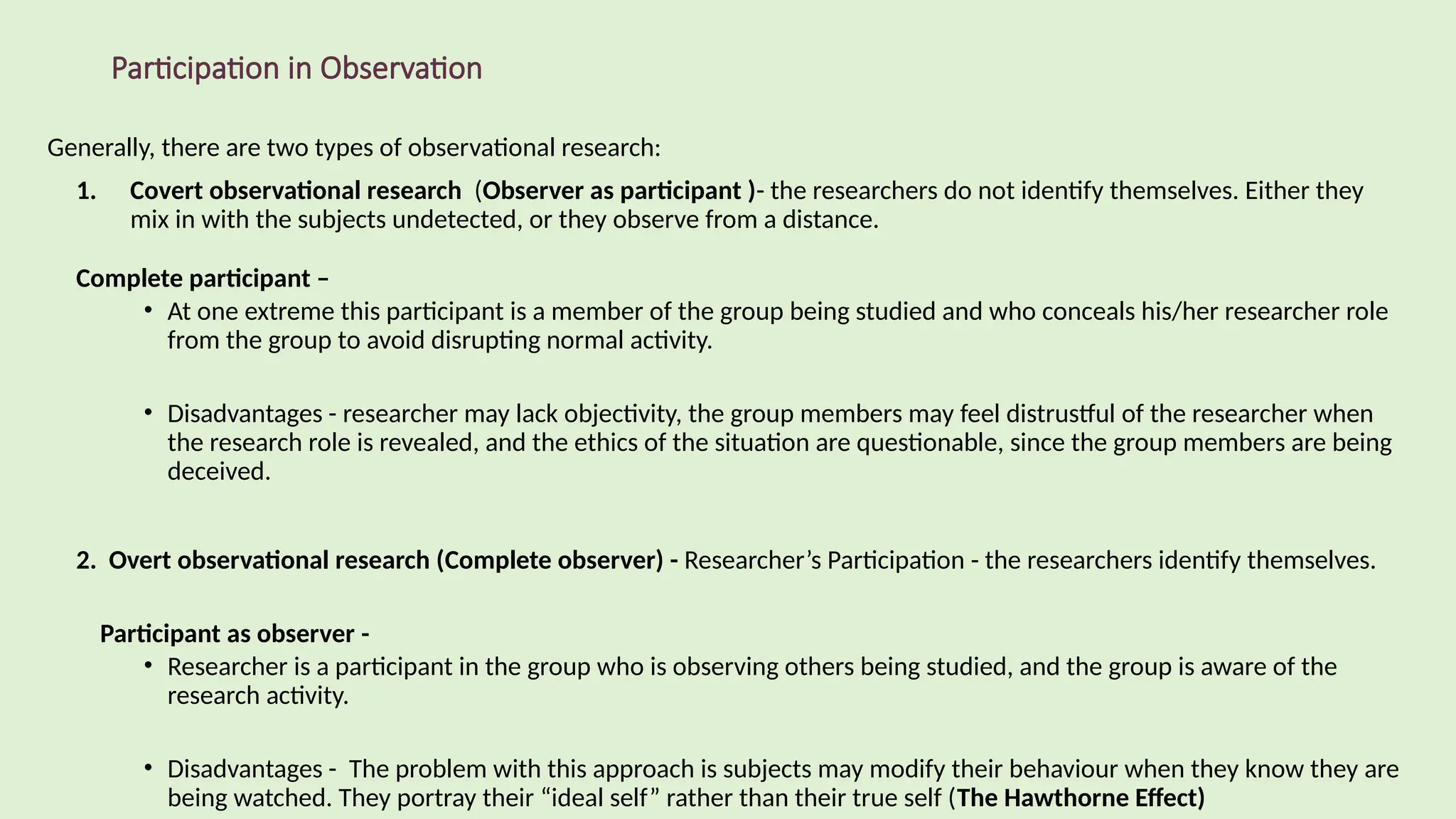
Participation in Observation
Generally, there are two types of observational research:
1. Covert observational research (Observer as participant )- the researchers do not identify themselves. Either they
mix in with the subjects undetected, or they observe from a distance.
Complete participant –
• At one extreme this participant is a member of the group being studied and who conceals his/her researcher role
from the group to avoid disrupting normal activity.
• Disadvantages - researcher may lack objectivity, the group members may feel distrustful of the researcher when
the research role is revealed, and the ethics of the situation are questionable, since the group members are being
deceived.
2. Overt observational research (Complete observer) - Researcher’s Participation - the researchers identify themselves.
Participant as observer -
• Researcher is a participant in the group who is observing others being studied, and the group is aware of the
research activity.
• Disadvantages - The problem with this approach is subjects may modify their behaviour when they know they are
being watched. They portray their “ideal self” rather than their true self (The Hawthorne Effect)
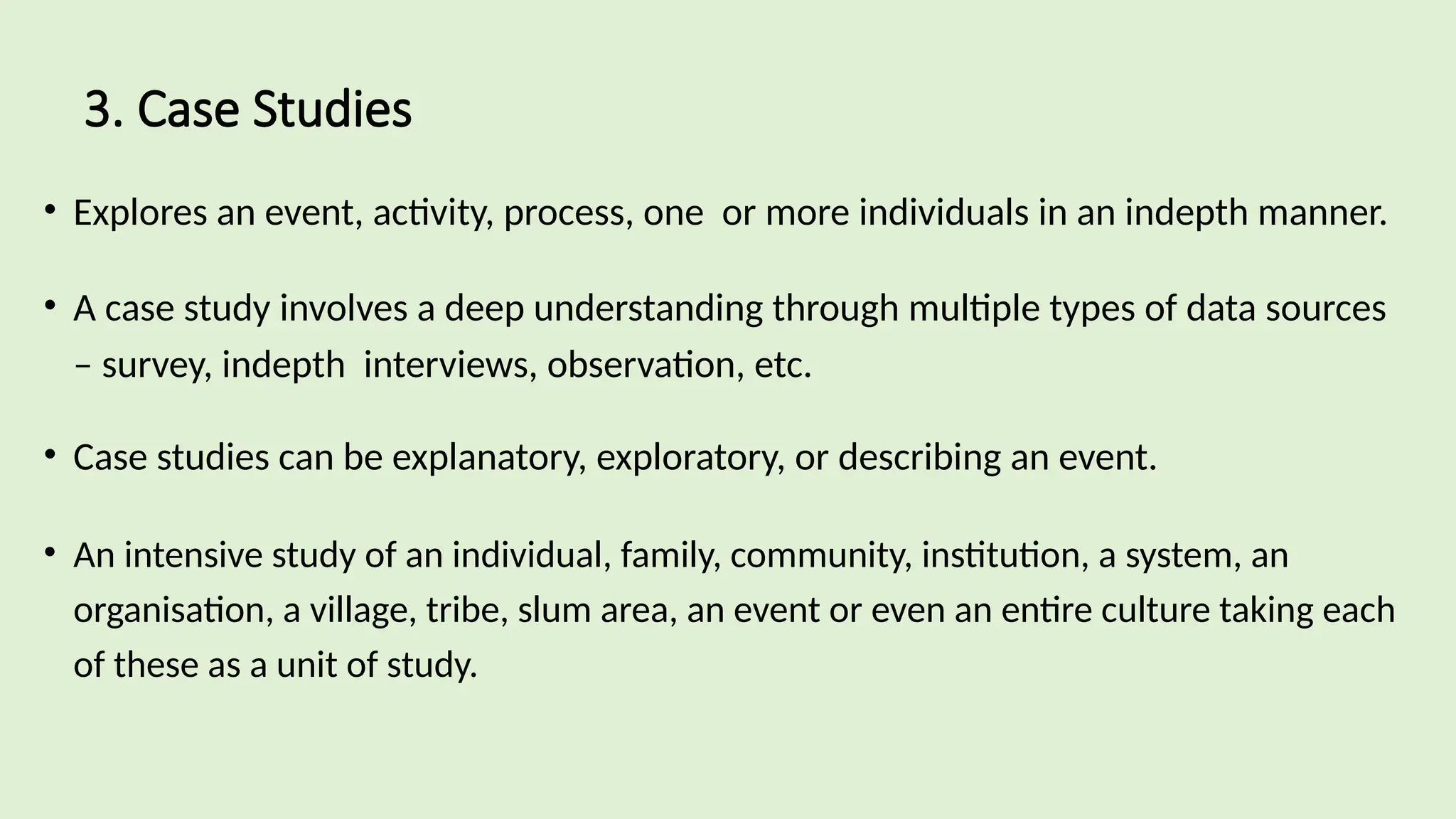
3. Case Studies
• Explores an event, activity, process, one or more individuals in an indepth manner.
• A case study involves a deep understanding through multiple types of data sources
– survey, indepth interviews, observation, etc.
• Case studies can be explanatory, exploratory, or describing an event.
• An intensive study of an individual, family, community, institution, a system, an
organisation, a village, tribe, slum area, an event or even an entire culture taking each
of these as a unit of study.
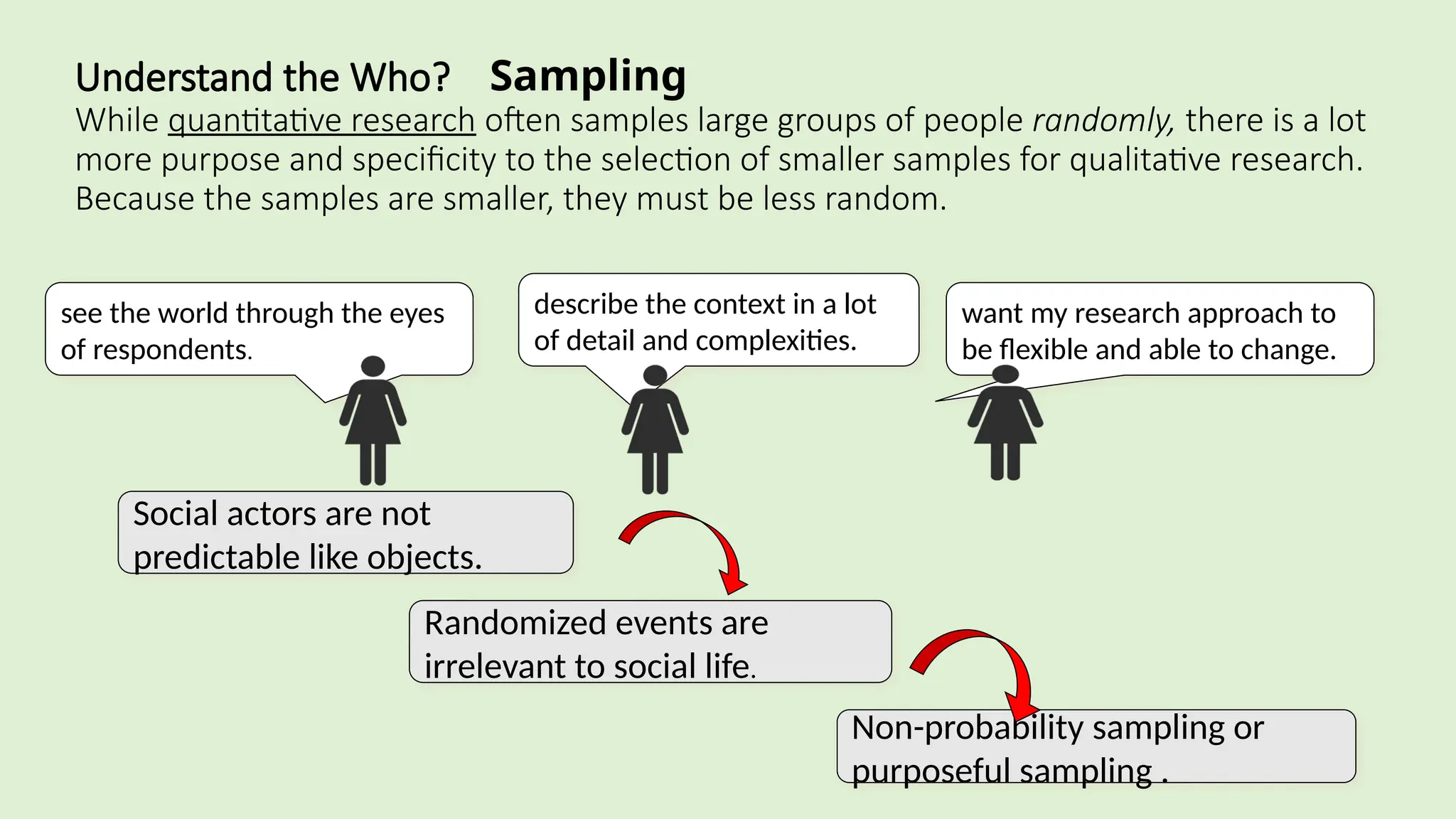
Understand the Who? Sampling
While quantitative research often samples large groups of people randomly, there is a lot
more purpose and specificity to the selection of smaller samples for qualitative research.
Because the samples are smaller, they must be less random.
see the world through the eyes
of respondents.
describe the context in a lot
of detail and complexities.
want my research approach to
be flexible and able to change.
Social actors are not
predictable like objects.
Randomized events are
irrelevant to social life.
Non-probability sampling or
purposeful sampling .
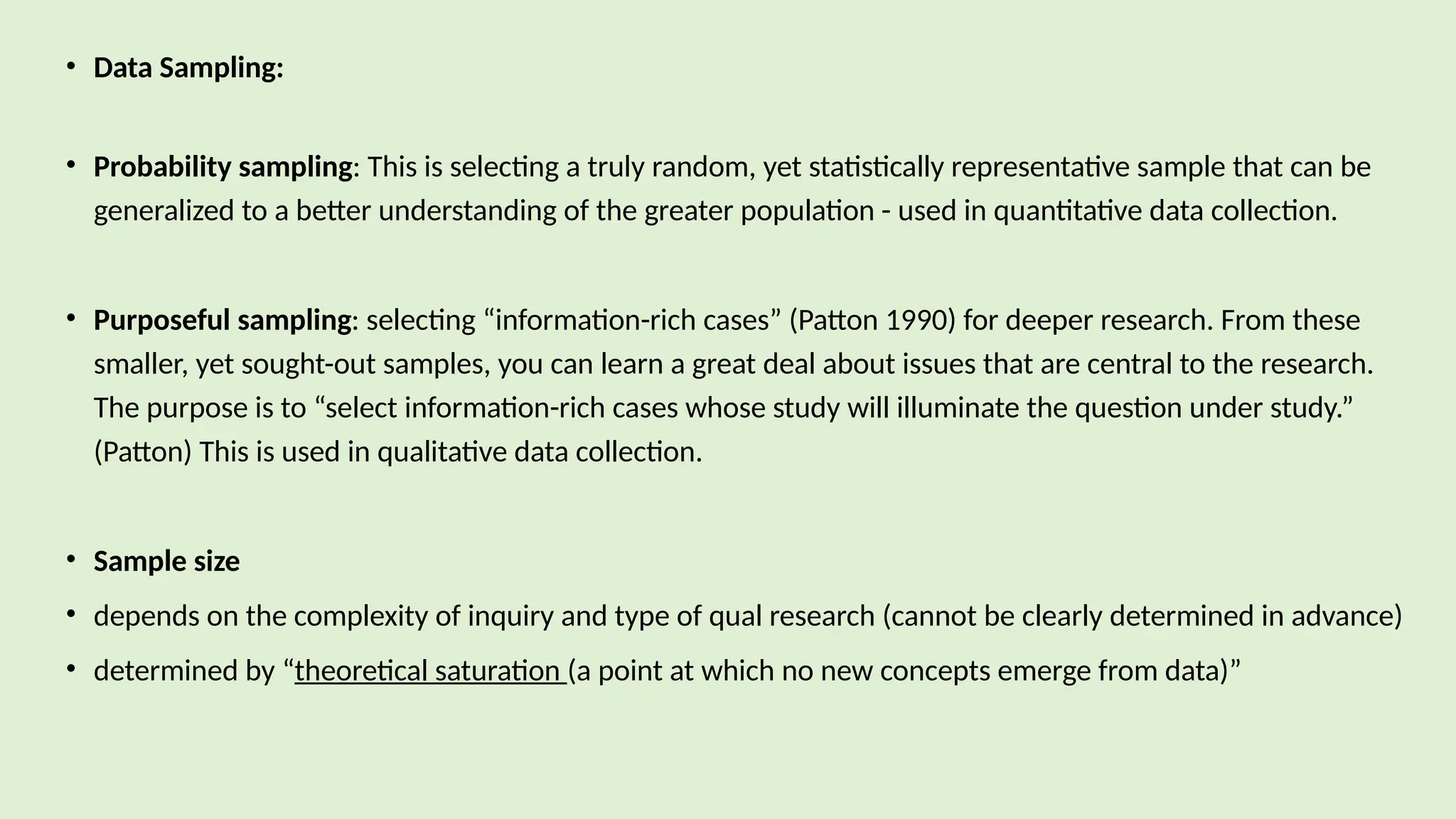
• Data Sampling:
• Probability sampling: This is selecting a truly random, yet statistically representative sample that can be
generalized to a better understanding of the greater population - used in quantitative data collection.
• Purposeful sampling: selecting “information-rich cases” (Patton 1990) for deeper research. From these
smaller, yet sought-out samples, you can learn a great deal about issues that are central to the research.
The purpose is to “select information-rich cases whose study will illuminate the question under study.”
(Patton) This is used in qualitative data collection.
• Sample size
• depends on the complexity of inquiry and type of qual research (cannot be clearly determined in advance)
• determined by “theoretical saturation (a point at which no new concepts emerge from data)”
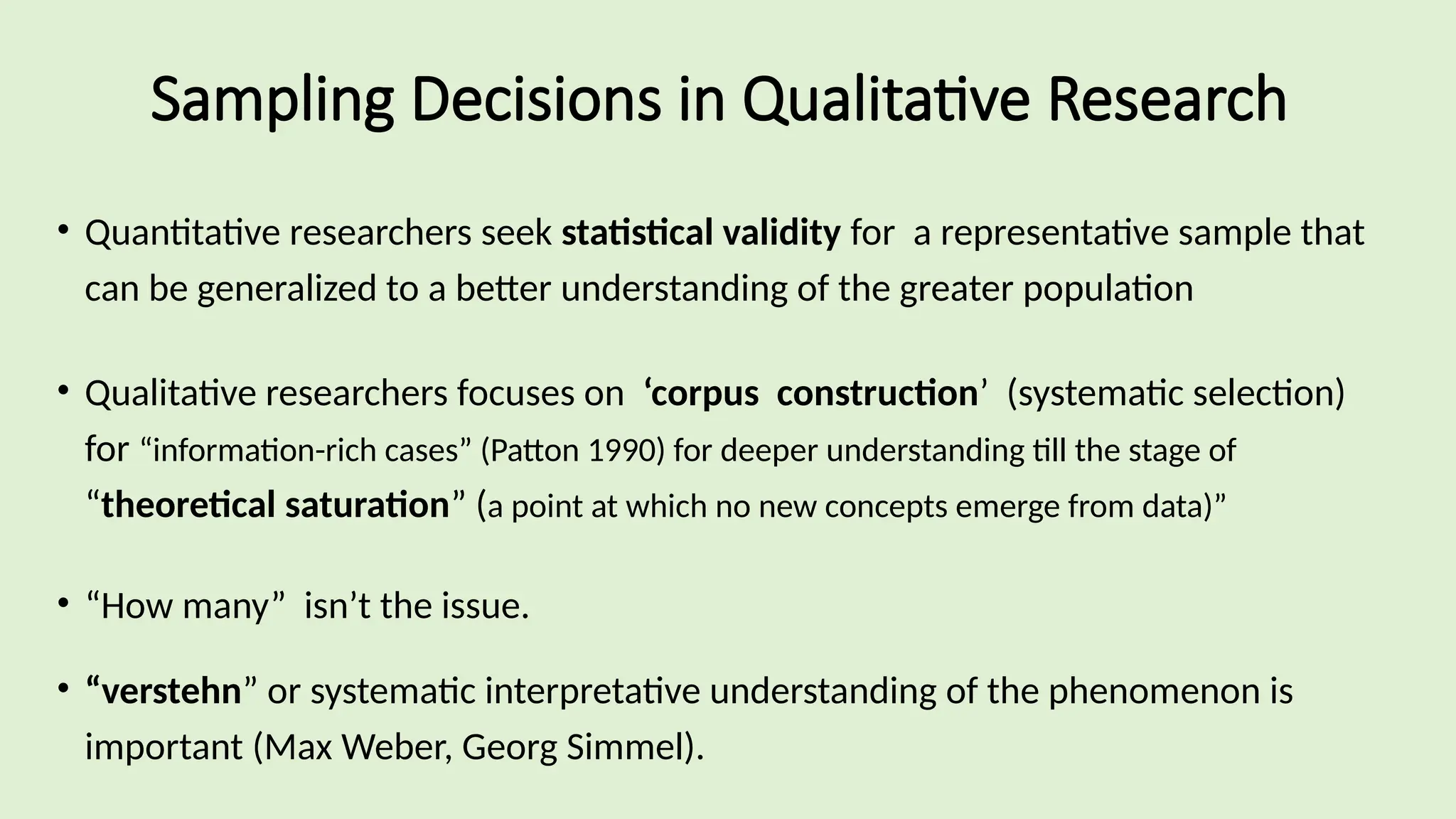
Sampling Decisions in Qualitative Research
• Quantitative researchers seek statistical validity for a representative sample that
can be generalized to a better understanding of the greater population
• Qualitative researchers focuses on ‘corpus construction’ (systematic selection)
for “information-rich cases” (Patton 1990) for deeper understanding till the stage of
“theoretical saturation” (a point at which no new concepts emerge from data)”
• “How many” isn’t the issue.
• “verstehn” or systematic interpretative understanding of the phenomenon is
important (Max Weber, Georg Simmel).
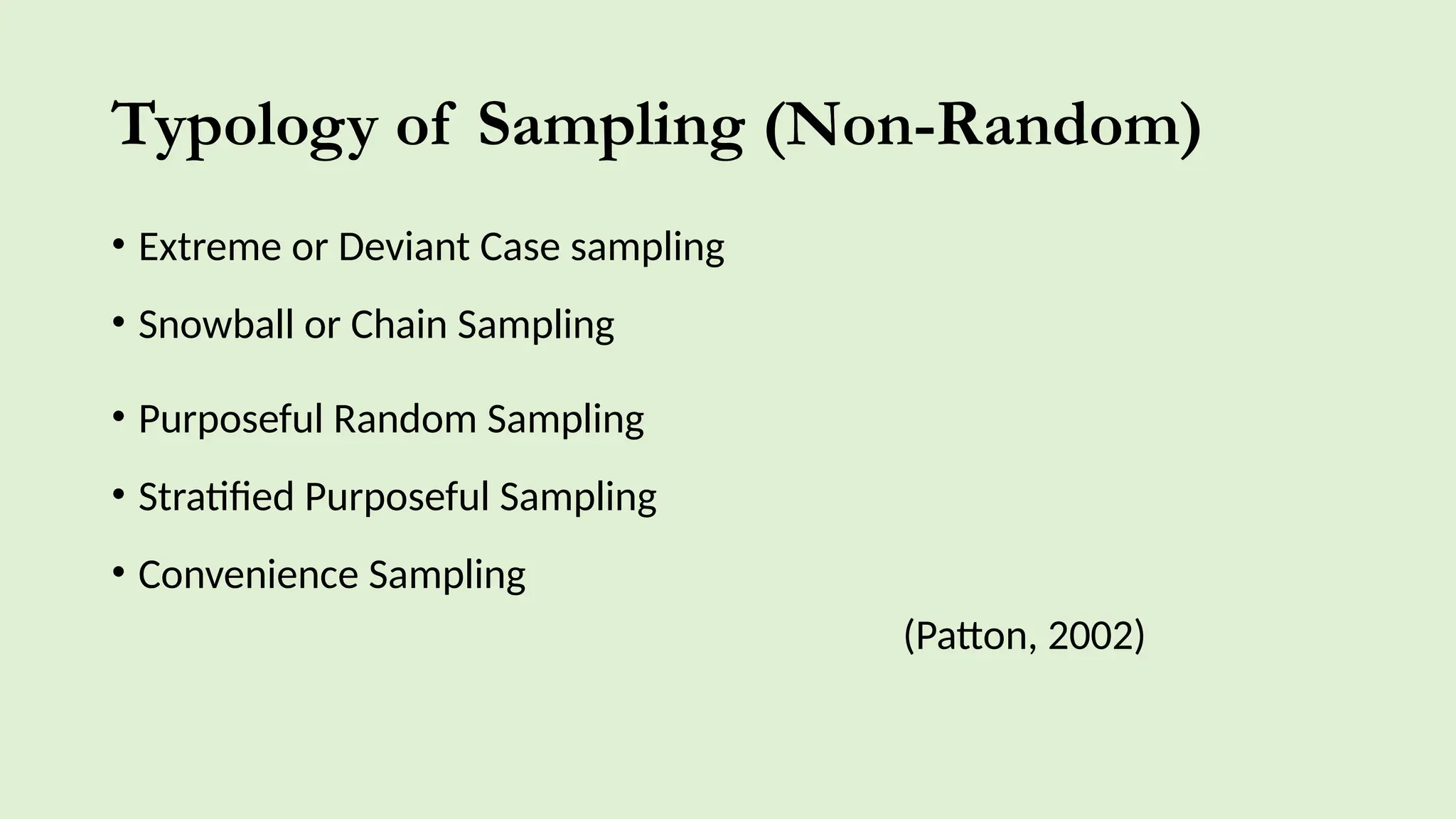
Typology of Sampling (Non-Random)
• Extreme or Deviant Case sampling
• Snowball or Chain Sampling
• Purposeful Random Sampling
• Stratified Purposeful Sampling
• Convenience Sampling
(Patton, 2002)
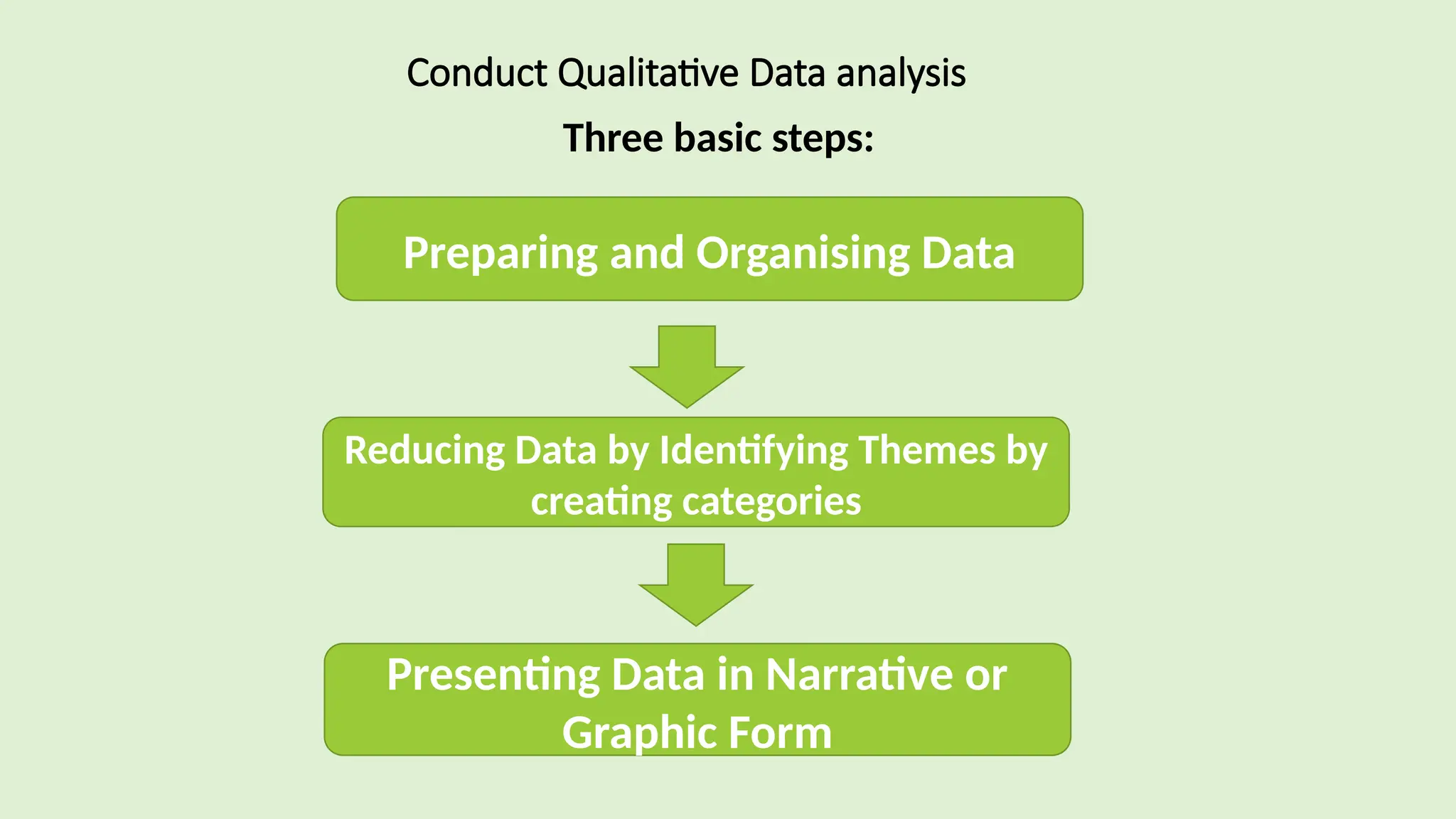
Conduct Qualitative Data analysis
Three basic steps:
Preparing and Organising Data
Reducing Data by Identifying Themes by
creating categories
Presenting Data in Narrative or
Graphic Form
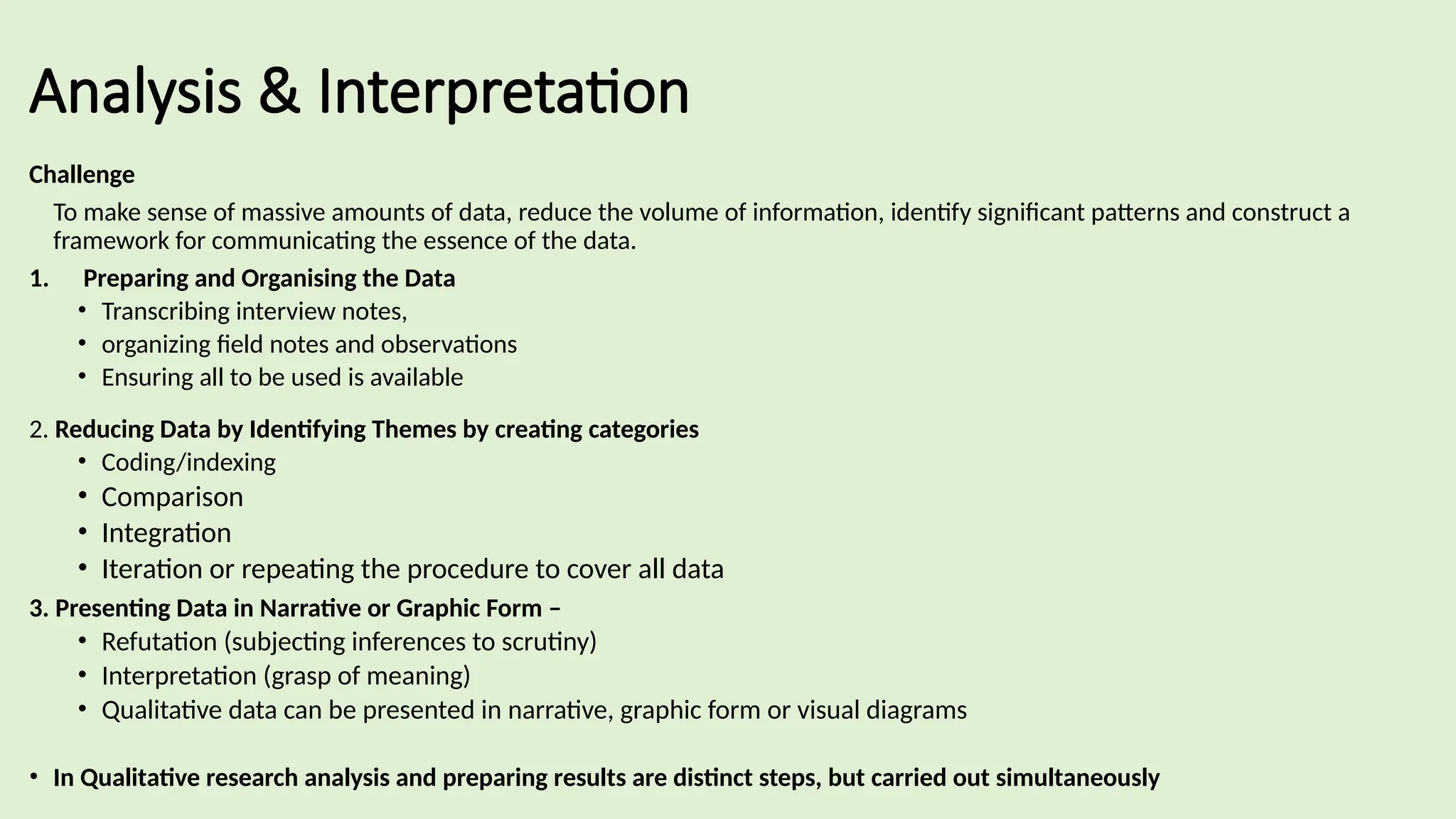
Analysis & Interpretation
Challenge
To make sense of massive amounts of data, reduce the volume of information, identify significant patterns and construct a
framework for communicating the essence of the data.
1. Preparing and Organising the Data
• Transcribing interview notes,
• organizing field notes and observations
• Ensuring all to be used is available
2. Reducing Data by Identifying Themes by creating categories
• Coding/indexing
• Comparison
• Integration
• Iteration or repeating the procedure to cover all data
3. Presenting Data in Narrative or Graphic Form –
• Refutation (subjecting inferences to scrutiny)
• Interpretation (grasp of meaning)
• Qualitative data can be presented in narrative, graphic form or visual diagrams
• In Qualitative research analysis and preparing results are distinct steps, but carried out simultaneously
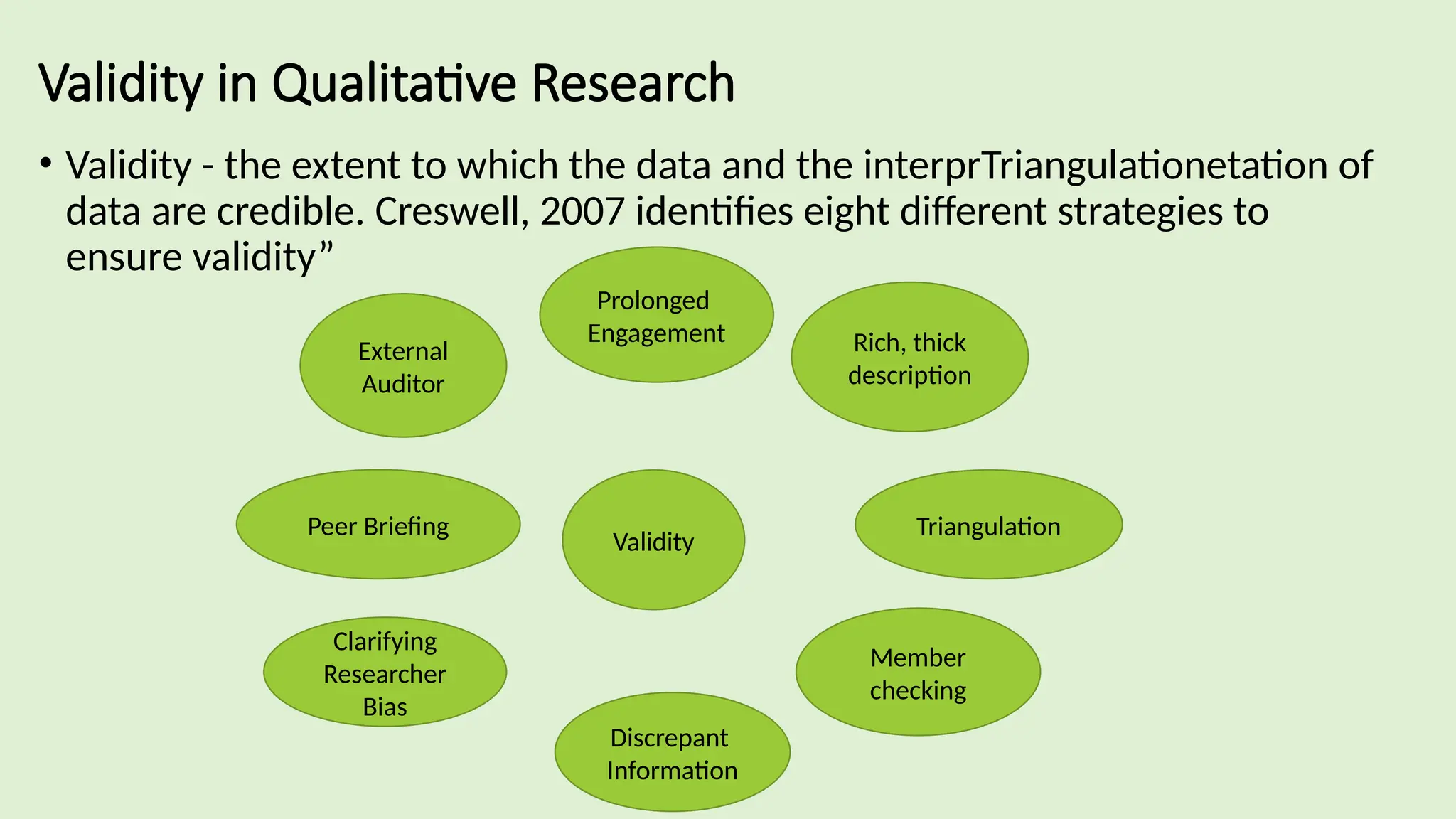
Validity in Qualitative Research
• Validity - the extent to which the data and the interprTriangulationetation of
data are credible. Creswell, 2007 identifies eight different strategies to
ensure validity”
Validity
Prolonged
Engagement
Triangulation
Member
checking
Discrepant
Information
Clarifying
Researcher
Bias
Peer Briefing
External
Auditor
Rich, thick
description
Findings
•Reports the essence of the experience
•Reader should get an understanding of what it is
like to experience the phenomenon
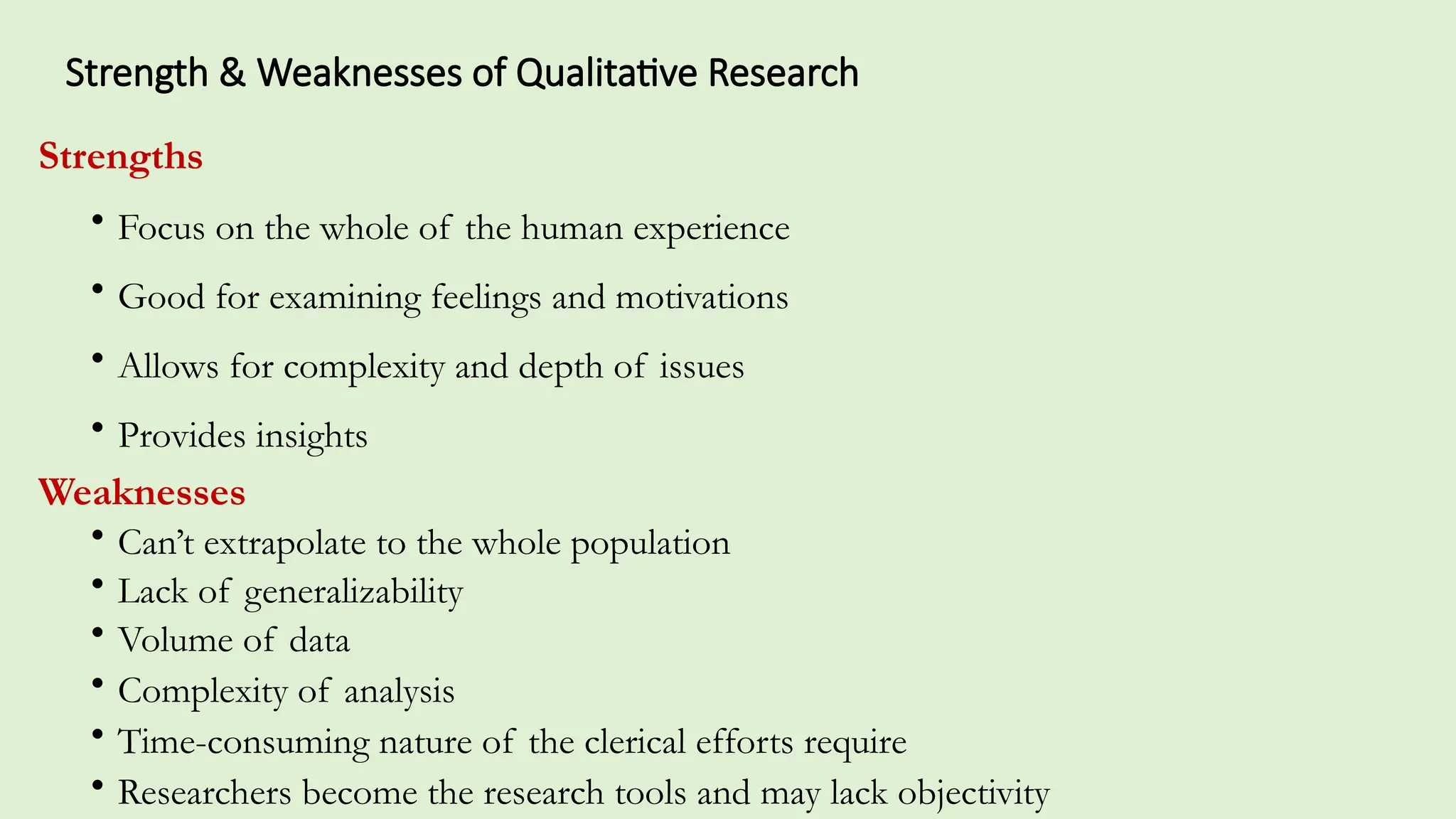
Strength & Weaknesses of Qualitative Research
Strengths
• Focus on the whole of the human experience
• Good for examining feelings and motivations
• Allows for complexity and depth of issues
• Provides insights
Weaknesses
• Can’t extrapolate to the whole population
• Lack of generalizability
• Volume of data
• Complexity of analysis
• Time-consuming nature of the clerical efforts require
• Researchers become the research tools and may lack objectivity
Skills & qualities of a researcher
• Researcher is the instrument for data collection
• Establishes good rapport with participants
• Empathetic
• Good Listener
• Explicates beliefs through bracketing
• Sensitivity required
• Reflexivity
• The meaning of the lived experience is interpreted from the participants’ stories
Making Methods Decision
•Consider the nature of the phenomenon you want to study
•Determine what you want to know about the phenomenon
•Be clear about your goals
Triangulation of Methods
• The concept of triangulation can be utilized to use different strategies in the same study, so that
each strategy counterbalances the margin of error in the other.
• Here the different methodological perspectives complement each other and are conceived as
the complementary compensation of the weaknesses and blind spots.
• It pools information from various sources, often of different kinds.
• This technique can give results at a low cost and in a reasonable time.
• Can be combination of quantitative & qualitative or combination of different qualitative
techniques.
• This a very useful tool for program monitoring, evaluation, and impact assessment.
Triangulation –Quantitative & Qualitative Methods
Evaluation NCLP-child labour programme in India
• Component of the programme
• Identification of child labour
• Non-formal education
• All educational aids
• Vocational education
• Teachers’ training
• Mainstreaming after completion
• Continuation and follow up
Quantitative Information
• Questionnaire can provide information on
• Background information of the child
• Pass out rate, discontinuation, mainstreaming,
• Vocational training, scholarships, teachers’ training
Questionnaire Cannot Answer
• Obligation of a child to work
• Parents work profile, timing, seasonality, traditional crafts
• Parents aspiration from child
• Local ambience, existence of educational facilities
• Observation linking education and occupation
So this can be supplemented by Qualitative Method
Qualitative Information
• In-depth interviews with the implementers
• FGDs with the teachers
• FGDs with the parents of the children
• Case studies from the pass outs
Follow Up
• To know the effectivity of the programme we need to do tracer study
• Tracer study is time and money consuming. So collecting sufficient sample for quantifiable result
is not logical.
• This is more true when social welfare programmes need to be continued by their own virtue,
not by their success rate
EXERCISE
In which projects would you use a qualitative approach used and in which
projects would you use see a quantitative approach? Why? Justification
The effectiveness of drug A versus drug B in the
treatment of migraine.
The role of the team leaders in a call centres.
A study of school teachers’ experiences of dealing with children who
have learning disorders.
Patients’ knowledge of the causes of heart disease.
References
• Methods of Social Research, by Kenneth Bailey, 2007
• Research Methods in Cultural Anthropology, by H. Russell Bernard,
• Research Methods in Anthropology: Qualitative and Quantitative
Approaches 5th Edition, by H. Russell Bernard
• Analyzing Qualitative Data: Systematic Approaches by
H. Russell Bernard and Amber Y. Wutich, 2016

Qualitative Methods_of_Research_Design_Q

  • 1.
  • 2.
    Introduction •Research Design isalways about making decision amongst several options •It involves the methodology and procedures a researcher uses to conduct scientific enquiry. •The purpose of the research, the orientation of the researcher are some of the key factors that guide the research design.
  • 3.
    Ontology (belief aboutreality) Epistemology (philosophies or research approaches) Methodology (procedures by which researchers go about their work discovering & analysing knowledge in a systematic way) Methods (techniques that are used for conduction of research Research
  • 4.
    Branches • Ontologically speaking,there are multiple realities or multiple truths based on one’s construction of reality. Reality is socially constructed (Berger and Luckmann, 1966) and so is constantly changing. Ontological belief about reality leads to understanding - (1) Realism – one truth exits which can be discovered using objective measurements. Once truth is found, it can be generalised. (2) Relativism – believes in multiple version of reality. What is real depends on the meaning you attach. It cannot be generalised as it is context bound. • Ontological beliefs guide Epistemological beliefs – what the researcher believes about the nature of reality will dictate the approach, methods the researcher would adopt for gathering knowledge– (1) Objective or etic approach based on realism in which the researcher takes an outsider’s view of the situation. (2) Subjective or emic approach or understanding internal elements which involves interacting with people to get an in-depth understanding of the situation.
  • 5.
    Methodological Frameworks For discoveringand analysing knowledge in a systematic way –- two major methodological frameworks: 1. Positivism - grounded in common sense or social reality that is based on self-evident truths resembling physical laws of nature . • Positivism believes that scientific method can be used to know that objective reality. • Hard Data, only objective-observable facts are important • Deductive reasoning - aims at testing an existing theory (general to the more specific). (Filmer et al. 1973) 2. Constructionism -It is based on the assumptions that our knowledge of social reality is: • subjective; • Situationally and culturally variable; • Inductive reasoning – aims at developing a theory (specific observations to broad generalizations). • Constructionists rather than suppressing personal feelings include them in the analysis --- subjective interpretations are not a source of bias, instead help to understand how people ‘accomplish’ social reality (Garfinkel 1967).
  • 6.
    Quantitative and Qualitativemethods • As theoretical orientations positivism and constructionism have considerable methodological implications for sociological research. • Quantitative research involves the use of methodological techniques that represent the human experience in numerical categories, sometimes referred to as statistics. • Qualitative research provides detailed description and analysis of the quality, or the substance, of the human experience. • There is overlap between the two, both in practice and theory. • As is the case with the positivistic/ constructionist debate, quantitative and qualitative methods do not represent disciplinary absolutes. Indeed, some researchers opt for what is referred to as ‘mixed methods’ (Creswell 2003), which combines qualitative and qualitative techniques.
  • 7.
    Basic Features ofQuantitative & Qualitative Method
  • 8.
    When is aQualitative Approach needed?? • Little is known or present understanding is inadequate • Making sense of complex situations or social processes • Learn from participants about their experiences (beliefs, motivations, opinions) • Construct a hypothesis/theory from data • Understand phenomena deeply and in detail
  • 9.
    what is qualitativeresearch? • It’s a not a single approach, but rather a very broad systematic collection, organization and interpretation of data collection and research. • There is no one way to conduct qualitative research. • It is complicated -the wrong question can lead to useless data. A well- formed question is the key to good research and often leads to more research and more questions. • Qualitative data requires deep interpretation and the many methods of doing that.
  • 10.
    Traditions in QualitativeMethodology - 1. Ethnography • Anthropological origin • Studies a cultural group in a natural setting by living in that situation over a prolonged period of time. • Holistic study of people, culture, societies, social relations, social processes, behaviour in situ • Rather than relying on interviews or surveys, researcher experiences the environment first hand, and sometimes as a "participant observer” • Bronislaw Malinowski (1884 – 1942) -Argonauts of the Western Pacific • Ruth Benedict (1887 – 1948) – Patterns of Culture (1934) • Margaret Mead (1901-1978) - Coming of Age in Samoa (1928)
  • 11.
    Traditions in QualitativeMethodology – 2. Phenomenology • Understand and describe a specific phenomenon in- depth and reach at the essence of participants' lived experience of the phenomenon. • Rely on the participants' own perspectives to provide insight into their motivations. • Combination of methods, such as conducting interviews, reading documents, watching videos, or visiting places and events, to understand the meaning participants place on whatever's being examined. • Example- To study of a company’s lockdown. While a quantitative study can find out what problems the workers are facing, a phenomenological study would aim to better understand the experiences of the workers. • Edmund Husserl - 1859 – 1938 - Logical Investigations • Jean Paul Sartre - 1905-1980
  • 12.
    Traditions in QualitativeMethodology – 3. Grounded Theory • Developed by Glaser and Strauss, grounded theory is a systematic methodology involving the construction of theories through methodical gathering and analysis of data. • This research methodology uses Inductive reasoning. • Grounded theory begins with a question. • As researchers review the data collected, repeated ideas are tagged with codes. • As more data is collected, and re-reviewed, codes can be grouped into concepts, and then into categories. • These categories may become the basis for new theory. • Grounded theory is quite different from the traditional model of research, where the researcher chooses an existing theoretical framework, and only then collects data to show how the theory does or does not apply to the phenomenon under study.
  • 13.
    4. Case Studies •In-depth study of a single case
  • 14.
    Data Collection Techniquesin Qualitative Research 1. Interviews – semi structured, unstructured/ indepth, group interviews (FGDs) 2. Observation – participatory, non-participatory 3. Case Study
  • 15.
    1. Interviews Interview is“a conversation with a purpose” (Burgess, 1984). Interview yields a narrative. Types-  Individual Interviews (for collecting data on individuals’ personal histories, perspectives, and experiences). • Elicits in-depth responses of the participant’s perspective with nuances and contradictions. • Gets at interpretive perspective, i.e., the connections and relationships a person sees between particular events, phenomena, and beliefs • Usually conducted face-to-face and involve one interviewer and one participant. • Useful for learning about the perspectives of individuals, as opposed to group issues such as norms of a community.  Group Interviews (eliciting data on the cultural norms of a group). • Possible to observe the group process, the dynamics of attitude and opinion change and opinion leadership.
  • 16.
    2.Observation Method • Qualitativemethods of data collection, such as interviewing, observation and document analysis, have been included under the umbrella term of "ethnographic methods" in recent years. • Pioneered by anthropologists Bronislaw Malinowski and Franz Boas - affiliated with the Chicago School of Sociology in the early twentieth century. • Observational research (or qualitative field research) is a social research technique that involves the observation of phenomena in their natural setting.
  • 17.
    Participation in Observation Generally,there are two types of observational research: 1. Covert observational research (Observer as participant )- the researchers do not identify themselves. Either they mix in with the subjects undetected, or they observe from a distance. Complete participant – • At one extreme this participant is a member of the group being studied and who conceals his/her researcher role from the group to avoid disrupting normal activity. • Disadvantages - researcher may lack objectivity, the group members may feel distrustful of the researcher when the research role is revealed, and the ethics of the situation are questionable, since the group members are being deceived. 2. Overt observational research (Complete observer) - Researcher’s Participation - the researchers identify themselves. Participant as observer - • Researcher is a participant in the group who is observing others being studied, and the group is aware of the research activity. • Disadvantages - The problem with this approach is subjects may modify their behaviour when they know they are being watched. They portray their “ideal self” rather than their true self (The Hawthorne Effect)
  • 18.
    3. Case Studies •Explores an event, activity, process, one or more individuals in an indepth manner. • A case study involves a deep understanding through multiple types of data sources – survey, indepth interviews, observation, etc. • Case studies can be explanatory, exploratory, or describing an event. • An intensive study of an individual, family, community, institution, a system, an organisation, a village, tribe, slum area, an event or even an entire culture taking each of these as a unit of study.
  • 19.
    Understand the Who?Sampling While quantitative research often samples large groups of people randomly, there is a lot more purpose and specificity to the selection of smaller samples for qualitative research. Because the samples are smaller, they must be less random. see the world through the eyes of respondents. describe the context in a lot of detail and complexities. want my research approach to be flexible and able to change. Social actors are not predictable like objects. Randomized events are irrelevant to social life. Non-probability sampling or purposeful sampling .
  • 20.
    • Data Sampling: •Probability sampling: This is selecting a truly random, yet statistically representative sample that can be generalized to a better understanding of the greater population - used in quantitative data collection. • Purposeful sampling: selecting “information-rich cases” (Patton 1990) for deeper research. From these smaller, yet sought-out samples, you can learn a great deal about issues that are central to the research. The purpose is to “select information-rich cases whose study will illuminate the question under study.” (Patton) This is used in qualitative data collection. • Sample size • depends on the complexity of inquiry and type of qual research (cannot be clearly determined in advance) • determined by “theoretical saturation (a point at which no new concepts emerge from data)”
  • 21.
    Sampling Decisions inQualitative Research • Quantitative researchers seek statistical validity for a representative sample that can be generalized to a better understanding of the greater population • Qualitative researchers focuses on ‘corpus construction’ (systematic selection) for “information-rich cases” (Patton 1990) for deeper understanding till the stage of “theoretical saturation” (a point at which no new concepts emerge from data)” • “How many” isn’t the issue. • “verstehn” or systematic interpretative understanding of the phenomenon is important (Max Weber, Georg Simmel).
  • 22.
    Typology of Sampling(Non-Random) • Extreme or Deviant Case sampling • Snowball or Chain Sampling • Purposeful Random Sampling • Stratified Purposeful Sampling • Convenience Sampling (Patton, 2002)
  • 23.
    Conduct Qualitative Dataanalysis Three basic steps: Preparing and Organising Data Reducing Data by Identifying Themes by creating categories Presenting Data in Narrative or Graphic Form
  • 24.
    Analysis & Interpretation Challenge Tomake sense of massive amounts of data, reduce the volume of information, identify significant patterns and construct a framework for communicating the essence of the data. 1. Preparing and Organising the Data • Transcribing interview notes, • organizing field notes and observations • Ensuring all to be used is available 2. Reducing Data by Identifying Themes by creating categories • Coding/indexing • Comparison • Integration • Iteration or repeating the procedure to cover all data 3. Presenting Data in Narrative or Graphic Form – • Refutation (subjecting inferences to scrutiny) • Interpretation (grasp of meaning) • Qualitative data can be presented in narrative, graphic form or visual diagrams • In Qualitative research analysis and preparing results are distinct steps, but carried out simultaneously
  • 25.
    Validity in QualitativeResearch • Validity - the extent to which the data and the interprTriangulationetation of data are credible. Creswell, 2007 identifies eight different strategies to ensure validity” Validity Prolonged Engagement Triangulation Member checking Discrepant Information Clarifying Researcher Bias Peer Briefing External Auditor Rich, thick description
  • 26.
    Findings •Reports the essenceof the experience •Reader should get an understanding of what it is like to experience the phenomenon
  • 27.
    Strength & Weaknessesof Qualitative Research Strengths • Focus on the whole of the human experience • Good for examining feelings and motivations • Allows for complexity and depth of issues • Provides insights Weaknesses • Can’t extrapolate to the whole population • Lack of generalizability • Volume of data • Complexity of analysis • Time-consuming nature of the clerical efforts require • Researchers become the research tools and may lack objectivity
  • 28.
    Skills & qualitiesof a researcher • Researcher is the instrument for data collection • Establishes good rapport with participants • Empathetic • Good Listener • Explicates beliefs through bracketing • Sensitivity required • Reflexivity • The meaning of the lived experience is interpreted from the participants’ stories
  • 29.
    Making Methods Decision •Considerthe nature of the phenomenon you want to study •Determine what you want to know about the phenomenon •Be clear about your goals
  • 30.
    Triangulation of Methods •The concept of triangulation can be utilized to use different strategies in the same study, so that each strategy counterbalances the margin of error in the other. • Here the different methodological perspectives complement each other and are conceived as the complementary compensation of the weaknesses and blind spots. • It pools information from various sources, often of different kinds. • This technique can give results at a low cost and in a reasonable time. • Can be combination of quantitative & qualitative or combination of different qualitative techniques. • This a very useful tool for program monitoring, evaluation, and impact assessment.
  • 31.
    Triangulation –Quantitative &Qualitative Methods Evaluation NCLP-child labour programme in India • Component of the programme • Identification of child labour • Non-formal education • All educational aids • Vocational education • Teachers’ training • Mainstreaming after completion • Continuation and follow up
  • 32.
    Quantitative Information • Questionnairecan provide information on • Background information of the child • Pass out rate, discontinuation, mainstreaming, • Vocational training, scholarships, teachers’ training Questionnaire Cannot Answer • Obligation of a child to work • Parents work profile, timing, seasonality, traditional crafts • Parents aspiration from child • Local ambience, existence of educational facilities • Observation linking education and occupation So this can be supplemented by Qualitative Method
  • 33.
    Qualitative Information • In-depthinterviews with the implementers • FGDs with the teachers • FGDs with the parents of the children • Case studies from the pass outs Follow Up • To know the effectivity of the programme we need to do tracer study • Tracer study is time and money consuming. So collecting sufficient sample for quantifiable result is not logical. • This is more true when social welfare programmes need to be continued by their own virtue, not by their success rate
  • 34.
    EXERCISE In which projectswould you use a qualitative approach used and in which projects would you use see a quantitative approach? Why? Justification The effectiveness of drug A versus drug B in the treatment of migraine. The role of the team leaders in a call centres. A study of school teachers’ experiences of dealing with children who have learning disorders. Patients’ knowledge of the causes of heart disease.
  • 35.
    References • Methods ofSocial Research, by Kenneth Bailey, 2007 • Research Methods in Cultural Anthropology, by H. Russell Bernard, • Research Methods in Anthropology: Qualitative and Quantitative Approaches 5th Edition, by H. Russell Bernard • Analyzing Qualitative Data: Systematic Approaches by H. Russell Bernard and Amber Y. Wutich, 2016