
RECENT TREND IN
EDUCATIONAL RESEARCH
Prof. Ramakanta Mohalik
RIE (NCERT) Bhubaneswar
mohalikrk@gmail.com
INTRODUCTION
• Knowledge creation and research are positively related to all round
development of society.
• NEP 2020 has given more stress on promoting quality research in
higher education.
• NEP 2020 proposed to create National Research Foundation (NRF) to
promote and fund research.
• It also recommended for levelling HEI as Research University.
• Hence it essential to develop research ability of all students and
faculty.
What is Research Trends?
• Research is a scientific process of studying educational
problems to find suitable solutions.
• Trend is a general direction in which something is developing
or changing.
• Research trend is the direction in which educational research is
developing/ coming up.
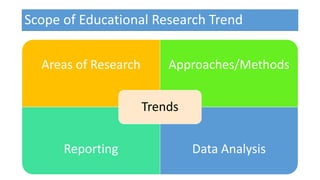
Scope of Educational Research Trend
Areas of Research Approaches/Methods
Reporting Data Analysis
Trends
Areas of Research
• ICT in education (Digital natives/Gamification/Artificial Intelligence/
Blended learning/online-virtual education/simulations/digital
contents)
• Integrated teaching/learning (art/sports/ICT)
• Liberal education
• Indigenous knowledge (Yoga education/Vedic math)
• STEM and STEAM (Science Technology Engineering Arts and
Mathematics)
• Multi-lingual education
• Education in regional mediums
• Policy research
• Internationalisation of education
Approaches/Methods
• Quantitative (Survey/Experimental-quasi/true, Meta analysis)
• Qualitative (Case study/Content-document-discourse
analysis/Grounded theory/Multiple case analysis)
• Mixed
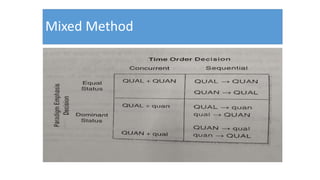
Mixed Method
Sampling and Tools
• Probability sampling
• Non-probability sampling
• Standardised tools
• Researcher made tools
Data Analysis (Computer data analysis)
• Quantitative analysis (SPSS/Systat/Excel)
• Qualitative analysis (QDA Minor Lite/NVIVO)
Reporting & Publishing
• Similarity index
• Citations
• Referencing
• Online publishing (fake-clone journals)
• Peer reviewing
• Copy right issues
• Research ethics
Issues in Educational Research
• Quantity Vs Quality
• Lack theoretical framework
• Questionable validity of tools
• Doubtful data
• Mechanical use of statistics
• Ambiguous findings
• Too general implications
• Disconnection between research and practice
• Poor evaluation/reviews

RECENT TREND IN EDUCATIONAL RESEARCH.pptx

  • 1.
    RECENT TREND IN EDUCATIONALRESEARCH Prof. Ramakanta Mohalik RIE (NCERT) Bhubaneswar mohalikrk@gmail.com
  • 2.
    INTRODUCTION • Knowledge creationand research are positively related to all round development of society. • NEP 2020 has given more stress on promoting quality research in higher education. • NEP 2020 proposed to create National Research Foundation (NRF) to promote and fund research. • It also recommended for levelling HEI as Research University. • Hence it essential to develop research ability of all students and faculty.
  • 3.
    What is ResearchTrends? • Research is a scientific process of studying educational problems to find suitable solutions. • Trend is a general direction in which something is developing or changing. • Research trend is the direction in which educational research is developing/ coming up.
  • 4.
    Scope of EducationalResearch Trend Areas of Research Approaches/Methods Reporting Data Analysis Trends
  • 5.
    Areas of Research •ICT in education (Digital natives/Gamification/Artificial Intelligence/ Blended learning/online-virtual education/simulations/digital contents) • Integrated teaching/learning (art/sports/ICT) • Liberal education • Indigenous knowledge (Yoga education/Vedic math) • STEM and STEAM (Science Technology Engineering Arts and Mathematics) • Multi-lingual education • Education in regional mediums • Policy research • Internationalisation of education
  • 6.
    Approaches/Methods • Quantitative (Survey/Experimental-quasi/true,Meta analysis) • Qualitative (Case study/Content-document-discourse analysis/Grounded theory/Multiple case analysis) • Mixed
  • 7.
  • 8.
    Sampling and Tools •Probability sampling • Non-probability sampling • Standardised tools • Researcher made tools
  • 9.
    Data Analysis (Computerdata analysis) • Quantitative analysis (SPSS/Systat/Excel) • Qualitative analysis (QDA Minor Lite/NVIVO)
  • 10.
    Reporting & Publishing •Similarity index • Citations • Referencing • Online publishing (fake-clone journals) • Peer reviewing • Copy right issues • Research ethics
  • 11.
    Issues in EducationalResearch • Quantity Vs Quality • Lack theoretical framework • Questionable validity of tools • Doubtful data • Mechanical use of statistics • Ambiguous findings • Too general implications • Disconnection between research and practice • Poor evaluation/reviews