NARRATIVE RESEARCH
&
CASE STUDY
QUALITATIVE RESEARCH
METHODS
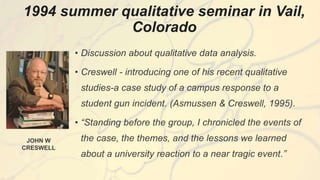
1994 summer qualitative seminar in Vail,
Colorado
• Discussion about qualitative data analysis.
• Creswell - introducing one of his recent qualitative
studies-a case study of a campus response to a
student gun incident. (Asmussen & Creswell, 1995).
• “Standing before the group, I chronicled the events of
the case, the themes, and the lessons we learned
about a university reaction to a near tragic event.”
JOHN W
CRESWELL
AUDIENCE RESPONSES
• Then, unplanned, Harry Wolcott of the University of Oregon, He explained
how he would approach the study as a cultural anthropologist. And he
"turned" the case study into ethnography, framing the study in an entirely
new way.
• Les Goodchild, then of Denver University, spoke, and he turned the
gunman case into a historical study.
• This made Creswell think that…..
“that one designed a study differently depending on the method of
qualitative research”
REMEMBER……
• Each approach to qualitative research is not mutually exclusive.
They can be used in combinations.
• For example, a case study approach can also incorporate
grounded theory.
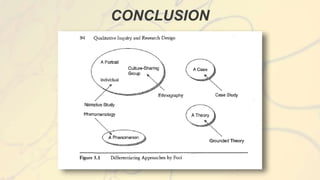
Qualitative inquiry and research design:
Choosing among five approaches
• GROUNDED THEORY
• ETHNOGRAPHY
• PHENOMENOLOGY
• NARRATIVE RESEARCH
• CASE STUDY
Creswell, J.W. (2007). Qualitative inquiry and research design: Choosing among five approaches (2nd ed.).
Thousand Oaks, CA: Sage.
THE POWER OF
A STORY
NARRATIVE RESEARCH
NARRATIVE RESEARCH
•A mode of inquiry in qualitative research, with a
specific focus on the stories told by individuals.
•It explores what the story means and the lessons to be
learned.
DEFINITION
"narrative is understood as a spoken or written text giving an account of
an event/action or series of events/actions, chronologically connected"
(Czarniawska, 2004)
HISTORY
Narrative inquiry was first used by
Connelly and Clandinin as a methodology
to describe the personal stories of
teachers.
The focus is on…..
• Studying a single person
• Gathering data through the collection of stories
• Reporting individual experiences
• Discussing the meaning of those experiences for the individual.
Who writes or records the story?
Biography vs. Autobiography
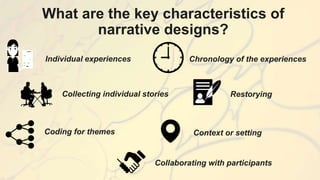
What are the key characteristics of
narrative designs?
Individual experiences
Collecting individual stories
Chronology of the experiences
Restorying
Coding for themes Context or setting
Collaborating with participants
Steps in conducting narrative research
Identify a
phenomenon
1
Purposefully
select an
individual
from whom
you can learn
about the
phenomenon
2
Collect the
story from
that
individual
3
Restory or
retell the
individual’s
story
4
Collaborate
with the
participant
storyteller
5
Write a story
about the
participant’s
experiences
6
Validate
the
accuracy
of the
report
7
Collect the story from that individual
>
• Have the individual tell about his or her experiences through
personal conversations or interviews.
• Have the individual record his or her story in a journal or diary.
• Observe the individual and record field notes.
• Collect letters sent by the individual.
• Assemble stories about the individual from family members.
• Obtain photographs, and other personal/family/social artifacts.
Several ways to collect stories (field texts) from individuals:
Restory or retell the individual’s story
>
Chronological sequence
Logical connections among ideas ? Analyzing it for key elements
Rewriting the story
Restory or retell the individual’s story
>
• Narrative researchers differ about the elements to select in the raw data before
chronologically sequencing them.
• Two approaches regarding these elements are
problem solution and three-dimensional space approaches.
PROBLEM SOLUTİON APPROACH
> >
Characters Setting Problem Actions Resolution
Individual’s
archetype,
personality,
behaviors, style,
and patterns
Context,
environment,
conditions, place,
time, locale, year
and era
Question to be
answered or
phenomena to
be described or
explained
Movements
through the story
illustrating
character’s
thinking, feelings,
intentions,
actions, and
reactions about
failed and
successful
attempts
Answers the
question and
explains what
caused the
turning point or
the character to
change
THREE-DIMENSIONAL SPACE APPROACH
> >
Interaction Continuity Situation
Personal Social Past Present Future Place
Look inward
to internal
conditions,
feelings,
hopes,
aesthetic
reactions,
moral
dispositions
Look outward
to existential
conditions in
the
environment
with other
people and
their
intentions,
purposes,
assumptions,
and points of
view
Look
backward to
remembered
stories and
experiences
from earlier
times
Look at
current
stories and
experiences
relating to
actions of an
event.
Look forward
to implied and
possible
experiences
and plot lines
Look at context,
time and place
situated in a
physical landscape
or in a setting
bounded by
characters’
intentions, purposes
and different points
of view.
> >
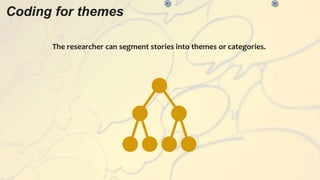
Coding for themes
The researcher can segment stories into themes or categories.
Collaborate with the participant–storyteller
>
This collaboration might involve
• Negotiating on how to enter to the research site
• Working closely with the participant to get field texts
• Writing and telling the individual’s story in the researcher’s words.
Collaboration between the researcher and the participant decreases the potential
gap between the narrative told and the narrative reported.
Write a story about the participant’s experiences5
>
• Restory has a central place in the narrative report.
• Specific themes that derived from the story should be emphasized.
• It is not necessary to write a specific literature section. The literature
about the problem might be added to the final sections of the study.
Write a story about the participant’s experiences
>
• The setting in which the individual experiences the central
phenomenon should be described in detail.
• A section about the importance of narrative research and
the procedures involved in it can be written.
• The researcher can use the first-person pronoun to refer
to yourself.
What are some ethical issues in gathering stories?
• Distorting data
• Inability to tell the story because it is horrific
• Forgetting story
AN EXAMPLE….
Overview of the study
• The story of Vonnie Lee, a 29-year-old mentally ill man whom the author met at
Opportunity House
• Vonnie Lee talks openly about his life but his descriptions of his life centered on a
bus route.
• The author took a bus trip with Vonnie Lee to his work place.
“The bus held special meaning for Lee
and on the bus he supplied the researcher with
details about the people, places, and events of
the journey.”
Researcher conclusions
• The bus gave meaning to Vonnie Lee’s life through escape and empowerment
• This meaning explained why he told his life stories in the form of bus routes
• Vonnie Lee’s stable self-image, the bus trip, helped him survive the problems in
his life
• The researcher reflected on the use of metaphor as a framework for analyzing
stories of participants in life history projects at the end of the study
CASE STUDY RESEARCH
CASE STUDY
“Case study research involves the study of an issue explored
through one or more cases within a
bounded system (i.e., a setting, a context)”
BOUNDED SYSTEM
Edge of the case
Heart of the study
The "case" selected for study has boundaries, often
bounded by time and place. It also has interrelated parts that form a
whole. Hence, the proper case to be studied is both "bounded" and a
"system
CASE STUDY IS INTERDISCIPLINARY
• The case study approach is familiar to social scientists because
of its popularity in psychology (Freud), medicine (case analysis
of a problem), law (case law), and political science (case
reports).
• Case study research has a long, distinguished history across
many disciplines.
TYPES OF CASE STUDIES
• Single instrumental case study - The researcher focuses on a
single issue then selects a single case to illustrate the issue.
• Collective or multiple instrumental case study – The
researcher focuses on one issue but selects multiple cases to
illustrate the issue that can be purposefully sampled from one site
or several sites
One more….
• Intrinsic case study – This approach focuses on the case itself
because the case presents an unusual or unique situation (e.g.,
evaluating a program or one particular student who is having
difficulty studying)
CONFUSION- Is it a inquiry or methodology??
• Stake - states that case study research is not a methodology
but a choice of what is to be studied (i.e. a case within a
bounded system)
• Others present it as a strategy of inquiry, a methodology, or a
comprehensive research strategy
(Denzin & Lincoln, 2005; Merriam, 1998; Yin, 2003)
Case Study Research Procedures
• Determine if a case study is appropriate for the research problem
• Identify the case or cases to be studied
• What kind of case study is most appropriate
• What case or cases will be studied
• Select cases that show different perspectives through maximal variation
sampling
DATA COLLECTION
• Engage in multiple forms of data collection including interviews,
observations, documents, audiovisual materials, participant-
observations to develop an in-depth understanding of the
case(s)
THEMES AND ANALYSIS
• Develop a detailed description of the case(s) and common themes
in the cases
• When using multiple cases describe each case and themes first (within-case
analysis)
• Compare cases to look for common themes (cross-case analysis)
• Look for common assertions and meanings within the case
• Report the lessons learned from the case regarding the issue of
the case (instrumental) or learning about an unusual situation
(intrinsic case)
Case Study Challenges
• Identifying cases to study
• Identifying whether a single case or multiple cases are needed
• Selecting an appropriate purposeful sampling strategy
• Having access to multiple sources of data
• Deciding how the boundaries of a case might be constrained by
time, events, or processes
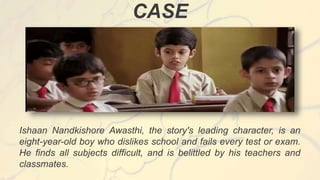
CASE
Ishaan Nandkishore Awasthi, the story's leading character, is an
eight-year-old boy who dislikes school and fails every test or exam.
He finds all subjects difficult, and is belittled by his teachers and
classmates.
INVESTIGATOR CONDUCTING A CASE STUDY
• Prof Nikumb speaks to Ishant’s Parents, brother, friends and other professors.
• He discovers that he is finding it difficult to read and write.
• Thus he comes to a conclusion that he might be suffering from Dyslexia.
CONCLUSION
REFERENCES
• Creswell, J.W. (2007) Qualitative inquiry and research design : choosing among five approaches. Thousand
Oaks : Sage Publications, 2007.
• Ollerenshaw, J. A., & Creswell, J. W. (2002). Narrative research: a comparison of two restorying data
analysis approaches. Qualitative Inquiry, 8(3), 329-347.
• Webster, L., & Mertowa, P. (2007).Using narrative inquiry as a research method: an introduction to using
critical event narrative analysis research on learning and teaching. Oxon: Routledge.
• Stake, R.E. (1995) The art of case study research, Thousand Oaks, Calif.; London: Sage.
• Yin, R.K. (2009) Case study research : design and methods, Thousand Oaks, Calif. Sage Publications.
“Principles are powerful but cases are memorable”.

Narrative research and case study

  • 1.
  • 2.
    1994 summer qualitativeseminar in Vail, Colorado • Discussion about qualitative data analysis. • Creswell - introducing one of his recent qualitative studies-a case study of a campus response to a student gun incident. (Asmussen & Creswell, 1995). • “Standing before the group, I chronicled the events of the case, the themes, and the lessons we learned about a university reaction to a near tragic event.” JOHN W CRESWELL
  • 3.
    AUDIENCE RESPONSES • Then,unplanned, Harry Wolcott of the University of Oregon, He explained how he would approach the study as a cultural anthropologist. And he "turned" the case study into ethnography, framing the study in an entirely new way. • Les Goodchild, then of Denver University, spoke, and he turned the gunman case into a historical study. • This made Creswell think that….. “that one designed a study differently depending on the method of qualitative research”
  • 4.
    REMEMBER…… • Each approachto qualitative research is not mutually exclusive. They can be used in combinations. • For example, a case study approach can also incorporate grounded theory.
  • 6.
    Qualitative inquiry andresearch design: Choosing among five approaches • GROUNDED THEORY • ETHNOGRAPHY • PHENOMENOLOGY • NARRATIVE RESEARCH • CASE STUDY Creswell, J.W. (2007). Qualitative inquiry and research design: Choosing among five approaches (2nd ed.). Thousand Oaks, CA: Sage.
  • 7.
    THE POWER OF ASTORY NARRATIVE RESEARCH
  • 8.
    NARRATIVE RESEARCH •A modeof inquiry in qualitative research, with a specific focus on the stories told by individuals. •It explores what the story means and the lessons to be learned.
  • 9.
    DEFINITION "narrative is understoodas a spoken or written text giving an account of an event/action or series of events/actions, chronologically connected" (Czarniawska, 2004)
  • 10.
    HISTORY Narrative inquiry wasfirst used by Connelly and Clandinin as a methodology to describe the personal stories of teachers.
  • 11.
    The focus ison….. • Studying a single person • Gathering data through the collection of stories • Reporting individual experiences • Discussing the meaning of those experiences for the individual.
  • 12.
    Who writes orrecords the story? Biography vs. Autobiography
  • 13.
    What are thekey characteristics of narrative designs? Individual experiences Collecting individual stories Chronology of the experiences Restorying Coding for themes Context or setting Collaborating with participants
  • 14.
    Steps in conductingnarrative research Identify a phenomenon 1 Purposefully select an individual from whom you can learn about the phenomenon 2 Collect the story from that individual 3 Restory or retell the individual’s story 4 Collaborate with the participant storyteller 5 Write a story about the participant’s experiences 6 Validate the accuracy of the report 7
  • 15.
    Collect the storyfrom that individual > • Have the individual tell about his or her experiences through personal conversations or interviews. • Have the individual record his or her story in a journal or diary. • Observe the individual and record field notes. • Collect letters sent by the individual. • Assemble stories about the individual from family members. • Obtain photographs, and other personal/family/social artifacts. Several ways to collect stories (field texts) from individuals:
  • 16.
    Restory or retellthe individual’s story > Chronological sequence Logical connections among ideas ? Analyzing it for key elements Rewriting the story
  • 17.
    Restory or retellthe individual’s story > • Narrative researchers differ about the elements to select in the raw data before chronologically sequencing them. • Two approaches regarding these elements are problem solution and three-dimensional space approaches.
  • 18.
    PROBLEM SOLUTİON APPROACH >> Characters Setting Problem Actions Resolution Individual’s archetype, personality, behaviors, style, and patterns Context, environment, conditions, place, time, locale, year and era Question to be answered or phenomena to be described or explained Movements through the story illustrating character’s thinking, feelings, intentions, actions, and reactions about failed and successful attempts Answers the question and explains what caused the turning point or the character to change
  • 19.
    THREE-DIMENSIONAL SPACE APPROACH >> Interaction Continuity Situation Personal Social Past Present Future Place Look inward to internal conditions, feelings, hopes, aesthetic reactions, moral dispositions Look outward to existential conditions in the environment with other people and their intentions, purposes, assumptions, and points of view Look backward to remembered stories and experiences from earlier times Look at current stories and experiences relating to actions of an event. Look forward to implied and possible experiences and plot lines Look at context, time and place situated in a physical landscape or in a setting bounded by characters’ intentions, purposes and different points of view.
  • 20.
    > > Coding forthemes The researcher can segment stories into themes or categories.
  • 21.
    Collaborate with theparticipant–storyteller > This collaboration might involve • Negotiating on how to enter to the research site • Working closely with the participant to get field texts • Writing and telling the individual’s story in the researcher’s words. Collaboration between the researcher and the participant decreases the potential gap between the narrative told and the narrative reported.
  • 22.
    Write a storyabout the participant’s experiences5 > • Restory has a central place in the narrative report. • Specific themes that derived from the story should be emphasized. • It is not necessary to write a specific literature section. The literature about the problem might be added to the final sections of the study.
  • 23.
    Write a storyabout the participant’s experiences > • The setting in which the individual experiences the central phenomenon should be described in detail. • A section about the importance of narrative research and the procedures involved in it can be written. • The researcher can use the first-person pronoun to refer to yourself.
  • 24.
    What are someethical issues in gathering stories? • Distorting data • Inability to tell the story because it is horrific • Forgetting story
  • 25.
  • 26.
    Overview of thestudy • The story of Vonnie Lee, a 29-year-old mentally ill man whom the author met at Opportunity House • Vonnie Lee talks openly about his life but his descriptions of his life centered on a bus route. • The author took a bus trip with Vonnie Lee to his work place. “The bus held special meaning for Lee and on the bus he supplied the researcher with details about the people, places, and events of the journey.”
  • 27.
    Researcher conclusions • Thebus gave meaning to Vonnie Lee’s life through escape and empowerment • This meaning explained why he told his life stories in the form of bus routes • Vonnie Lee’s stable self-image, the bus trip, helped him survive the problems in his life • The researcher reflected on the use of metaphor as a framework for analyzing stories of participants in life history projects at the end of the study
  • 28.
  • 29.
    CASE STUDY “Case studyresearch involves the study of an issue explored through one or more cases within a bounded system (i.e., a setting, a context)”
  • 30.
    BOUNDED SYSTEM Edge ofthe case Heart of the study The "case" selected for study has boundaries, often bounded by time and place. It also has interrelated parts that form a whole. Hence, the proper case to be studied is both "bounded" and a "system
  • 31.
    CASE STUDY ISINTERDISCIPLINARY • The case study approach is familiar to social scientists because of its popularity in psychology (Freud), medicine (case analysis of a problem), law (case law), and political science (case reports). • Case study research has a long, distinguished history across many disciplines.
  • 32.
    TYPES OF CASESTUDIES • Single instrumental case study - The researcher focuses on a single issue then selects a single case to illustrate the issue. • Collective or multiple instrumental case study – The researcher focuses on one issue but selects multiple cases to illustrate the issue that can be purposefully sampled from one site or several sites
  • 33.
    One more…. • Intrinsiccase study – This approach focuses on the case itself because the case presents an unusual or unique situation (e.g., evaluating a program or one particular student who is having difficulty studying)
  • 34.
    CONFUSION- Is ita inquiry or methodology?? • Stake - states that case study research is not a methodology but a choice of what is to be studied (i.e. a case within a bounded system) • Others present it as a strategy of inquiry, a methodology, or a comprehensive research strategy (Denzin & Lincoln, 2005; Merriam, 1998; Yin, 2003)
  • 35.
    Case Study ResearchProcedures • Determine if a case study is appropriate for the research problem • Identify the case or cases to be studied • What kind of case study is most appropriate • What case or cases will be studied • Select cases that show different perspectives through maximal variation sampling
  • 36.
    DATA COLLECTION • Engagein multiple forms of data collection including interviews, observations, documents, audiovisual materials, participant- observations to develop an in-depth understanding of the case(s)
  • 37.
    THEMES AND ANALYSIS •Develop a detailed description of the case(s) and common themes in the cases • When using multiple cases describe each case and themes first (within-case analysis) • Compare cases to look for common themes (cross-case analysis) • Look for common assertions and meanings within the case • Report the lessons learned from the case regarding the issue of the case (instrumental) or learning about an unusual situation (intrinsic case)
  • 38.
    Case Study Challenges •Identifying cases to study • Identifying whether a single case or multiple cases are needed • Selecting an appropriate purposeful sampling strategy • Having access to multiple sources of data • Deciding how the boundaries of a case might be constrained by time, events, or processes
  • 40.
    CASE Ishaan Nandkishore Awasthi,the story's leading character, is an eight-year-old boy who dislikes school and fails every test or exam. He finds all subjects difficult, and is belittled by his teachers and classmates.
  • 41.
    INVESTIGATOR CONDUCTING ACASE STUDY • Prof Nikumb speaks to Ishant’s Parents, brother, friends and other professors. • He discovers that he is finding it difficult to read and write. • Thus he comes to a conclusion that he might be suffering from Dyslexia.
  • 42.
  • 43.
    REFERENCES • Creswell, J.W.(2007) Qualitative inquiry and research design : choosing among five approaches. Thousand Oaks : Sage Publications, 2007. • Ollerenshaw, J. A., & Creswell, J. W. (2002). Narrative research: a comparison of two restorying data analysis approaches. Qualitative Inquiry, 8(3), 329-347. • Webster, L., & Mertowa, P. (2007).Using narrative inquiry as a research method: an introduction to using critical event narrative analysis research on learning and teaching. Oxon: Routledge. • Stake, R.E. (1995) The art of case study research, Thousand Oaks, Calif.; London: Sage. • Yin, R.K. (2009) Case study research : design and methods, Thousand Oaks, Calif. Sage Publications.
  • 44.
    “Principles are powerfulbut cases are memorable”.