NARRATIVE
A Media Studies Key Aspect
What Is It?
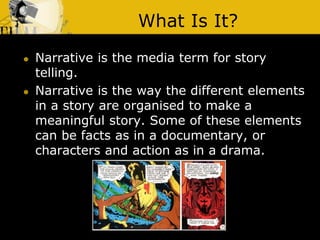
 Narrative is the media term for story
telling.
 Narrative is the way the different elements
in a story are organised to make a
meaningful story. Some of these elements
can be facts as in a documentary, or
characters and action as in a drama.
What Is It?
 When we look at narrative we see
that stories throughout the media
share certain characteristics. This
often links them to genre.
 Different media tell stories in a
variety of different ways.
Narrative Structure(s)
 This is the way the story or plot unfolds.
 Is the story an open or closed structure?
 A closed structure means the story ends
satisfactorily as in most films – this is
known as closure.
 An open ending means there is no final
conclusion to the story – a television soap
has no final ending, it just has minor
endings.
 Some texts have an interactive structure
e.g. Big Brother.
Narrative Structure(s)
 A multi-strand structure means there are
several narratives running at the same time.
This is very common in television, such as
Holby City, and The Bill.
 Other narrative structures include point of
view (POV). (Documentaries often do this)
 A popular narrative device is the enigma.
The plot constructs a puzzle that the
audience is asked to solve while the
characters act out the story.
How it is informed
 Narrative is informed by character,
action, and location.
How it is informed
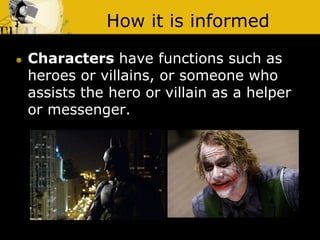
 Characters have functions such as
heroes or villains, or someone who
assists the hero or villain as a helper
or messenger.
How it is informed
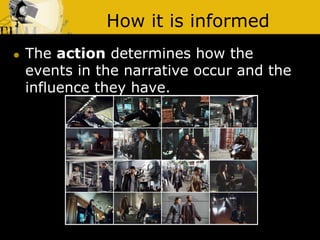
 The action determines how the
events in the narrative occur and the
influence they have.
How it is informed
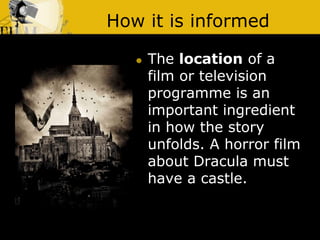
 The location of a
film or television
programme is an
important ingredient
in how the story
unfolds. A horror film
about Dracula must
have a castle.
How it is informed
 Narrative is often delivered to the
audience by expectation, suspense,
tension and closure.
 The audience is led to expect certain
things to happen which leads to
tension and excitement.
 Expectation, suspense and tension
are created by the use of Media
Language,
Our Job
 Directors and producers use many
techniques to get a story to an audience
in an involving, interesting, exciting and
entertaining way. Our job as media
students is to find out what these
techniques are, and see where and how
they are used and what they mean in
media texts. This is known as Textual
Analysis.
Questions to ask
 How is the narrative organised?
 What is the audience’s role in
relation to the narrative?
 How are the characters used in
the narrative?
Questions to ask
 What techniques of identification
and alienation are used in the
text?
 What else does the filmmaker do
to engage our attention and tell
the story?
 What are the major themes of the
narrative and what values and
ideology are evident?
Run Lola Run
 1998 German thriller.
 Dir. Tom Tykwer
 Franka Potente (Lola)
 Moritz Bleibtreu
(Manni)
 Dist. Sony Pictures
 Budget: $1,750,000
 Gross: $7,267,585
Narrative Theory
 There are four main theorists to
consider:
 Tzvetan Todorov
 Vladimir Propp
 Roland Barthes
 Lévi-Strauss
TODOROV
 Todorov’s theory has three main parts:
1. The text begins with a sate of equilibrium –
everything appears to be normal or calm.
2. There is some kind of disruption or
disequalibrium – this is often a threat to the
normal situation or it could be just a setback.
3. A new equilibrium is produced to end the
narrative. In the best narratives there is some kind
of change for the better perhaps in the main
character’s behaviour or outlook on life.
TODOROV
 Todorov suggests there are five stages to
how the narrative progresses:
1. The equilibrium has to be carefully shown
(otherwise the disruption may not be
dramatic enough to create a strong plot)
2. There is a disruption
3. There is a recognition that a disruption
has happened.
4. There is an attempt to repair the damage
done by the disruption.
5. A new equilibrium is achieved.
TODOROV
 Here narrative is not seen as linear,
but as circular.
 The narrative is driven by the
characters’ attempts to restore the
equilibrium, although the end result
is not quite the same as the
beginning.
PROPP
 Propp studied folk tales and he
proposed ways of grouping
characters and their actions
into eight broad character
types or ‘spheres of action’.
 N.B. One character may
occupy more than one sphere
of action
Spheres of Action
 1. The villain
 2. The hero, or character who seeks
something, usually motivated by a lack of
something (money, love etc.) The hero
doesn’t have to be heroic in the way most
people would understand it – heroes can
be male or female, brave or cowardly.
 3. The donor, who provides an object with
some magic property.
 4. The helper, who aids the hero.
Spheres of Action
 5. The princess, reward for the hero, and
object of the villain’s schemes. Again, this
is not necessarily a beautiful damsel in
distress – the princess can be male!
 6. Her father, who rewards the hero.
 7. The dispatcher, who sends the hero on
his way
 8. The false hero, the character who also
lays claim to the princess but is unsuitable
and causes complications.
Star Wars
 Match them up
Star Wars - An Example
 Villain – Darth Vader
 Hero – Luke Skywalker
 Donor – Obi-Wan Kenobi
 Helper – Han Solo
 Princess – Princess Leia
 Father – The Rebellion
 Dispatcher – R2D2
 False Hero – Darth Vader
Levi-Strauss
 No, nothing to do with jeans!
 He introduced the notion of binary
oppositions as a useful way to
consider the production of meaning
within narratives.
 He argued that all construction of
meaning was dependent, to some
degree, on these oppositions.
Examples
 Good vs Evil
 Male vs Female
 Humanity vs Technology
 Nature vs Industrialism
 East vs West
 Dark vs Light
 Dirt vs Cleanliness
Roland Barthes
 A name you’ll become very familiar
with soon. In the meantime, in terms
of narrative he suggested five codes:
 The hermeneutic code (the enigma)
 The proairetic code (the action)
 The semic code (the images)
 The symbolic code (the subtext)
 The referential code (the cultural
influence)

Narrative

  • 1.
  • 2.
    What Is It? Narrative is the media term for story telling.  Narrative is the way the different elements in a story are organised to make a meaningful story. Some of these elements can be facts as in a documentary, or characters and action as in a drama.
  • 3.
    What Is It? When we look at narrative we see that stories throughout the media share certain characteristics. This often links them to genre.  Different media tell stories in a variety of different ways.
  • 4.
    Narrative Structure(s)  Thisis the way the story or plot unfolds.  Is the story an open or closed structure?  A closed structure means the story ends satisfactorily as in most films – this is known as closure.  An open ending means there is no final conclusion to the story – a television soap has no final ending, it just has minor endings.  Some texts have an interactive structure e.g. Big Brother.
  • 5.
    Narrative Structure(s)  Amulti-strand structure means there are several narratives running at the same time. This is very common in television, such as Holby City, and The Bill.  Other narrative structures include point of view (POV). (Documentaries often do this)  A popular narrative device is the enigma. The plot constructs a puzzle that the audience is asked to solve while the characters act out the story.
  • 6.
    How it isinformed  Narrative is informed by character, action, and location.
  • 7.
    How it isinformed  Characters have functions such as heroes or villains, or someone who assists the hero or villain as a helper or messenger.
  • 8.
    How it isinformed  The action determines how the events in the narrative occur and the influence they have.
  • 9.
    How it isinformed  The location of a film or television programme is an important ingredient in how the story unfolds. A horror film about Dracula must have a castle.
  • 10.
    How it isinformed  Narrative is often delivered to the audience by expectation, suspense, tension and closure.  The audience is led to expect certain things to happen which leads to tension and excitement.  Expectation, suspense and tension are created by the use of Media Language,
  • 11.
    Our Job  Directorsand producers use many techniques to get a story to an audience in an involving, interesting, exciting and entertaining way. Our job as media students is to find out what these techniques are, and see where and how they are used and what they mean in media texts. This is known as Textual Analysis.
  • 12.
    Questions to ask How is the narrative organised?  What is the audience’s role in relation to the narrative?  How are the characters used in the narrative?
  • 13.
    Questions to ask What techniques of identification and alienation are used in the text?  What else does the filmmaker do to engage our attention and tell the story?  What are the major themes of the narrative and what values and ideology are evident?
  • 14.
    Run Lola Run 1998 German thriller.  Dir. Tom Tykwer  Franka Potente (Lola)  Moritz Bleibtreu (Manni)  Dist. Sony Pictures  Budget: $1,750,000  Gross: $7,267,585
  • 15.
    Narrative Theory  Thereare four main theorists to consider:  Tzvetan Todorov  Vladimir Propp  Roland Barthes  Lévi-Strauss
  • 16.
    TODOROV  Todorov’s theoryhas three main parts: 1. The text begins with a sate of equilibrium – everything appears to be normal or calm. 2. There is some kind of disruption or disequalibrium – this is often a threat to the normal situation or it could be just a setback. 3. A new equilibrium is produced to end the narrative. In the best narratives there is some kind of change for the better perhaps in the main character’s behaviour or outlook on life.
  • 17.
    TODOROV  Todorov suggeststhere are five stages to how the narrative progresses: 1. The equilibrium has to be carefully shown (otherwise the disruption may not be dramatic enough to create a strong plot) 2. There is a disruption 3. There is a recognition that a disruption has happened. 4. There is an attempt to repair the damage done by the disruption. 5. A new equilibrium is achieved.
  • 18.
    TODOROV  Here narrativeis not seen as linear, but as circular.  The narrative is driven by the characters’ attempts to restore the equilibrium, although the end result is not quite the same as the beginning.
  • 19.
    PROPP  Propp studiedfolk tales and he proposed ways of grouping characters and their actions into eight broad character types or ‘spheres of action’.  N.B. One character may occupy more than one sphere of action
  • 20.
    Spheres of Action 1. The villain  2. The hero, or character who seeks something, usually motivated by a lack of something (money, love etc.) The hero doesn’t have to be heroic in the way most people would understand it – heroes can be male or female, brave or cowardly.  3. The donor, who provides an object with some magic property.  4. The helper, who aids the hero.
  • 21.
    Spheres of Action 5. The princess, reward for the hero, and object of the villain’s schemes. Again, this is not necessarily a beautiful damsel in distress – the princess can be male!  6. Her father, who rewards the hero.  7. The dispatcher, who sends the hero on his way  8. The false hero, the character who also lays claim to the princess but is unsuitable and causes complications.
  • 22.
  • 23.
    Star Wars -An Example  Villain – Darth Vader  Hero – Luke Skywalker  Donor – Obi-Wan Kenobi  Helper – Han Solo  Princess – Princess Leia  Father – The Rebellion  Dispatcher – R2D2  False Hero – Darth Vader
  • 24.
    Levi-Strauss  No, nothingto do with jeans!  He introduced the notion of binary oppositions as a useful way to consider the production of meaning within narratives.  He argued that all construction of meaning was dependent, to some degree, on these oppositions.
  • 25.
    Examples  Good vsEvil  Male vs Female  Humanity vs Technology  Nature vs Industrialism  East vs West  Dark vs Light  Dirt vs Cleanliness
  • 26.
    Roland Barthes  Aname you’ll become very familiar with soon. In the meantime, in terms of narrative he suggested five codes:  The hermeneutic code (the enigma)  The proairetic code (the action)  The semic code (the images)  The symbolic code (the subtext)  The referential code (the cultural influence)