Made by
Rahila Khan
SBK Women’sUniversity
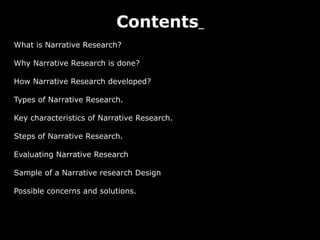
Contents
What is Narrative Research?
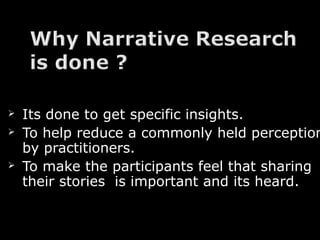
Why Narrative Research is done?
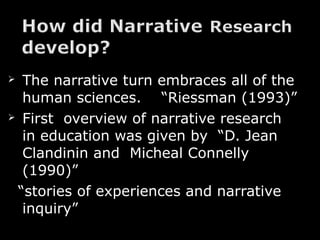
How Narrative Research developed?
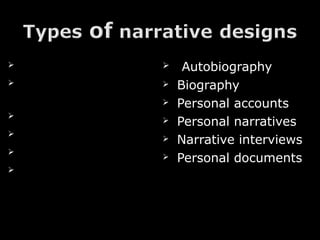
Types of Narrative Research.
Key characteristics of Narrative Research.
Steps of Narrative Research.
Evaluating Narrative Research
Sample of a Narrative research Design
Possible concerns and solutions.
 “ to narrate”
 “ to tell a story in detail”
 researchers describe the lives of
individuals,
 collects stories about people’s lives,
 write narratives of individual experiences
.
( Connelly & Clandinin, 1990 ).
 Its done to get specific insights.
 To help reduce a commonly held perception
by practitioners.
 To make the participants feel that sharing
their stories is important and its heard.
 The narrative turn embraces all of the
human sciences. “Riessman (1993)”
 First overview of narrative research
in education was given by “D. Jean
Clandinin and Micheal Connelly
(1990)”
“stories of experiences and narrative
inquiry”
 Autobiography
 Biography
 Personal accounts
 Personal narratives
 Narrative interviews
 Personal documents
 Documents of life
 Life stories and
histories
 Popular memories
 Ethno histories
 Ethno biographies
 Ethno psychologies
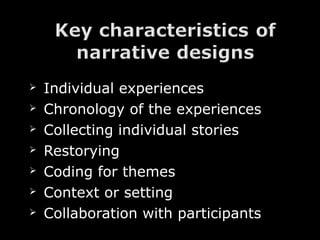
 Individual experiences
 Chronology of the experiences
 Collecting individual stories
 Restorying
 Coding for themes
 Context or setting
 Collaboration with participants
 Single individual
 exploring the experiences
of that individual
 Researcher analyzes and writes
about an individual life using a
time sequence or chronology of
events
 Researcher orders these events
in a way that makes sense to a
reader
 Stories have a beginning, middle, and
end.
 Like a novel, stories have time, place,
plot, and scene.
 Involve a conflict, or struggle; a
protagonist or character; and a sequence
with implied causality (a plot) during
which the predicament is resolved in
some fashion
 Varied sources of data comprise the data
base
researcher gathers stories and
analyzes them for elements of the
story.
researcher rewrites the story to
place it in a chronological sequence.
restorying provides a causal link
among ideas.
information would include
interaction, continuity, and situation
 Themes provide the complexity of
the story
 Themes add depth to the insight
about understanding an individual’s
experiences
 Themes can be incorporated into the
passage retelling the individual’s
experience or as a separate section
of the study
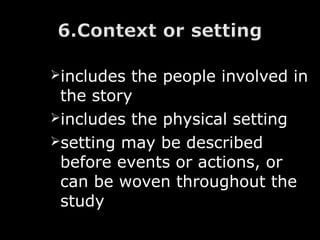
includes the people involved in
the story
includes the physical setting
setting may be described
before events or actions, or
can be woven throughout the
study
 Inquirer actively involves the
participant in the inquiry as it
unfolds .
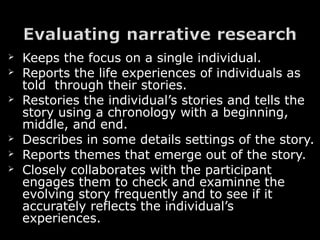
 Keeps the focus on a single individual.
 Reports the life experiences of individuals as
told through their stories.
 Restories the individual’s stories and tells the
story using a chronology with a beginning,
middle, and end.
 Describes in some details settings of the story.
 Reports themes that emerge out of the story.
 Closely collaborates with the participant
engages them to check and examinne the
evolving story frequently and to see if it
accurately reflects the individual’s
experiences.
This study was inspired by an interest in the stories that young refugee children tell about
their early experiences in an American school. This article presents a narrative inquiry into
the stories and artwork of three early childhood students, Allison , Cindy and Aurora ,along
with the narratives of their families, all Karen refugees from Myanmar. Through the themes
presented in the stories collected, kids revealed strategies that they used in bridging home
and school and in building friendships in their classroom. Importantly, viewing the
children’s narratives through the stories of their families created a more holistic view of
what the children experienced during the during periods of cultural dissonance.
Objectives
As a greater number of children and families are finding refuge in new communities across
the globe, it is essential for educators to understand how refugees of all ages are making
meaning of their experiences and provide them with opportunities to tell their stories.
 These can teach us how to support children’s and families’ adaptation into a new
community,
 how to foster smooth transitions,
 how to adapt our classrooms to provide students with the best educational experiences
possible.
 Story authenticity? (Faking the data possible)
 Distortion of data? (self reported information)
 Is the story real? ( horrific or raw to recall)
 The collection of multiple field texts,
 The triangulation of data,
 member checking.
Narrative research design

Narrative research design

  • 1.
    Made by Rahila Khan SBKWomen’sUniversity
  • 2.
    Contents What is NarrativeResearch? Why Narrative Research is done? How Narrative Research developed? Types of Narrative Research. Key characteristics of Narrative Research. Steps of Narrative Research. Evaluating Narrative Research Sample of a Narrative research Design Possible concerns and solutions.
  • 3.
     “ tonarrate”  “ to tell a story in detail”
  • 4.
     researchers describethe lives of individuals,  collects stories about people’s lives,  write narratives of individual experiences . ( Connelly & Clandinin, 1990 ).
  • 5.
     Its doneto get specific insights.  To help reduce a commonly held perception by practitioners.  To make the participants feel that sharing their stories is important and its heard.
  • 6.
     The narrativeturn embraces all of the human sciences. “Riessman (1993)”  First overview of narrative research in education was given by “D. Jean Clandinin and Micheal Connelly (1990)” “stories of experiences and narrative inquiry”
  • 7.
     Autobiography  Biography Personal accounts  Personal narratives  Narrative interviews  Personal documents  Documents of life  Life stories and histories  Popular memories  Ethno histories  Ethno biographies  Ethno psychologies
  • 8.
     Individual experiences Chronology of the experiences  Collecting individual stories  Restorying  Coding for themes  Context or setting  Collaboration with participants
  • 9.
     Single individual exploring the experiences of that individual
  • 10.
     Researcher analyzesand writes about an individual life using a time sequence or chronology of events  Researcher orders these events in a way that makes sense to a reader
  • 11.
     Stories havea beginning, middle, and end.  Like a novel, stories have time, place, plot, and scene.  Involve a conflict, or struggle; a protagonist or character; and a sequence with implied causality (a plot) during which the predicament is resolved in some fashion  Varied sources of data comprise the data base
  • 12.
    researcher gathers storiesand analyzes them for elements of the story. researcher rewrites the story to place it in a chronological sequence. restorying provides a causal link among ideas. information would include interaction, continuity, and situation
  • 13.
     Themes providethe complexity of the story  Themes add depth to the insight about understanding an individual’s experiences  Themes can be incorporated into the passage retelling the individual’s experience or as a separate section of the study
  • 14.
    includes the peopleinvolved in the story includes the physical setting setting may be described before events or actions, or can be woven throughout the study
  • 15.
     Inquirer activelyinvolves the participant in the inquiry as it unfolds .
  • 17.
     Keeps thefocus on a single individual.  Reports the life experiences of individuals as told through their stories.  Restories the individual’s stories and tells the story using a chronology with a beginning, middle, and end.  Describes in some details settings of the story.  Reports themes that emerge out of the story.  Closely collaborates with the participant engages them to check and examinne the evolving story frequently and to see if it accurately reflects the individual’s experiences.
  • 18.
    This study wasinspired by an interest in the stories that young refugee children tell about their early experiences in an American school. This article presents a narrative inquiry into the stories and artwork of three early childhood students, Allison , Cindy and Aurora ,along with the narratives of their families, all Karen refugees from Myanmar. Through the themes presented in the stories collected, kids revealed strategies that they used in bridging home and school and in building friendships in their classroom. Importantly, viewing the children’s narratives through the stories of their families created a more holistic view of what the children experienced during the during periods of cultural dissonance. Objectives As a greater number of children and families are finding refuge in new communities across the globe, it is essential for educators to understand how refugees of all ages are making meaning of their experiences and provide them with opportunities to tell their stories.  These can teach us how to support children’s and families’ adaptation into a new community,  how to foster smooth transitions,  how to adapt our classrooms to provide students with the best educational experiences possible.
  • 19.
     Story authenticity?(Faking the data possible)  Distortion of data? (self reported information)  Is the story real? ( horrific or raw to recall)  The collection of multiple field texts,  The triangulation of data,  member checking.