
Research Design
A. Thangamani ramalingam
PT, MSc(psy),PGDRM, ACspss MIAP
Research design
 Research design is not related to any
particular method of collecting data or any
particular type of data. Any research
design can, in principle, use any type of
data collection method and can use either
quantitative or qualitative data. Research
design refers to the structure of an
enquiry: it is a logical matter rather than
a logistical one.
Meaning of research design
 What is the study about?
 Why is the study being made?
 Where will the study be carried out?
 What type of data is required?
 Where can the required data be found?
 What periods of time will the study include?
What will be the sample design?
 What techniques of data collection will be
used?
 How will the data be analysed?
 In what style will the report be prepared?
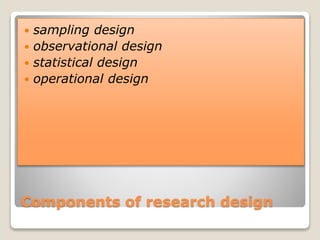
Components of research design
 sampling design
 observational design
 statistical design
 operational design
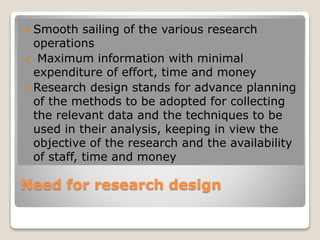
Need for research design
 Smooth sailing of the various research
operations
 Maximum information with minimal
expenditure of effort, time and money
 Research design stands for advance planning
of the methods to be adopted for collecting
the relevant data and the techniques to be
used in their analysis, keeping in view the
objective of the research and the availability
of staff, time and money
Features for good design
 Flexible, appropriate, efficient, economical
 Minimises bias
 Maximises the reliability of the data
(i) the means of obtaining information;
(ii) the availability and skills of the researcher and his
staff, if any;
(iii) the objective of the problem to be studied;
(iv) the nature of the problem to be studied; and
(v) the availability of time and money for the research
work.
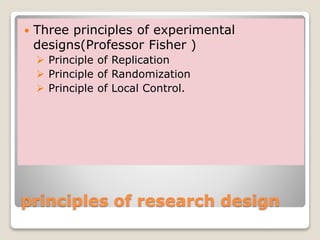
principles of research design
 Three principles of experimental
designs(Professor Fisher )
 Principle of Replication
 Principle of Randomization
 Principle of Local Control.
Research designs
Research design and data
collection methods
Effective design
 Research needs to be structured in such a
way that the evidence also bears on
alternative rival explanations and enables
us to identify which of the competing
explanations is most compelling
empirically. It also means that we must
not simply look for evidence that supports
our favourite theory: we should also look
for evidence that has the potential to
disprove our preferred explanations.

Research design

  • 1.
    Research Design A. Thangamaniramalingam PT, MSc(psy),PGDRM, ACspss MIAP
  • 2.
    Research design  Researchdesign is not related to any particular method of collecting data or any particular type of data. Any research design can, in principle, use any type of data collection method and can use either quantitative or qualitative data. Research design refers to the structure of an enquiry: it is a logical matter rather than a logistical one.
  • 3.
    Meaning of researchdesign  What is the study about?  Why is the study being made?  Where will the study be carried out?  What type of data is required?  Where can the required data be found?  What periods of time will the study include? What will be the sample design?  What techniques of data collection will be used?  How will the data be analysed?  In what style will the report be prepared?
  • 4.
    Components of researchdesign  sampling design  observational design  statistical design  operational design
  • 5.
    Need for researchdesign  Smooth sailing of the various research operations  Maximum information with minimal expenditure of effort, time and money  Research design stands for advance planning of the methods to be adopted for collecting the relevant data and the techniques to be used in their analysis, keeping in view the objective of the research and the availability of staff, time and money
  • 6.
    Features for gooddesign  Flexible, appropriate, efficient, economical  Minimises bias  Maximises the reliability of the data (i) the means of obtaining information; (ii) the availability and skills of the researcher and his staff, if any; (iii) the objective of the problem to be studied; (iv) the nature of the problem to be studied; and (v) the availability of time and money for the research work.
  • 7.
    principles of researchdesign  Three principles of experimental designs(Professor Fisher )  Principle of Replication  Principle of Randomization  Principle of Local Control.
  • 8.
  • 9.
    Research design anddata collection methods
  • 10.
    Effective design  Researchneeds to be structured in such a way that the evidence also bears on alternative rival explanations and enables us to identify which of the competing explanations is most compelling empirically. It also means that we must not simply look for evidence that supports our favourite theory: we should also look for evidence that has the potential to disprove our preferred explanations.