Constraint Induced
Movement Therapy
- Nidhi Chhabra
Objective
Introduction
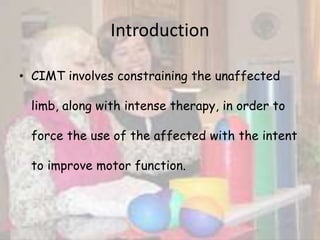
• CIMT involves constraining the unaffected
limb, along with intense therapy, in order to
force the use of the affected with the intent
to improve motor function.
History
• Early research was done by Edward Taub on
surgically deafferented monkeys.
• “learned non-use”.
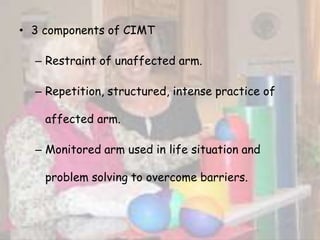
• 3 components of CIMT
– Restraint of unaffected arm.
– Repetition, structured, intense practice of
affected arm.
– Monitored arm used in life situation and
problem solving to overcome barriers.
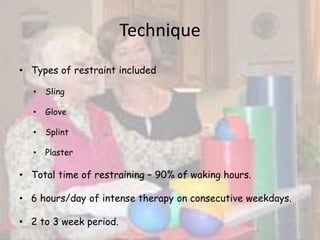
Technique
• Types of restraint included
• Sling
• Glove
• Splint
• Plaster
• Total time of restraining – 90% of waking hours.
• 6 hours/day of intense therapy on consecutive weekdays.
• 2 to 3 week period.
• Minimum inclusion criteria
– Upto 20 degree wrist extension
– Upto 10 degree thumb abduction
– Upto 10 degree finger extension.
Advantages Disadvantages
Overall great improvements in
function as compared to conventional
treatment.
Requires enormous labour.
Highly researched treatment
approach.
Patient endures many hours of
frustration.
Increased social participation. Patient can suffer from muscle
soreness resulting in stiffness and
discomfort in the involved UE as well
as skin lesions.
Cortical reorganisation observed. Not beneficial for all stroke or head
injury patients.
Evidence
STUDY YEAR AUTHOR PATIENT RESULT
RCT 2000 Dromeric A.W,
Edwards D.F,
Hahn M
Acute stroke
patients
CIMT was
associated with
less arm
impairment at
the end of
treatment.
RCT 2002 Edward. T et al Children with
Hemiparesis CP
Major and
sustained
improvement in
motor
functions.
RCT 2006 Wolf S. et al 3-9 months
after stroke
Clinically
relevant
improvement
seen persisting
for at least 1
year.
STUDY YEAR AUTHOR PATIENT RESULT
RCT 1998 Wolfgang. H et
al
Chronic stroke
patients, UE
motor deficits
Intervention
had general
applicability.
RCT 2007 Boake et al Subacute
stroke patients
CIMT has little
difference on
overall
outcome in
motor
movements.
Meta-analysis 2010 Corbetta. D et
al
All RCTs and
Quasi RCTs
from Jan 2009
to April 2010
included
Majority of
studies were
underpowered
and imprecise,
exposing the
analysis to
small-study
bias. Large
RCTs needed to
resolve the
uncertainties.
Modified CIMT
• To promote better compliance.
• Protocol :
– 30 mins of 1 to 1 therapy for 3 days a
week;
– 5 hours/day in restraint (weekdays) for 10
weeks.
Modified CIMT
• To promote better compliance.
• Protocol: 30 mins of 1 to 1 therapy,
3 days/ week,
5 hours/day in restraint (weekdays)
10 weeks .
Take home
message
References
• Constraint Induced Movement Therapy, Psych
428, May 2008.
• Constraint Induced Movement Therapy: A
New Family of Techniques with Broad
Application to Physical Rehabilitation- A
Clinical Review, Edward Taub et al.
• www.ncbi.nlm.nih.gov/pubmed.
• www.scholar.google.co.in.
Thank you !

Constrained induced movement therapy

  • 1.
  • 2.
  • 3.
    Introduction • CIMT involvesconstraining the unaffected limb, along with intense therapy, in order to force the use of the affected with the intent to improve motor function.
  • 4.
    History • Early researchwas done by Edward Taub on surgically deafferented monkeys. • “learned non-use”.
  • 5.
    • 3 componentsof CIMT – Restraint of unaffected arm. – Repetition, structured, intense practice of affected arm. – Monitored arm used in life situation and problem solving to overcome barriers.
  • 6.
    Technique • Types ofrestraint included • Sling • Glove • Splint • Plaster • Total time of restraining – 90% of waking hours. • 6 hours/day of intense therapy on consecutive weekdays. • 2 to 3 week period.
  • 7.
    • Minimum inclusioncriteria – Upto 20 degree wrist extension – Upto 10 degree thumb abduction – Upto 10 degree finger extension.
  • 8.
    Advantages Disadvantages Overall greatimprovements in function as compared to conventional treatment. Requires enormous labour. Highly researched treatment approach. Patient endures many hours of frustration. Increased social participation. Patient can suffer from muscle soreness resulting in stiffness and discomfort in the involved UE as well as skin lesions. Cortical reorganisation observed. Not beneficial for all stroke or head injury patients.
  • 9.
    Evidence STUDY YEAR AUTHORPATIENT RESULT RCT 2000 Dromeric A.W, Edwards D.F, Hahn M Acute stroke patients CIMT was associated with less arm impairment at the end of treatment. RCT 2002 Edward. T et al Children with Hemiparesis CP Major and sustained improvement in motor functions. RCT 2006 Wolf S. et al 3-9 months after stroke Clinically relevant improvement seen persisting for at least 1 year.
  • 10.
    STUDY YEAR AUTHORPATIENT RESULT RCT 1998 Wolfgang. H et al Chronic stroke patients, UE motor deficits Intervention had general applicability. RCT 2007 Boake et al Subacute stroke patients CIMT has little difference on overall outcome in motor movements. Meta-analysis 2010 Corbetta. D et al All RCTs and Quasi RCTs from Jan 2009 to April 2010 included Majority of studies were underpowered and imprecise, exposing the analysis to small-study bias. Large RCTs needed to resolve the uncertainties.
  • 11.
    Modified CIMT • Topromote better compliance. • Protocol : – 30 mins of 1 to 1 therapy for 3 days a week; – 5 hours/day in restraint (weekdays) for 10 weeks.
  • 12.
    Modified CIMT • Topromote better compliance. • Protocol: 30 mins of 1 to 1 therapy, 3 days/ week, 5 hours/day in restraint (weekdays) 10 weeks . Take home message
  • 13.
    References • Constraint InducedMovement Therapy, Psych 428, May 2008. • Constraint Induced Movement Therapy: A New Family of Techniques with Broad Application to Physical Rehabilitation- A Clinical Review, Edward Taub et al. • www.ncbi.nlm.nih.gov/pubmed. • www.scholar.google.co.in.
  • 14.

Editor's Notes

  • #13 More gain and improvement seem to be made using this technique, 3 months or more after stroke when compared to traditional therapy and also in children with hemiparesis Cerebral Palsy. Maybe its time to change PTs current treatment model for patients with learned non-use.