



Research Design
Faculty guide prepared & presented by
Dr. Ranbir Singh Mr. Mahesh Kumar
Assistant professor Research Scholar
Institute of Hotel & Tourism management, MDU,Rohtak
Contents
Meaning of Research design
Definition of Research Design
Need for Research design
Features of a good Research design
Cross check is research design appropriate for
Important concepts relating to Research Design
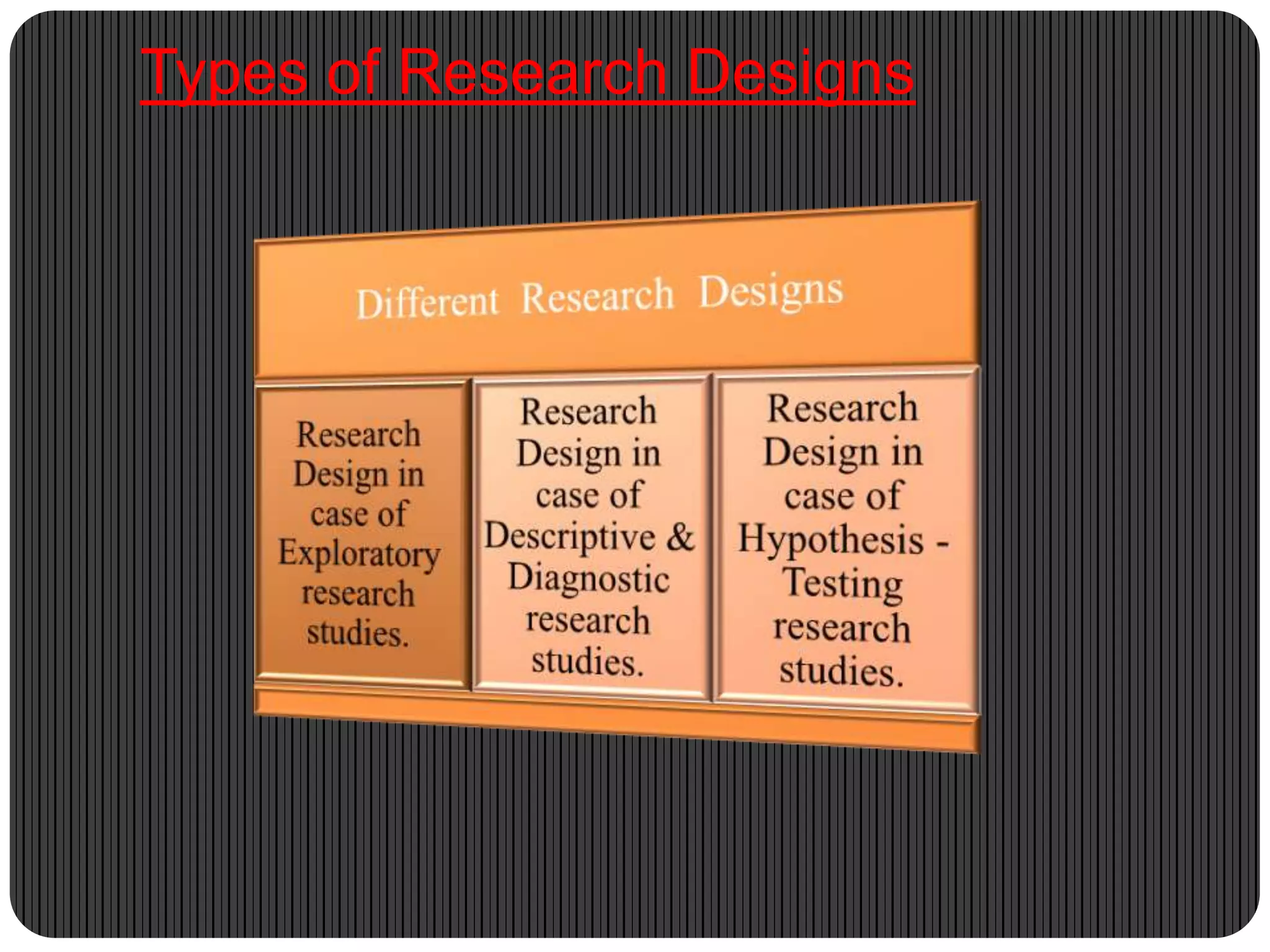
Different Research Designs
Principles of Experimental Designs
Important Experimental Designs
It is second important step of research process leads defining
the research problem.
Research design stands for advance planning of methods
to be adopted for collecting the relevant data and technique
to be used.
Decisions regarding what, when, how, where, how much, by
what means concerning a research constitute of research
design.
Design includes an outline of what the researcher will do
from writing the hypotheses and operational implications to
the final analysis of data.
Definition
“A research design is the arrangement of conditions for collection
and analysis of data in a manner that aims to combine relevance to
the research purpose with economy in procedure.”
Claire sellitz & others, research methods in social sciences (1962, p 50)
A Research design is a plan, structure and strategy of investigation so
conceived as to obtain answer to the research problem. The plan is
complete program of research. It includes an outline of what the
investigation will do from writing the hypotheses and their
operational implication to the final analysis of data.
In other words, the research design is conceptual
structure in which research is conducted, it
constitute the blueprint for the
collection, measurement and analysis of data.
Need and Functions
Acts as event organizer (advance planning)
 keep objectives of the research before eyes
Further saves time during research
Save Energy, time, money & efforts otherwise waste
Advance plan for data collection
Helps in selecting tools, methods and techniques
Reduce chances for bias
Anticipate potential problems
Acts as control tool (limit boundaries of research)
Features of a good research design
A clear statement and orientation to that
objective/Research problem
Illustrate methods and techniques to be used
Clear idea about sample size and the target population to
be studied
Should be flexible, appropriate, efficient, economical
Aligning Research Design with
Research Problem/ objective
 The objective of the problem to be studied
 The nature of the problem to be studied
 The means of obtaining information
 The time and money for the research work
 The skills of researcher
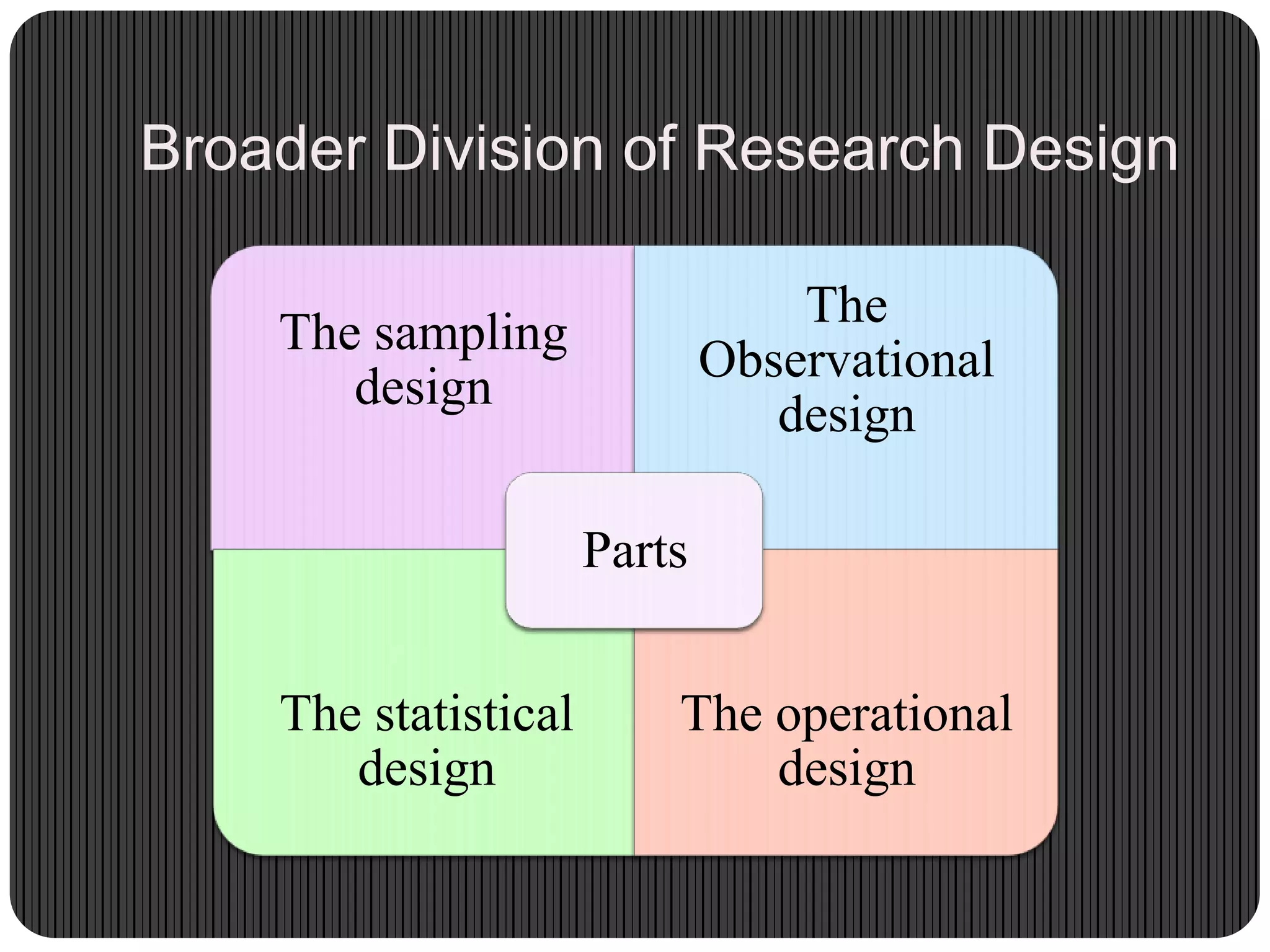
Broader Division of Research Design
The sampling
design
The
Observational
design
The statistical
design
The operational
design
Parts
Sampling Design – deals with the method of selecting
items to be observed for the given study.
Statistical Design – how many items are to be observed
and how the data gathered is to be analyzed.
Observational Design – relates to the conditions under
which the observations are to be made.
Operational Design – techniques by which the
procedures specified can be carried out.
Important concepts relating to
Research Design
Variables is a concept that is capable of measuring different values.
Dependent variable is one which depends upon or is the consequences other
variable.
Independent variable is antecedent to dependent variable.
Extraneous variable are those which are not related to purpose of study but may
effect the dependent variable.
Control In experimental researches, the term „control‟ is used to refer to restrain
experimental conditions.
Confounded relationship: When the dependent variable is not free from the
influence of extraneous variable(s), the relationship between the dependent and
independent variables is said to be confounded by an extraneous variable(s).
Research hypothesis is a predictive statement that relate an independent variable to a
dependent variable.
Hypothesis-testing research -When the purpose of research is to test a research
hypothesis, it is termed as hypothesis testing research.
Experimental hypothesis-testing research – when the independent variable is
manipulated.
Non-experimental hypothesis-testing research – when the independent variable is not
manipulated.
Experimental group is when a group is exposed to some special conditions in
experimental hypotheses testing.
Control group is when a group is exposed to usual conditions.
Treatments – The different conditions under which experimental
and control groups are put
Experiments- The Process of examining the truth of a statistical
hypothesis (comparative not absolute) relating to some research
problem.
Types of Research Designs
Research Design in case of Exploratory Research
Aim: Developing the working hypothesis from an operational point of view.
Emphasis: Discovery of new ideas or deep insights.
Methods of Research:
1) survey of concerning literature
2) The experience survey
3) Insight stimulating analysis (non structured investigations)
For Descriptive and Diagnostic research
Descriptive studies – which are concerned with the description of the
characteristics. ex. Most social researches.
Diagnostic studies – to determine the frequency with which something
occurs or determine whether certain variables are associated.
Both share common needs
1. careful planning
2. no bias
3. maximum reliability
4. rigid design
Focus
1.Formulating the objective of the study.
2.Designing the methods of data collection
3.Selecting the sample
4.Collecting the data
5.Processing and analyzing the data
6.Reporting the findings
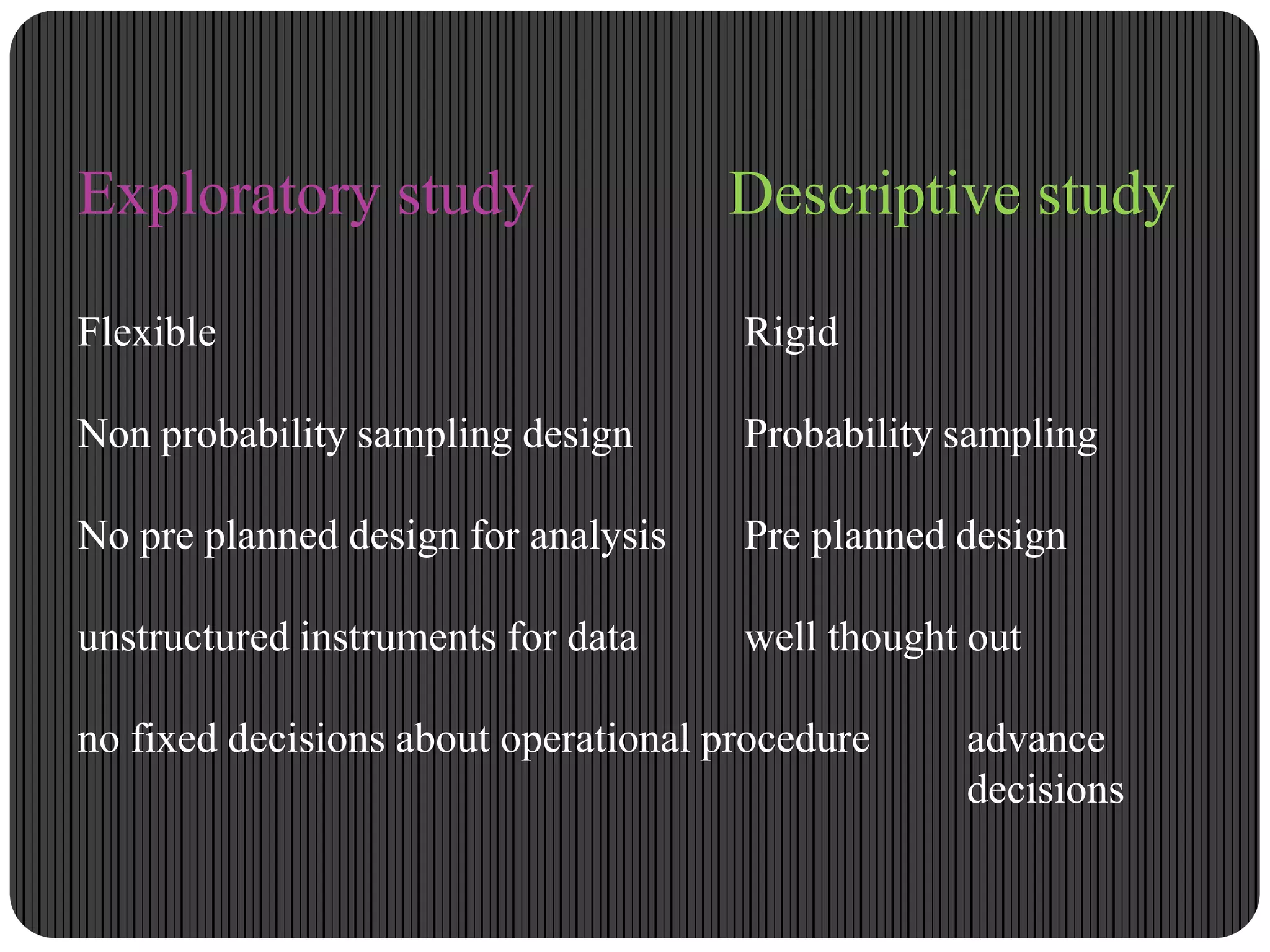
Exploratory study Descriptive study
Flexible Rigid
Non probability sampling design Probability sampling
No pre planned design for analysis Pre planned design
unstructured instruments for data well thought out
no fixed decisions about operational procedure advance
decisions
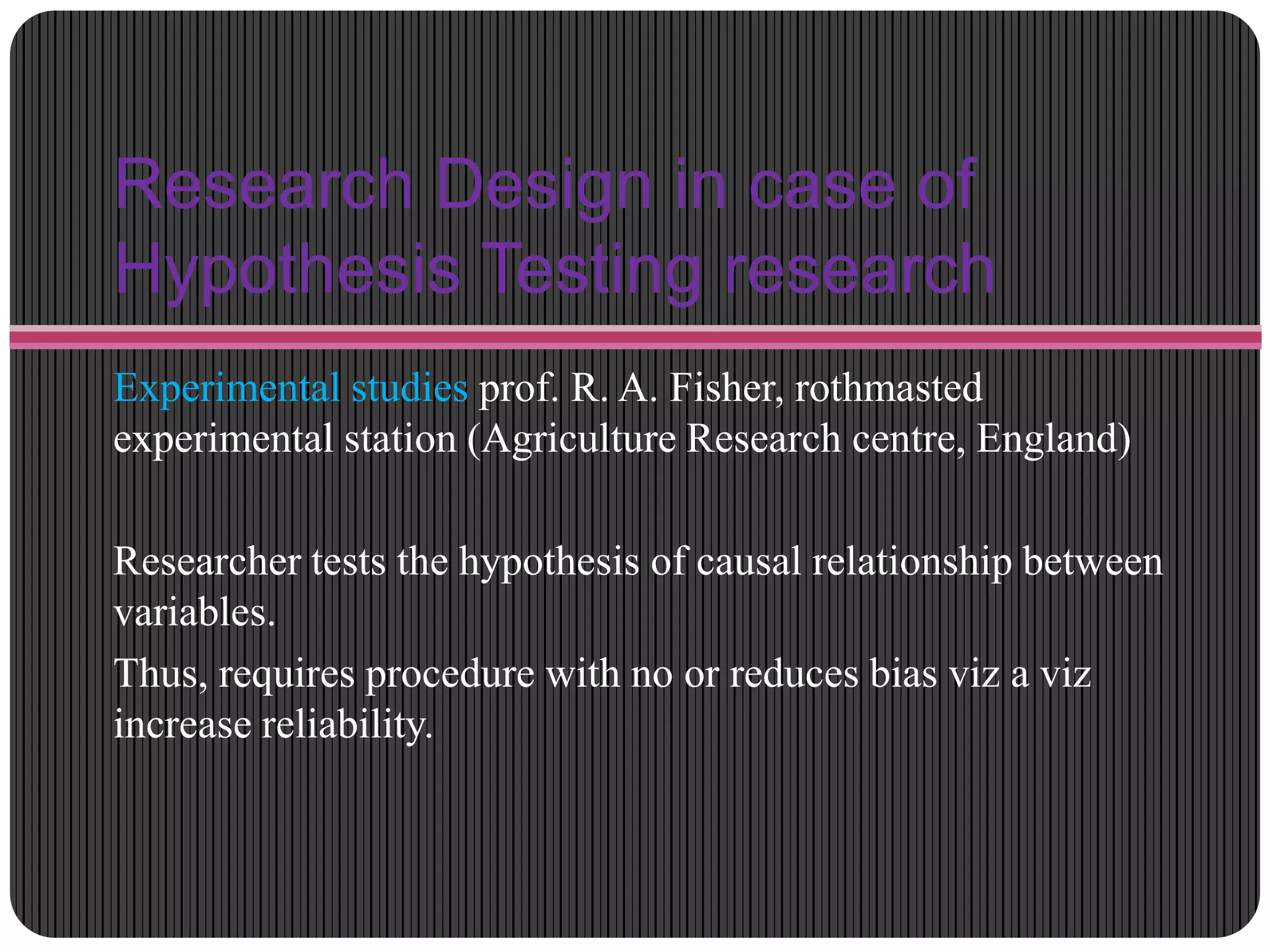
Research Design in case of
Hypothesis Testing research
Experimental studies prof. R. A. Fisher, rothmasted
experimental station (Agriculture Research centre, England)
Researcher tests the hypothesis of causal relationship between
variables.
Thus, requires procedure with no or reduces bias viz a viz
increase reliability.
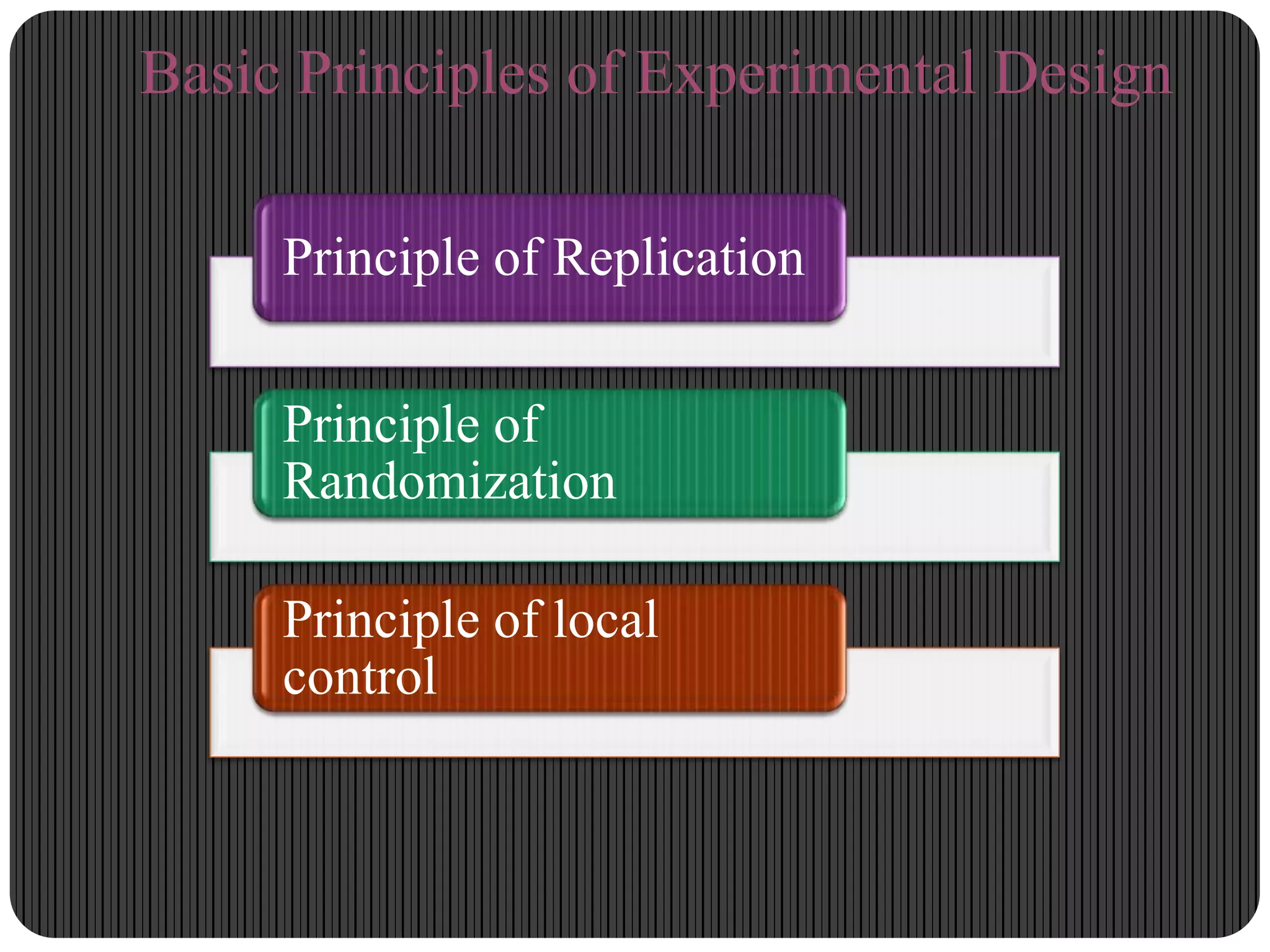
Basic Principles of Experimental Design
Principle of Replication
Principle of
Randomization
Principle of local
control
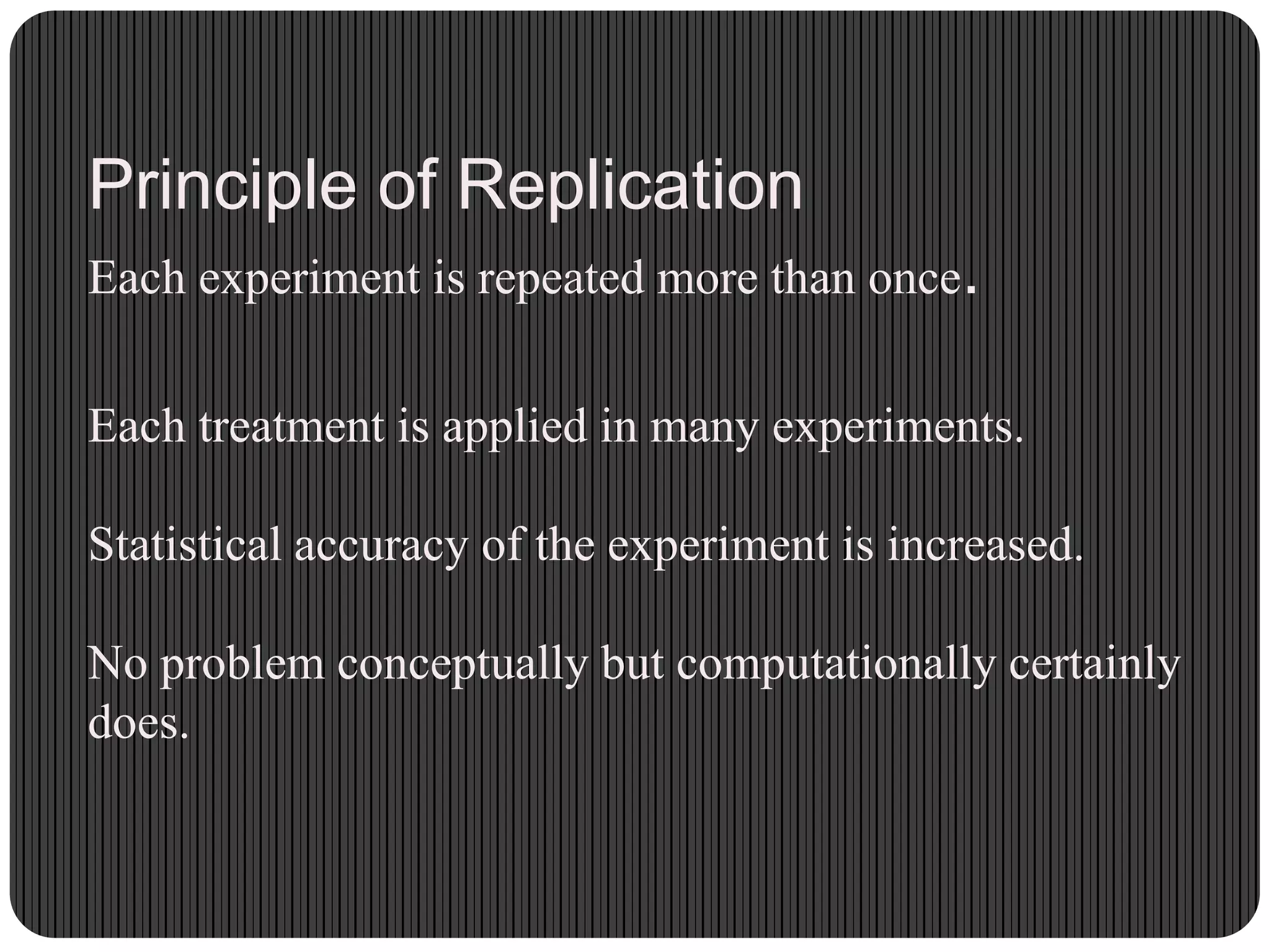
Principle of Replication
Each experiment is repeated more than once.
Each treatment is applied in many experiments.
Statistical accuracy of the experiment is increased.
No problem conceptually but computationally certainly
does.
Principle of Randomization
This principle provides protection when we
conduct an experiment against the effect of
extraneous factors i.e. termed as „chance‟.
Through this principle, we can have a better
estimate of the experimental error.
Principle of Local Control
The extraneous factor, the known source of variability, is
made to vary deliberately which can be measured and hence
eliminated from the experimental error.
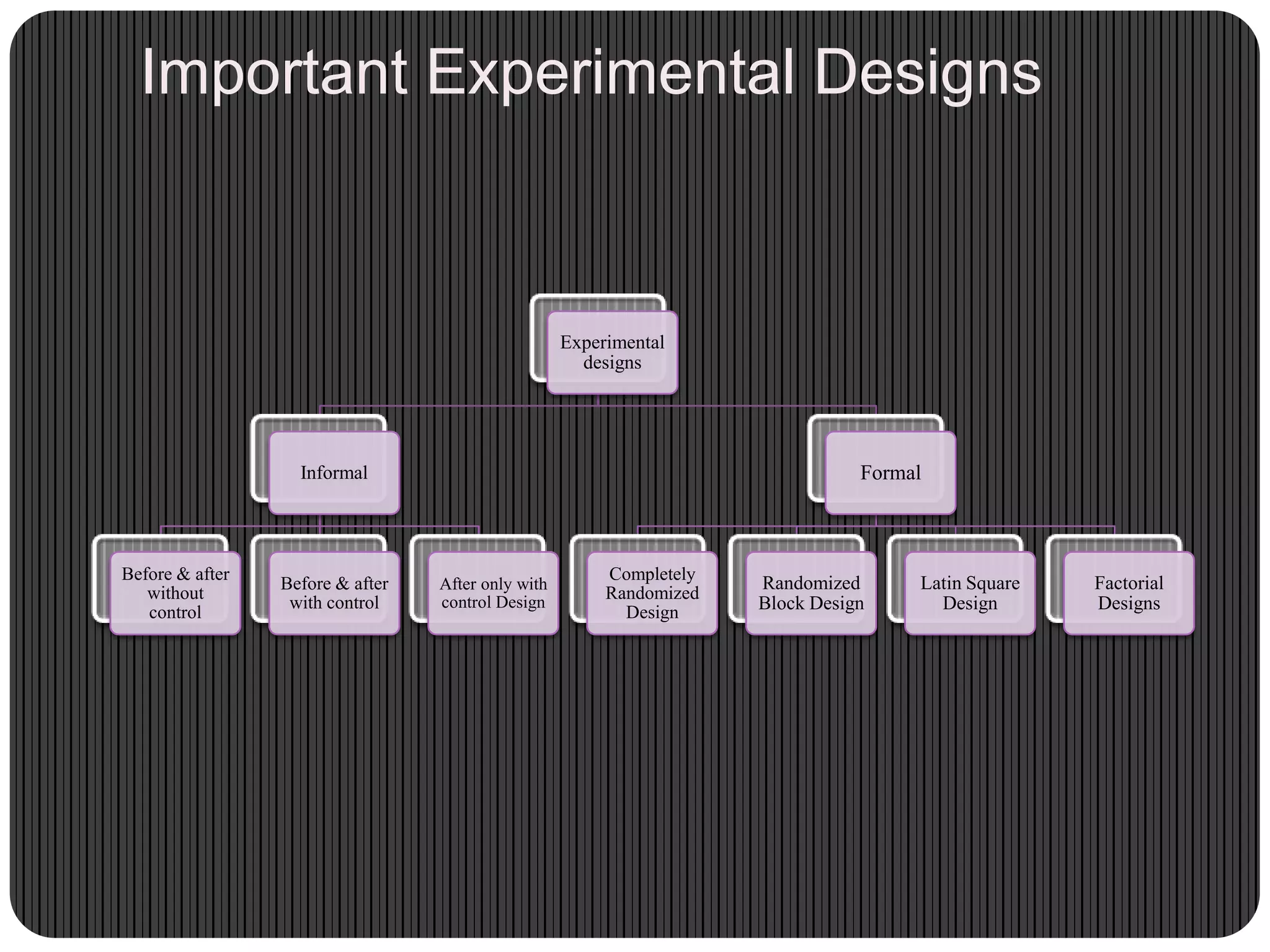
Important Experimental Designs
Experimental
designs
Informal
Before & after
without
control
Before & after
with control
After only with
control Design
Formal
Completely
Randomized
Design
Randomized
Block Design
Latin Square
Design
Factorial
Designs
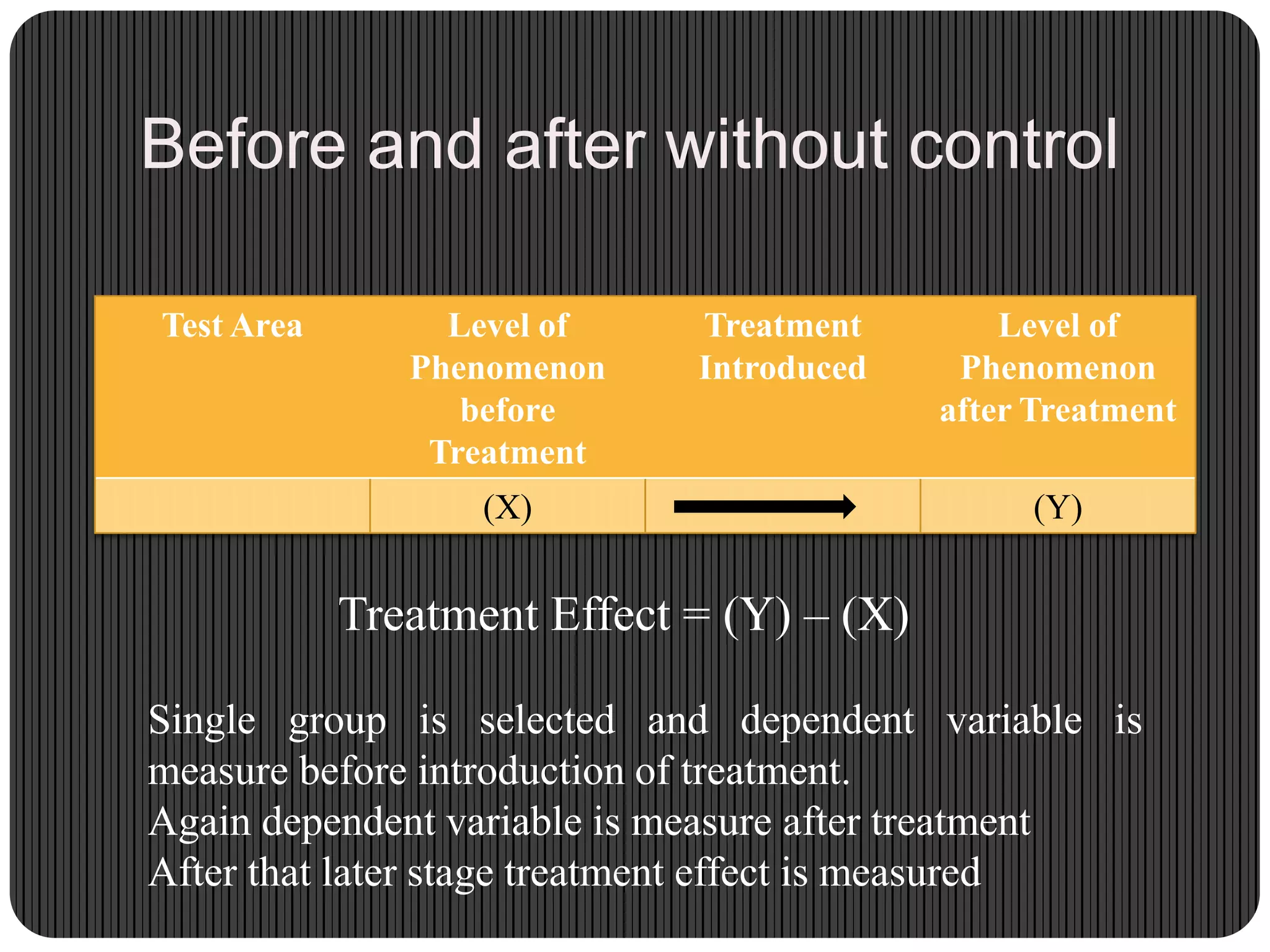
Before and after without control
Test Area Level of
Phenomenon
before
Treatment
Treatment
Introduced
Level of
Phenomenon
after Treatment
(X) (Y)
Treatment Effect = (Y) – (X)
Single group is selected and dependent variable is
measure before introduction of treatment.
Again dependent variable is measure after treatment
After that later stage treatment effect is measured
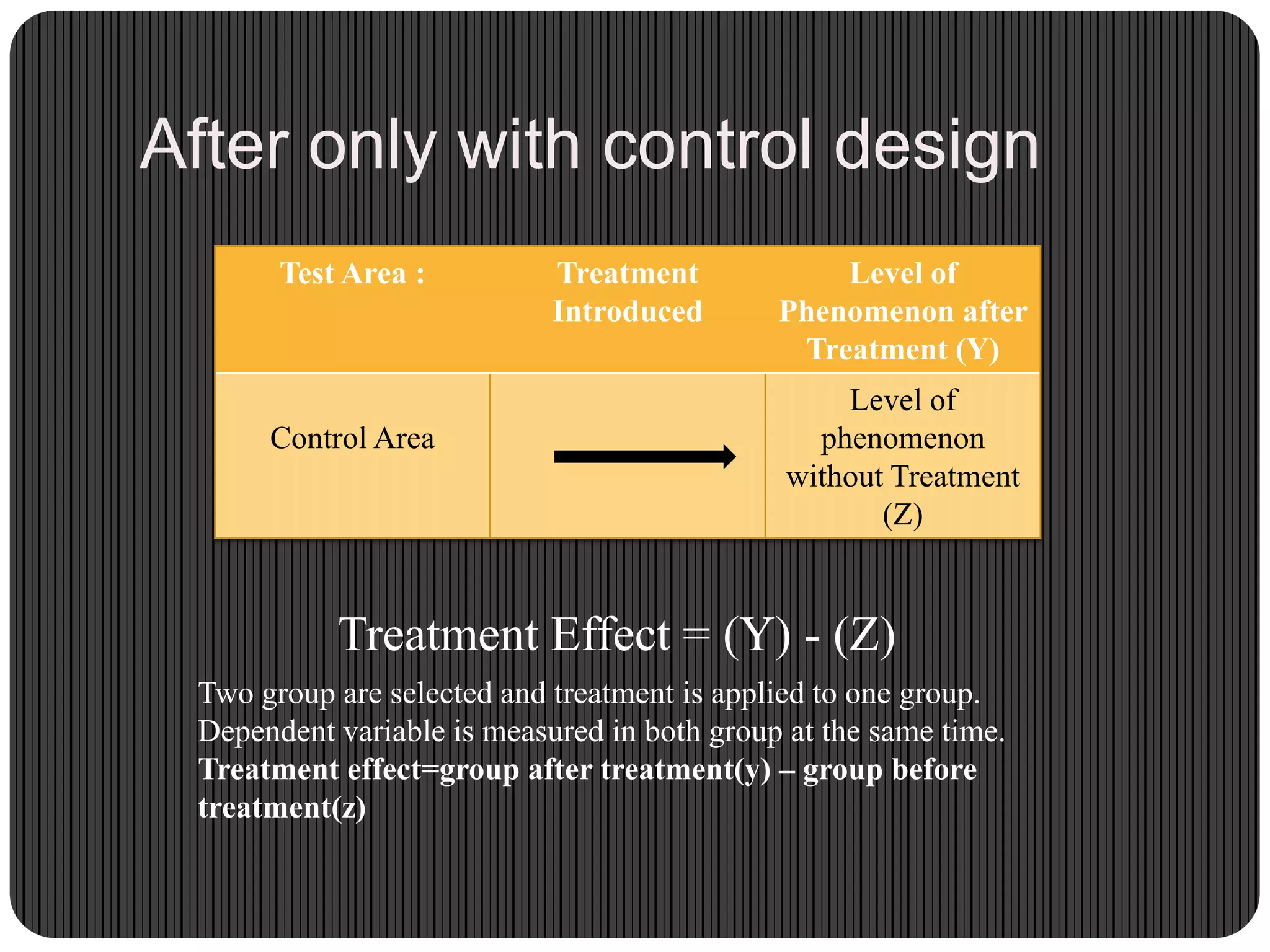
After only with control design
Test Area : Treatment
Introduced
Level of
Phenomenon after
Treatment (Y)
Control Area
Level of
phenomenon
without Treatment
(Z)
Treatment Effect = (Y) - (Z)
Two group are selected and treatment is applied to one group.
Dependent variable is measured in both group at the same time.
Treatment effect=group after treatment(y) – group before
treatment(z)
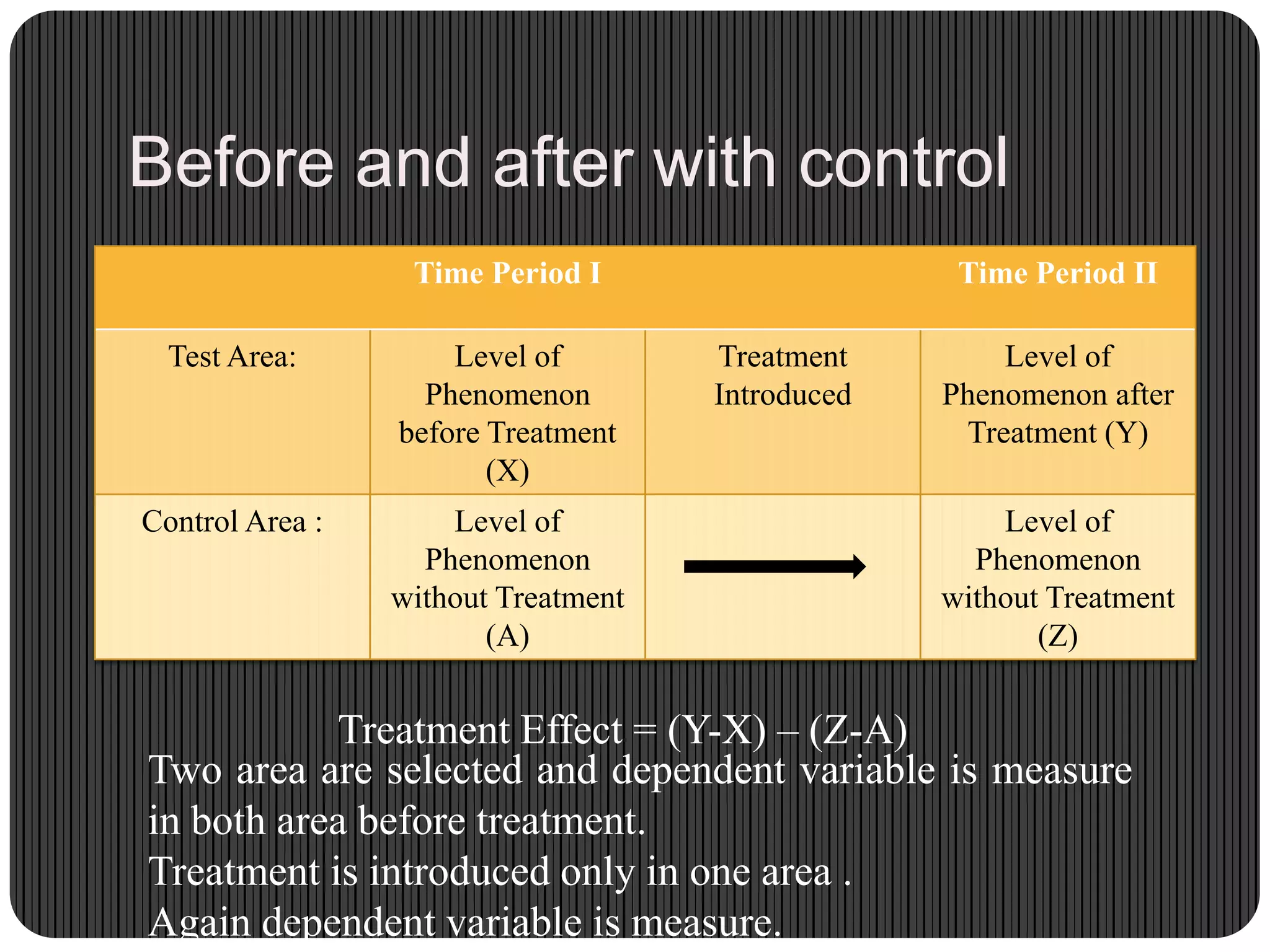
Before and after with control
Time Period I Time Period II
Test Area: Level of
Phenomenon
before Treatment
(X)
Treatment
Introduced
Level of
Phenomenon after
Treatment (Y)
Control Area : Level of
Phenomenon
without Treatment
(A)
Level of
Phenomenon
without Treatment
(Z)
Treatment Effect = (Y-X) – (Z-A)
Two area are selected and dependent variable is measure
in both area before treatment.
Treatment is introduced only in one area .
Again dependent variable is measure.
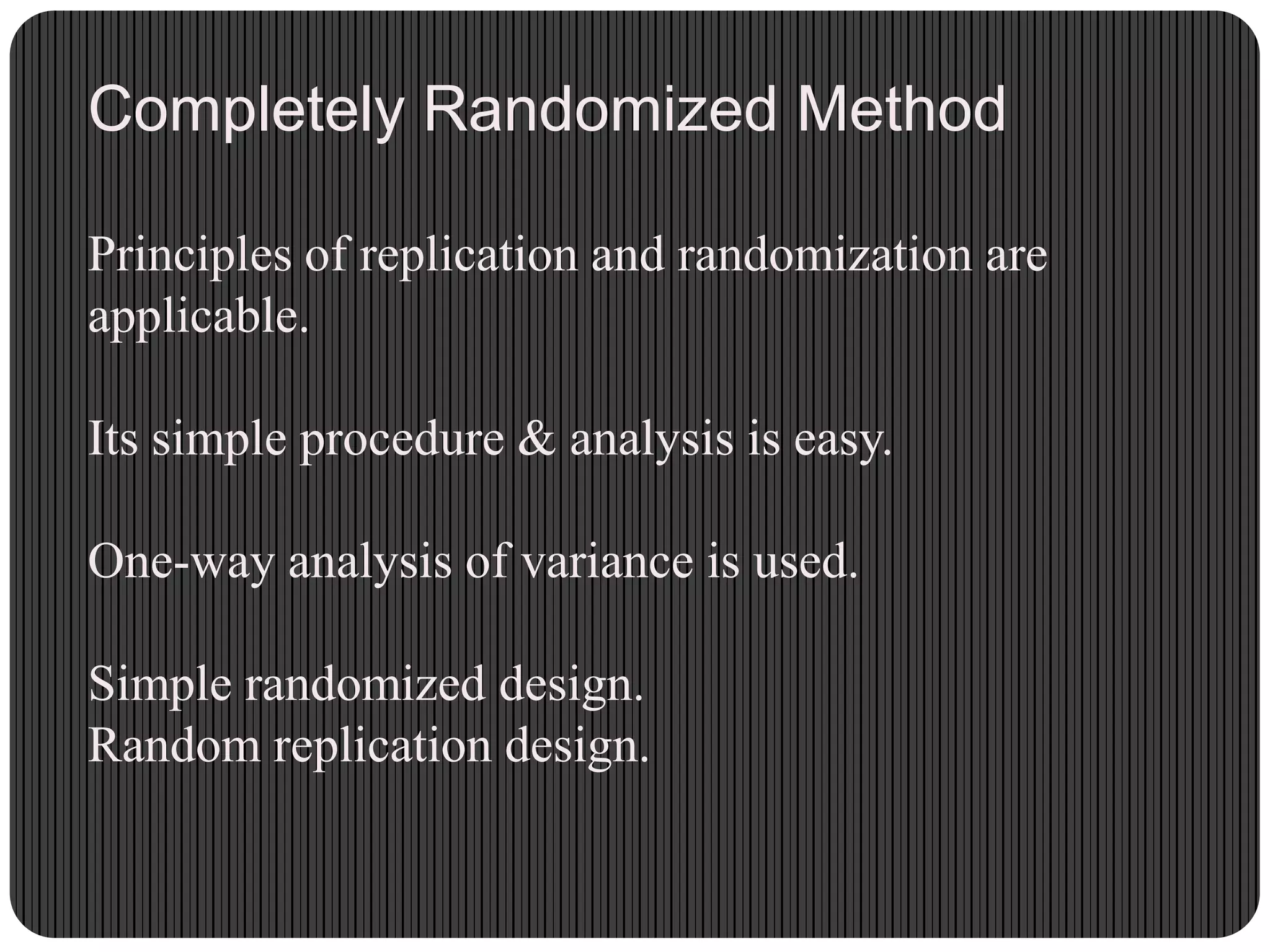
Completely Randomized Method
Principles of replication and randomization are
applicable.
Its simple procedure & analysis is easy.
One-way analysis of variance is used.
Simple randomized design.
Random replication design.
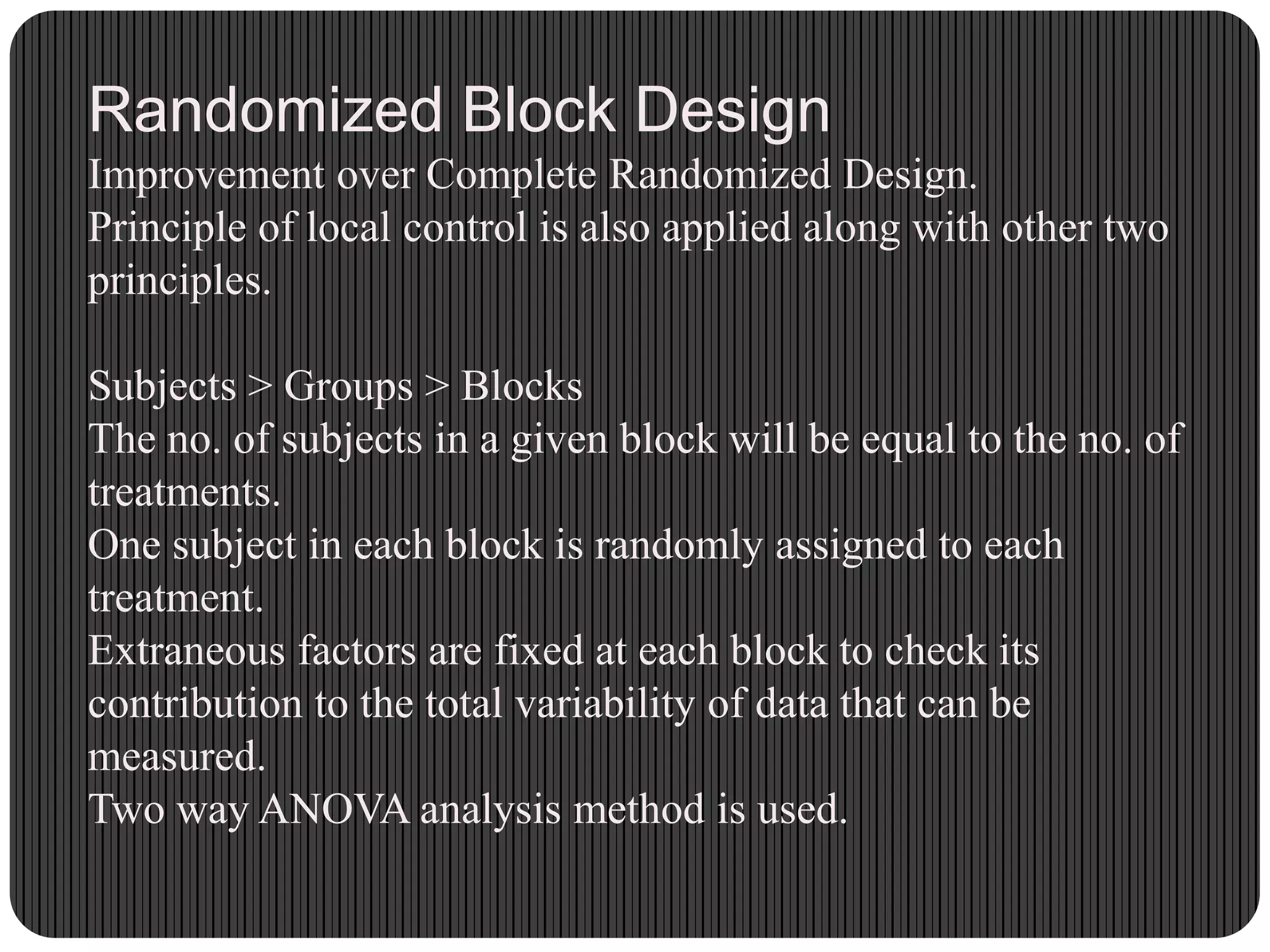
Randomized Block Design
Improvement over Complete Randomized Design.
Principle of local control is also applied along with other two
principles.
Subjects > Groups > Blocks
The no. of subjects in a given block will be equal to the no. of
treatments.
One subject in each block is randomly assigned to each
treatment.
Extraneous factors are fixed at each block to check its
contribution to the total variability of data that can be
measured.
Two way ANOVA analysis method is used.
Latin square Design
Frequently used in agricultural research , where
nature plays pivotal role.
No treatment appears more than 1 in row & column.
Perfect only for 5*5 to 9*9.
Factorial design
used in experiments where the effects of
varying more than one factor are to be
determined.
Used in social and economic phenomenon
where a large number of factors affect a
particular problem.
Two factor/ simple factorial design
multi factor/ complex factorial design.
Conclusion
References
C. R. Kothari, Research Methodology.
Ranjeet Kumar, Research Methodology.
Research design mahesh

Research design mahesh

  • 1.
    Research Design Faculty guideprepared & presented by Dr. Ranbir Singh Mr. Mahesh Kumar Assistant professor Research Scholar Institute of Hotel & Tourism management, MDU,Rohtak
  • 2.
    Contents Meaning of Researchdesign Definition of Research Design Need for Research design Features of a good Research design Cross check is research design appropriate for Important concepts relating to Research Design Different Research Designs Principles of Experimental Designs Important Experimental Designs
  • 3.
    It is secondimportant step of research process leads defining the research problem. Research design stands for advance planning of methods to be adopted for collecting the relevant data and technique to be used. Decisions regarding what, when, how, where, how much, by what means concerning a research constitute of research design. Design includes an outline of what the researcher will do from writing the hypotheses and operational implications to the final analysis of data.
  • 4.
    Definition “A research designis the arrangement of conditions for collection and analysis of data in a manner that aims to combine relevance to the research purpose with economy in procedure.” Claire sellitz & others, research methods in social sciences (1962, p 50) A Research design is a plan, structure and strategy of investigation so conceived as to obtain answer to the research problem. The plan is complete program of research. It includes an outline of what the investigation will do from writing the hypotheses and their operational implication to the final analysis of data.
  • 5.
    In other words,the research design is conceptual structure in which research is conducted, it constitute the blueprint for the collection, measurement and analysis of data.
  • 6.
    Need and Functions Actsas event organizer (advance planning)  keep objectives of the research before eyes Further saves time during research Save Energy, time, money & efforts otherwise waste Advance plan for data collection Helps in selecting tools, methods and techniques Reduce chances for bias Anticipate potential problems Acts as control tool (limit boundaries of research)
  • 7.
    Features of agood research design A clear statement and orientation to that objective/Research problem Illustrate methods and techniques to be used Clear idea about sample size and the target population to be studied Should be flexible, appropriate, efficient, economical
  • 8.
    Aligning Research Designwith Research Problem/ objective  The objective of the problem to be studied  The nature of the problem to be studied  The means of obtaining information  The time and money for the research work  The skills of researcher
  • 9.
    Broader Division ofResearch Design The sampling design The Observational design The statistical design The operational design Parts
  • 10.
    Sampling Design –deals with the method of selecting items to be observed for the given study. Statistical Design – how many items are to be observed and how the data gathered is to be analyzed. Observational Design – relates to the conditions under which the observations are to be made. Operational Design – techniques by which the procedures specified can be carried out.
  • 11.
    Important concepts relatingto Research Design Variables is a concept that is capable of measuring different values. Dependent variable is one which depends upon or is the consequences other variable. Independent variable is antecedent to dependent variable. Extraneous variable are those which are not related to purpose of study but may effect the dependent variable. Control In experimental researches, the term „control‟ is used to refer to restrain experimental conditions.
  • 12.
    Confounded relationship: Whenthe dependent variable is not free from the influence of extraneous variable(s), the relationship between the dependent and independent variables is said to be confounded by an extraneous variable(s). Research hypothesis is a predictive statement that relate an independent variable to a dependent variable. Hypothesis-testing research -When the purpose of research is to test a research hypothesis, it is termed as hypothesis testing research. Experimental hypothesis-testing research – when the independent variable is manipulated. Non-experimental hypothesis-testing research – when the independent variable is not manipulated. Experimental group is when a group is exposed to some special conditions in experimental hypotheses testing. Control group is when a group is exposed to usual conditions.
  • 13.
    Treatments – Thedifferent conditions under which experimental and control groups are put Experiments- The Process of examining the truth of a statistical hypothesis (comparative not absolute) relating to some research problem.
  • 14.
  • 15.
    Research Design incase of Exploratory Research Aim: Developing the working hypothesis from an operational point of view. Emphasis: Discovery of new ideas or deep insights. Methods of Research: 1) survey of concerning literature 2) The experience survey 3) Insight stimulating analysis (non structured investigations)
  • 16.
    For Descriptive andDiagnostic research Descriptive studies – which are concerned with the description of the characteristics. ex. Most social researches. Diagnostic studies – to determine the frequency with which something occurs or determine whether certain variables are associated. Both share common needs 1. careful planning 2. no bias 3. maximum reliability 4. rigid design
  • 17.
    Focus 1.Formulating the objectiveof the study. 2.Designing the methods of data collection 3.Selecting the sample 4.Collecting the data 5.Processing and analyzing the data 6.Reporting the findings
  • 18.
    Exploratory study Descriptivestudy Flexible Rigid Non probability sampling design Probability sampling No pre planned design for analysis Pre planned design unstructured instruments for data well thought out no fixed decisions about operational procedure advance decisions
  • 19.
    Research Design incase of Hypothesis Testing research Experimental studies prof. R. A. Fisher, rothmasted experimental station (Agriculture Research centre, England) Researcher tests the hypothesis of causal relationship between variables. Thus, requires procedure with no or reduces bias viz a viz increase reliability.
  • 20.
    Basic Principles ofExperimental Design Principle of Replication Principle of Randomization Principle of local control
  • 21.
    Principle of Replication Eachexperiment is repeated more than once. Each treatment is applied in many experiments. Statistical accuracy of the experiment is increased. No problem conceptually but computationally certainly does.
  • 22.
    Principle of Randomization Thisprinciple provides protection when we conduct an experiment against the effect of extraneous factors i.e. termed as „chance‟. Through this principle, we can have a better estimate of the experimental error.
  • 23.
    Principle of LocalControl The extraneous factor, the known source of variability, is made to vary deliberately which can be measured and hence eliminated from the experimental error.
  • 24.
    Important Experimental Designs Experimental designs Informal Before& after without control Before & after with control After only with control Design Formal Completely Randomized Design Randomized Block Design Latin Square Design Factorial Designs
  • 25.
    Before and afterwithout control Test Area Level of Phenomenon before Treatment Treatment Introduced Level of Phenomenon after Treatment (X) (Y) Treatment Effect = (Y) – (X) Single group is selected and dependent variable is measure before introduction of treatment. Again dependent variable is measure after treatment After that later stage treatment effect is measured
  • 26.
    After only withcontrol design Test Area : Treatment Introduced Level of Phenomenon after Treatment (Y) Control Area Level of phenomenon without Treatment (Z) Treatment Effect = (Y) - (Z) Two group are selected and treatment is applied to one group. Dependent variable is measured in both group at the same time. Treatment effect=group after treatment(y) – group before treatment(z)
  • 27.
    Before and afterwith control Time Period I Time Period II Test Area: Level of Phenomenon before Treatment (X) Treatment Introduced Level of Phenomenon after Treatment (Y) Control Area : Level of Phenomenon without Treatment (A) Level of Phenomenon without Treatment (Z) Treatment Effect = (Y-X) – (Z-A) Two area are selected and dependent variable is measure in both area before treatment. Treatment is introduced only in one area . Again dependent variable is measure.
  • 28.
    Completely Randomized Method Principlesof replication and randomization are applicable. Its simple procedure & analysis is easy. One-way analysis of variance is used. Simple randomized design. Random replication design.
  • 29.
    Randomized Block Design Improvementover Complete Randomized Design. Principle of local control is also applied along with other two principles. Subjects > Groups > Blocks The no. of subjects in a given block will be equal to the no. of treatments. One subject in each block is randomly assigned to each treatment. Extraneous factors are fixed at each block to check its contribution to the total variability of data that can be measured. Two way ANOVA analysis method is used.
  • 30.
    Latin square Design Frequentlyused in agricultural research , where nature plays pivotal role. No treatment appears more than 1 in row & column. Perfect only for 5*5 to 9*9.
  • 31.
    Factorial design used inexperiments where the effects of varying more than one factor are to be determined. Used in social and economic phenomenon where a large number of factors affect a particular problem. Two factor/ simple factorial design multi factor/ complex factorial design.
  • 32.
  • 34.
    References C. R. Kothari,Research Methodology. Ranjeet Kumar, Research Methodology.