WORK CONDITIONING
&
WORK HARDENING
INTRODUCTION
9/11/2018 1:40 AM
2
 Work Conditioning & Work Hardening are the Rehabilitation system to
address specific aspect of return to work.
 Why Work Retraining has Emerged?
 There are significant differences between a person who is medically
healed & a person who is prepared for RTW at full job functions.
1. The person’s physical strength to perform the job has typically
declined gradually through inactivity
2. Individual’s Physiological resources have been depleted – Energy
level & Endurance
3. The person’s psychosocial equilibrium is unsettled – Fear of Reinjury
& other Anxieties
4. The body part “healed” in medical terms may still be vulnerable to
reinjury when subjected to job demands.
9/11/2018 1:40 AM
3
 Literature suggest there are a number of measures required,
beyond healing in order to accomplish a safe and successful
return to full productivity. These are :
1. Physical strength- Built up & maintained
2. The illness-induced physiological & chemical changes that
impact energy levels & Endurance must be reversed.
3. The capability in strength & Endurance depleted by inactivity
must be restored.
9/11/2018 1:40 AM
4
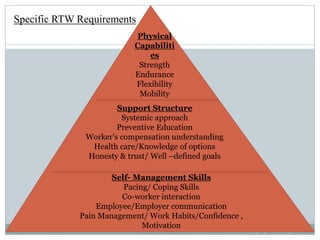
Specific RTW Requirements
Physical
Capabiliti
es
Strength
Endurance
Flexibility
Mobility
Support Structure
Systemic approach
Preventive Education
Worker’s compensation understanding
Health care/Knowledge of options
Honesty & trust/ Well –defined goals
Self- Management Skills
Pacing/ Coping Skills
Co-worker interaction
Employee/Employer communication
Pain Management/ Work Habits/Confidence ,
Motivation
CARF Work Hardening Definition
9/11/2018 1:40 AM
5
 Work Hardening is a highly structured, goal-oriented, individualized
Rx program designed to maximize the person’s ability to return to
work.
 Interdisciplinary in nature with a capability of addressing the
functional, physical, behavioral & vocational needs of the person
served.
 It provides a transition between the initial injury Mx & return to work,
while addressing the issues of productivity, safety, physical tolerance &
work behaviors.
 It uses real or simulated work activities in a relevant work environment
in conjunction with physical conditioning tasks.
 These activities are used to progressively improve the biomechanical,
neuromuscular, cardiovascular/metabolic, behavioral, attitudinal &
vocational function of the person served.
APTA Work Conditioning APTA Work Hardening
9/11/2018 1:40 AM
 Work conditioning is a work
related, intensive, goal-oriented Rx
Program specifically designed to
restore an individual’s systemic,
neuromusculoskeletal (strength,
endurance, movement, flexibility
& motor control) and
cardiopulmonary functions.
 The objective of the Work
Conditioning program is to restore
the client’s physical capacity &
function so the client can return to
work.
 Work Hardening is a highly
structured, goal-oriented,
individualized Rx program
designed to return the person to
work .
 Interdisciplinary in nature.
 Uses simulated or real work
activities designed to restore
physical, behavioral & vocational
functions.
 It addresses the issues of
productivity, safety, physical
tolerances & worker behaviors.
6
Definition
Work conditioning Work hardening
9/11/2018 1:40 AM
1. Frequency: 2-4 wks, 3-5
oningdays/wks, 2-3hrs/day
2. Work Simulation not
included
3. Capability level of worker
based on Physical fitness
4. Traditional Clinical method
5. Focuses on Fitness level
6. Progress measures fitness
level
1. Frequency: 4-8 wks, 5
days/wks
4 hrs/day
2. Work Simulation included
3. Proper Body Mechanics
4. By Functional capacity
Assessment
5. Uses Job Requirement as
objective. Movements required
in workplace are used for
establishing Rx Plan
6. Progress measures use of
incremental task
7
COMPARISON
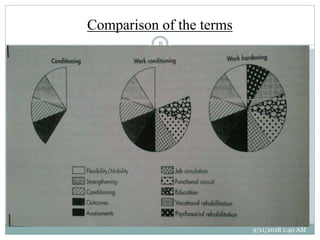
Comparison of the terms
9/11/2018 1:40 AM
8
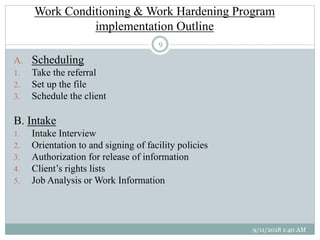
Work Conditioning & Work Hardening Program
implementation Outline
9/11/2018 1:40 AM
9
A. Scheduling
1. Take the referral
2. Set up the file
3. Schedule the client
B. Intake
1. Intake Interview
2. Orientation to and signing of facility policies
3. Authorization for release of information
4. Client’s rights lists
5. Job Analysis or Work Information
9/11/2018 1:40 AM
10
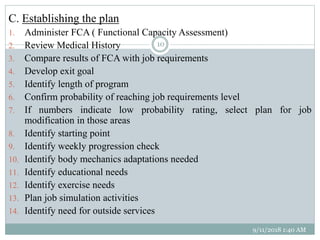
C. Establishing the plan
1. Administer FCA ( Functional Capacity Assessment)
2. Review Medical History
3. Compare results of FCA with job requirements
4. Develop exit goal
5. Identify length of program
6. Confirm probability of reaching job requirements level
7. If numbers indicate low probability rating, select plan for job
modification in those areas
8. Identify starting point
9. Identify weekly progression check
10. Identify body mechanics adaptations needed
11. Identify educational needs
12. Identify exercise needs
13. Plan job simulation activities
14. Identify need for outside services
9/11/2018 1:40 AM
11
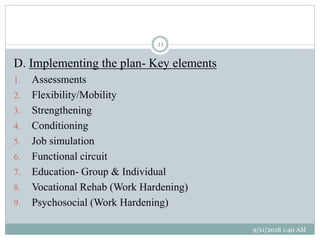
D. Implementing the plan- Key elements
1. Assessments
2. Flexibility/Mobility
3. Strengthening
4. Conditioning
5. Job simulation
6. Functional circuit
7. Education- Group & Individual
8. Vocational Rehab (Work Hardening)
9. Psychosocial (Work Hardening)
Key issues & Strategies in Work Retraining
9/11/2018 1:40 AM
12
1. Pain issues
2. Clinical & Physical Issues
3. Motivational & Mental issues
4. Combination Clinical & Motivational issues.
Advantages
9/11/2018 1:40 AM
13
1. Increased RTW rates
2. Accelerated time frames
3. Increased restored functions & Productivity
4. Reduced reinjure
5. Lower costs

Work conditioning and Work hardening

  • 1.
  • 2.
    INTRODUCTION 9/11/2018 1:40 AM 2 Work Conditioning & Work Hardening are the Rehabilitation system to address specific aspect of return to work.  Why Work Retraining has Emerged?  There are significant differences between a person who is medically healed & a person who is prepared for RTW at full job functions. 1. The person’s physical strength to perform the job has typically declined gradually through inactivity 2. Individual’s Physiological resources have been depleted – Energy level & Endurance 3. The person’s psychosocial equilibrium is unsettled – Fear of Reinjury & other Anxieties 4. The body part “healed” in medical terms may still be vulnerable to reinjury when subjected to job demands.
  • 3.
    9/11/2018 1:40 AM 3 Literature suggest there are a number of measures required, beyond healing in order to accomplish a safe and successful return to full productivity. These are : 1. Physical strength- Built up & maintained 2. The illness-induced physiological & chemical changes that impact energy levels & Endurance must be reversed. 3. The capability in strength & Endurance depleted by inactivity must be restored.
  • 4.
    9/11/2018 1:40 AM 4 SpecificRTW Requirements Physical Capabiliti es Strength Endurance Flexibility Mobility Support Structure Systemic approach Preventive Education Worker’s compensation understanding Health care/Knowledge of options Honesty & trust/ Well –defined goals Self- Management Skills Pacing/ Coping Skills Co-worker interaction Employee/Employer communication Pain Management/ Work Habits/Confidence , Motivation
  • 5.
    CARF Work HardeningDefinition 9/11/2018 1:40 AM 5  Work Hardening is a highly structured, goal-oriented, individualized Rx program designed to maximize the person’s ability to return to work.  Interdisciplinary in nature with a capability of addressing the functional, physical, behavioral & vocational needs of the person served.  It provides a transition between the initial injury Mx & return to work, while addressing the issues of productivity, safety, physical tolerance & work behaviors.  It uses real or simulated work activities in a relevant work environment in conjunction with physical conditioning tasks.  These activities are used to progressively improve the biomechanical, neuromuscular, cardiovascular/metabolic, behavioral, attitudinal & vocational function of the person served.
  • 6.
    APTA Work ConditioningAPTA Work Hardening 9/11/2018 1:40 AM  Work conditioning is a work related, intensive, goal-oriented Rx Program specifically designed to restore an individual’s systemic, neuromusculoskeletal (strength, endurance, movement, flexibility & motor control) and cardiopulmonary functions.  The objective of the Work Conditioning program is to restore the client’s physical capacity & function so the client can return to work.  Work Hardening is a highly structured, goal-oriented, individualized Rx program designed to return the person to work .  Interdisciplinary in nature.  Uses simulated or real work activities designed to restore physical, behavioral & vocational functions.  It addresses the issues of productivity, safety, physical tolerances & worker behaviors. 6 Definition
  • 7.
    Work conditioning Workhardening 9/11/2018 1:40 AM 1. Frequency: 2-4 wks, 3-5 oningdays/wks, 2-3hrs/day 2. Work Simulation not included 3. Capability level of worker based on Physical fitness 4. Traditional Clinical method 5. Focuses on Fitness level 6. Progress measures fitness level 1. Frequency: 4-8 wks, 5 days/wks 4 hrs/day 2. Work Simulation included 3. Proper Body Mechanics 4. By Functional capacity Assessment 5. Uses Job Requirement as objective. Movements required in workplace are used for establishing Rx Plan 6. Progress measures use of incremental task 7 COMPARISON
  • 8.
    Comparison of theterms 9/11/2018 1:40 AM 8
  • 9.
    Work Conditioning &Work Hardening Program implementation Outline 9/11/2018 1:40 AM 9 A. Scheduling 1. Take the referral 2. Set up the file 3. Schedule the client B. Intake 1. Intake Interview 2. Orientation to and signing of facility policies 3. Authorization for release of information 4. Client’s rights lists 5. Job Analysis or Work Information
  • 10.
    9/11/2018 1:40 AM 10 C.Establishing the plan 1. Administer FCA ( Functional Capacity Assessment) 2. Review Medical History 3. Compare results of FCA with job requirements 4. Develop exit goal 5. Identify length of program 6. Confirm probability of reaching job requirements level 7. If numbers indicate low probability rating, select plan for job modification in those areas 8. Identify starting point 9. Identify weekly progression check 10. Identify body mechanics adaptations needed 11. Identify educational needs 12. Identify exercise needs 13. Plan job simulation activities 14. Identify need for outside services
  • 11.
    9/11/2018 1:40 AM 11 D.Implementing the plan- Key elements 1. Assessments 2. Flexibility/Mobility 3. Strengthening 4. Conditioning 5. Job simulation 6. Functional circuit 7. Education- Group & Individual 8. Vocational Rehab (Work Hardening) 9. Psychosocial (Work Hardening)
  • 12.
    Key issues &Strategies in Work Retraining 9/11/2018 1:40 AM 12 1. Pain issues 2. Clinical & Physical Issues 3. Motivational & Mental issues 4. Combination Clinical & Motivational issues.
  • 13.
    Advantages 9/11/2018 1:40 AM 13 1.Increased RTW rates 2. Accelerated time frames 3. Increased restored functions & Productivity 4. Reduced reinjure 5. Lower costs