When it is needed?
1. A patient is complaining of numbness.
2. A patient is complaining of tingling (paresthesias).
3. A patient has pain.
4. A patient has weakness.
5. A patient has a limp.
6. A patient has muscle atrophy.
7. A patient has depressed deep tendon reflexes.
8. A patient has fatigue.
REACTION OF REGENERATION TEST
 F-G TEST
 Faradic response-innervated muscles
 Galvanic response- innervated /denervated
 Wallarian degeneration and degeneration
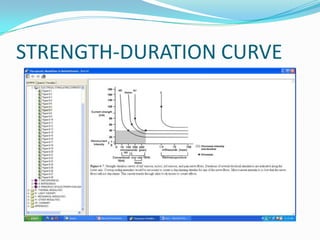
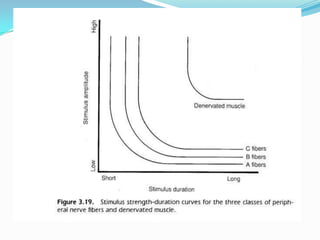
STRENGTH-DURATION CURVE
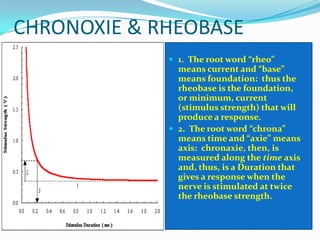
CHRONOXIE & RHEOBASE
              1. The root word “rheo”
               means current and “base”
               means foundation: thus the
               rheobase is the foundation,
               or minimum, current
               (stimulus strength) that will
               produce a response.
              2. The root word “chrona”
               means time and “axie” means
               axis: chronaxie, then, is
               measured along the time axis
               and, thus, is a Duration that
               gives a response when the
               nerve is stimulated at twice
               the rheobase strength.
GALVANIC TWITCH-TETANUS RATIO
TEST
 Continuous DC used
1   :   3.5to 6.5
 In denervation unity occurs, both happens with same
 intensity
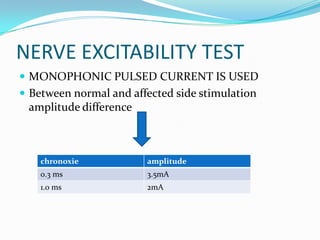
NERVE EXCITABILITY TEST
 MONOPHONIC PULSED CURRENT IS USED
 Between normal and affected side stimulation
 amplitude difference


    chronoxie           amplitude
    0.3 ms              3.5mA
    1.0 ms              2mA
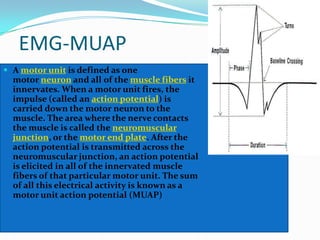
EMG-MUAP
 A motor unit is defined as one
  motor neuron and all of the muscle fibers it
  innervates. When a motor unit fires, the
  impulse (called an action potential) is
  carried down the motor neuron to the
  muscle. The area where the nerve contacts
  the muscle is called the neuromuscular
  junction, or the motor end plate. After the
  action potential is transmitted across the
  neuromuscular junction, an action potential
  is elicited in all of the innervated muscle
  fibers of that particular motor unit. The sum
  of all this electrical activity is known as a
  motor unit action potential (MUAP)
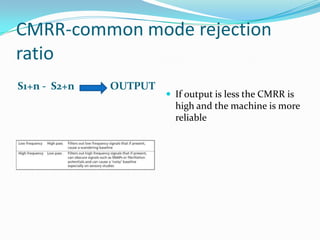
CMRR-common mode rejection
ratio
S1+n - S2+n   OUTPUT
                        If output is less the CMRR is
                         high and the machine is more
                         reliable
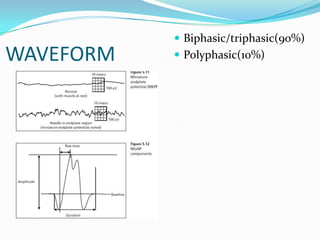
 Biphasic/triphasic(90%)
WAVEFORM    Polyphasic(10%)
EMG CIRCUIT


                                           Filters-
                                                        Rectifiers
                                            notch
             Preamplifier   Amplifier                    –raw to     Sound/osc
Signal 1mV
                 50x
                                        filter, high
                             20-200x                   integrated     illoscope
                                            pass,
                                                          EMG
                                          lowpass
ELECTRODES
MONOPOLAR NEEDLE
CONCENTRIC NEEDLE
BIPOLAR CONCENTRIC NEEDLE
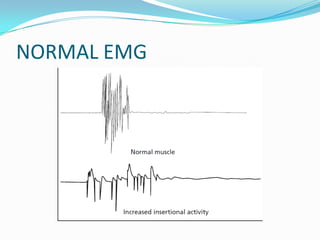
NORMAL EMG
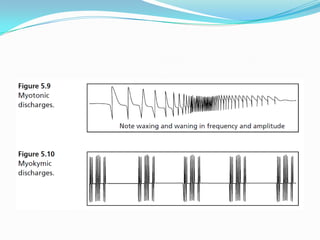
Spontaneous activity
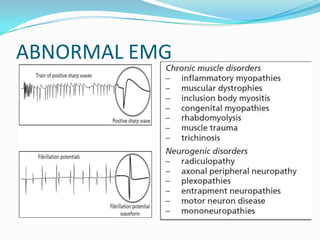
ABNORMAL EMG
INDICATIONS
 Diseases of muscle,    Neuropathy
 nerve and NMJ           Myopathy
                         Radiculopathy
                         Myelopathy
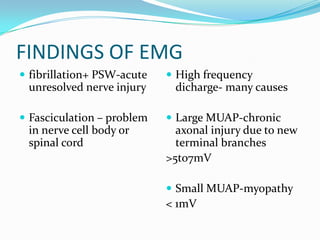
FINDINGS OF EMG
 fibrillation+ PSW-acute    High frequency
 unresolved nerve injury     dicharge- many causes

 Fasciculation – problem    Large MUAP-chronic
 in nerve cell body or        axonal injury due to new
 spinal cord                  terminal branches
                            >5to7mV

                             Small MUAP-myopathy
                            < 1mV
FINDINGS OF EMG
Electrodiagnosis 1

Electrodiagnosis 1

  • 2.
    When it isneeded? 1. A patient is complaining of numbness. 2. A patient is complaining of tingling (paresthesias). 3. A patient has pain. 4. A patient has weakness. 5. A patient has a limp. 6. A patient has muscle atrophy. 7. A patient has depressed deep tendon reflexes. 8. A patient has fatigue.
  • 4.
    REACTION OF REGENERATIONTEST  F-G TEST  Faradic response-innervated muscles  Galvanic response- innervated /denervated  Wallarian degeneration and degeneration
  • 5.
  • 7.
    CHRONOXIE & RHEOBASE  1. The root word “rheo” means current and “base” means foundation: thus the rheobase is the foundation, or minimum, current (stimulus strength) that will produce a response.  2. The root word “chrona” means time and “axie” means axis: chronaxie, then, is measured along the time axis and, thus, is a Duration that gives a response when the nerve is stimulated at twice the rheobase strength.
  • 8.
    GALVANIC TWITCH-TETANUS RATIO TEST Continuous DC used 1 : 3.5to 6.5  In denervation unity occurs, both happens with same intensity
  • 9.
    NERVE EXCITABILITY TEST MONOPHONIC PULSED CURRENT IS USED  Between normal and affected side stimulation amplitude difference chronoxie amplitude 0.3 ms 3.5mA 1.0 ms 2mA
  • 10.
    EMG-MUAP  A motorunit is defined as one motor neuron and all of the muscle fibers it innervates. When a motor unit fires, the impulse (called an action potential) is carried down the motor neuron to the muscle. The area where the nerve contacts the muscle is called the neuromuscular junction, or the motor end plate. After the action potential is transmitted across the neuromuscular junction, an action potential is elicited in all of the innervated muscle fibers of that particular motor unit. The sum of all this electrical activity is known as a motor unit action potential (MUAP)
  • 13.
    CMRR-common mode rejection ratio S1+n- S2+n OUTPUT  If output is less the CMRR is high and the machine is more reliable
  • 14.
  • 15.
    EMG CIRCUIT Filters- Rectifiers notch Preamplifier Amplifier –raw to Sound/osc Signal 1mV 50x filter, high 20-200x integrated illoscope pass, EMG lowpass
  • 16.
  • 17.
  • 18.
  • 19.
  • 20.
  • 21.
  • 22.
  • 27.
    INDICATIONS  Diseases ofmuscle,  Neuropathy nerve and NMJ  Myopathy  Radiculopathy  Myelopathy
  • 28.
    FINDINGS OF EMG fibrillation+ PSW-acute  High frequency unresolved nerve injury dicharge- many causes  Fasciculation – problem  Large MUAP-chronic in nerve cell body or axonal injury due to new spinal cord terminal branches >5to7mV  Small MUAP-myopathy < 1mV
  • 29.