WHAT IS NCS ?
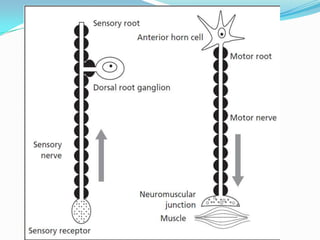
 A nerve conduction study (NCS) : is a test used to
 evaluate/ detect the function of motor and sensory
 nerves of the human body.

 Nerve conduction velocity (NCV): is a common
 measurement made during this test.
 The nerve conduction studies most commonly
 performed are compound muscle action potentials
 (CMAPs) for motor nerves, sensory nerve action
 potentials (SNAPs) for sensory nerves, compound
 nerve action potentials (CNAPs) for mixed (sensory
 and motor) nerves and late responses (primarily F-
 waves and H-reflexes).
Components :
   MNCS
   F WAVE RESPONSE
   SNCS
   H REFLEX
   REPETITIVE STIMULUS TEST-decrement
   EVOKED POTENTIALS
          SSEP
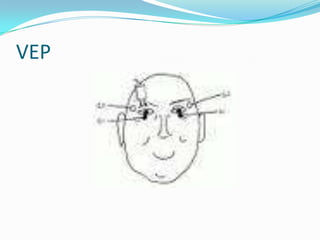
          VEP
          BAEP
NCS
 Latency      Latency – time interval between the
 Velocity      onset of a stimulus and the onset of a
 amplitude     response (can also be referred to as a
                motor latency or a sensory latency).
               Amplitude – the maximal height of
                the action potential.
               Conduction velocity – how fast the
                fastest part of the impulse travels (can
                also be referred to as a motor
                conduction velocity or a sensory
                conduction velocity).
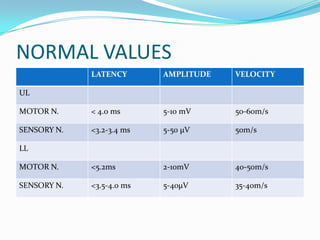
NORMAL VALUES
             LATENCY       AMPLITUDE   VELOCITY

UL

MOTOR N.     < 4.0 ms      5-10 mV     50-60m/s

SENSORY N.   <3.2-3.4 ms   5-50 µV     50m/s

LL

MOTOR N.     <5.2ms        2-10mV      40-50m/s

SENSORY N.   <3.5-4.0 ms   5-40µV      35-40m/s
CMAP
ELECTRODE PLACEMENT
 ACTIVE ELECTRODE : placed on the motor point of
  the muscle
 REFERENCE ELECTRODE : placed nearby tendon or
  bone
 GROUND ELECTRODE : in between active and
  reference electrode
B. DISK ELECTRODE


A. GROUND ELECTRODE


             C. RING ELECTRODE
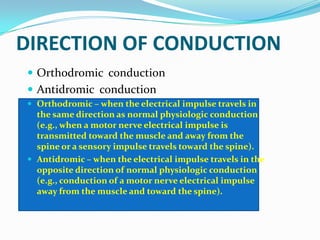
DIRECTION OF CONDUCTION
 Orthodromic conduction
 Antidromic conduction
 Orthodromic – when the electrical impulse travels in
  the same direction as normal physiologic conduction
  (e.g., when a motor nerve electrical impulse is
  transmitted toward the muscle and away from the
  spine or a sensory impulse travels toward the spine).
 Antidromic – when the electrical impulse travels in the
  opposite direction of normal physiologic conduction
  (e.g., conduction of a motor nerve electrical impulse
  away from the muscle and toward the spine).
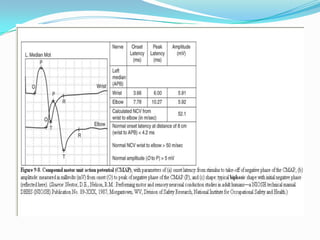
M-WAVE
 Orthodromically   stimulated motor response known
  as CMAP
 Supramaximal stimulus
 MNCV =
      distance between 2 stimulus sites
        difference between 2 latency
 USES :
    When all motor fibers undergo Demyelination
           long latency
           Slow NCV
    Partial demyelination
        Normal latency and velocity

        Reduced amplitude

    Well marked demyelination
        Absence of conduction

    Axonal degeneration
        Reduced amplitude

    Neuropraxia
        Distal to the lesion – normal NCV

        Proximal to the lesion – reduced conduction velocity
F-WAVE
  A compound muscle action potential evoked by
 antidromically stimulating a motor nerve from a
 muscle using maximal electrical stimulus. It
 represents the time required for a stimulus to travel
 antidromically toward the spinal cord and return
 orthodromically to the muscle along a very small
 percentage of the fibers
 F wave latency :
      median nerve – 22.34 ms
      ulnar nerve – 23.32ms
      peroneal nerve – 40.56ms
      tibial nerve – 38.58ms
F –wave latency in GBS
 USES :

    A prolonged asymmetric F waves suggest a proximal root lesion.

    Clinical application best for plexopathy.
              Quite prolonged in demyelination and mild prolongation in
               axonal injury.

    Assesses proximal neuropathology
    Eg:
              GBS
              Thoracic outlet syndrome
              Charcot’s Mary-tooth disease
              proximal nerve entrapment
SNCV
 It is performed by electrical stimulation of a peripheral
    nerve and recording from a purely sensory portion of
    the nerve, such as on a finger.
   14 cm standard distance is used
   Threshold level stimulus is required
   sensory latencies are on the scale of milliseconds(ms).
   sensory amplitude are on microvolt range.
 2 TYPES :
     ORTHODROMIC TESTS
     ANTIDROMIC TESTS
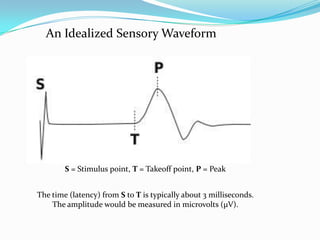
An Idealized Sensory Waveform


        S = Stimulus point, T = Takeoff point, P = Peak


The time (latency) from S to T is typically about 3 milliseconds.
    The amplitude would be measured in microvolts (μV).
H-REFLEX
          A     compound      muscle     action
   potential evoked by orthodromically
   Stimulating sensory fibers, synapsing at the
   spinal level and returning Orthodromically
   via motor fibers. The response is thought to
   be due to a Monosynaptic spinal reflex
   (hoffmann reflex) found in normal adults
   in the Gastrocnemius-soleus and flexor
   carpi radialis muscles.
4. H - REFLEX
 Assesses continuity and function of sensory and
  motor monosynaptic pathway of 1st sacral nerve
  root
 Submaximal stimulus/LONG LATENCY-
  29.8ms
 Disappears during supra maximal stimulus
 H-reflex study uses stimulation of a nerve and
  recording the reflex electrical discharge from a
  muscle in the limb.
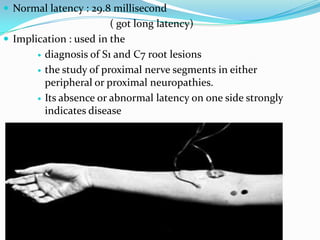
H -reflex
 Normal latency : 29.8 millisecond
                        ( got long latency)
 Implication : used in the
        diagnosis of S1 and C7 root lesions

        the study of proximal nerve segments in either
         peripheral or proximal neuropathies.
        Its absence or abnormal latency on one side strongly
         indicates disease
REPETITIVE STIMULATION
 Repeated electrical stimulus applied to the motor
  neuron at a rate of 3-5 / second , the amplitude of the
  recorded muscle response is constant
 Decrement of more than 10% is abnormal
 Supramaximal stimulus
 Used to find NMJ abnormalities
   Eg: myaesthenia gravis
       Lambert Eaton syndrome
 MMEP is measured
REPETITIVE STIMULATION


       A repetitive nerve stimulation study
      demonstrating a 61 percent decrement in
      area and a 54 percent decrement in
      amplitude from the first to the fourth
      stimulation.
EVOKED POTENTIALS
 Assessing the electrical activity in CNS
Modified 10-20 System
Evoked Potentials
VEP
SSEP

Electrodiagnosis 2

  • 1.
    WHAT IS NCS?  A nerve conduction study (NCS) : is a test used to evaluate/ detect the function of motor and sensory nerves of the human body.  Nerve conduction velocity (NCV): is a common measurement made during this test.
  • 2.
     The nerveconduction studies most commonly performed are compound muscle action potentials (CMAPs) for motor nerves, sensory nerve action potentials (SNAPs) for sensory nerves, compound nerve action potentials (CNAPs) for mixed (sensory and motor) nerves and late responses (primarily F- waves and H-reflexes).
  • 6.
    Components :  MNCS  F WAVE RESPONSE  SNCS  H REFLEX  REPETITIVE STIMULUS TEST-decrement  EVOKED POTENTIALS  SSEP  VEP  BAEP
  • 7.
    NCS  Latency  Latency – time interval between the  Velocity onset of a stimulus and the onset of a  amplitude response (can also be referred to as a motor latency or a sensory latency).  Amplitude – the maximal height of the action potential.  Conduction velocity – how fast the fastest part of the impulse travels (can also be referred to as a motor conduction velocity or a sensory conduction velocity).
  • 8.
    NORMAL VALUES LATENCY AMPLITUDE VELOCITY UL MOTOR N. < 4.0 ms 5-10 mV 50-60m/s SENSORY N. <3.2-3.4 ms 5-50 µV 50m/s LL MOTOR N. <5.2ms 2-10mV 40-50m/s SENSORY N. <3.5-4.0 ms 5-40µV 35-40m/s
  • 9.
  • 11.
    ELECTRODE PLACEMENT  ACTIVEELECTRODE : placed on the motor point of the muscle  REFERENCE ELECTRODE : placed nearby tendon or bone  GROUND ELECTRODE : in between active and reference electrode
  • 13.
    B. DISK ELECTRODE A.GROUND ELECTRODE C. RING ELECTRODE
  • 14.
    DIRECTION OF CONDUCTION Orthodromic conduction  Antidromic conduction  Orthodromic – when the electrical impulse travels in the same direction as normal physiologic conduction (e.g., when a motor nerve electrical impulse is transmitted toward the muscle and away from the spine or a sensory impulse travels toward the spine).  Antidromic – when the electrical impulse travels in the opposite direction of normal physiologic conduction (e.g., conduction of a motor nerve electrical impulse away from the muscle and toward the spine).
  • 17.
    M-WAVE  Orthodromically stimulated motor response known as CMAP  Supramaximal stimulus  MNCV = distance between 2 stimulus sites difference between 2 latency
  • 21.
     USES :  When all motor fibers undergo Demyelination  long latency  Slow NCV  Partial demyelination  Normal latency and velocity  Reduced amplitude  Well marked demyelination  Absence of conduction  Axonal degeneration  Reduced amplitude  Neuropraxia  Distal to the lesion – normal NCV  Proximal to the lesion – reduced conduction velocity
  • 22.
    F-WAVE Acompound muscle action potential evoked by antidromically stimulating a motor nerve from a muscle using maximal electrical stimulus. It represents the time required for a stimulus to travel antidromically toward the spinal cord and return orthodromically to the muscle along a very small percentage of the fibers
  • 23.
     F wavelatency : median nerve – 22.34 ms ulnar nerve – 23.32ms peroneal nerve – 40.56ms tibial nerve – 38.58ms
  • 24.
  • 25.
     USES :  A prolonged asymmetric F waves suggest a proximal root lesion.  Clinical application best for plexopathy.  Quite prolonged in demyelination and mild prolongation in axonal injury.  Assesses proximal neuropathology  Eg:  GBS  Thoracic outlet syndrome  Charcot’s Mary-tooth disease  proximal nerve entrapment
  • 26.
    SNCV  It isperformed by electrical stimulation of a peripheral nerve and recording from a purely sensory portion of the nerve, such as on a finger.  14 cm standard distance is used  Threshold level stimulus is required  sensory latencies are on the scale of milliseconds(ms).  sensory amplitude are on microvolt range.  2 TYPES :  ORTHODROMIC TESTS  ANTIDROMIC TESTS
  • 27.
    An Idealized SensoryWaveform S = Stimulus point, T = Takeoff point, P = Peak The time (latency) from S to T is typically about 3 milliseconds. The amplitude would be measured in microvolts (μV).
  • 29.
    H-REFLEX A compound muscle action potential evoked by orthodromically Stimulating sensory fibers, synapsing at the spinal level and returning Orthodromically via motor fibers. The response is thought to be due to a Monosynaptic spinal reflex (hoffmann reflex) found in normal adults in the Gastrocnemius-soleus and flexor carpi radialis muscles.
  • 30.
    4. H -REFLEX  Assesses continuity and function of sensory and motor monosynaptic pathway of 1st sacral nerve root  Submaximal stimulus/LONG LATENCY- 29.8ms  Disappears during supra maximal stimulus  H-reflex study uses stimulation of a nerve and recording the reflex electrical discharge from a muscle in the limb.
  • 32.
  • 33.
     Normal latency: 29.8 millisecond ( got long latency)  Implication : used in the  diagnosis of S1 and C7 root lesions  the study of proximal nerve segments in either peripheral or proximal neuropathies.  Its absence or abnormal latency on one side strongly indicates disease
  • 36.
    REPETITIVE STIMULATION  Repeatedelectrical stimulus applied to the motor neuron at a rate of 3-5 / second , the amplitude of the recorded muscle response is constant  Decrement of more than 10% is abnormal  Supramaximal stimulus  Used to find NMJ abnormalities  Eg: myaesthenia gravis Lambert Eaton syndrome  MMEP is measured
  • 37.
    REPETITIVE STIMULATION A repetitive nerve stimulation study demonstrating a 61 percent decrement in area and a 54 percent decrement in amplitude from the first to the fourth stimulation.
  • 38.
    EVOKED POTENTIALS  Assessingthe electrical activity in CNS
  • 39.
  • 40.
  • 41.
  • 42.