Pusher Syndrome
Ade Wijaya, MD – June 2019
Definition:
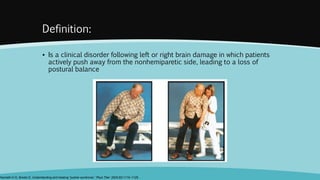
▪ Is a clinical disorder following left or right brain damage in which patients
actively push away from the nonhemiparetic side, leading to a loss of
postural balance
Karnath H-O, Broetz D. Understanding and treating “pusher syndrome.” Phys Ther. 2003;83:1119–1125.
Introduction
▪ 1985 (Patricia Davies), stroke patients use their non paretic extremities to
push toward the paretic side  loss lateral postural balance  fall toward
the hemiparetic side
▪ Forceful resistance against interventions aiming to correct their tilted
posture
▪ 10,4 % patients
▪ More common in right side stroke
Davies PM. Steps to Follow: A Guide to the Treatment of Adult Hemiplegia. New York, NY: Springer; 1985.
Pedersen PM, Wandel A, Jorgensen HS, et al. Ipsilateral pushing in stroke: incidence, relation to neuropsychological symptoms, and impact on rehabilitation—the Copenhagen stroke study. Arch Phys Med Rehabil. 1996;77:25–28.
Pusher Syndrome vs Disequilibrum
Push toward the
paretic side
Cling to something
with their
nonparetic hand
Bohannon RW, Smith MB, Larkin PA. Relationship between independent sitting balance and side of hemiparesis. Phys Ther. 1986;66: 944–945.
Dettmann MA, Linder MT, Sepic SB. Relationships among walking performance, postural stability, and functional assessment of the hemiplegic patient. Am J Phys Med. 1987;66:77–90.
Patophysiology
▪ Posterolateral thalamus
▪ Altered perception of the body’s orientation in relation to gravity
Karnath H-O, Broetz D. Understanding and treating “pusher syndrome.” Phys Ther. 2003;83:1119–1125.
Diagnosis
▪ 1) spontaneous body posture
▪ 2) increase of pushing force by spreading of the nonparetic extremities from
the body
▪ 3) resistance to passive correction of posture
Karnath H-O, Broetz D. Understanding and treating “pusher syndrome.” Phys Ther. 2003;83:1119–1125.
Karnath H-O, Ferber S, Dichgans J. The origin of contraversive pushing: evidence for a second graviceptive system in humans. Neurology. 2000;55:1298–1304.
Karnath H-O, Broetz D, Goetz A. Klinik, Ursache und Therapie der Pusher-Symptomatik. Nervenarzt. 2001;72:86–92.
Treatment
▪ Realize the disturbed perception of erect body position.
▪ Visually explore the surroundings and the body’s relation to the
surroundings. (Ensure that the patient sees whether he or she is oriented
upright). We suggest that the physical therapist use visual aids that give
feedback about body orientation and work in a room containing many
vertical structures, such as door frames, windows, pillars, and so on.
▪ Learn the movements necessary to reach a vertical body position.
▪ Maintain the vertical body position while performing other activities.
Karnath H-O, Broetz D. Understanding and treating “pusher syndrome.” Phys Ther. 2003;83:1119–1125.
Prognosis
▪ At the time of admission to the hospital following the stroke, patients with
contraversive pushing have a more severely impaired level of
consciousness and ability to walk, paresis of the upper and lower
extremities, and lower initial function in activities of daily living than
patients with hemiparesis but without contraversive pushing
▪ Good prognosis at 6 months
Pedersen PM, Wandel A, Jorgensen HS, et al. Ipsilateral pushing in stroke: incidence, relation to neuropsychological symptoms, and impact on rehabilitation—the Copenhagen stroke study. Arch Phys Med Rehabil. 1996;77:25–28.
Karnath H-O, Johannsen L, Broetz D, et al. Prognosis of contraversive pushing. J Neurol. 2002;249:1250–1253.
Summary
▪ Push away from the non paretic side  lost of postural balance
▪ Posterolateral thalamus
▪ Altered perception of the body’s orientation in relation to gravity
▪ Good prognosis
Pusher Syndrome

Pusher Syndrome

  • 1.
  • 2.
    Definition: ▪ Is aclinical disorder following left or right brain damage in which patients actively push away from the nonhemiparetic side, leading to a loss of postural balance Karnath H-O, Broetz D. Understanding and treating “pusher syndrome.” Phys Ther. 2003;83:1119–1125.
  • 3.
    Introduction ▪ 1985 (PatriciaDavies), stroke patients use their non paretic extremities to push toward the paretic side  loss lateral postural balance  fall toward the hemiparetic side ▪ Forceful resistance against interventions aiming to correct their tilted posture ▪ 10,4 % patients ▪ More common in right side stroke Davies PM. Steps to Follow: A Guide to the Treatment of Adult Hemiplegia. New York, NY: Springer; 1985. Pedersen PM, Wandel A, Jorgensen HS, et al. Ipsilateral pushing in stroke: incidence, relation to neuropsychological symptoms, and impact on rehabilitation—the Copenhagen stroke study. Arch Phys Med Rehabil. 1996;77:25–28.
  • 4.
    Pusher Syndrome vsDisequilibrum Push toward the paretic side Cling to something with their nonparetic hand Bohannon RW, Smith MB, Larkin PA. Relationship between independent sitting balance and side of hemiparesis. Phys Ther. 1986;66: 944–945. Dettmann MA, Linder MT, Sepic SB. Relationships among walking performance, postural stability, and functional assessment of the hemiplegic patient. Am J Phys Med. 1987;66:77–90.
  • 5.
    Patophysiology ▪ Posterolateral thalamus ▪Altered perception of the body’s orientation in relation to gravity Karnath H-O, Broetz D. Understanding and treating “pusher syndrome.” Phys Ther. 2003;83:1119–1125.
  • 6.
    Diagnosis ▪ 1) spontaneousbody posture ▪ 2) increase of pushing force by spreading of the nonparetic extremities from the body ▪ 3) resistance to passive correction of posture Karnath H-O, Broetz D. Understanding and treating “pusher syndrome.” Phys Ther. 2003;83:1119–1125.
  • 7.
    Karnath H-O, FerberS, Dichgans J. The origin of contraversive pushing: evidence for a second graviceptive system in humans. Neurology. 2000;55:1298–1304. Karnath H-O, Broetz D, Goetz A. Klinik, Ursache und Therapie der Pusher-Symptomatik. Nervenarzt. 2001;72:86–92.
  • 8.
    Treatment ▪ Realize thedisturbed perception of erect body position. ▪ Visually explore the surroundings and the body’s relation to the surroundings. (Ensure that the patient sees whether he or she is oriented upright). We suggest that the physical therapist use visual aids that give feedback about body orientation and work in a room containing many vertical structures, such as door frames, windows, pillars, and so on. ▪ Learn the movements necessary to reach a vertical body position. ▪ Maintain the vertical body position while performing other activities. Karnath H-O, Broetz D. Understanding and treating “pusher syndrome.” Phys Ther. 2003;83:1119–1125.
  • 9.
    Prognosis ▪ At thetime of admission to the hospital following the stroke, patients with contraversive pushing have a more severely impaired level of consciousness and ability to walk, paresis of the upper and lower extremities, and lower initial function in activities of daily living than patients with hemiparesis but without contraversive pushing ▪ Good prognosis at 6 months Pedersen PM, Wandel A, Jorgensen HS, et al. Ipsilateral pushing in stroke: incidence, relation to neuropsychological symptoms, and impact on rehabilitation—the Copenhagen stroke study. Arch Phys Med Rehabil. 1996;77:25–28. Karnath H-O, Johannsen L, Broetz D, et al. Prognosis of contraversive pushing. J Neurol. 2002;249:1250–1253.
  • 10.
    Summary ▪ Push awayfrom the non paretic side  lost of postural balance ▪ Posterolateral thalamus ▪ Altered perception of the body’s orientation in relation to gravity ▪ Good prognosis