A. Thangamani ramalingam
PT, MSc(psy),PGDRM,
ACspss MIAP
Objectives
• Research problem : Statement of research
problem., Statement of purpose and
objectives of research problem, Necessity of
defining the problem.
Research problem
• A research problem, in general, refers to some
difficulty which a researcher experiences in the context
of either a theoretical or practical situation and wants
to obtain a solution for the same.
• A research problem is a statement about an area of
concern
• The selection of a problem is governed by reflective
thinking (convergent, divergent, reflective and scientific
thinking). In reflective thinking individual conceived for
a new solution for an old problem
Statement of research problem(5Ws)
• A clear concise
description of the issue
• one or two sentences in
length that outlines the
problem addressed by the
study
A good problem statement
• What is the problem?
• Who is the client?
• What form can the
resolution be?
• Research-worthy problem
statement should address
all six questions: what,
how, where, when, why,
and who.
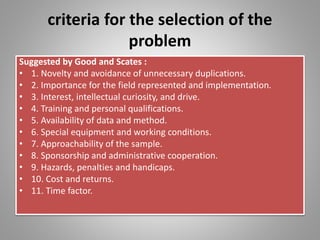
criteria for the selection of the
problem
Suggested by Good and Scates :
• 1. Novelty and avoidance of unnecessary duplications.
• 2. Importance for the field represented and implementation.
• 3. Interest, intellectual curiosity, and drive.
• 4. Training and personal qualifications.
• 5. Availability of data and method.
• 6. Special equipment and working conditions.
• 7. Approachability of the sample.
• 8. Sponsorship and administrative cooperation.
• 9. Hazards, penalties and handicaps.
• 10. Cost and returns.
• 11. Time factor.
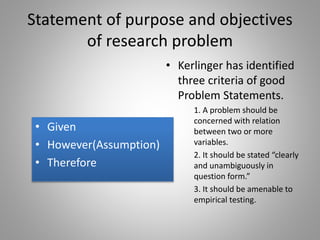
Statement of purpose and objectives
of research problem
• Given
• However(Assumption)
• Therefore
• Kerlinger has identified
three criteria of good
Problem Statements.
1. A problem should be
concerned with relation
between two or more
variables.
2. It should be stated “clearly
and unambiguously in
question form.”
3. It should be amenable to
empirical testing.
Problem statement models
• Action-knowledge conflict
• knowledge-knowledge conflict
• Policy-Action conflict(knowledge void)
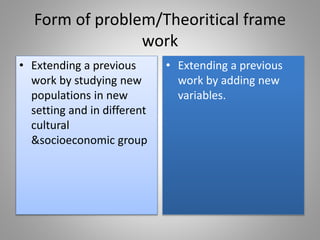
Form of problem/Theoritical frame
work
• Extending a previous
work by studying new
populations in new
setting and in different
cultural
&socioeconomic group
• Extending a previous
work by adding new
variables.
• Hildreth Hoke McAshan has proposed an objective
guide for judging the merits of a problem
1. Is the problem really important?
2. Is the problem interesting to others?
3. Is the chosen problem a real problem?
4. Does the problem display originality and creativeness?
5. Am I really concerned with finding the solution?
6. Am I able to state hypotheses from the problem in a testable form?
7. Will I learn something new from this problem?
8. Do I understand the relationship of this specific problem to the broader
problem area?
9. Will be able to select a sample from which I can generalize to some
population?
10. Will some other intelligent person be able to replicate the study?
11. Will my proposed data-gathering instruments actually give the
Information which I want?
12. Is the study, including the application of its results, practical? The number
of affirmative answers should be required for a suitable problem
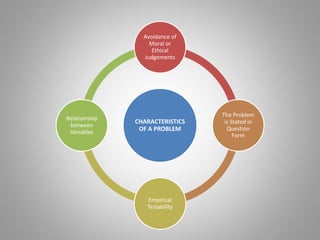
CHARACTERISTICS
OF A PROBLEM
Avoidance of
Moral or
Ethical
Judgements
The Problem
is Stated in
Question
Form
Empirical
Testability
Relationship
between
Variables
Necessity of defining the problem.
• To avoid deviating from the goal, The definition of
a problem sets the direction of the study
• To derive the objectives
• Proper methodology selection of the study.
• Selection of variables of the study.
• Clarity for the readers
• The definition helps the researcher to control
subjectivity or biases of the researcher.
• Makes the study feasible

Research problem

  • 1.
    A. Thangamani ramalingam PT,MSc(psy),PGDRM, ACspss MIAP
  • 2.
    Objectives • Research problem: Statement of research problem., Statement of purpose and objectives of research problem, Necessity of defining the problem.
  • 3.
    Research problem • Aresearch problem, in general, refers to some difficulty which a researcher experiences in the context of either a theoretical or practical situation and wants to obtain a solution for the same. • A research problem is a statement about an area of concern • The selection of a problem is governed by reflective thinking (convergent, divergent, reflective and scientific thinking). In reflective thinking individual conceived for a new solution for an old problem
  • 4.
    Statement of researchproblem(5Ws) • A clear concise description of the issue • one or two sentences in length that outlines the problem addressed by the study A good problem statement • What is the problem? • Who is the client? • What form can the resolution be? • Research-worthy problem statement should address all six questions: what, how, where, when, why, and who.
  • 5.
    criteria for theselection of the problem Suggested by Good and Scates : • 1. Novelty and avoidance of unnecessary duplications. • 2. Importance for the field represented and implementation. • 3. Interest, intellectual curiosity, and drive. • 4. Training and personal qualifications. • 5. Availability of data and method. • 6. Special equipment and working conditions. • 7. Approachability of the sample. • 8. Sponsorship and administrative cooperation. • 9. Hazards, penalties and handicaps. • 10. Cost and returns. • 11. Time factor.
  • 6.
    Statement of purposeand objectives of research problem • Given • However(Assumption) • Therefore • Kerlinger has identified three criteria of good Problem Statements. 1. A problem should be concerned with relation between two or more variables. 2. It should be stated “clearly and unambiguously in question form.” 3. It should be amenable to empirical testing.
  • 7.
    Problem statement models •Action-knowledge conflict • knowledge-knowledge conflict • Policy-Action conflict(knowledge void)
  • 8.
    Form of problem/Theoriticalframe work • Extending a previous work by studying new populations in new setting and in different cultural &socioeconomic group • Extending a previous work by adding new variables.
  • 9.
    • Hildreth HokeMcAshan has proposed an objective guide for judging the merits of a problem 1. Is the problem really important? 2. Is the problem interesting to others? 3. Is the chosen problem a real problem? 4. Does the problem display originality and creativeness? 5. Am I really concerned with finding the solution? 6. Am I able to state hypotheses from the problem in a testable form? 7. Will I learn something new from this problem? 8. Do I understand the relationship of this specific problem to the broader problem area? 9. Will be able to select a sample from which I can generalize to some population? 10. Will some other intelligent person be able to replicate the study? 11. Will my proposed data-gathering instruments actually give the Information which I want? 12. Is the study, including the application of its results, practical? The number of affirmative answers should be required for a suitable problem
  • 10.
    CHARACTERISTICS OF A PROBLEM Avoidanceof Moral or Ethical Judgements The Problem is Stated in Question Form Empirical Testability Relationship between Variables
  • 11.
    Necessity of definingthe problem. • To avoid deviating from the goal, The definition of a problem sets the direction of the study • To derive the objectives • Proper methodology selection of the study. • Selection of variables of the study. • Clarity for the readers • The definition helps the researcher to control subjectivity or biases of the researcher. • Makes the study feasible