Chapter 2. Research
Design
DR. ANITA RATHOD
Content:
 Meaning and Definition
 Objectives & limitations
 Essentials of good Research Design
 Process of Research
Definitions of Research design:
 According to Miller, “Research Design is the
planned sequence of the entire process involved in
conducting a research study”.
 According to P.V. Young, “Research design is the
logical and systematic planning and directing of a
piece of research.”
 According to E.A. Suchman ,“A research design
is not a highly specific plan to be followed without
deviation, but rather a series of guide posts to
keep one headed in the right direction.”
 According to Ackoff ,“Research Design is the
process of making decisions before the situation
arises in which the decision has to be carried out.
It is a process of deliberate anticipation directed
towards bringing an unexpected situation under
control.”
 According to Jahoda, Deutsch and Cook, “A
research design is the arrangement of conditions
for collection and analysis of data in a manner that
alms to combine relevance to the research purpose
with economy in procedure.”
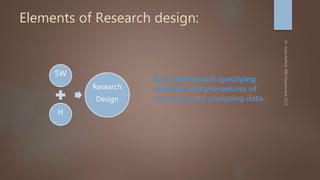
Elements of Research design:
5W
H
Research
Design
Basic framework specifying
methods and procedures of
collecting and analyzing data.
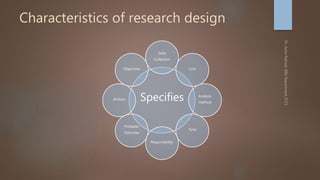
Characteristics of research design
Specifies
Data
Collection
Cost
Analysis
method
Time
Responsibility
Probable
Outcome
Actions
Objectives
Objectives of Research Design
 To provide answers to the research questions
 To control variance.
 To arrive at an objective, accurate, valid and economic solution of the
given problem to the maximum possible extent.
 To provide the research with a valid test of the hypothesis on the basis of
empirical evidence obtained by the researcher by utilizing the least amount
of money, manpower and time and maximum possibility of its being
approved by other investigators engaged in the given area of investigation.
 it also indicates whether or not the variables of the research are to be
manipulated or selected, what specific values of the manipulated or
selected variables are to be utilized in the scientific investigation, how a
conceptual variable can be converted into observable facts.
Need of Research Design
(TO give answers to the following questions)
 (i) What is the study about and what type of data are required?
 (ii) What is the purpose of the study? What is its scope?
 (iii) What are the sources of the needed data?
 (iv) What should be the place or area of study?
 (v) What time, approximately, is required for the study?
 (vi) What should be the amount of material or number of
cases for the study?
 (vii) What type of sampling should be used?
 (viii) What method of data collection would be appropriate?
 (ix) How will the data be analyzed?
 (xi) What would be the methodology of study?
 (xii) What should be the specific nature of study?
Essentials of good Research Design
 Objectives: The findings are said to be objective when they pertain to the
method of data collection and the scoring of the responses. The objectivity
in respect of the procedure may be judged by the degree of agreement
between the final scores assigned to various persons by more than one
independent observer. The more the agreement among the observers the
more objective are the observation, recording and evaluation of the
responses. Therefore, a good research design should permit fairly
objectives measuring instruments in which every observer visualizing a
performance comes to the same conclusion.
 Reliability: The question of reliability of knowledge is usually raised when
the presence of a problem arouses in the knower a demand, not only for
something more than mere conjecture, but for something for which it shall
be useful in a given situation and perhaps in other similar situations.
Reliable knowledge means any claim that is substantiated as trustworthy
for a given purpose.
 Validity: Validity implies self-consistency or absence of self-contradiction.
It is identified with formal truth or self-consistency. A valid reasoning
conforms to the rules of correct reasoning. It is that type of reasoning
where conclusions automatically follow from the premises legitimately.
 Generalisability: The degree of generalisability is known in terms of the
replicability and reproducibility of the findings in spite of different
measures and settings respectively.
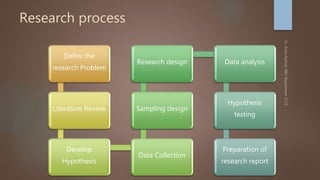
Research process
Definr the
research Problem
Literature Review
Develop
Hypothesis
Data Collection
Sampling design
Research design Data analysis
Hypothesis
testing
Preparation of
research report
Example (job satisfaction of
employees)
 What exactly you want to find out (problem)?
 Go through all available information available to you.
 Create assumptions (hypothesis)
 Step by step procedure to follow research
 Universe, population, samples
 Sources of data collection
 Interprete the collected data
 Use tools such as chi square, z test, ANOVA etc..
 Prepare research report.

Research Design, Process of research with examples

  • 1.
  • 2.
    Content:  Meaning andDefinition  Objectives & limitations  Essentials of good Research Design  Process of Research
  • 3.
    Definitions of Researchdesign:  According to Miller, “Research Design is the planned sequence of the entire process involved in conducting a research study”.  According to P.V. Young, “Research design is the logical and systematic planning and directing of a piece of research.”
  • 4.
     According toE.A. Suchman ,“A research design is not a highly specific plan to be followed without deviation, but rather a series of guide posts to keep one headed in the right direction.”  According to Ackoff ,“Research Design is the process of making decisions before the situation arises in which the decision has to be carried out. It is a process of deliberate anticipation directed towards bringing an unexpected situation under control.”
  • 5.
     According toJahoda, Deutsch and Cook, “A research design is the arrangement of conditions for collection and analysis of data in a manner that alms to combine relevance to the research purpose with economy in procedure.”
  • 6.
    Elements of Researchdesign: 5W H Research Design Basic framework specifying methods and procedures of collecting and analyzing data.
  • 7.
    Characteristics of researchdesign Specifies Data Collection Cost Analysis method Time Responsibility Probable Outcome Actions Objectives
  • 8.
    Objectives of ResearchDesign  To provide answers to the research questions  To control variance.  To arrive at an objective, accurate, valid and economic solution of the given problem to the maximum possible extent.  To provide the research with a valid test of the hypothesis on the basis of empirical evidence obtained by the researcher by utilizing the least amount of money, manpower and time and maximum possibility of its being approved by other investigators engaged in the given area of investigation.  it also indicates whether or not the variables of the research are to be manipulated or selected, what specific values of the manipulated or selected variables are to be utilized in the scientific investigation, how a conceptual variable can be converted into observable facts.
  • 9.
    Need of ResearchDesign (TO give answers to the following questions)  (i) What is the study about and what type of data are required?  (ii) What is the purpose of the study? What is its scope?  (iii) What are the sources of the needed data?  (iv) What should be the place or area of study?  (v) What time, approximately, is required for the study?  (vi) What should be the amount of material or number of cases for the study?  (vii) What type of sampling should be used?  (viii) What method of data collection would be appropriate?  (ix) How will the data be analyzed?  (xi) What would be the methodology of study?  (xii) What should be the specific nature of study?
  • 10.
    Essentials of goodResearch Design  Objectives: The findings are said to be objective when they pertain to the method of data collection and the scoring of the responses. The objectivity in respect of the procedure may be judged by the degree of agreement between the final scores assigned to various persons by more than one independent observer. The more the agreement among the observers the more objective are the observation, recording and evaluation of the responses. Therefore, a good research design should permit fairly objectives measuring instruments in which every observer visualizing a performance comes to the same conclusion.  Reliability: The question of reliability of knowledge is usually raised when the presence of a problem arouses in the knower a demand, not only for something more than mere conjecture, but for something for which it shall be useful in a given situation and perhaps in other similar situations. Reliable knowledge means any claim that is substantiated as trustworthy for a given purpose.
  • 11.
     Validity: Validityimplies self-consistency or absence of self-contradiction. It is identified with formal truth or self-consistency. A valid reasoning conforms to the rules of correct reasoning. It is that type of reasoning where conclusions automatically follow from the premises legitimately.  Generalisability: The degree of generalisability is known in terms of the replicability and reproducibility of the findings in spite of different measures and settings respectively.
  • 12.
    Research process Definr the researchProblem Literature Review Develop Hypothesis Data Collection Sampling design Research design Data analysis Hypothesis testing Preparation of research report
  • 13.
    Example (job satisfactionof employees)  What exactly you want to find out (problem)?  Go through all available information available to you.  Create assumptions (hypothesis)  Step by step procedure to follow research  Universe, population, samples  Sources of data collection  Interprete the collected data  Use tools such as chi square, z test, ANOVA etc..  Prepare research report.