





RESEARCH METHODOLOGY
DR. NIRAJ KUMAR
ASSOCIATE PROFESSOR PHYSIOTHERAPY DEPT.
SHRI GURU RAM RAI INSTITUTE OF MEDICAL AND
HEALTH SCIENCES
•Clinical research is a structured process of investigating facts
and theories.
•It is a method of answering the questions in a systematic and
objective way to examine clinical conditions and outcomes.
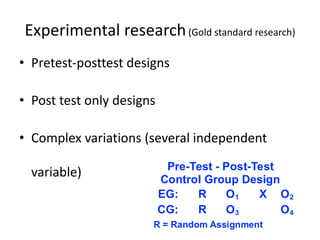
Experimental research(Gold standard research)
• Pretest-posttest designs
• Post test only designs
• Complex variations (several independent
variable)
Experimental research
• Quasi experimental designs
• Sequential clinical trials
• Single case experimental designs
Non-Experimental research
Descriptive
or
Exploratory
Descriptive research
• Systematically describe and interpret conditions or
relationships that already exist.
• Involves questionnaires, , interviews or direct observation
Correlational research
• Used to examine the extent to which variation in
one variable corresponds with variation in one or
more other factors.
Epidemiology
• Concerned with the risk of disease or disability
associated with specific exposures.
– Surveys
– Experimental studies
– Correlational studies
Evaluation research
• An objective and empirical assessment of the
success of a program or policy in meeting its
goal and objectives.
• Used to assist
– Decision making
– Determining if a clinical program should be
implemented, continued, or modified
Methodological research
• Involves the development and validation of
measurement tools used in practice and
clinical research.
Purpose of a research design
Provide information regarding:
• What is the study?
• Why is the study being carried out?
• Where will the study be carried out?
• How will the study be carried out?
• What will be the processes and tasks involved?
• What will be the data?
• How will the data be collected?
• What methods of sampling will be used? and
• How will the analysis be done?
Functions of the research design
• Provide a plan to undertake systematic study
and help to provide procedures to undertake
the research work; and
• Ensure objective, valid, and economic
undertaking of the study.
Types of research design
Factors
• Nature of investigation,
• Data collection methods,
• Number of contacts made with the subjects,
• and the Period of reference
Nature of Investigation
• Exploratory
• Descriptive
• Experimental
• Semi or Quasi- experimental
• Non- experimental and
• Field research.
Data Collection Methods
• Survey
• Case studies and
• Content analysis
Definitions of Study Design
• Case–control study
– Retrospective comparison of exposures of persons with disease (cases) with those of persons
without the disease (controls). (Harm/Etiology) (EBM Toolkit, 2008)
• Case–series
– Report of a number of cases of disease. (Harm/Etiology) (EBM Toolkit, 2008)
• Cohort study
– A study that begins with the gathering of two matched groups (the cohorts), one which has
been exposed to a prognostic factor, risk factor, or intervention and one which has not. The
groups are then followed forward in time (prospective) to measure the development of
different outcomes. In a retrospective cohort study, cohorts are identified at a point of time in
the past and information is collected on their subsequent outcomes. (Diagnosis, Harm/Etiology,
Prognosis, Therapy) (EBM Toolkit, 2008)
• Meta–analysis
– Broad term that includes reports that collect and synthesize data from individual studies to
provide new information. (McKibbon, 2009)
3/29/2019 15
The research plan
Title
• Concise and informative
• Has an independent variable, dependent
variable and the sample.
Abstract
• Should be in one page
• It includes
– A brief description of the method
– Procedures
– Methods for data analysis
– The proposed duration of the study and overall
projected costs may be stated
Statement of the research problem
– Rationale and justification for the study
• Why the study was needed?
– Significance of the study
• What is the use?
Statement of the purpose of the
study
• Specific aims or objectives
– Help the researcher guide the discussion of results
when the study is completed (comparative,
correlational, reliability of an instrument and the
relationships)
• Research hypotheses or guiding questions
– Positive or negative
Aim
• to map, to develop, to design, to track, to
generate, to theorize, to build …
• Sometimes ‘to investigate, to understand, and
to explore…
• to synthesize, to catalogue, to challenge, to
critically interrogate …
Objectives
• There are usually more than one, are the
specific steps you will take to achieve your
aim.
Objectives
• Objectives are often expressed through active
sentences. So, objectives often start something like In
order to achieve this aim, I will… collect, construct,
produce, test, trial, measure, document, pilot,
deconstruct, analyse…
• The list of objectives spells out what you actually and
really will do to get to the point of it all.
• Objectives have to be practical, do-able and
achievable.
Background of the study
• Topics for review of literature related to
– Theory and supportive rational
– Related studies
– Methods
• Previous work by the investigator that supports
the project
Method
• Subjects : Characteristics, sampling method, plans for recruitment
• Materials: instrumentation, plans to establish reliability and validity
• Procedures
– Study design
– Details of test and treatment administration
– Data collection methods
– Timetable and organizational chart
• Data management and analysis
Literature cited
References should be in any one of the format
Vancouver
Harvard
Sampling
Population
• The larger group to which research results are
generalized is called a population.
– Defined aggregate of Objects
– Persons
– Places
– Organizations, animals, days etc.
Sample
• Through a process of
sampling, a researcher
chooses a subgroup of the
population, called a sample.
• It serves as the reference
group for drawing conclusions
about the population.
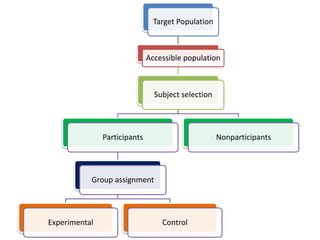
Target population
• Target or reference population: to study the
overall group of people
– OA
– Learning disability
– Gait dysfunction in hemiplegia
Target Population
Accessible population
Subject selection
Participants
Group assignment
Experimental Control
Nonparticipants
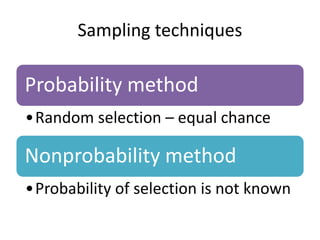
Sampling techniques
Probability method
•Random selection – equal chance
Nonprobability method
•Probability of selection is not known
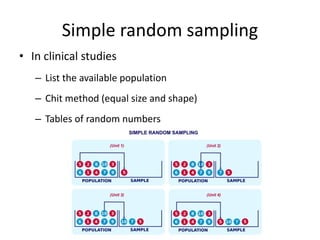
Simple random sampling
• In clinical studies
– List the available population
– Chit method (equal size and shape)
– Tables of random numbers
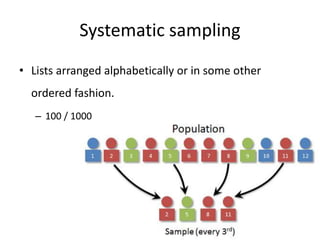
Systematic sampling
• Lists arranged alphabetically or in some other
ordered fashion.
– 100 / 1000
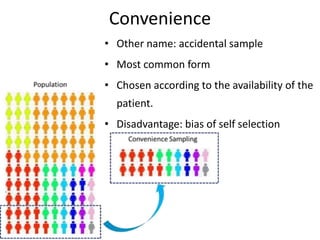
Convenience
• Other name: accidental sample
• Most common form
• Chosen according to the availability of the
patient.
• Disadvantage: bias of self selection
Normality test
Less than 50 (<50)
• Shapiro – Wilk test
• If the significance value is
greater than 0.05
More than 50 (>50)
• Kolmogorov – Smirnov test
• KS Test
• If the significance value is
greater than 0.05
Parametric (Normal distribution)
• Parametric – paired t test (pre-
post design),
• Repeated measures Anova –
(Pre-Post-Follow up)
• Independent t test – individual
comparison of 2 data
(between group)
• One way Anova – to
comparison of all 3 group
• Pearson correlation – validity.
Nonparametric (Non normal distribution)
• Non- parametric - Wilcoxon (pre-
post design)
• Friedman test (Pre-Post-Follow up)
• Mann Whitney – individual
comparison of 2 data (between
group)
• Krusskal Wallis - to comparison of
all 3 group
• Spearman rank correlation
coefficient
Presentation of the research
Visual presentation
• Avoid confusing slides
• 4 types of slides may be presented
– Words or phrases (text)
– Photographs
– Graphs
– Tables
Words and Phrases
• Title
• Purpose
• Important background material
• Hypothesis
• Description of subjects and study protocol
• Summary of results and
• Conclusion
Abstract should contain
• Overview and purpose of the study
• General description of methods
• Highlights of results
• Statement of significance of results
• General conclusion
Abstract
• Abstract summarizes
– The purpose of the study
– Number and type of subjects
– The basic procedures used
– Summary of the results
– And the major conclusion
• Must be concise
• Word limits 100
Introduction
• Statement of the problem
• Clinical relevance
• Review of literature
• Rationale and theoretical framework
• Specific purpose and hypotheses (or guiding
questions)
Introduction should contain
• The 1st one or two paragraphs of the
introduction should have a clear
understanding of the problem being studied.
• The introduction should end with a statement
of the specific purpose of the study
Methodology should contain
• No. of subjects
• Selection criteria
• Informed consent
• Approved by the appropriate committees.
• Description of equipment
• Data collection procedures
Results should contain
• Should contain only a report of results
• Significant test and its probability.
• Tables and figures
• Statements to support or reject hypotheses
Discussion should contain
• Reflects the researcher‘s interpretation of the
results in terms of the purpose of the study and
the outside world.
• The should comment on
– Importance of the result
– Limitation of the study
– Suggestion for future research
– And clinical implications
Conclusion
• A brief restatement of the purpose of the study and its
principal findings.
• Author states the deductions made from the results.
• Phrases like “the results of this study indicates” and
“this study demonstrates” serve to link the summary of
results and the meaning of those results.
• List of all references cited in the article
RESEARCH METHODOLOGY

RESEARCH METHODOLOGY

  • 1.
    RESEARCH METHODOLOGY DR. NIRAJKUMAR ASSOCIATE PROFESSOR PHYSIOTHERAPY DEPT. SHRI GURU RAM RAI INSTITUTE OF MEDICAL AND HEALTH SCIENCES
  • 2.
    •Clinical research isa structured process of investigating facts and theories. •It is a method of answering the questions in a systematic and objective way to examine clinical conditions and outcomes.
  • 3.
    Experimental research(Gold standardresearch) • Pretest-posttest designs • Post test only designs • Complex variations (several independent variable)
  • 4.
    Experimental research • Quasiexperimental designs • Sequential clinical trials • Single case experimental designs
  • 5.
  • 6.
    Descriptive research • Systematicallydescribe and interpret conditions or relationships that already exist. • Involves questionnaires, , interviews or direct observation Correlational research • Used to examine the extent to which variation in one variable corresponds with variation in one or more other factors.
  • 7.
    Epidemiology • Concerned withthe risk of disease or disability associated with specific exposures. – Surveys – Experimental studies – Correlational studies
  • 8.
    Evaluation research • Anobjective and empirical assessment of the success of a program or policy in meeting its goal and objectives. • Used to assist – Decision making – Determining if a clinical program should be implemented, continued, or modified
  • 9.
    Methodological research • Involvesthe development and validation of measurement tools used in practice and clinical research.
  • 10.
    Purpose of aresearch design Provide information regarding: • What is the study? • Why is the study being carried out? • Where will the study be carried out? • How will the study be carried out? • What will be the processes and tasks involved? • What will be the data? • How will the data be collected? • What methods of sampling will be used? and • How will the analysis be done?
  • 11.
    Functions of theresearch design • Provide a plan to undertake systematic study and help to provide procedures to undertake the research work; and • Ensure objective, valid, and economic undertaking of the study.
  • 12.
    Types of researchdesign Factors • Nature of investigation, • Data collection methods, • Number of contacts made with the subjects, • and the Period of reference
  • 13.
    Nature of Investigation •Exploratory • Descriptive • Experimental • Semi or Quasi- experimental • Non- experimental and • Field research.
  • 14.
    Data Collection Methods •Survey • Case studies and • Content analysis
  • 15.
    Definitions of StudyDesign • Case–control study – Retrospective comparison of exposures of persons with disease (cases) with those of persons without the disease (controls). (Harm/Etiology) (EBM Toolkit, 2008) • Case–series – Report of a number of cases of disease. (Harm/Etiology) (EBM Toolkit, 2008) • Cohort study – A study that begins with the gathering of two matched groups (the cohorts), one which has been exposed to a prognostic factor, risk factor, or intervention and one which has not. The groups are then followed forward in time (prospective) to measure the development of different outcomes. In a retrospective cohort study, cohorts are identified at a point of time in the past and information is collected on their subsequent outcomes. (Diagnosis, Harm/Etiology, Prognosis, Therapy) (EBM Toolkit, 2008) • Meta–analysis – Broad term that includes reports that collect and synthesize data from individual studies to provide new information. (McKibbon, 2009) 3/29/2019 15
  • 16.
  • 17.
    Title • Concise andinformative • Has an independent variable, dependent variable and the sample.
  • 18.
    Abstract • Should bein one page • It includes – A brief description of the method – Procedures – Methods for data analysis – The proposed duration of the study and overall projected costs may be stated
  • 19.
    Statement of theresearch problem – Rationale and justification for the study • Why the study was needed? – Significance of the study • What is the use?
  • 20.
    Statement of thepurpose of the study • Specific aims or objectives – Help the researcher guide the discussion of results when the study is completed (comparative, correlational, reliability of an instrument and the relationships) • Research hypotheses or guiding questions – Positive or negative
  • 21.
    Aim • to map,to develop, to design, to track, to generate, to theorize, to build … • Sometimes ‘to investigate, to understand, and to explore… • to synthesize, to catalogue, to challenge, to critically interrogate …
  • 22.
    Objectives • There areusually more than one, are the specific steps you will take to achieve your aim.
  • 23.
    Objectives • Objectives areoften expressed through active sentences. So, objectives often start something like In order to achieve this aim, I will… collect, construct, produce, test, trial, measure, document, pilot, deconstruct, analyse… • The list of objectives spells out what you actually and really will do to get to the point of it all. • Objectives have to be practical, do-able and achievable.
  • 24.
    Background of thestudy • Topics for review of literature related to – Theory and supportive rational – Related studies – Methods • Previous work by the investigator that supports the project
  • 25.
    Method • Subjects :Characteristics, sampling method, plans for recruitment • Materials: instrumentation, plans to establish reliability and validity • Procedures – Study design – Details of test and treatment administration – Data collection methods – Timetable and organizational chart • Data management and analysis
  • 26.
    Literature cited References shouldbe in any one of the format Vancouver Harvard
  • 27.
  • 28.
    Population • The largergroup to which research results are generalized is called a population. – Defined aggregate of Objects – Persons – Places – Organizations, animals, days etc.
  • 29.
    Sample • Through aprocess of sampling, a researcher chooses a subgroup of the population, called a sample. • It serves as the reference group for drawing conclusions about the population.
  • 30.
    Target population • Targetor reference population: to study the overall group of people – OA – Learning disability – Gait dysfunction in hemiplegia
  • 31.
    Target Population Accessible population Subjectselection Participants Group assignment Experimental Control Nonparticipants
  • 32.
    Sampling techniques Probability method •Randomselection – equal chance Nonprobability method •Probability of selection is not known
  • 33.
    Simple random sampling •In clinical studies – List the available population – Chit method (equal size and shape) – Tables of random numbers
  • 34.
    Systematic sampling • Listsarranged alphabetically or in some other ordered fashion. – 100 / 1000
  • 35.
    Convenience • Other name:accidental sample • Most common form • Chosen according to the availability of the patient. • Disadvantage: bias of self selection
  • 36.
    Normality test Less than50 (<50) • Shapiro – Wilk test • If the significance value is greater than 0.05 More than 50 (>50) • Kolmogorov – Smirnov test • KS Test • If the significance value is greater than 0.05
  • 37.
    Parametric (Normal distribution) •Parametric – paired t test (pre- post design), • Repeated measures Anova – (Pre-Post-Follow up) • Independent t test – individual comparison of 2 data (between group) • One way Anova – to comparison of all 3 group • Pearson correlation – validity. Nonparametric (Non normal distribution) • Non- parametric - Wilcoxon (pre- post design) • Friedman test (Pre-Post-Follow up) • Mann Whitney – individual comparison of 2 data (between group) • Krusskal Wallis - to comparison of all 3 group • Spearman rank correlation coefficient
  • 38.
  • 39.
    Visual presentation • Avoidconfusing slides • 4 types of slides may be presented – Words or phrases (text) – Photographs – Graphs – Tables
  • 40.
    Words and Phrases •Title • Purpose • Important background material • Hypothesis • Description of subjects and study protocol • Summary of results and • Conclusion
  • 41.
    Abstract should contain •Overview and purpose of the study • General description of methods • Highlights of results • Statement of significance of results • General conclusion
  • 42.
    Abstract • Abstract summarizes –The purpose of the study – Number and type of subjects – The basic procedures used – Summary of the results – And the major conclusion • Must be concise • Word limits 100
  • 43.
    Introduction • Statement ofthe problem • Clinical relevance • Review of literature • Rationale and theoretical framework • Specific purpose and hypotheses (or guiding questions)
  • 44.
    Introduction should contain •The 1st one or two paragraphs of the introduction should have a clear understanding of the problem being studied. • The introduction should end with a statement of the specific purpose of the study
  • 45.
    Methodology should contain •No. of subjects • Selection criteria • Informed consent • Approved by the appropriate committees. • Description of equipment • Data collection procedures
  • 46.
    Results should contain •Should contain only a report of results • Significant test and its probability. • Tables and figures • Statements to support or reject hypotheses
  • 47.
    Discussion should contain •Reflects the researcher‘s interpretation of the results in terms of the purpose of the study and the outside world. • The should comment on – Importance of the result – Limitation of the study – Suggestion for future research – And clinical implications
  • 48.
    Conclusion • A briefrestatement of the purpose of the study and its principal findings. • Author states the deductions made from the results. • Phrases like “the results of this study indicates” and “this study demonstrates” serve to link the summary of results and the meaning of those results.
  • 49.
    • List ofall references cited in the article