Professional Practice and Ethics
Dr Sreeraj S R, Ph.D.
Sreeraj S R
Physiotherapy in India
2
• Physiotherapy in India is considered under Allied and Health Professionals,
Ministry of Health and Family Welfare.
• According to THE NATIONAL COMMISSION FOR ALLIED AND HEALTHCARE
PROFESSIONS ACT, 2021, a “Physiotherapy Professional is a person who
practices physiotherapy by undertaking comprehensive examination and
appropriate investigation, provides treatment and advice to any persons
preparatory to or for the purpose of or in connection with movement or
functional dysfunction, malfunction, disorder, disability, healing and pain from
trauma and disease, using physical modalities including exercise, mobilization,
manipulations, electrical and thermal agents and other electro therapeutics for
prevention, screening, diagnosis, treatment, health promotion and fitness. The
physiotherapist can practice independently or as a part of a multi-disciplinary
team and has a minimum qualification of a baccalaureate degree”.
Sreeraj S R
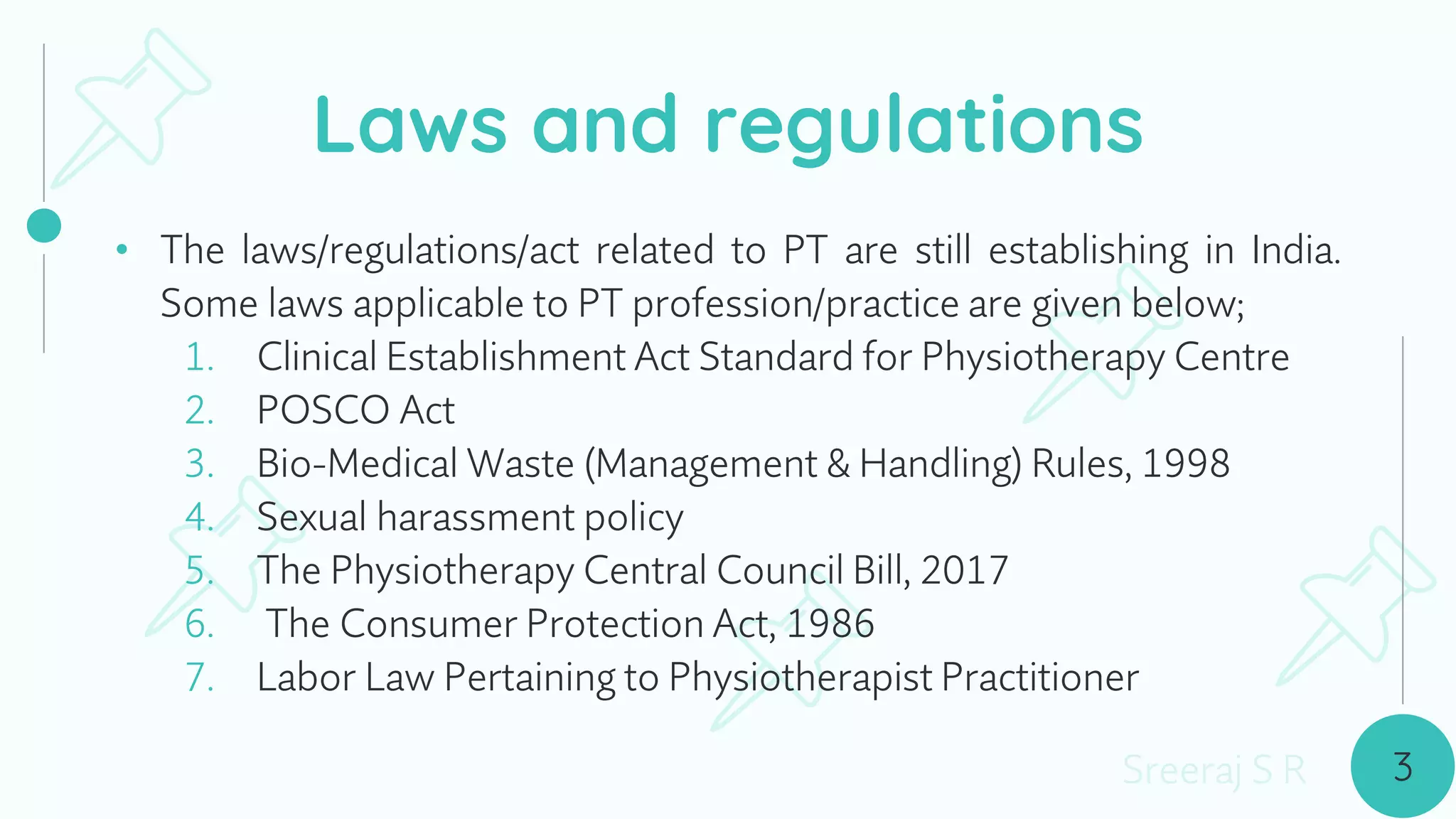
Laws and regulations
3
• The laws/regulations/act related to PT are still establishing in India.
Some laws applicable to PT profession/practice are given below;
1. Clinical Establishment Act Standard for Physiotherapy Centre
2. POSCO Act
3. Bio-Medical Waste (Management & Handling) Rules, 1998
4. Sexual harassment policy
5. The Physiotherapy Central Council Bill, 2017
6. The Consumer Protection Act, 1986
7. Labor Law Pertaining to Physiotherapist Practitioner
Sreeraj S R
Clinical Establishment Act
4
• In 2010, Clinical Establishments (Registration and Regulation) Act, 2010
has been enacted by the GoI to provide for registration and
regulation of all clinical establishments in the country.
• The Ministry has notified the “National Council for Clinical
Establishments” and ‘The Clinical Establishments (Central
Government) Rules, 2012” under this Act vide Gazette.
• This Act is applicable to all kinds of clinical establishments from the
public and private sectors, of all recognized systems of medicine
including single doctor clinics.
• The only exception will be establishments run by the Armed forces.
Sreeraj S R
POSCO Act
5
• The Protection of Children from Sexual Offence act, 2012 ACT
NO. 32 OF 2012[19th June 2012.]
• An Act to protect children from offences of sexual assault,
sexual harassment and pornography and provide for
establishment of Special Courts for trial of such offences and
for matters connected therewith or incidental thereto.
• POCSO effectively implements sexual exploitation and sexual
abuse of children as heinous crimes and effectively addressed.
Sreeraj S R
BMW (Management & Handling)
6
• The Biomedical Waste Management & Handling) Rules, 1998 came
into force in 1998 in exercise of the powers conferred by section 6,8
& 25 of The Environment (Protection) Act, 1986, the Central Govt.
• The Segregation, Packaging, Transportation and Storage of BMW
shall be done as under:-
1. It shall not be mixed with other wastes.
2. It shall be segregated into containers / bags at the points of
generation in accordance with Schedule II prior to its storage
transportation, treatment and disposal.
3. The containers shall be labelled according to Schedule III.
Sreeraj S R
Sexual harassment policy
7
• Workplace sexual harassment is a form of gender discrimination
which violates a woman’s fundamental right to equality and right to
life, guaranteed under Articles 14, 15 and 21 of the Constitution of
India.
• India’s first legislation specifically addressing the issue of the Sexual
Harassment of Women at Workplace (Prevention, Prohibition and
Redressal) Act, 2013 (“POSH Act”) was enacted by the Ministry of
Women and Child Development, India in 2013.
• The POSH Act has been enacted with the objective of preventing and
protecting women against workplace sexual harassment and to
ensure effective redressal of complaints of sexual harassment.
Sreeraj S R
The Physiotherapy Central Council Bill, 2017
8
• THE PHYSIOTHERAPY CENTRAL COUNCIL BILL, 2017,
proposed to provide for the constitution of Central Council of
the Physiotherapy, the coordinated development in the
education of physiotherapy with a view to regulating and
maintaining standards of such education, maintenance of
Register of Physiotherapists and for matters connected
therewith or incidental thereto.
• This Act extends to the whole of India.
• The Central Council may hold the power to make regulations.
Sreeraj S R
The Physiotherapy Central Council Bill, 2017
9
• The Act regulates;
1. The Register, maintained under sub-section (1) of section 23
2. Prohibition in employment as physiotherapist by clinical
establishment.
3. Penalty for violation of provisions of this Act.
4. Penalty for practicing as professional by nonprofessional.
5. Punishment for dishonest use of certificates, etc.
6. Rules and regulations to be laid before Parliament.
7. Power to remove difficulties.
Sreeraj S R
The Consumer Protection Act, 1986
10
• Consumer Protection Act, 1986 creating consumer disputes redressal
agencies has the following issues addressed:
1. The right to safety: To be protected against products, production
processes and services which are hazardous to health or life
2. The right to be informed: To be given the facts needed to make an
informed choice and to be protected against dishonest or
misleading advertising and labeling
3. The right to choose: To be able to select from a range of products
and services, offered at competitive prices, with an assurance of
satisfactory quality
Sreeraj S R
The Consumer Protection Act, 1986
11
4. The right to be heard: To have consumer interests represented in the
making and execution of government policy, and in the development of
products and services
5. The right to redress: To receive a fair settlement of just claims, including
compensation for misrepresentation, shoddy goods or unsatisfactory
services
6. The right to consumer education: To acquire knowledge and skills needed
to make informed, confident choice about goods and services, while
being aware of basic consumer rights and responsibilities
7. The right to a healthy environment: To live and work in a good
environment that is non-threatening to well-being in present and future.
Sreeraj S R
Labor Law to Physiotherapy clinic/practice
12
• In 2020, the Indian Parliament combined 25 labour laws
into three codes, i.e.,
1. the Social Security Code,
2. the Code on Industrial Relations and
3. the Code on Occupational Safety, Health and
Working Conditions.
• The Code on Wages, enacted in 2019, also amalgamated
four relevant labour laws.
Sreeraj S R
Labor Law to Physiotherapy clinic/practice
13
• The following Labour Laws are applicable to private Hospitals:-
A. To all hospitals and nursing homes –
i. The Minimum Wages Act, 1948;
ii. The Industrial Disputes Act, 1947.
B. To those employing twenty or more persons –
i. The Payment of Gratuity Act, 1972.
C. To those employing 10 or more employees.
i. The Payment of Bonus Act, 1965;
ii. Employees Provident Fund Act, 1952
Sreeraj S R
Ethical responsibilities of PTs
14
• Physical therapists;
1. Respect the rights and dignity of all individuals
2. Comply with the laws and regulations governing the practice of physical therapy
in the country in which they practise.
3. Accept responsibility for the exercise of sound judgement.
4. Provide honest, competent and accountable professional services.
5. Are committed to providing quality services.
6. Are entitled to a just and fair level of remuneration for their services.
7. Provide accurate information to patients/clients, other agencies and the
community about physical therapy and about the services physical therapists
provide.
8. Contribute to the planning and development of services that address the health
needs of the community.
Sreeraj S R
7. Professional competence
8. Maximization of benefit
9. Institutional arrangements
10. Transparency and
accountability
11. Totality of responsibility
12. Environmental protection
Ethics in Research
15
1. Essentiality
2. Voluntariness
3. Non-exploitation
4. Social responsibility
5. Ensuring privacy and
confidentiality
6. Risk minimization
Sreeraj S R
Ethics in Teaching
16
• There are three fundamental principles of “universal ethics”.
1. a. Beneficence (do good)
b. Non maleficence (do not harm)
2. Justice and equality (versus bias)
3. Autonomy or individual freedom (versus paternalism)
• House (1990) has discussed three principle of ethics
1. Mutual respect
2. No coercion and non manipulation and
3. Support of democratic values
• Jagsi R in 2004 explained all ethical issues for health educators on these three basic principles
1. Respect for individual
2. Beneficences and
3. Distributive justice
Sreeraj S R
Professional bodies
17
• WCPT
• MSOTPT
• IAP
Sreeraj S R
WP
18
• World Physiotherapy (WP) operates as a non-profit organisation and is
registered as a charity (World Confederation for Physical Therapy) in the
UK.
• Founded in 1951
• Sole international voice for physical therapy
• 660,000 physical therapists worldwide through its 125 member
organisations.
• The confederation operates as a non-profit organisation and is registered
as a charity in the UK.
• It has been in official relations with the World Health Organization (WHO)
since 1952
Sreeraj S R
WP vision and mission
19
• Vision
• WCPT's vision is to move physical therapy forward so the profession is
recognized globally for its significant role in improving health and
wellbeing.
• Mission: As the international voice of physical therapy WCPT's mission is to:
• unite the profession internationally;
• represent physical therapy and physical therapists internationally;
• promote high standards of physical therapy practice, education and
research;
• facilitate communication and information exchange among member
organizations, regions, subgroups and their members;
• collaborate with national and international organizations; and
• contribute to the improvement of global health.
Sreeraj S R
WP groups
20
• WCPT has formal associations with many groups aiming to improve
the profile and practice of physical therapists worldwide.
• WCPT subgroups are international physical therapy organizations
which have a specific area of interest and meet WCPT’s criteria for
recognition as a WCPT subgroup.
• WCPT also supports informal groupings which do not yet have
official subgroup status, to exchange information and expertise in
specific fields.
Sreeraj S R
IAP
21
• The Indian Association of Physiotherapist (IAP), is a non-
profit, non-governmental organization that represents
the physiotherapy profession at National and
international level.
• The IAP is registered under Indian society act, in the year
1955.
• The Indian Association of Physiotherapists was a member
The of WCPT from 1967 and of WORLD
PHYSIOTHERAPY (WP) from 2020
Sreeraj S R
IAP
22
• The Principal aim of IAP are;
1. To promote the development of reciprocity of physiotherapy qualifications and to
improve the quality of physiotherapy education and practice in India.
2. To promote physiotherapy in India and to oversee all matters dealing with physiotherapy.
3. To facilitate migration and the right of establishment of physiotherapists in India, within
the National and legislative framework.
4. To encourage closer co-operation among the national physiotherapy associations within
the Region in all professional matters in the interest to improve general health of the
population of the region.
5. To co-operate with international organizations in India to promote the aims and
objectives of IAP.
6. To represent the interests of and speak for its Member Organizations with Indian
Authorities.
7. To develop policies and declarations for proposition to the Executive Committee and
General Meeting of the IAP.
8. To represent the profession of physiotherapy on a regional basis in consultation with the
Executive Committee or as delegated by the Executive Committee of the IAP.
Sreeraj S R
MSOTPT
23
• The Maharashtra State Council for Occupational Therapy and
Physiotherapy act, 2002 which was first published in the Maharashtra
Government Gazette, Part IV, on the 12th January 2004.
• An Act to provide for the constitution of the MSOTPT for the purpose
of co-ordination and determination of standards of education in the
field of Occupational Therapy and Physiotherapy and for the
maintenance of a Register of Occupational Therapists and
Physiotherapists for the State of Maharashtra and for matters
connected therewith or incidental thereto.
Sreeraj S R
Functions of MSOTPT
24
• Subjects to such conditions as may be prescribed by or Powers, under the
provisions of this Act, the powers, duties and functions of the Council shall be:
1. to determine and co-ordinate the standards of occupational therapy and
physiotherapy education at all levels;
2. to recommend to the Government, the grant of permission to open new
institutions or to open new courses of study or, training, under section 17;
3. to maintain the registers, and to provide for the registration of occupational
therapists and physiotherapists in the State;
4. to prescribe a code of ethics for regulating the professional conduct of
practitioners in occupational therapy or physiotherapy;
Sreeraj S R
Functions of MSOTPT
25
5. to advise the Government in matters relating to the requirement of
manpower in the field of occupational therapy and physiotherapy ;
6. to hear and decide appeals from any decision of the Registrar;
7. to reprimand a practitioner, or to suspend or to remove him from the
register, or to take such other disciplinary action against him as may, in the
opinion of the Council, be necessary or expedient; and
8. to hold elections before the expiry of the term of office of the members of
the Council or in any case within a period of six months after the date of
expiry of such term;
9. to exercise such power, perform such other duties and discharge such
other functions, as are laid down in this Act, or as may be prescribed.
Sreeraj S R
Offences and penalty, MSOTPT
26
• No person other than an institution recognised or
authorised under this Act shall confer, grant or issue any
degree, licence, certificate or any other like award as
qualified to practice physiotherapy.
• All offences under this Act shall be cognizable and non-
bailable.
Sreeraj S R
Offences and penalty, MSOTPT
27
• If any person not being a registered practitioner takes or uses the
description of physiotherapy practitioner, physiotherapist or
consultant in physiotherapy or not possessing a recognised
physiotherapy qualification, uses a degree or a diploma or an
abbreviation indicating or implying such physiotherapy qualification,
shall, on conviction, be punished for;
1. a first offence, with fine which may extend to 5000/- rupees; and
2. for a subsequent offence with imprisonment which may extend to
one year or with fine which may extend to 10,000/- rupees, or with
both.
Sreeraj S R
Offences and penalty, MSOTPT
28
• If any person whose name has been removed from the
register fails without sufficient cause, forthwith to
surrender certificate of registration or renewed certificate
of registration or both, he shall, on conviction, be punished
with fine which may extend to 500/- rupees per month of
such failure.
Sreeraj S R
Professional development,
competence and expertise
29
Sreeraj S R
The Professional Development Continuum
30
• As professionals, PTs have an obligation to update their
skills.
• The Guide for Professional Conduct (GPC) of the
American Physical Therapy Association (APTA) takes note
of this as:
• “A physical therapist has a lifelong professional
responsibility for maintaining competence through
ongoing self-assessment, education, and enhancement of
knowledge and skills” (GPC 5.2).
Sreeraj S R
Dimensions of Clinical Expertise
31
• In addition to technical
skills, expertise in physical
therapy involves a
blending of four specialty
areas of physical therapy
as identified by Jensen and
colleagues, 2000
Sreeraj S R
Activities That Promote Professional Development
32
• Professional development requires activities involving;
• a multidimensional knowledge base, a collaborative
problem-solving approach to clinical reasoning, a focus on
movement linked to patient function, and a sense of caring
and commitment toward patients.
• cultivation of attributes and behaviors such as humility,
passion for clinical work, collegial interaction, and limited
delegation to support staff.
• Mandatory continuing education is the most common
approach to ensuring continuing professional competence
Sreeraj S R
12. Interaction with colleagues
13. Working with a mentor
14. Peer review
15. Self-assessment
16. Post professional education
17. Study groups
18. Participation in interdisciplinary teams
19. Participation in clinical research
20. Leadership in professional associations
21. Development of a professional portfolio
22. Reflective practice
Activities That Promote Professional Development
33
1. Formal continuing education courses
2. Employer Inservice or education
opportunities
3. Internship or residency practice
4. Changes in work position and new
challenges
5. Individual research on topics of interest
6. Reading professional journals
7. Clinical experience
8. Professional association activities
9. Clinical specialization
10. Journal clubs
11. Career ladders (pathways for professional
advancement)
Sreeraj S R
Attributes of Physical Therapists
34
Clinical Reasoning
1. Patient empowerment a primary goal of
therapy
2. Collaborative problem-solving approach
3. Context of clinical practice: teacher/coach
Knowledge Base
1. Eclectic academic background
2. Frequent use of collegial knowledge
3. Greater use of movement observation
4. Reflection on practice
5. Extent of clinical experience
6. Specialty knowledge from continuing
education
7. Knowledge from patients
Values and Virtues
1. Love of clinical care
2. Humility
3. Inquisitiveness
4. Caring
5. Commitment to professional growth
Clinical Practice Style
1. Patient education central to practice
2. Individualized interventions
3. Limited delegation of care to support
personnel
4. Extensive use of growth opportunities in the
workplace
Sreeraj S R
References
35
1. Model Curriculum Handbook PHYSIOTHERAPY. Ministry of Health and Family Welfare | GOI [Internet].
mohfw.gov.in/ 2017 [cited 2021 Jun 21]; Available from: https://tinyurl.com/4yavtabv. Accessed 21 June
2021.
2. Acts | Ministry of Health and Family Welfare | GOI [Internet]. mohfw.gov.in 2019 [cited 2021 Jun
21];Available from: https://tinyurl.com/7wd9puzn
3. Policy statement: Ethical principles [Internet]. World Physiotherapy. 2019 [cited 2021 Jun 22]. Available
from: https://world.physio/policy/policy-statement-ethical-principles
4. Guidelines | Indian Council of Medical Research | Government of India [Internet]. Icmr.nic.in. 2019 [cited
2021 Jun 22]. Available from: https://main.icmr.nic.in/content/guidelines-0
5. Singh A. Ethics for medical educators: an overview and fallacies. Indian J Psychol Med. 2010;32(2):83-86.
doi:10.4103/0253-7176.78502
6. World Physiotherapy [Internet]. Home | World Physiotherapy. 2021 [cited 2021 Jun 22]. Available from:
https://world.physio/
7. महाराष्ट्र राज्य व्यवसायोपचार आणि भौतिकोपचार पररषद,मुंबई [Internet]. Mahaotandptcouncil.in2020 [cited
2021 Jun 22]; Available from: https://www.mahaotandptcouncil.in/Home/Downloads
8. Jensen GM, Gwyer J, Shepard KF et al. Expert practice in physical therapy. Phys Ther 2000;80[1]:28-43.
9. Swisher LL, Page CG. Professionalism in Physical Therapy : History, Practice & Development. Elsevier
Saunders, St. Louis, Mo; 2005:193-207.

Professional Practice and Ethics for Physiotherapists

  • 1.
    Professional Practice andEthics Dr Sreeraj S R, Ph.D.
  • 2.
    Sreeraj S R Physiotherapyin India 2 • Physiotherapy in India is considered under Allied and Health Professionals, Ministry of Health and Family Welfare. • According to THE NATIONAL COMMISSION FOR ALLIED AND HEALTHCARE PROFESSIONS ACT, 2021, a “Physiotherapy Professional is a person who practices physiotherapy by undertaking comprehensive examination and appropriate investigation, provides treatment and advice to any persons preparatory to or for the purpose of or in connection with movement or functional dysfunction, malfunction, disorder, disability, healing and pain from trauma and disease, using physical modalities including exercise, mobilization, manipulations, electrical and thermal agents and other electro therapeutics for prevention, screening, diagnosis, treatment, health promotion and fitness. The physiotherapist can practice independently or as a part of a multi-disciplinary team and has a minimum qualification of a baccalaureate degree”.
  • 3.
    Sreeraj S R Lawsand regulations 3 • The laws/regulations/act related to PT are still establishing in India. Some laws applicable to PT profession/practice are given below; 1. Clinical Establishment Act Standard for Physiotherapy Centre 2. POSCO Act 3. Bio-Medical Waste (Management & Handling) Rules, 1998 4. Sexual harassment policy 5. The Physiotherapy Central Council Bill, 2017 6. The Consumer Protection Act, 1986 7. Labor Law Pertaining to Physiotherapist Practitioner
  • 4.
    Sreeraj S R ClinicalEstablishment Act 4 • In 2010, Clinical Establishments (Registration and Regulation) Act, 2010 has been enacted by the GoI to provide for registration and regulation of all clinical establishments in the country. • The Ministry has notified the “National Council for Clinical Establishments” and ‘The Clinical Establishments (Central Government) Rules, 2012” under this Act vide Gazette. • This Act is applicable to all kinds of clinical establishments from the public and private sectors, of all recognized systems of medicine including single doctor clinics. • The only exception will be establishments run by the Armed forces.
  • 5.
    Sreeraj S R POSCOAct 5 • The Protection of Children from Sexual Offence act, 2012 ACT NO. 32 OF 2012[19th June 2012.] • An Act to protect children from offences of sexual assault, sexual harassment and pornography and provide for establishment of Special Courts for trial of such offences and for matters connected therewith or incidental thereto. • POCSO effectively implements sexual exploitation and sexual abuse of children as heinous crimes and effectively addressed.
  • 6.
    Sreeraj S R BMW(Management & Handling) 6 • The Biomedical Waste Management & Handling) Rules, 1998 came into force in 1998 in exercise of the powers conferred by section 6,8 & 25 of The Environment (Protection) Act, 1986, the Central Govt. • The Segregation, Packaging, Transportation and Storage of BMW shall be done as under:- 1. It shall not be mixed with other wastes. 2. It shall be segregated into containers / bags at the points of generation in accordance with Schedule II prior to its storage transportation, treatment and disposal. 3. The containers shall be labelled according to Schedule III.
  • 7.
    Sreeraj S R Sexualharassment policy 7 • Workplace sexual harassment is a form of gender discrimination which violates a woman’s fundamental right to equality and right to life, guaranteed under Articles 14, 15 and 21 of the Constitution of India. • India’s first legislation specifically addressing the issue of the Sexual Harassment of Women at Workplace (Prevention, Prohibition and Redressal) Act, 2013 (“POSH Act”) was enacted by the Ministry of Women and Child Development, India in 2013. • The POSH Act has been enacted with the objective of preventing and protecting women against workplace sexual harassment and to ensure effective redressal of complaints of sexual harassment.
  • 8.
    Sreeraj S R ThePhysiotherapy Central Council Bill, 2017 8 • THE PHYSIOTHERAPY CENTRAL COUNCIL BILL, 2017, proposed to provide for the constitution of Central Council of the Physiotherapy, the coordinated development in the education of physiotherapy with a view to regulating and maintaining standards of such education, maintenance of Register of Physiotherapists and for matters connected therewith or incidental thereto. • This Act extends to the whole of India. • The Central Council may hold the power to make regulations.
  • 9.
    Sreeraj S R ThePhysiotherapy Central Council Bill, 2017 9 • The Act regulates; 1. The Register, maintained under sub-section (1) of section 23 2. Prohibition in employment as physiotherapist by clinical establishment. 3. Penalty for violation of provisions of this Act. 4. Penalty for practicing as professional by nonprofessional. 5. Punishment for dishonest use of certificates, etc. 6. Rules and regulations to be laid before Parliament. 7. Power to remove difficulties.
  • 10.
    Sreeraj S R TheConsumer Protection Act, 1986 10 • Consumer Protection Act, 1986 creating consumer disputes redressal agencies has the following issues addressed: 1. The right to safety: To be protected against products, production processes and services which are hazardous to health or life 2. The right to be informed: To be given the facts needed to make an informed choice and to be protected against dishonest or misleading advertising and labeling 3. The right to choose: To be able to select from a range of products and services, offered at competitive prices, with an assurance of satisfactory quality
  • 11.
    Sreeraj S R TheConsumer Protection Act, 1986 11 4. The right to be heard: To have consumer interests represented in the making and execution of government policy, and in the development of products and services 5. The right to redress: To receive a fair settlement of just claims, including compensation for misrepresentation, shoddy goods or unsatisfactory services 6. The right to consumer education: To acquire knowledge and skills needed to make informed, confident choice about goods and services, while being aware of basic consumer rights and responsibilities 7. The right to a healthy environment: To live and work in a good environment that is non-threatening to well-being in present and future.
  • 12.
    Sreeraj S R LaborLaw to Physiotherapy clinic/practice 12 • In 2020, the Indian Parliament combined 25 labour laws into three codes, i.e., 1. the Social Security Code, 2. the Code on Industrial Relations and 3. the Code on Occupational Safety, Health and Working Conditions. • The Code on Wages, enacted in 2019, also amalgamated four relevant labour laws.
  • 13.
    Sreeraj S R LaborLaw to Physiotherapy clinic/practice 13 • The following Labour Laws are applicable to private Hospitals:- A. To all hospitals and nursing homes – i. The Minimum Wages Act, 1948; ii. The Industrial Disputes Act, 1947. B. To those employing twenty or more persons – i. The Payment of Gratuity Act, 1972. C. To those employing 10 or more employees. i. The Payment of Bonus Act, 1965; ii. Employees Provident Fund Act, 1952
  • 14.
    Sreeraj S R Ethicalresponsibilities of PTs 14 • Physical therapists; 1. Respect the rights and dignity of all individuals 2. Comply with the laws and regulations governing the practice of physical therapy in the country in which they practise. 3. Accept responsibility for the exercise of sound judgement. 4. Provide honest, competent and accountable professional services. 5. Are committed to providing quality services. 6. Are entitled to a just and fair level of remuneration for their services. 7. Provide accurate information to patients/clients, other agencies and the community about physical therapy and about the services physical therapists provide. 8. Contribute to the planning and development of services that address the health needs of the community.
  • 15.
    Sreeraj S R 7.Professional competence 8. Maximization of benefit 9. Institutional arrangements 10. Transparency and accountability 11. Totality of responsibility 12. Environmental protection Ethics in Research 15 1. Essentiality 2. Voluntariness 3. Non-exploitation 4. Social responsibility 5. Ensuring privacy and confidentiality 6. Risk minimization
  • 16.
    Sreeraj S R Ethicsin Teaching 16 • There are three fundamental principles of “universal ethics”. 1. a. Beneficence (do good) b. Non maleficence (do not harm) 2. Justice and equality (versus bias) 3. Autonomy or individual freedom (versus paternalism) • House (1990) has discussed three principle of ethics 1. Mutual respect 2. No coercion and non manipulation and 3. Support of democratic values • Jagsi R in 2004 explained all ethical issues for health educators on these three basic principles 1. Respect for individual 2. Beneficences and 3. Distributive justice
  • 17.
    Sreeraj S R Professionalbodies 17 • WCPT • MSOTPT • IAP
  • 18.
    Sreeraj S R WP 18 •World Physiotherapy (WP) operates as a non-profit organisation and is registered as a charity (World Confederation for Physical Therapy) in the UK. • Founded in 1951 • Sole international voice for physical therapy • 660,000 physical therapists worldwide through its 125 member organisations. • The confederation operates as a non-profit organisation and is registered as a charity in the UK. • It has been in official relations with the World Health Organization (WHO) since 1952
  • 19.
    Sreeraj S R WPvision and mission 19 • Vision • WCPT's vision is to move physical therapy forward so the profession is recognized globally for its significant role in improving health and wellbeing. • Mission: As the international voice of physical therapy WCPT's mission is to: • unite the profession internationally; • represent physical therapy and physical therapists internationally; • promote high standards of physical therapy practice, education and research; • facilitate communication and information exchange among member organizations, regions, subgroups and their members; • collaborate with national and international organizations; and • contribute to the improvement of global health.
  • 20.
    Sreeraj S R WPgroups 20 • WCPT has formal associations with many groups aiming to improve the profile and practice of physical therapists worldwide. • WCPT subgroups are international physical therapy organizations which have a specific area of interest and meet WCPT’s criteria for recognition as a WCPT subgroup. • WCPT also supports informal groupings which do not yet have official subgroup status, to exchange information and expertise in specific fields.
  • 21.
    Sreeraj S R IAP 21 •The Indian Association of Physiotherapist (IAP), is a non- profit, non-governmental organization that represents the physiotherapy profession at National and international level. • The IAP is registered under Indian society act, in the year 1955. • The Indian Association of Physiotherapists was a member The of WCPT from 1967 and of WORLD PHYSIOTHERAPY (WP) from 2020
  • 22.
    Sreeraj S R IAP 22 •The Principal aim of IAP are; 1. To promote the development of reciprocity of physiotherapy qualifications and to improve the quality of physiotherapy education and practice in India. 2. To promote physiotherapy in India and to oversee all matters dealing with physiotherapy. 3. To facilitate migration and the right of establishment of physiotherapists in India, within the National and legislative framework. 4. To encourage closer co-operation among the national physiotherapy associations within the Region in all professional matters in the interest to improve general health of the population of the region. 5. To co-operate with international organizations in India to promote the aims and objectives of IAP. 6. To represent the interests of and speak for its Member Organizations with Indian Authorities. 7. To develop policies and declarations for proposition to the Executive Committee and General Meeting of the IAP. 8. To represent the profession of physiotherapy on a regional basis in consultation with the Executive Committee or as delegated by the Executive Committee of the IAP.
  • 23.
    Sreeraj S R MSOTPT 23 •The Maharashtra State Council for Occupational Therapy and Physiotherapy act, 2002 which was first published in the Maharashtra Government Gazette, Part IV, on the 12th January 2004. • An Act to provide for the constitution of the MSOTPT for the purpose of co-ordination and determination of standards of education in the field of Occupational Therapy and Physiotherapy and for the maintenance of a Register of Occupational Therapists and Physiotherapists for the State of Maharashtra and for matters connected therewith or incidental thereto.
  • 24.
    Sreeraj S R Functionsof MSOTPT 24 • Subjects to such conditions as may be prescribed by or Powers, under the provisions of this Act, the powers, duties and functions of the Council shall be: 1. to determine and co-ordinate the standards of occupational therapy and physiotherapy education at all levels; 2. to recommend to the Government, the grant of permission to open new institutions or to open new courses of study or, training, under section 17; 3. to maintain the registers, and to provide for the registration of occupational therapists and physiotherapists in the State; 4. to prescribe a code of ethics for regulating the professional conduct of practitioners in occupational therapy or physiotherapy;
  • 25.
    Sreeraj S R Functionsof MSOTPT 25 5. to advise the Government in matters relating to the requirement of manpower in the field of occupational therapy and physiotherapy ; 6. to hear and decide appeals from any decision of the Registrar; 7. to reprimand a practitioner, or to suspend or to remove him from the register, or to take such other disciplinary action against him as may, in the opinion of the Council, be necessary or expedient; and 8. to hold elections before the expiry of the term of office of the members of the Council or in any case within a period of six months after the date of expiry of such term; 9. to exercise such power, perform such other duties and discharge such other functions, as are laid down in this Act, or as may be prescribed.
  • 26.
    Sreeraj S R Offencesand penalty, MSOTPT 26 • No person other than an institution recognised or authorised under this Act shall confer, grant or issue any degree, licence, certificate or any other like award as qualified to practice physiotherapy. • All offences under this Act shall be cognizable and non- bailable.
  • 27.
    Sreeraj S R Offencesand penalty, MSOTPT 27 • If any person not being a registered practitioner takes or uses the description of physiotherapy practitioner, physiotherapist or consultant in physiotherapy or not possessing a recognised physiotherapy qualification, uses a degree or a diploma or an abbreviation indicating or implying such physiotherapy qualification, shall, on conviction, be punished for; 1. a first offence, with fine which may extend to 5000/- rupees; and 2. for a subsequent offence with imprisonment which may extend to one year or with fine which may extend to 10,000/- rupees, or with both.
  • 28.
    Sreeraj S R Offencesand penalty, MSOTPT 28 • If any person whose name has been removed from the register fails without sufficient cause, forthwith to surrender certificate of registration or renewed certificate of registration or both, he shall, on conviction, be punished with fine which may extend to 500/- rupees per month of such failure.
  • 29.
    Sreeraj S R Professionaldevelopment, competence and expertise 29
  • 30.
    Sreeraj S R TheProfessional Development Continuum 30 • As professionals, PTs have an obligation to update their skills. • The Guide for Professional Conduct (GPC) of the American Physical Therapy Association (APTA) takes note of this as: • “A physical therapist has a lifelong professional responsibility for maintaining competence through ongoing self-assessment, education, and enhancement of knowledge and skills” (GPC 5.2).
  • 31.
    Sreeraj S R Dimensionsof Clinical Expertise 31 • In addition to technical skills, expertise in physical therapy involves a blending of four specialty areas of physical therapy as identified by Jensen and colleagues, 2000
  • 32.
    Sreeraj S R ActivitiesThat Promote Professional Development 32 • Professional development requires activities involving; • a multidimensional knowledge base, a collaborative problem-solving approach to clinical reasoning, a focus on movement linked to patient function, and a sense of caring and commitment toward patients. • cultivation of attributes and behaviors such as humility, passion for clinical work, collegial interaction, and limited delegation to support staff. • Mandatory continuing education is the most common approach to ensuring continuing professional competence
  • 33.
    Sreeraj S R 12.Interaction with colleagues 13. Working with a mentor 14. Peer review 15. Self-assessment 16. Post professional education 17. Study groups 18. Participation in interdisciplinary teams 19. Participation in clinical research 20. Leadership in professional associations 21. Development of a professional portfolio 22. Reflective practice Activities That Promote Professional Development 33 1. Formal continuing education courses 2. Employer Inservice or education opportunities 3. Internship or residency practice 4. Changes in work position and new challenges 5. Individual research on topics of interest 6. Reading professional journals 7. Clinical experience 8. Professional association activities 9. Clinical specialization 10. Journal clubs 11. Career ladders (pathways for professional advancement)
  • 34.
    Sreeraj S R Attributesof Physical Therapists 34 Clinical Reasoning 1. Patient empowerment a primary goal of therapy 2. Collaborative problem-solving approach 3. Context of clinical practice: teacher/coach Knowledge Base 1. Eclectic academic background 2. Frequent use of collegial knowledge 3. Greater use of movement observation 4. Reflection on practice 5. Extent of clinical experience 6. Specialty knowledge from continuing education 7. Knowledge from patients Values and Virtues 1. Love of clinical care 2. Humility 3. Inquisitiveness 4. Caring 5. Commitment to professional growth Clinical Practice Style 1. Patient education central to practice 2. Individualized interventions 3. Limited delegation of care to support personnel 4. Extensive use of growth opportunities in the workplace
  • 35.
    Sreeraj S R References 35 1.Model Curriculum Handbook PHYSIOTHERAPY. Ministry of Health and Family Welfare | GOI [Internet]. mohfw.gov.in/ 2017 [cited 2021 Jun 21]; Available from: https://tinyurl.com/4yavtabv. Accessed 21 June 2021. 2. Acts | Ministry of Health and Family Welfare | GOI [Internet]. mohfw.gov.in 2019 [cited 2021 Jun 21];Available from: https://tinyurl.com/7wd9puzn 3. Policy statement: Ethical principles [Internet]. World Physiotherapy. 2019 [cited 2021 Jun 22]. Available from: https://world.physio/policy/policy-statement-ethical-principles 4. Guidelines | Indian Council of Medical Research | Government of India [Internet]. Icmr.nic.in. 2019 [cited 2021 Jun 22]. Available from: https://main.icmr.nic.in/content/guidelines-0 5. Singh A. Ethics for medical educators: an overview and fallacies. Indian J Psychol Med. 2010;32(2):83-86. doi:10.4103/0253-7176.78502 6. World Physiotherapy [Internet]. Home | World Physiotherapy. 2021 [cited 2021 Jun 22]. Available from: https://world.physio/ 7. महाराष्ट्र राज्य व्यवसायोपचार आणि भौतिकोपचार पररषद,मुंबई [Internet]. Mahaotandptcouncil.in2020 [cited 2021 Jun 22]; Available from: https://www.mahaotandptcouncil.in/Home/Downloads 8. Jensen GM, Gwyer J, Shepard KF et al. Expert practice in physical therapy. Phys Ther 2000;80[1]:28-43. 9. Swisher LL, Page CG. Professionalism in Physical Therapy : History, Practice & Development. Elsevier Saunders, St. Louis, Mo; 2005:193-207.