PERIPHERAL VASCULAR DISEASE
PERIPHERAL VASCULAR DISEASES
• Reduction in blood flow & hence oxygen through
the peripheral vessels.
• When the need of tissues for oxygen exceeds the
supply, ischemia and necrosis will develop.
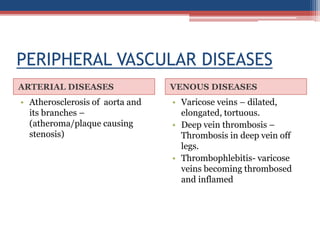
PERIPHERAL VASCULAR DISEASES
ARTERIAL DISEASES VENOUS DISEASES
• Atherosclerosis of aorta and
its branches –
(atheroma/plaque causing
stenosis)
• Varicose veins – dilated,
elongated, tortuous.
• Deep vein thrombosis –
Thrombosis in deep vein off
legs.
• Thrombophlebitis- varicose
veins becoming thrombosed
and inflamed
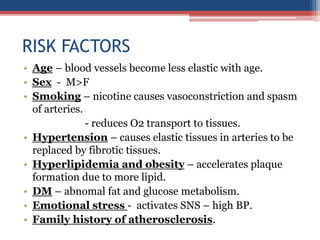
RISK FACTORS
• Age – blood vessels become less elastic with age.
• Sex - M>F
• Smoking – nicotine causes vasoconstriction and spasm
of arteries.
- reduces O2 transport to tissues.
• Hypertension – causes elastic tissues in arteries to be
replaced by fibrotic tissues.
• Hyperlipidemia and obesity – accelerates plaque
formation due to more lipid.
• DM – abnomal fat and glucose metabolism.
• Emotional stress - activates SNS – high BP.
• Family history of atherosclerosis.
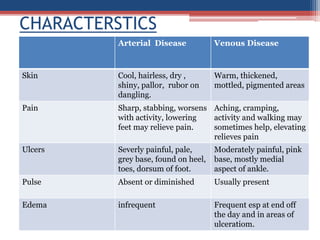
CHARACTERSTICS
Arterial Disease Venous Disease
Skin Cool, hairless, dry ,
shiny, pallor, rubor on
dangling.
Warm, thickened,
mottled, pigmented areas
Pain Sharp, stabbing, worsens
with activity, lowering
feet may relieve pain.
Aching, cramping,
activity and walking may
sometimes help, elevating
relieves pain
Ulcers Severly painful, pale,
grey base, found on heel,
toes, dorsum of foot.
Moderately painful, pink
base, mostly medial
aspect of ankle.
Pulse Absent or diminished Usually present
Edema infrequent Frequent esp at end off
the day and in areas of
ulceratiom.
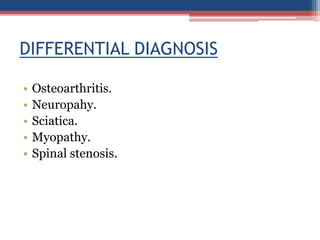
DIFFERENTIAL DIAGNOSIS
• Osteoarthritis.
• Neuropahy.
• Sciatica.
• Myopathy.
• Spinal stenosis.
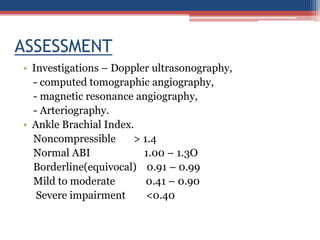
ASSESSMENT
• Investigations – Doppler ultrasonography,
- computed tomographic angiography,
- magnetic resonance angiography,
- Arteriography.
• Ankle Brachial Index.
Noncompressible > 1.4
Normal ABI 1.00 – 1.3O
Borderline(equivocal) 0.91 – 0.99
Mild to moderate 0.41 – 0.90
Severe impairment <0.40
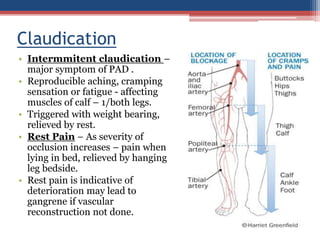
Claudication
• Intermmitent claudication –
major symptom of PAD .
• Reproducible aching, cramping
sensation or fatigue - affecting
muscles of calf – 1/both legs.
• Triggered with weight bearing,
relieved by rest.
• Rest Pain – As severity of
occlusion increases – pain when
lying in bed, relieved by hanging
leg bedside.
• Rest pain is indicative of
deterioration may lead to
gangrene if vascular
reconstruction not done.
EXERCISE TESTING
• Standardized treadmill protocols.
Claudication pain –
1 – no pain.
2 – onset of pain.
3 - mild pain.
4 - moderate pain.
5 – Severe pain.
• 6MWT if treadmill testing not possible.
• Balance test.
• Contraindications –
 Unstable angina.
Decompensated heart failure.
Uncontrolled cardiac arrhythmias.
Severe or symptomatic valvular heart disease
Critical limb ischaemia.
OTHER CONSIDERATIONS
• Most patients with PAD have co existing CAD.
EDUCATION & PRECAUTIONS
• Tobacco caessation.
• Nutrition – same as CAD
• Stress reduction.
WHEN DIABETES IS PRESENT –
Usually co existing neuropathy.
• Self eamination of distal foot
• Shock absorbing shoes , not tight.
• Avoid tight clothing.
• Regular glucose checkups.
• Lifelong exercise
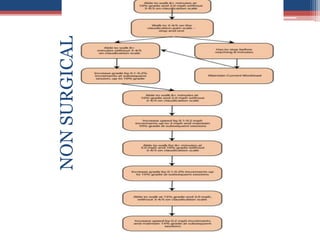
NON
SURGICAL
SURGICAL CONSIDERATIONS
Surgeries commonly performed –
• Sympathectomy
• Endarterectomy.
• Bypass procedures.
• Amputation.
• Angioplasty – avoid prolonged squatting if stent
in place
SPECIAL CONSIDERATIONS
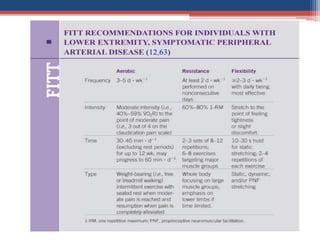
• Some patients may need to begin with 15 min
per day, gradually increasing 5 min per day bi
weekly.
• Supplement weight bearing with non weight
bearing –
arm and leg ergometry.
• Cycling may be used as warm up but not as
primary type of activity.
• Cold environment may aggravate symptoms of
IC therefore longer warm up may be necessary.
• Address all CVD risk factors.
REFERENCES
• PAD exercise training toolkit. A guide for health
care professionals. AACVPR.
THANK YOU

Physiotherapy Management in Peripheral arterial disease

  • 1.
  • 2.
    PERIPHERAL VASCULAR DISEASES •Reduction in blood flow & hence oxygen through the peripheral vessels. • When the need of tissues for oxygen exceeds the supply, ischemia and necrosis will develop.
  • 3.
    PERIPHERAL VASCULAR DISEASES ARTERIALDISEASES VENOUS DISEASES • Atherosclerosis of aorta and its branches – (atheroma/plaque causing stenosis) • Varicose veins – dilated, elongated, tortuous. • Deep vein thrombosis – Thrombosis in deep vein off legs. • Thrombophlebitis- varicose veins becoming thrombosed and inflamed
  • 4.
    RISK FACTORS • Age– blood vessels become less elastic with age. • Sex - M>F • Smoking – nicotine causes vasoconstriction and spasm of arteries. - reduces O2 transport to tissues. • Hypertension – causes elastic tissues in arteries to be replaced by fibrotic tissues. • Hyperlipidemia and obesity – accelerates plaque formation due to more lipid. • DM – abnomal fat and glucose metabolism. • Emotional stress - activates SNS – high BP. • Family history of atherosclerosis.
  • 5.
    CHARACTERSTICS Arterial Disease VenousDisease Skin Cool, hairless, dry , shiny, pallor, rubor on dangling. Warm, thickened, mottled, pigmented areas Pain Sharp, stabbing, worsens with activity, lowering feet may relieve pain. Aching, cramping, activity and walking may sometimes help, elevating relieves pain Ulcers Severly painful, pale, grey base, found on heel, toes, dorsum of foot. Moderately painful, pink base, mostly medial aspect of ankle. Pulse Absent or diminished Usually present Edema infrequent Frequent esp at end off the day and in areas of ulceratiom.
  • 6.
    DIFFERENTIAL DIAGNOSIS • Osteoarthritis. •Neuropahy. • Sciatica. • Myopathy. • Spinal stenosis.
  • 7.
    ASSESSMENT • Investigations –Doppler ultrasonography, - computed tomographic angiography, - magnetic resonance angiography, - Arteriography. • Ankle Brachial Index. Noncompressible > 1.4 Normal ABI 1.00 – 1.3O Borderline(equivocal) 0.91 – 0.99 Mild to moderate 0.41 – 0.90 Severe impairment <0.40
  • 8.
    Claudication • Intermmitent claudication– major symptom of PAD . • Reproducible aching, cramping sensation or fatigue - affecting muscles of calf – 1/both legs. • Triggered with weight bearing, relieved by rest. • Rest Pain – As severity of occlusion increases – pain when lying in bed, relieved by hanging leg bedside. • Rest pain is indicative of deterioration may lead to gangrene if vascular reconstruction not done.
  • 9.
    EXERCISE TESTING • Standardizedtreadmill protocols. Claudication pain – 1 – no pain. 2 – onset of pain. 3 - mild pain. 4 - moderate pain. 5 – Severe pain. • 6MWT if treadmill testing not possible. • Balance test. • Contraindications –  Unstable angina. Decompensated heart failure. Uncontrolled cardiac arrhythmias. Severe or symptomatic valvular heart disease Critical limb ischaemia.
  • 10.
    OTHER CONSIDERATIONS • Mostpatients with PAD have co existing CAD.
  • 11.
    EDUCATION & PRECAUTIONS •Tobacco caessation. • Nutrition – same as CAD • Stress reduction. WHEN DIABETES IS PRESENT – Usually co existing neuropathy. • Self eamination of distal foot • Shock absorbing shoes , not tight. • Avoid tight clothing. • Regular glucose checkups. • Lifelong exercise
  • 13.
  • 15.
    SURGICAL CONSIDERATIONS Surgeries commonlyperformed – • Sympathectomy • Endarterectomy. • Bypass procedures. • Amputation. • Angioplasty – avoid prolonged squatting if stent in place
  • 16.
    SPECIAL CONSIDERATIONS • Somepatients may need to begin with 15 min per day, gradually increasing 5 min per day bi weekly. • Supplement weight bearing with non weight bearing – arm and leg ergometry. • Cycling may be used as warm up but not as primary type of activity. • Cold environment may aggravate symptoms of IC therefore longer warm up may be necessary. • Address all CVD risk factors.
  • 17.
    REFERENCES • PAD exercisetraining toolkit. A guide for health care professionals. AACVPR.
  • 18.