RESEARCH OBJECTIVES
AND HYPOTHESIS
CONTENTS
01
02
03
04
RESEARCH
OBJECTIVES
TYPES OF RESEARCH
OBJECTIVES
TYPES OF
HYPOTHESIS
FORMULATING
HYPOTHESIS
PART 01
RESEARCH
OBJECTIVES
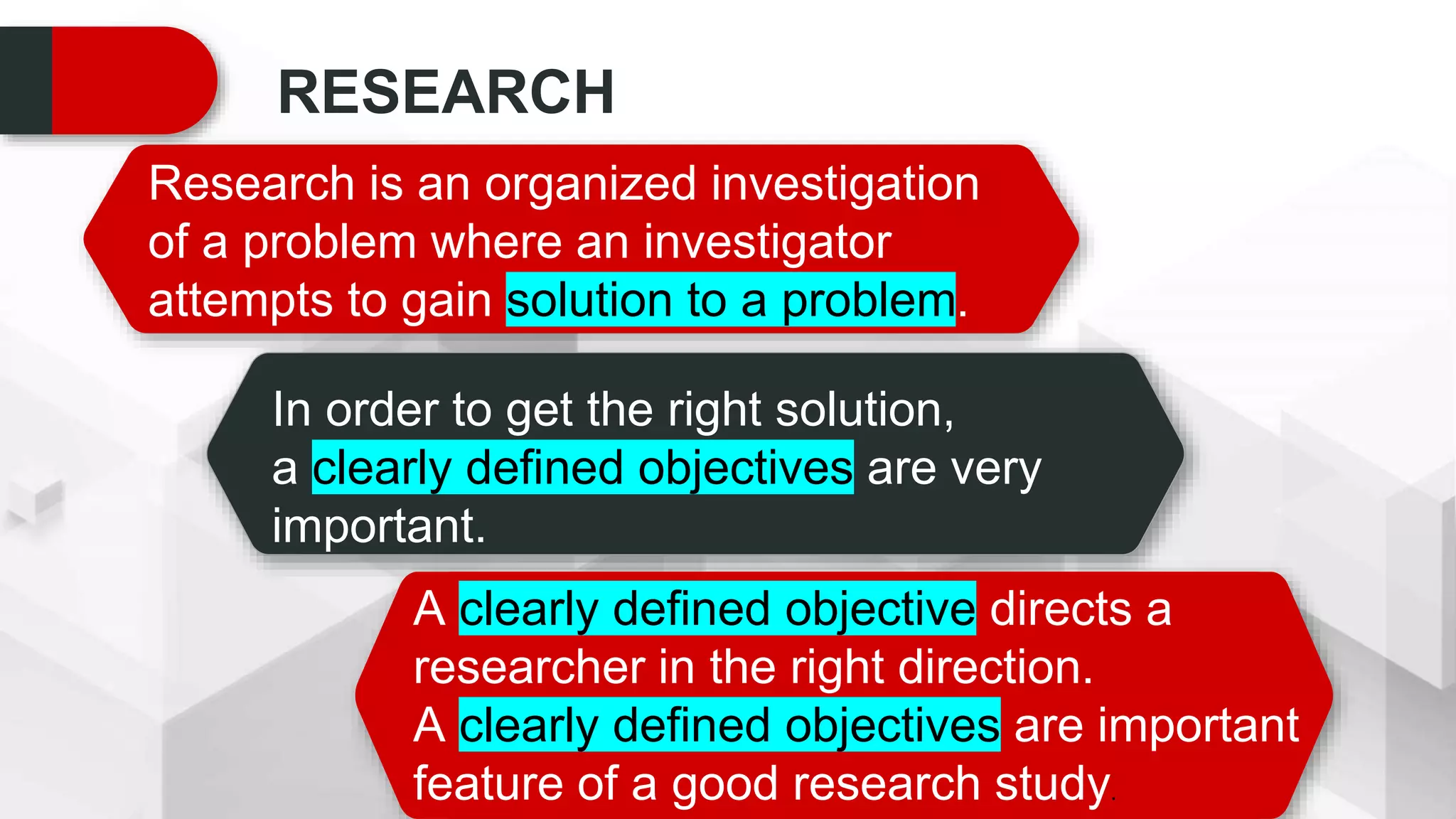
A clearly defined objective directs a researcher in the right direction.
In order to get the right solution,
a clearly defined objectives are very
important.
Research is an organized investigation
of a problem where an investigator
attempts to gain solution to a problem.
RESEARCH
A clearly defined objective directs a
researcher in the right direction.
A clearly defined objectives are important
feature of a good research study.
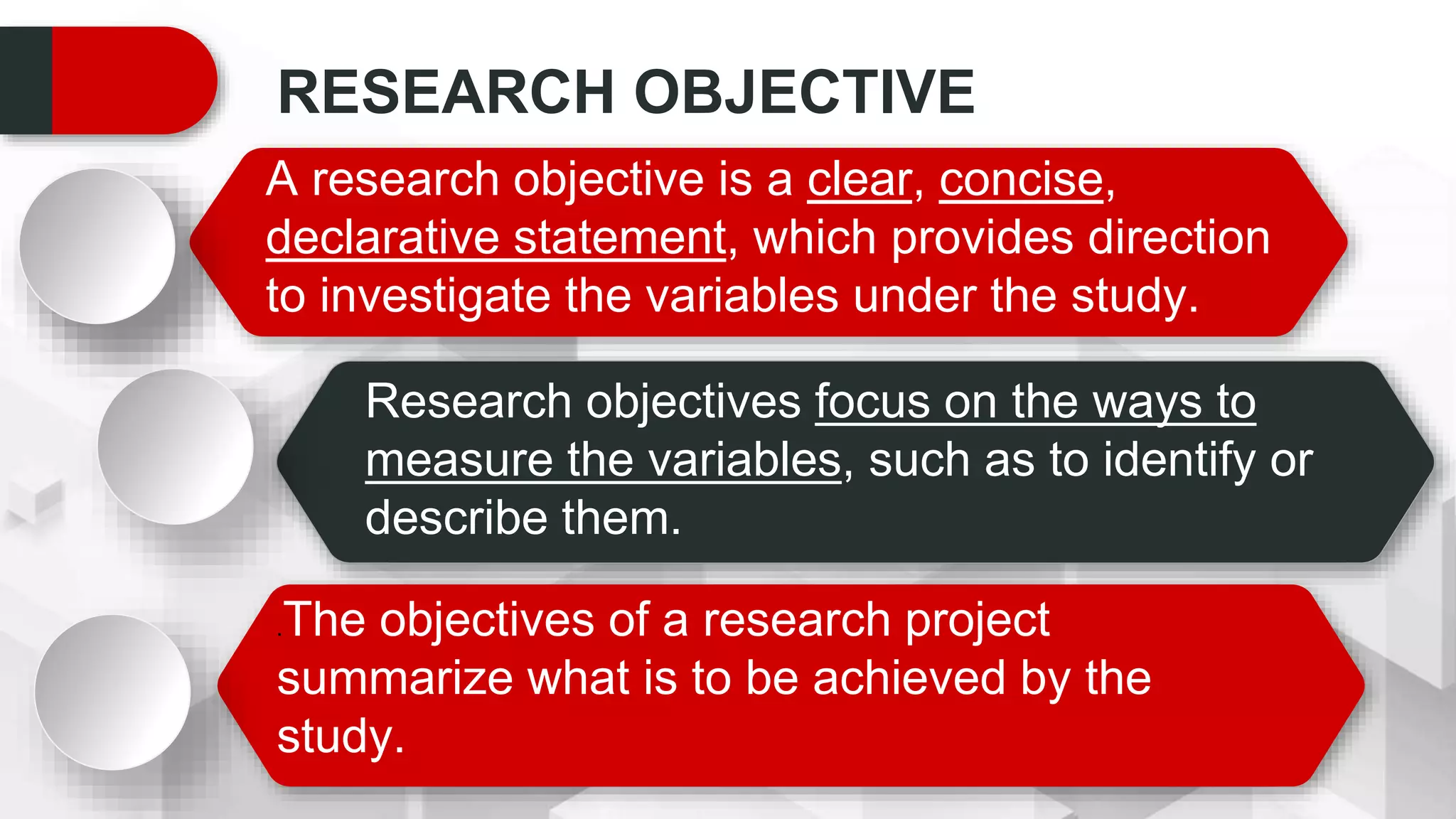
Research objectives focus on the ways to
measure the variables, such as to identify or
describe them.
RESEARCH OBJECTIVE
.The objectives of a research project
summarize what is to be achieved by the
study.
A research objective is a clear, concise,
declarative statement, which provides direction
to investigate the variables under the study.
specific
Take calculated risks. That is quite different from being rash.
measurable
CHARACTERISTICS OF RESEARCH
OBJECTIVES
R
T
attainable
realistic
Time-bound
S
M
A
01
02
03
04
FOCUS
NEED FOR OBJECTIVES
ORGANIZATION
GIVES DIRECTION
AVOID UNNECESSARY
DATA
TYPES OF RESEARCH
OBJECTIVES
PART 02
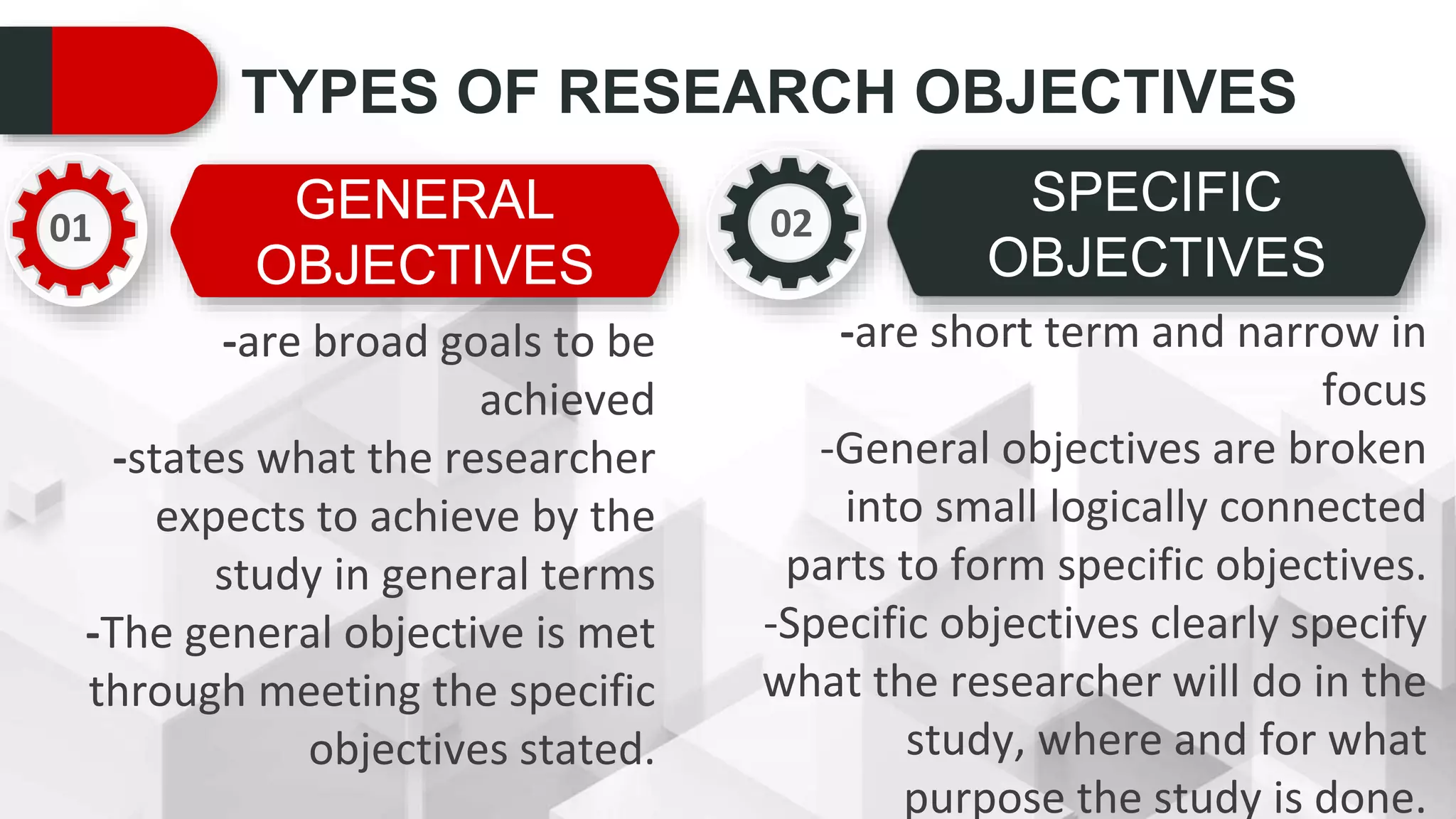
01
-are broad goals to be
achieved
-states what the researcher
expects to achieve by the
study in general terms
-The general objective is met
through meeting the specific
objectives stated.
TYPES OF RESEARCH OBJECTIVES
-are short term and narrow in
focus
-General objectives are broken
into small logically connected
parts to form specific objectives.
-Specific objectives clearly specify
what the researcher will do in the
study, where and for what
purpose the study is done.
GENERAL
OBJECTIVES
SPECIFIC
OBJECTIVES
02
01
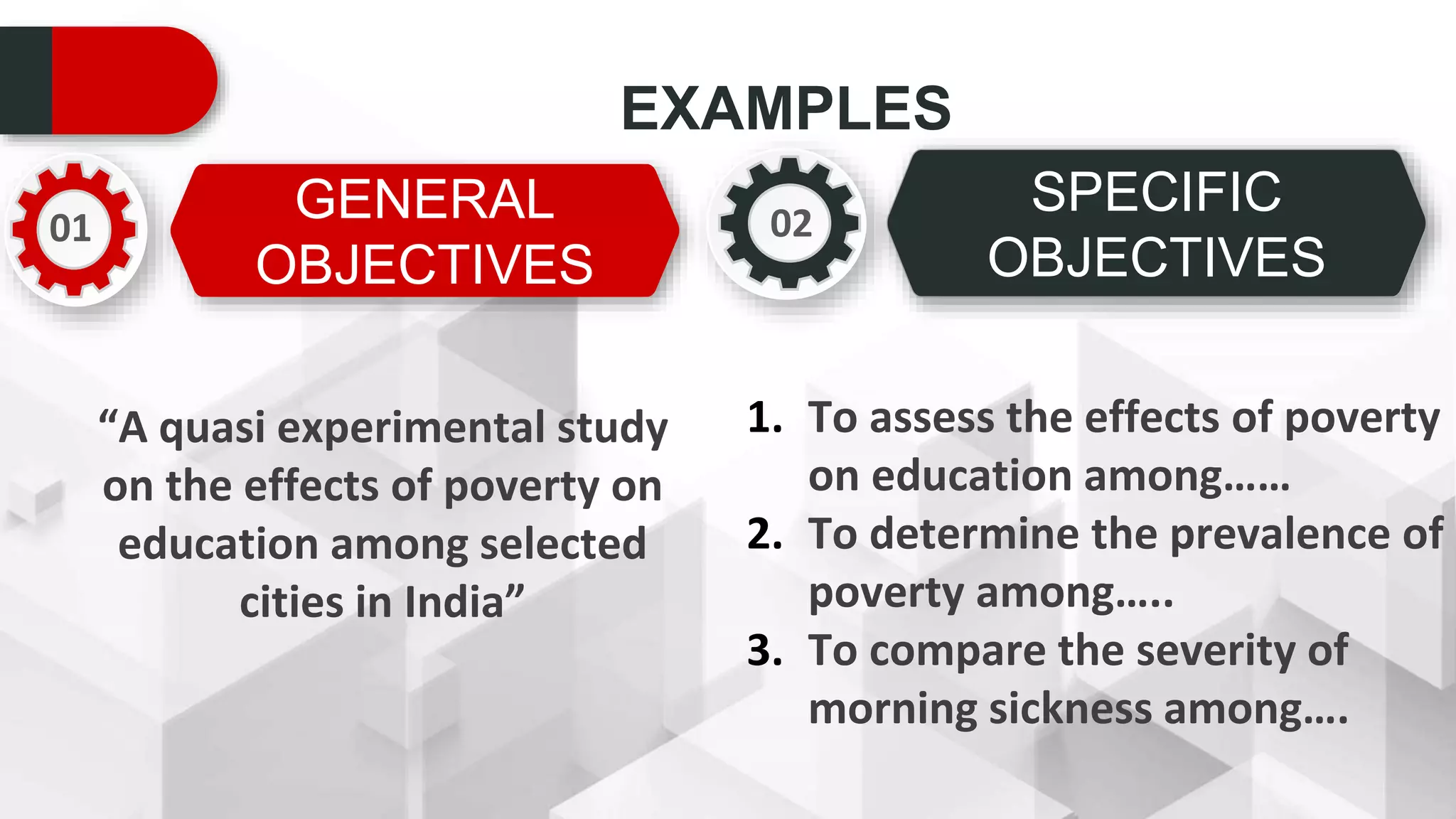
“A quasi experimental study
on the effects of poverty on
education among selected
cities in India”
EXAMPLES
1. To assess the effects of poverty
on education among……
2. To determine the prevalence of
poverty among…..
3. To compare the severity of
morning sickness among….
GENERAL
OBJECTIVES
SPECIFIC
OBJECTIVES
02
METHOD OF STATING OBJECTIVES
 The following guideline must be taken into account while stating
the objectives….
 The objectives should be presented briefly and concisely.
 The objective should cover the different aspects of the problem and
its contributing factors in a coherent way and in a logical sequence.
 The objectives should be clearly phrased in operational terms,
specifying exactly what the researcher is going to do, where and for
what purpose.
 The objectives are realistic considering the local conditions.
 The objectives use action verbs that are specific enough to be
HYPOTHESIS
And its types
PART 03
HYPOTHESIS
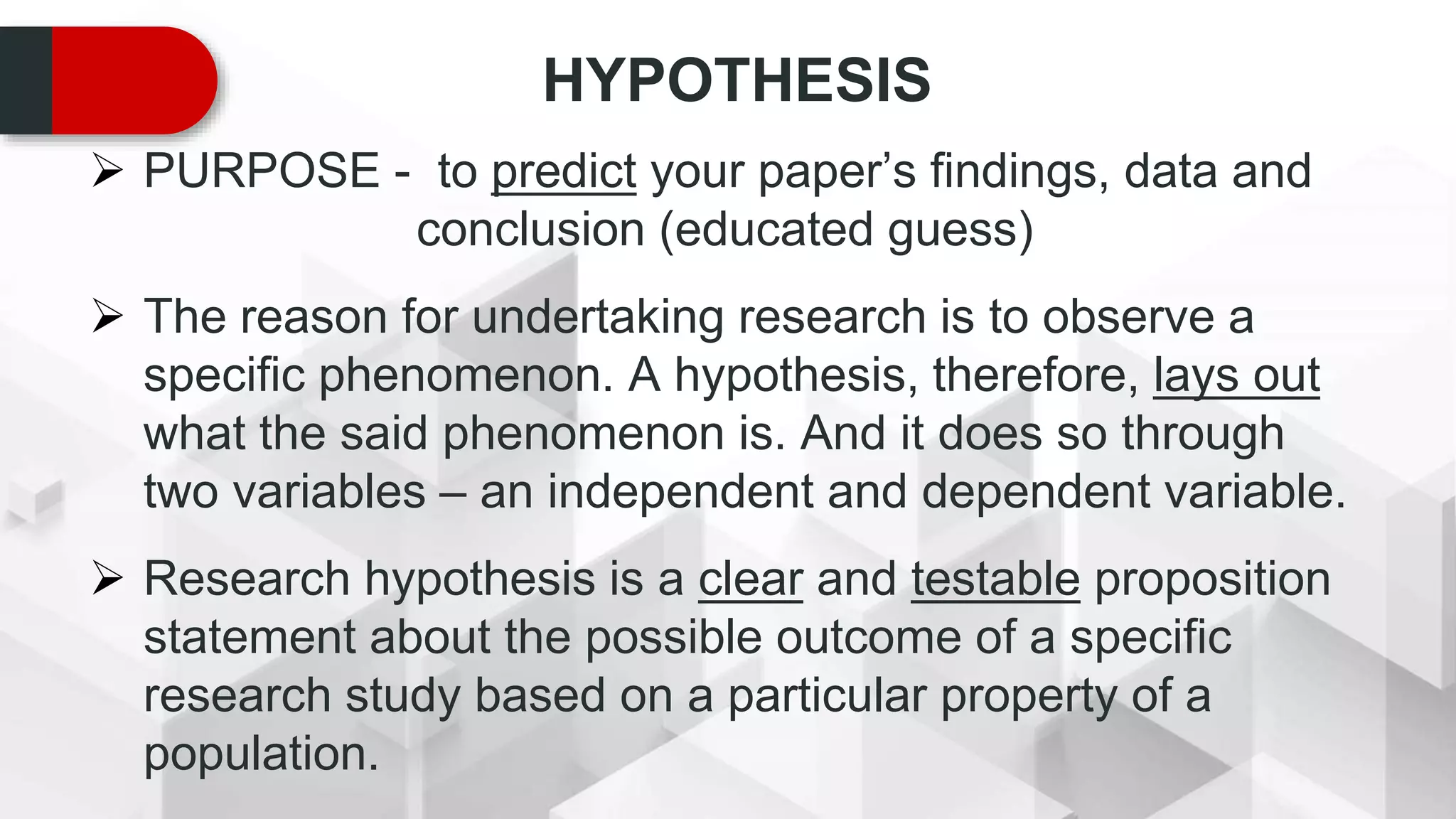
 PURPOSE - to predict your paper’s findings, data and
conclusion (educated guess)
 The reason for undertaking research is to observe a
specific phenomenon. A hypothesis, therefore, lays out
what the said phenomenon is. And it does so through
two variables – an independent and dependent variable.
 Research hypothesis is a clear and testable proposition
statement about the possible outcome of a specific
research study based on a particular property of a
population.
02
CHARACTERISTICS OF A GOOD
HYPOTHESIS
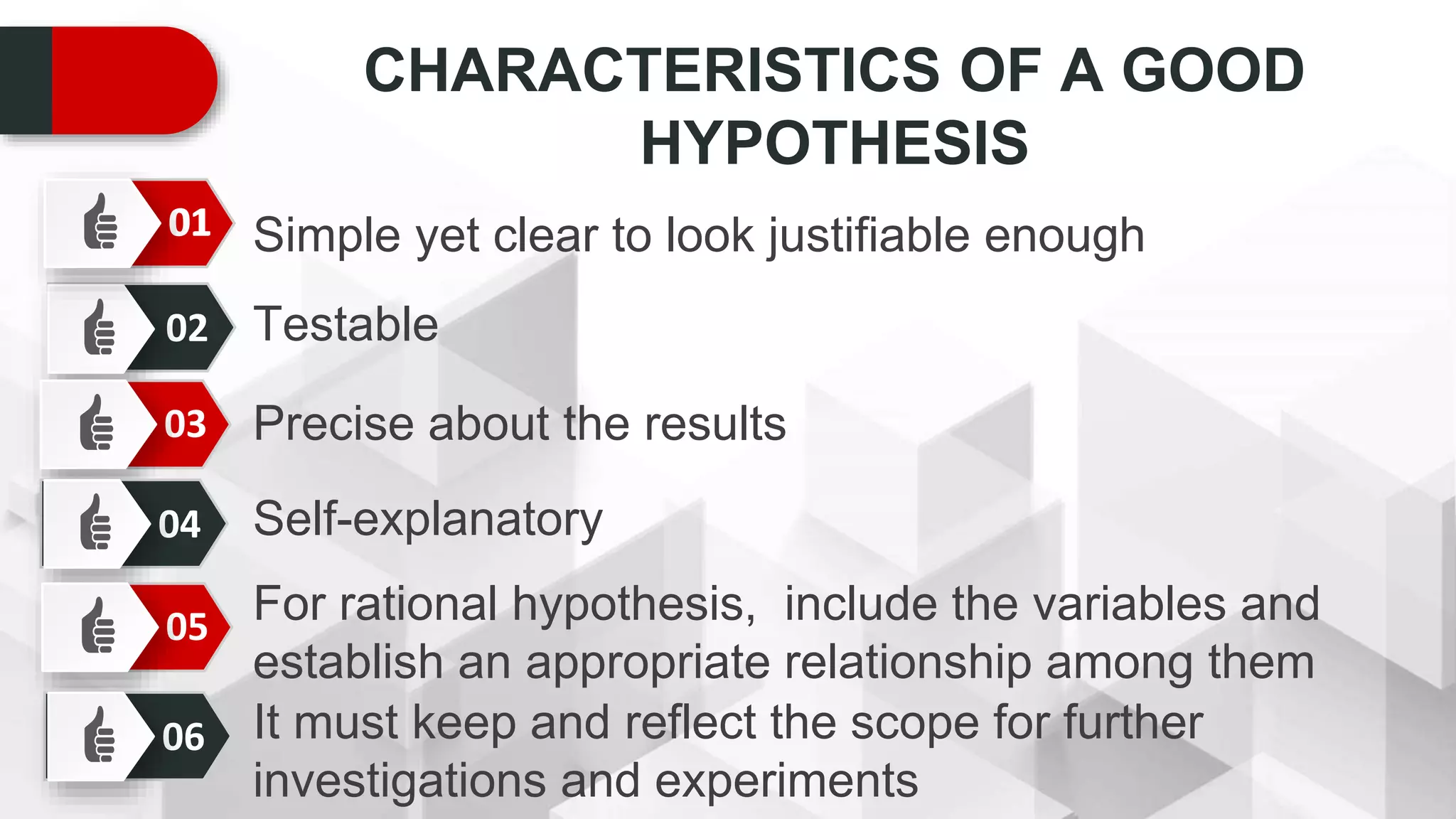
Testable
03 Precise about the results
04 Self-explanatory
05 For rational hypothesis, include the variables and
establish an appropriate relationship among them
06 It must keep and reflect the scope for further
investigations and experiments
01
01 Simple yet clear to look justifiable enough
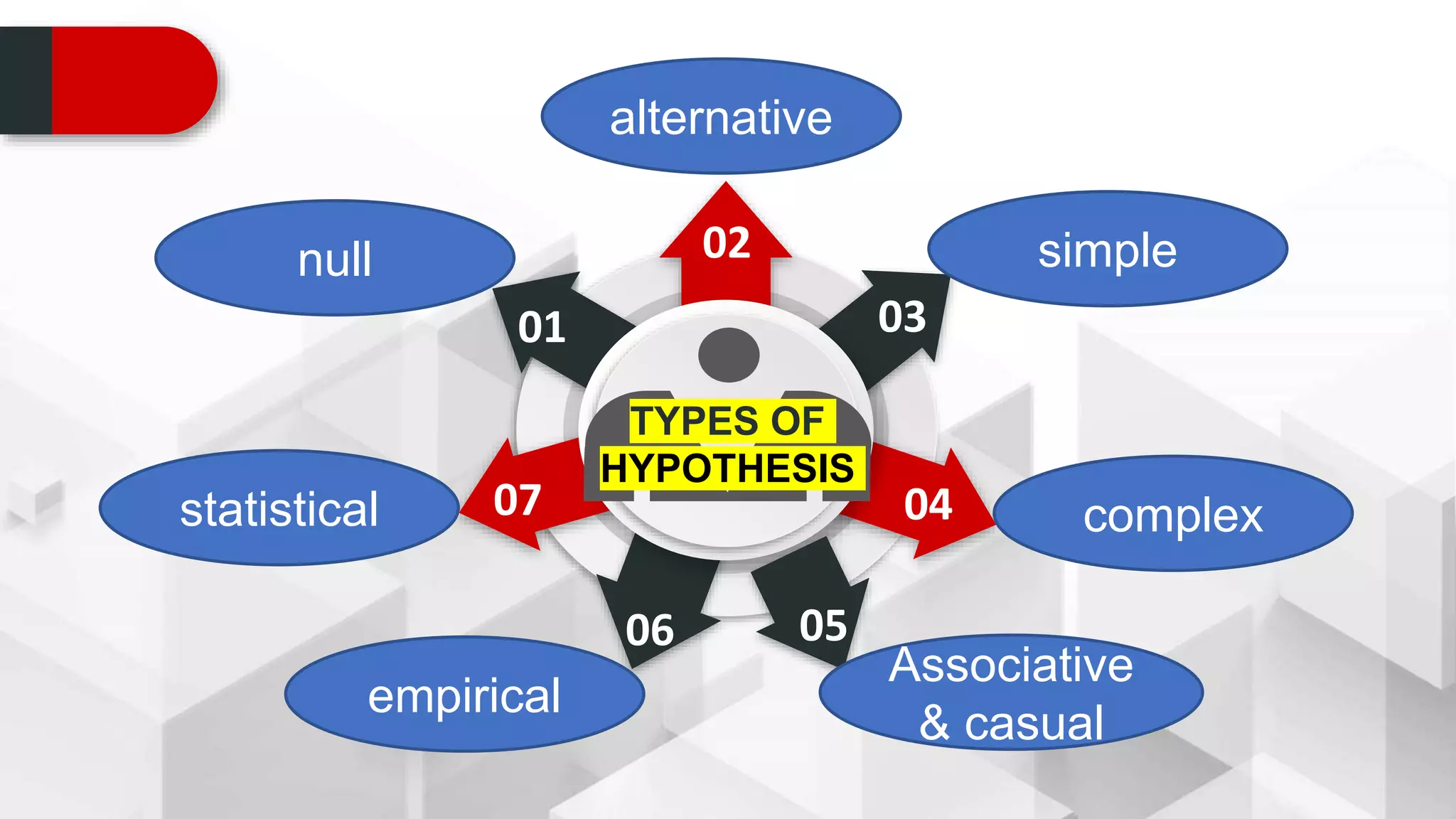
TYPES OF
HYPOTHESIS
01
02
03
04
06
07
05
null
alternative
Associative
& casual
complex
simple
statistical
empirical
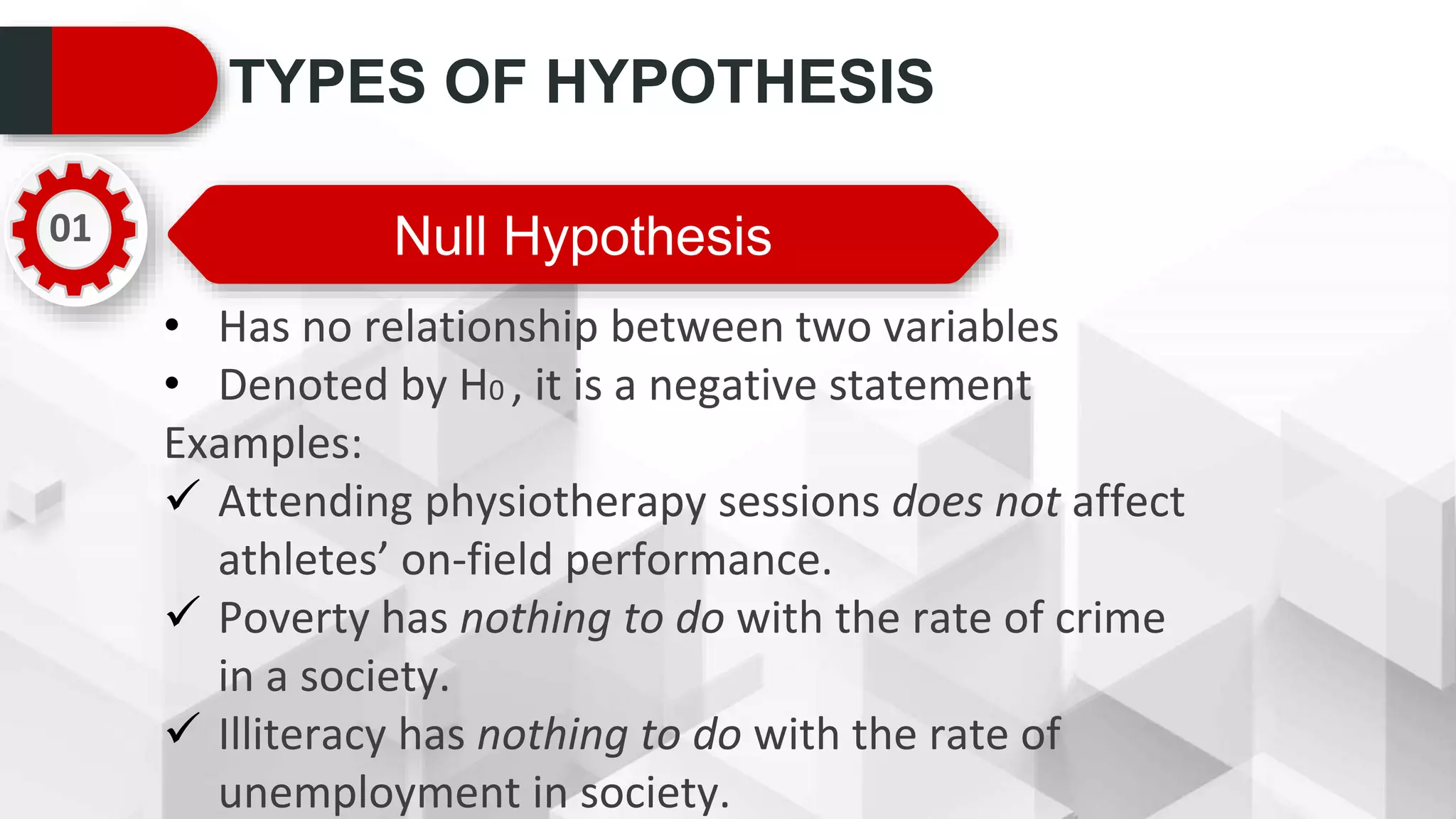
01
• Has no relationship between two variables
• Denoted by H0 , it is a negative statement
Examples:
 Attending physiotherapy sessions does not affect
athletes’ on-field performance.
 Poverty has nothing to do with the rate of crime
in a society.
 Illiteracy has nothing to do with the rate of
unemployment in society.
TYPES OF HYPOTHESIS
Null Hypothesis
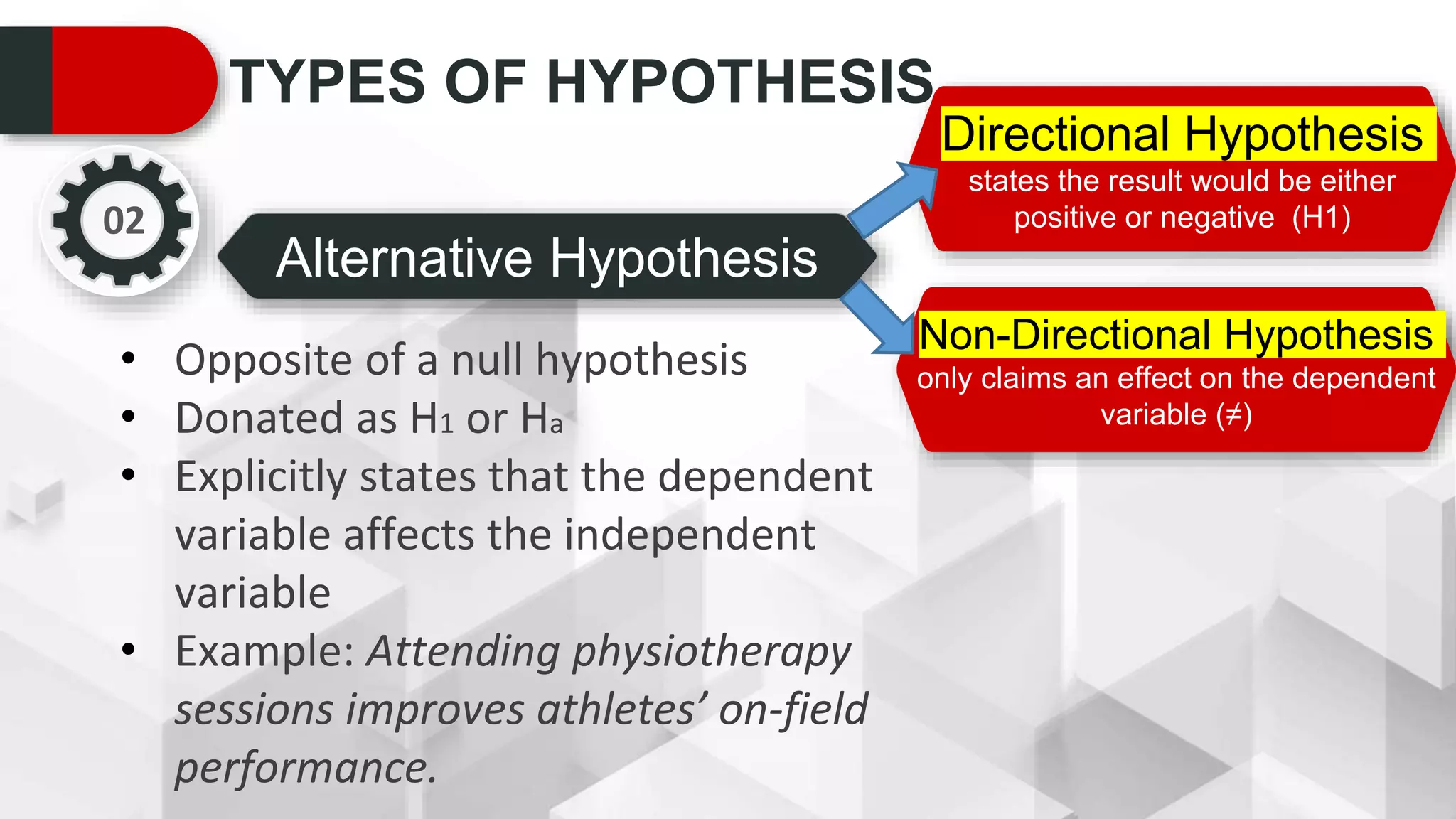
• Opposite of a null hypothesis
• Donated as H1 or Ha
• Explicitly states that the dependent
variable affects the independent
variable
• Example: Attending physiotherapy
sessions improves athletes’ on-field
performance.
TYPES OF HYPOTHESIS
Alternative Hypothesis
02
Directional Hypothesis
states the result would be either
positive or negative (H1)
Non-Directional Hypothesis
only claims an effect on the dependent
variable (≠)
03
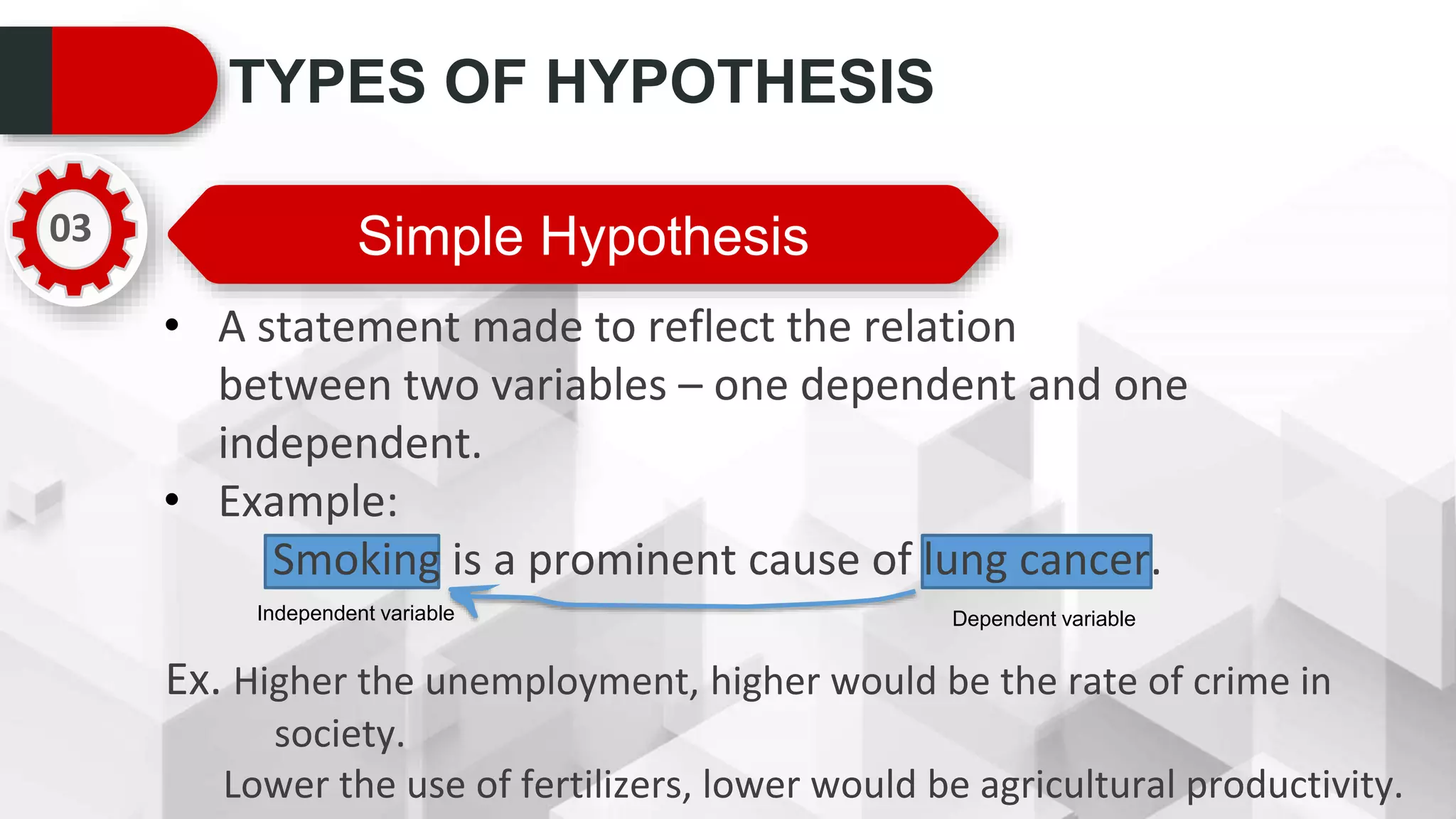
• A statement made to reflect the relation
between two variables – one dependent and one
independent.
• Example:
Smoking is a prominent cause of lung cancer.
TYPES OF HYPOTHESIS
Simple Hypothesis
Dependent variable
Independent variable
Ex. Higher the unemployment, higher would be the rate of crime in
society.
Lower the use of fertilizers, lower would be agricultural productivity.
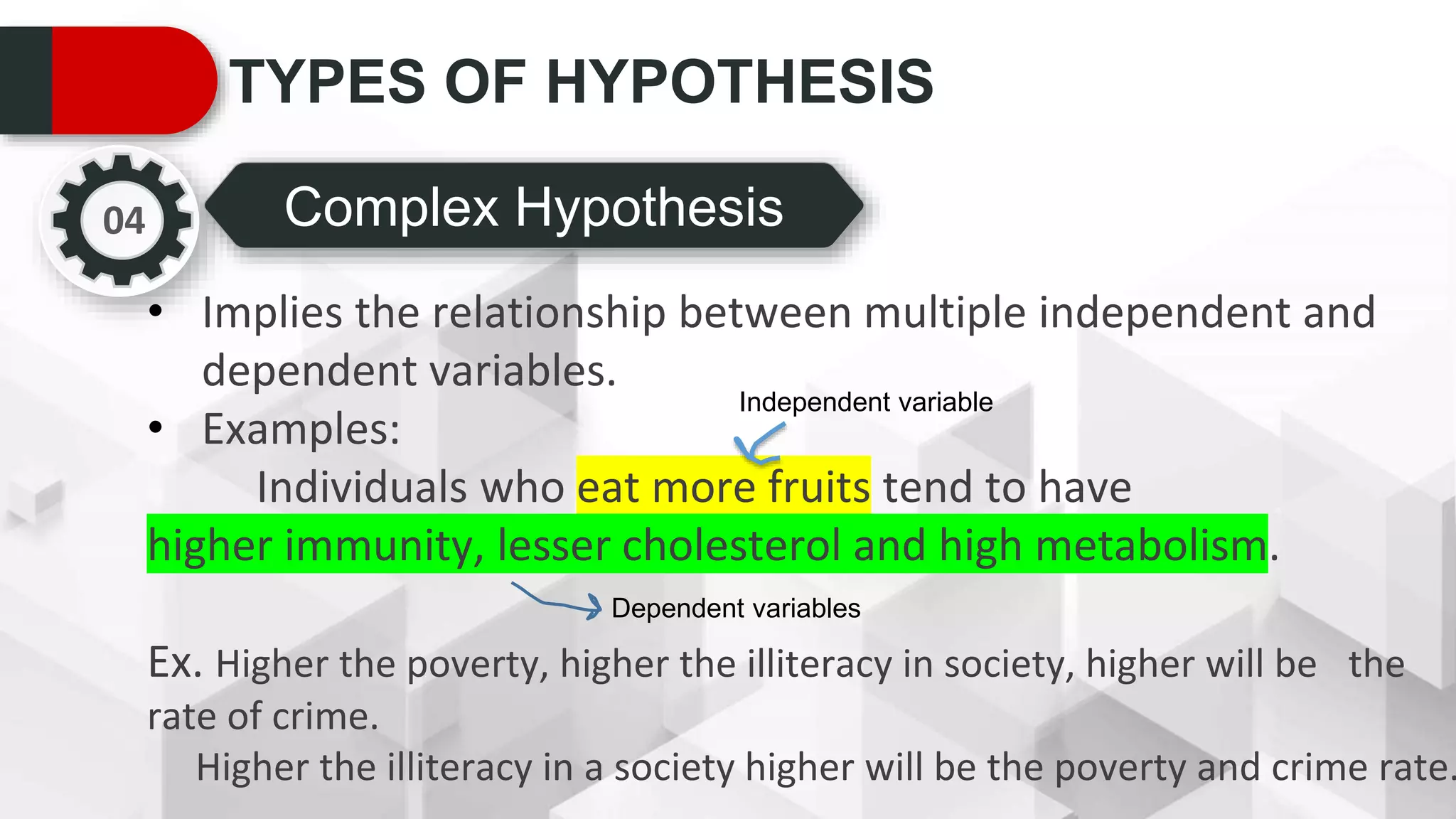
• Implies the relationship between multiple independent and
dependent variables.
• Examples:
Individuals who eat more fruits tend to have
higher immunity, lesser cholesterol and high metabolism.
Ex. Higher the poverty, higher the illiteracy in society, higher will be the
rate of crime.
Higher the illiteracy in a society higher will be the poverty and crime rate.
TYPES OF HYPOTHESIS
Complex Hypothesis
04
Independent variable
Dependent variables
05
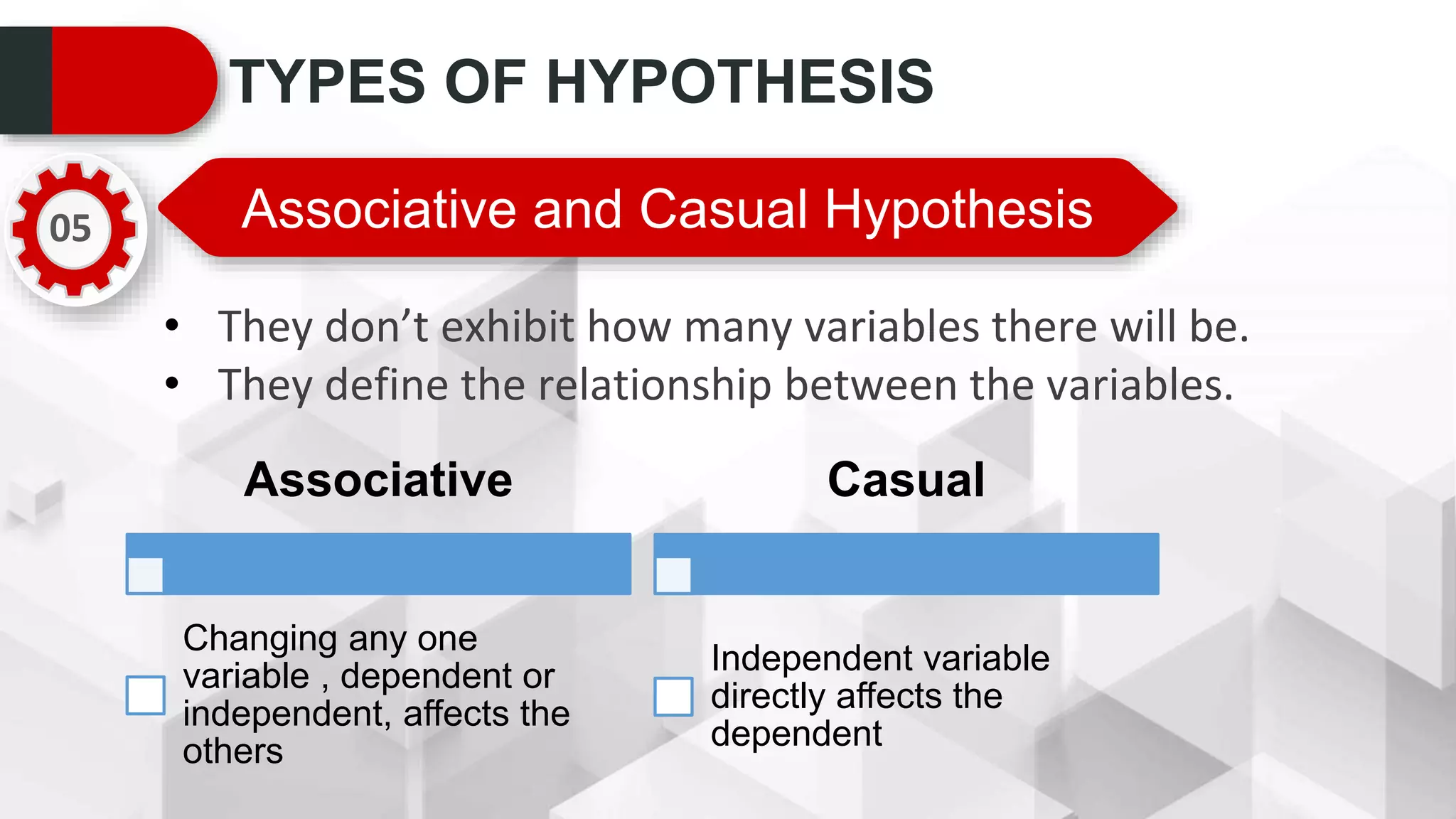
• They don’t exhibit how many variables there will be.
• They define the relationship between the variables.
TYPES OF HYPOTHESIS
Associative and Casual Hypothesis
Associative
Changing any one
variable , dependent or
independent, affects the
others
Casual
Independent variable
directly affects the
dependent
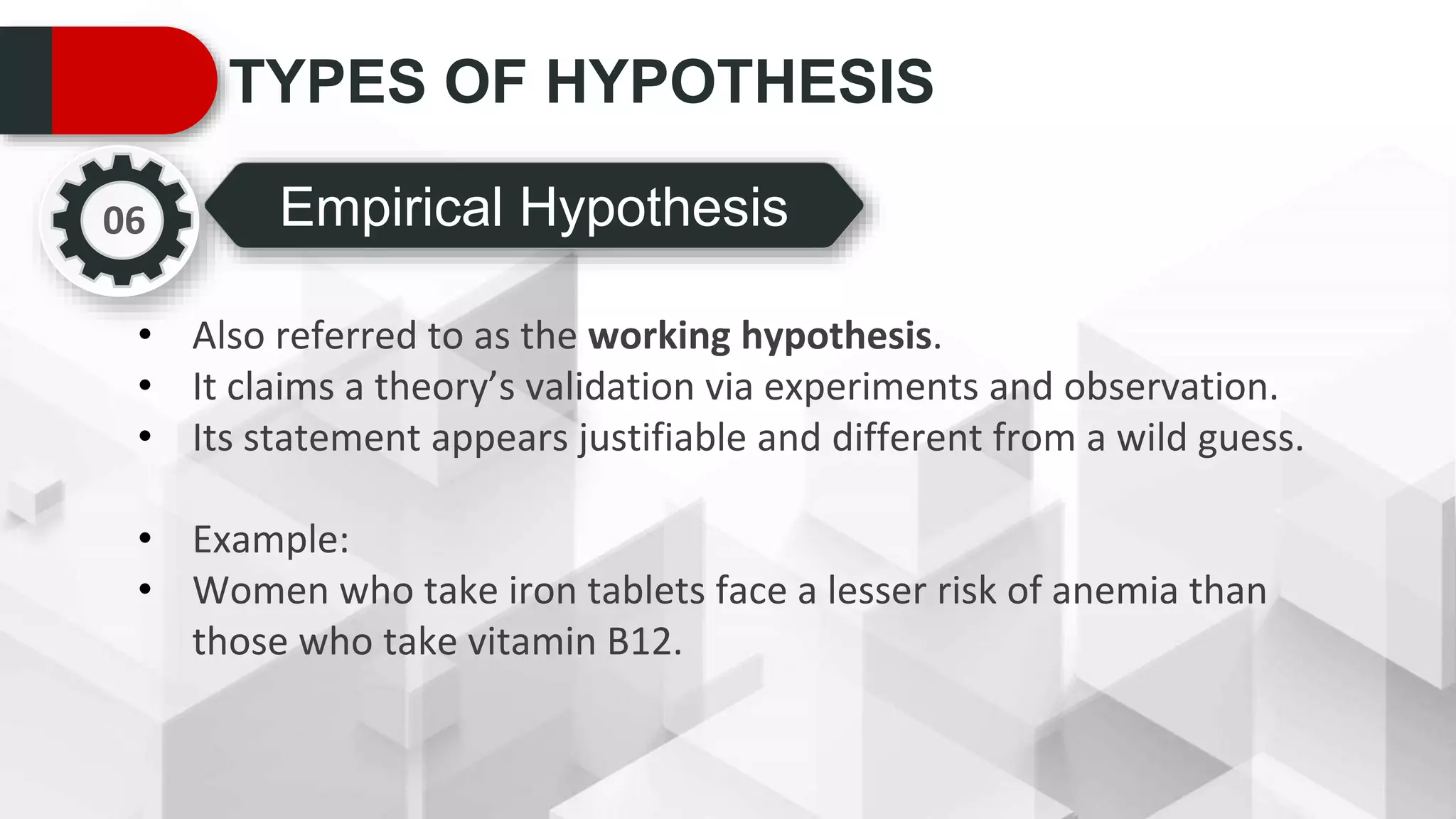
• Also referred to as the working hypothesis.
• It claims a theory’s validation via experiments and observation.
• Its statement appears justifiable and different from a wild guess.
• Example:
• Women who take iron tablets face a lesser risk of anemia than
those who take vitamin B12.
TYPES OF HYPOTHESIS
Empirical Hypothesis
06
07
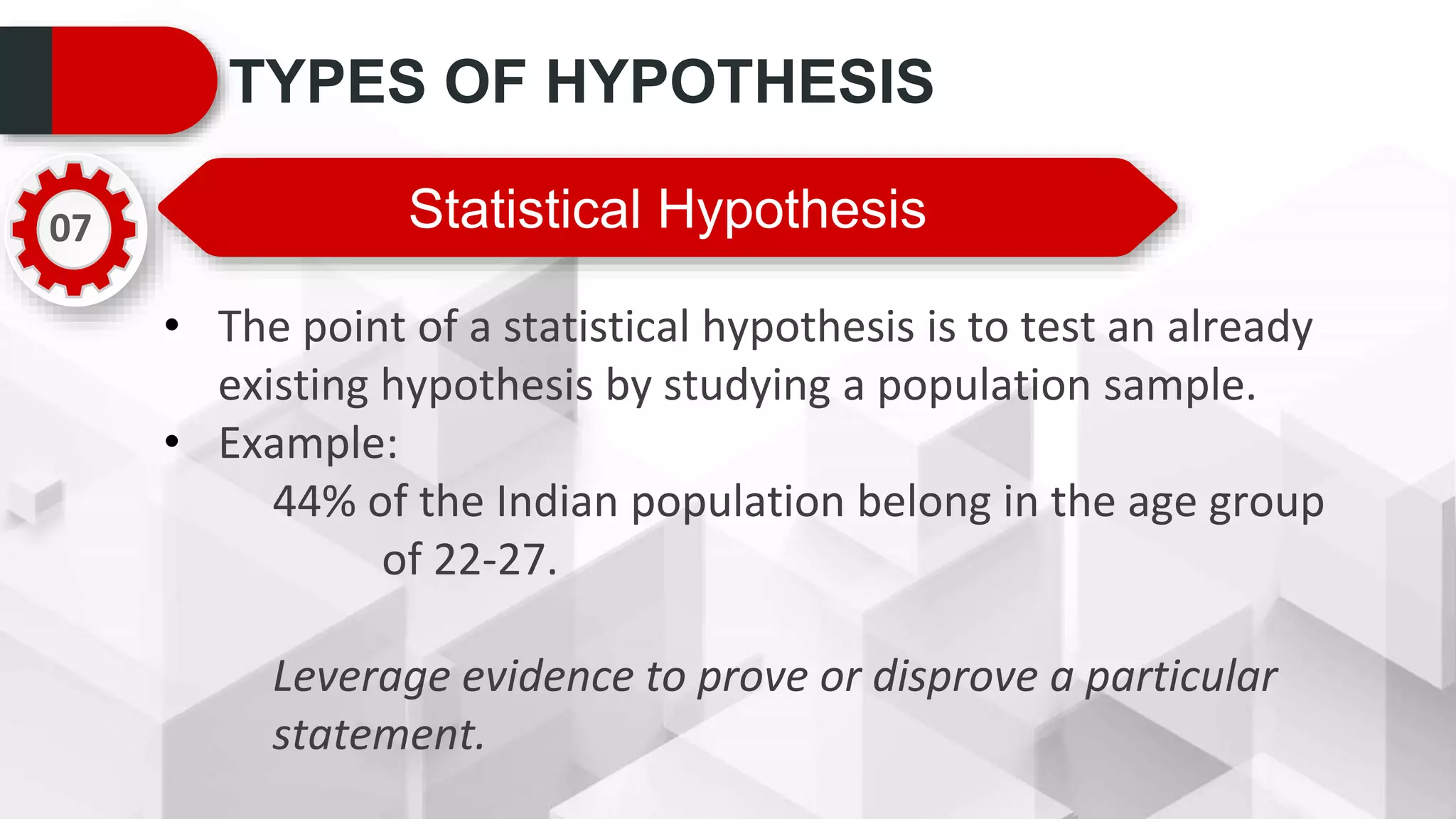
• The point of a statistical hypothesis is to test an already
existing hypothesis by studying a population sample.
• Example:
44% of the Indian population belong in the age group
of 22-27.
Leverage evidence to prove or disprove a particular
statement.
TYPES OF HYPOTHESIS
Statistical Hypothesis

Research Objectives and Hypothesis.pptx

  • 1.
  • 2.
  • 3.
  • 4.
    A clearly definedobjective directs a researcher in the right direction. In order to get the right solution, a clearly defined objectives are very important. Research is an organized investigation of a problem where an investigator attempts to gain solution to a problem. RESEARCH A clearly defined objective directs a researcher in the right direction. A clearly defined objectives are important feature of a good research study.
  • 5.
    Research objectives focuson the ways to measure the variables, such as to identify or describe them. RESEARCH OBJECTIVE .The objectives of a research project summarize what is to be achieved by the study. A research objective is a clear, concise, declarative statement, which provides direction to investigate the variables under the study.
  • 6.
    specific Take calculated risks.That is quite different from being rash. measurable CHARACTERISTICS OF RESEARCH OBJECTIVES R T attainable realistic Time-bound S M A
  • 7.
  • 8.
  • 9.
    01 -are broad goalsto be achieved -states what the researcher expects to achieve by the study in general terms -The general objective is met through meeting the specific objectives stated. TYPES OF RESEARCH OBJECTIVES -are short term and narrow in focus -General objectives are broken into small logically connected parts to form specific objectives. -Specific objectives clearly specify what the researcher will do in the study, where and for what purpose the study is done. GENERAL OBJECTIVES SPECIFIC OBJECTIVES 02
  • 10.
    01 “A quasi experimentalstudy on the effects of poverty on education among selected cities in India” EXAMPLES 1. To assess the effects of poverty on education among…… 2. To determine the prevalence of poverty among….. 3. To compare the severity of morning sickness among…. GENERAL OBJECTIVES SPECIFIC OBJECTIVES 02
  • 11.
    METHOD OF STATINGOBJECTIVES  The following guideline must be taken into account while stating the objectives….  The objectives should be presented briefly and concisely.  The objective should cover the different aspects of the problem and its contributing factors in a coherent way and in a logical sequence.  The objectives should be clearly phrased in operational terms, specifying exactly what the researcher is going to do, where and for what purpose.  The objectives are realistic considering the local conditions.  The objectives use action verbs that are specific enough to be
  • 15.
  • 17.
    HYPOTHESIS  PURPOSE -to predict your paper’s findings, data and conclusion (educated guess)  The reason for undertaking research is to observe a specific phenomenon. A hypothesis, therefore, lays out what the said phenomenon is. And it does so through two variables – an independent and dependent variable.  Research hypothesis is a clear and testable proposition statement about the possible outcome of a specific research study based on a particular property of a population.
  • 18.
    02 CHARACTERISTICS OF AGOOD HYPOTHESIS Testable 03 Precise about the results 04 Self-explanatory 05 For rational hypothesis, include the variables and establish an appropriate relationship among them 06 It must keep and reflect the scope for further investigations and experiments 01 01 Simple yet clear to look justifiable enough
  • 19.
  • 20.
    01 • Has norelationship between two variables • Denoted by H0 , it is a negative statement Examples:  Attending physiotherapy sessions does not affect athletes’ on-field performance.  Poverty has nothing to do with the rate of crime in a society.  Illiteracy has nothing to do with the rate of unemployment in society. TYPES OF HYPOTHESIS Null Hypothesis
  • 21.
    • Opposite ofa null hypothesis • Donated as H1 or Ha • Explicitly states that the dependent variable affects the independent variable • Example: Attending physiotherapy sessions improves athletes’ on-field performance. TYPES OF HYPOTHESIS Alternative Hypothesis 02 Directional Hypothesis states the result would be either positive or negative (H1) Non-Directional Hypothesis only claims an effect on the dependent variable (≠)
  • 22.
    03 • A statementmade to reflect the relation between two variables – one dependent and one independent. • Example: Smoking is a prominent cause of lung cancer. TYPES OF HYPOTHESIS Simple Hypothesis Dependent variable Independent variable Ex. Higher the unemployment, higher would be the rate of crime in society. Lower the use of fertilizers, lower would be agricultural productivity.
  • 23.
    • Implies therelationship between multiple independent and dependent variables. • Examples: Individuals who eat more fruits tend to have higher immunity, lesser cholesterol and high metabolism. Ex. Higher the poverty, higher the illiteracy in society, higher will be the rate of crime. Higher the illiteracy in a society higher will be the poverty and crime rate. TYPES OF HYPOTHESIS Complex Hypothesis 04 Independent variable Dependent variables
  • 24.
    05 • They don’texhibit how many variables there will be. • They define the relationship between the variables. TYPES OF HYPOTHESIS Associative and Casual Hypothesis Associative Changing any one variable , dependent or independent, affects the others Casual Independent variable directly affects the dependent
  • 25.
    • Also referredto as the working hypothesis. • It claims a theory’s validation via experiments and observation. • Its statement appears justifiable and different from a wild guess. • Example: • Women who take iron tablets face a lesser risk of anemia than those who take vitamin B12. TYPES OF HYPOTHESIS Empirical Hypothesis 06
  • 26.
    07 • The pointof a statistical hypothesis is to test an already existing hypothesis by studying a population sample. • Example: 44% of the Indian population belong in the age group of 22-27. Leverage evidence to prove or disprove a particular statement. TYPES OF HYPOTHESIS Statistical Hypothesis