Quantitative ResearchQuantitative Research
DesignDesign
An OVERVIEWAn OVERVIEW
Quantitative Research:Quantitative Research:
• Systematic scientific investigation of data
and their relationships.
• The kind of research that involves the
tallying, manipulation, or systematic
aggregation of quantities of data.
(Grant Henning "Quantitative Methods In Language Acquisition 
Research“)
Quantitative Research:Quantitative Research:
• The collection of numerical data in order to
explain, predict and/or control phenomena
of interest.
(L.R. Gay ”Educational Research: Competencies for Analysis and 
Application”)
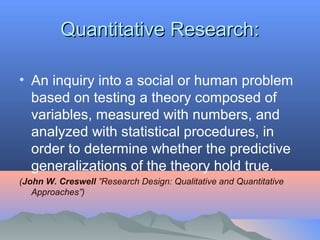
Quantitative Research:Quantitative Research:
• An inquiry into a social or human problem
based on testing a theory composed of
variables, measured with numbers, and
analyzed with statistical procedures, in
order to determine whether the predictive
generalizations of the theory hold true.
(John W. Creswell ”Research Design: Qualitative and Quantitative 
Approaches”)
Overview of Quantitative ResearchOverview of Quantitative Research
• The objective of quantitative research is to
develop and employ mathematical
models, theories and hypotheses
pertaining to natural phenomena.
• Measuring is key in quantitative research
because it shows the relationship between
data and observation.
Quantitative Research MethodsQuantitative Research Methods
• The basic building blocks of quantitative
research are variables.
Variables are something that takes on
different values or categories.
Common Types of Variables Classified by Level ofCommon Types of Variables Classified by Level of
Measurement and by Role of VariableMeasurement and by Role of Variable
Variable Type Key Characteristic Example
Level of Measurement
Categorical
Variable
Made up of different
types or categories
of a phenomenon
Gender categories:
male and female
Quantitative
Variable
Varies in degree or
amount of a
phenomenon
Annual Income
varies from zero
income to very high
income level
Variable Type Key Characteristic Example
Role Taken by the Variable
Independent
Variable
Presumed to cause changes
to occur in another variable
(causal variable)
Amount of studying (IV) affects
test grades (DV)
Dependent
Variable
A variable that changes
because of another variable
(effect or outcome
variable)
Amount of studying (IV) affects
test grades (DV)
Mediating
Variable
(Intervening
Variable)
Comes in between other
variables, helps to delineate
the process through which
variables affect one another
Amount of studying (IV) leads
to input and organization of
knowledge in long-term
memory (mediating variable)
which affects test grades (DV)
Moderator
Variable
Delineates how a relationship
of interest changes under
different conditions or
circumstances
Perhaps the relationship
between studying (IV) and test
grades (DV) changes
according to the different levels
of use of a drug such as
Retalin (moderator variable)
Types of Quantitative researchTypes of Quantitative research
•EXPERIMENTAL RESEARCH
DESIGN
•NONEXPERIMENTAL RESEARCH
DESIGN
Experimental Research DesignExperimental Research Design
• The purpose of experimental research is
to study cause and effect relationships.
• Its defining characteristic is active
manipulation of an independent variable
(i.e., it is only in experimental research that
“manipulation” is present).
• Also, random assignment (which creates
"equivalent" groups) is used in the
strongest experimental research designs.
Correlational ResearchCorrelational Research
• To find if the data has an observable
relationship that can be further specified
in terms of magnitude and/or an increase
or decrease.
Characteristics of CorrelationalCharacteristics of Correlational
ResearchResearch
• Correlation indicates the strength and
direction of a linear relationship between
variables.
Correlation and SignificanceCorrelation and Significance
• Is there a relationship
between two
variables/data?
• What is the direction
of the relationship?
• What is the
magnitude?
• These relationships
may show any
tendency for the
variables to vary
consistently.
• Pearson’s product
moment coefficient
correlation: -1.0 to
+1.0
Ex post factoEx post facto
‘‘from what is done afterwards’from what is done afterwards’
• Studies that investigate possible cause
and effect relationships by observing an
existing condition or state of affairs and
searching back in time for plausible causal
factors.
Characteristics of Ex Post FactoCharacteristics of Ex Post Facto
• Researcher takes the effect/dependent
variable and examines it retrospectively
• Establishes causes, relationships or
associations and their meanings.
• Researcher has little to no control over
independent variables.
• Flexible by nature.
When to use this?When to use this?
• You can use this where more powerful
experimental designs are not possible;
when you are unable to select, control and
manipulate the factors necessary to study
cause and effect relationships directly, or
when control variables except a single
independent variable may be unrealistic
and artificial.
Ex post facto advantages andEx post facto advantages and
disadvantagesdisadvantages
Advantages
• Show a correlation where
more rigorous
experimentation is not
possible
• Exploratory tool
• Useful to avoid articiality
in the research.
• Shows cause and effect
relationships
Disadvantages
• Lack of control for
independent variable and
randomizing subjects.
• Never certain if causative
factor has been included
or identified
• Relationship between two
factors does not est.
cause and effect.
• May be regarded as too
flexible.
ExperimentalExperimental
• Research in which the investigator
deliberately controls and manipulates the
independent variable to observe the effect
of that change on another the dependent
variable.
How and when to useHow and when to use
Experimental ResearchExperimental Research
• Most commonly used in Educational
research.
• You vary the independent variable and
look for the effect it has on the dependent
variable.
How and When to use Quasi-How and When to use Quasi-
experimental researchexperimental research
• Used when you have control over the
“when and the whom of measurement”,
but lack control over the “when and to
whom of exposure.”
• Common in educational research.
How and when to use Single CaseHow and when to use Single Case
researchresearch
• Process of continuous assessment of
some aspect of human behavior over a
period of time.
• Involves “intervention effects”, that are
replicated in the same subject(s) over
time.
• Used in many fields including psychology,
education and social work.
How and when to use Meta-How and when to use Meta-
analysis researchanalysis research
• Research to explore the effectiveness of
classroom methods.
• Involves aggregating the results of other
studies into a coherent account.
Useful TermsUseful Terms
• Correlation- Indicates the strength and direction
of a linear relationship between two random
variables.
• Ex post facto- from the Latin for "from
something done afterward"
• Quasi- the prefix 'quasi' denotes methods that
are "almost" or "socially approximate"
• Variable- a measurable factor, characteristic, or
attribute of an individual or a system
ReferencesReferences
• Research Methods in Education 5th
Edition, Louis Cohen, Lawrence, Manion
and Keith Morrison 2004, New York
• http://en.wikipedia.org/wiki/Main_Page,
4/10/2007

Quantitative research design (report)

  • 1.
  • 2.
    Quantitative Research:Quantitative Research: •Systematic scientific investigation of data and their relationships. • The kind of research that involves the tallying, manipulation, or systematic aggregation of quantities of data. (Grant Henning "Quantitative Methods In Language Acquisition  Research“)
  • 3.
    Quantitative Research:Quantitative Research: •The collection of numerical data in order to explain, predict and/or control phenomena of interest. (L.R. Gay ”Educational Research: Competencies for Analysis and  Application”)
  • 4.
    Quantitative Research:Quantitative Research: •An inquiry into a social or human problem based on testing a theory composed of variables, measured with numbers, and analyzed with statistical procedures, in order to determine whether the predictive generalizations of the theory hold true. (John W. Creswell ”Research Design: Qualitative and Quantitative  Approaches”)
  • 5.
    Overview of QuantitativeResearchOverview of Quantitative Research • The objective of quantitative research is to develop and employ mathematical models, theories and hypotheses pertaining to natural phenomena. • Measuring is key in quantitative research because it shows the relationship between data and observation.
  • 6.
    Quantitative Research MethodsQuantitativeResearch Methods • The basic building blocks of quantitative research are variables. Variables are something that takes on different values or categories.
  • 7.
    Common Types ofVariables Classified by Level ofCommon Types of Variables Classified by Level of Measurement and by Role of VariableMeasurement and by Role of Variable Variable Type Key Characteristic Example Level of Measurement Categorical Variable Made up of different types or categories of a phenomenon Gender categories: male and female Quantitative Variable Varies in degree or amount of a phenomenon Annual Income varies from zero income to very high income level
  • 8.
    Variable Type KeyCharacteristic Example Role Taken by the Variable Independent Variable Presumed to cause changes to occur in another variable (causal variable) Amount of studying (IV) affects test grades (DV) Dependent Variable A variable that changes because of another variable (effect or outcome variable) Amount of studying (IV) affects test grades (DV) Mediating Variable (Intervening Variable) Comes in between other variables, helps to delineate the process through which variables affect one another Amount of studying (IV) leads to input and organization of knowledge in long-term memory (mediating variable) which affects test grades (DV) Moderator Variable Delineates how a relationship of interest changes under different conditions or circumstances Perhaps the relationship between studying (IV) and test grades (DV) changes according to the different levels of use of a drug such as Retalin (moderator variable)
  • 9.
    Types of QuantitativeresearchTypes of Quantitative research •EXPERIMENTAL RESEARCH DESIGN •NONEXPERIMENTAL RESEARCH DESIGN
  • 10.
    Experimental Research DesignExperimentalResearch Design • The purpose of experimental research is to study cause and effect relationships. • Its defining characteristic is active manipulation of an independent variable (i.e., it is only in experimental research that “manipulation” is present). • Also, random assignment (which creates "equivalent" groups) is used in the strongest experimental research designs.
  • 11.
    Correlational ResearchCorrelational Research •To find if the data has an observable relationship that can be further specified in terms of magnitude and/or an increase or decrease.
  • 12.
    Characteristics of CorrelationalCharacteristicsof Correlational ResearchResearch • Correlation indicates the strength and direction of a linear relationship between variables.
  • 13.
    Correlation and SignificanceCorrelationand Significance • Is there a relationship between two variables/data? • What is the direction of the relationship? • What is the magnitude? • These relationships may show any tendency for the variables to vary consistently. • Pearson’s product moment coefficient correlation: -1.0 to +1.0
  • 15.
    Ex post factoExpost facto ‘‘from what is done afterwards’from what is done afterwards’
  • 16.
    • Studies thatinvestigate possible cause and effect relationships by observing an existing condition or state of affairs and searching back in time for plausible causal factors.
  • 17.
    Characteristics of ExPost FactoCharacteristics of Ex Post Facto • Researcher takes the effect/dependent variable and examines it retrospectively • Establishes causes, relationships or associations and their meanings. • Researcher has little to no control over independent variables. • Flexible by nature.
  • 18.
    When to usethis?When to use this? • You can use this where more powerful experimental designs are not possible; when you are unable to select, control and manipulate the factors necessary to study cause and effect relationships directly, or when control variables except a single independent variable may be unrealistic and artificial.
  • 19.
    Ex post factoadvantages andEx post facto advantages and disadvantagesdisadvantages Advantages • Show a correlation where more rigorous experimentation is not possible • Exploratory tool • Useful to avoid articiality in the research. • Shows cause and effect relationships Disadvantages • Lack of control for independent variable and randomizing subjects. • Never certain if causative factor has been included or identified • Relationship between two factors does not est. cause and effect. • May be regarded as too flexible.
  • 20.
    ExperimentalExperimental • Research inwhich the investigator deliberately controls and manipulates the independent variable to observe the effect of that change on another the dependent variable.
  • 21.
    How and whento useHow and when to use Experimental ResearchExperimental Research • Most commonly used in Educational research. • You vary the independent variable and look for the effect it has on the dependent variable.
  • 22.
    How and Whento use Quasi-How and When to use Quasi- experimental researchexperimental research • Used when you have control over the “when and the whom of measurement”, but lack control over the “when and to whom of exposure.” • Common in educational research.
  • 23.
    How and whento use Single CaseHow and when to use Single Case researchresearch • Process of continuous assessment of some aspect of human behavior over a period of time. • Involves “intervention effects”, that are replicated in the same subject(s) over time. • Used in many fields including psychology, education and social work.
  • 24.
    How and whento use Meta-How and when to use Meta- analysis researchanalysis research • Research to explore the effectiveness of classroom methods. • Involves aggregating the results of other studies into a coherent account.
  • 25.
    Useful TermsUseful Terms •Correlation- Indicates the strength and direction of a linear relationship between two random variables. • Ex post facto- from the Latin for "from something done afterward" • Quasi- the prefix 'quasi' denotes methods that are "almost" or "socially approximate" • Variable- a measurable factor, characteristic, or attribute of an individual or a system
  • 26.
    ReferencesReferences • Research Methodsin Education 5th Edition, Louis Cohen, Lawrence, Manion and Keith Morrison 2004, New York • http://en.wikipedia.org/wiki/Main_Page, 4/10/2007