ANATOMY& PHYSIOLOGY
Year : 2017
University Annual Exam
Revision Video Tutorial – Part - I
PART – A (ANATOMY)
• Write Short Notes on
a. Blood supply of the heart (4)
b. Types of Muscles (4)
c. Cranial nerves (6)
BLOOD SUPPLY OF THE
HEART
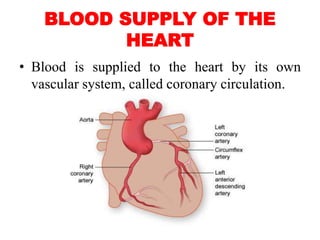
• Blood is supplied to the heart by its own
vascular system, called coronary circulation.
• The aorta (the main blood supplier to the
body) branches off into two main coronary
blood vessels (also called arteries).
• These coronary arteries branch off into
smaller arteries, which supply oxygen-rich
blood to the entire heart muscle.
CORONARY ARTERY BRANCHES
• Right Coronary
Artery
• Right posterior
descending
artery.
• Large marginal
branch.
• Left Coronary
Artery
• Left anterior
descending
artery.
• The circumflex
branch.
• LCA is larger than the RCA.
• RCA arises from anterior coronary sinus.
• LCA arises from the left posterior aortic sinus.
• Area of Distribution
• RCA – Rt. Atrium, Greater part of Rt
Ventricle & small part of left ventricle,
posterior part of inter-ventricular septum and
whole conducting system of heart except a part
of left branch of AV bundle.
.Area of Distribution
• LCA – Rt. Atrium, Greater part of Lt Ventricle
& small part of right ventricle, anterior part of
inter-ventricular septum and left branch of AV
bundle.
VENOUS DRAINAGE
• The venous drainage of the heart is by
means of three veins.
• Coronary Sinus
• Anterior Cardiac Veins
• Venae Cordis Minimae
LYMPHATICDRAINAGE
• Brachieocephalic Node
• Tracheobronchial Lymph Nodes.
APPLIED ANATOMY
• Coronary Artery Disease:
– Angina Pectoris: Severe chest pain behind the sternum
due to ischemia of the cardiac muscles.
– Myocardial Infraction: Necrosis of a part of the
myocardium due to severe and prolonged ischemia due
to narrowing of coronary arteries.
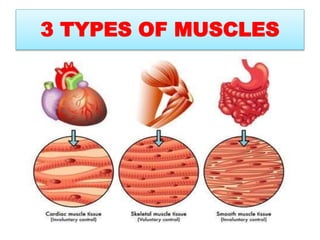
TYPES OF MUSCLES
• Muscular system consists of three muscles:
• Cardiac muscles, Smooth Muscles and Skeletal
Muscles.
• Skeletal muscles form 40 – 50% of total body
weight.
• Human body has more than 430 pairs of
skeletal muscles.
How many muscles are there in our body?
640 muscles
Which is the longest, Smallest and biggest
muscles in our body?
Longest: Sartorius, (This muscles runs
outside the hip, down and across inside the knees.)
Smallest: Stapedius, (Is located deep in the
ear.)
Biggest: The Gluteous Maximus
(Located in the buttocks)
MUSCLE CLASSIFICATION
• Functionally it is classified into Voluntarily (Can
be moved at will) e.g. Biceps and Triceps and
Involuntarily (Can’t move with intention, e.g. Heart
Muscles.
• Structurally it is of two types. Striated (have
stripes across fibers) e.g. Pharyngeal, cardiac and
skeletal muscles and Smooth muscles (no
striations) e.g. bladder muscles.
3 TYPES OF MUSCLES
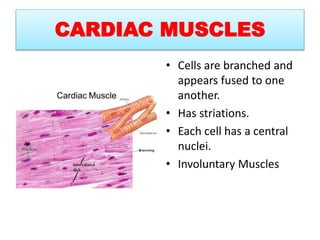
CARDIAC MUSCLES
• Cells are branched and
appears fused to one
another.
• Has striations.
• Each cell has a central
nuclei.
• Involuntary Muscles
CARDIAC MUSCLES
• Found only in the heart.
• Contractions of the cardiac muscles pumps
blood throughout the body and account for
the heart beat.
• Healthy cardiac muscles never fatigue.
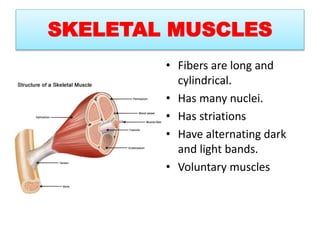
SKELETAL MUSCLES
• Fibers are long and
cylindrical.
• Has many nuclei.
• Has striations
• Have alternating dark
and light bands.
• Voluntary muscles
SKELETAL MUSCLES
• Attached to skeleton by tendons.
• Cause movement of bones at the joints.
• These muscles gets fatigue.
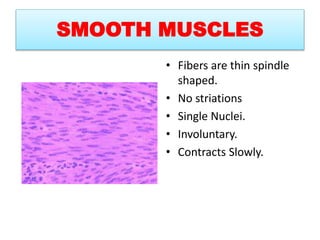
SMOOTH MUSCLES
• Fibers are thin spindle
shaped.
• No striations
• Single Nuclei.
• Involuntary.
• Contracts Slowly.
SMOOTH MUSCLES
• They fatigue but very slowly.
• Found in the urinary system
– Urinary bladder
– Controls urination
• Found in the respiratory system
– Controls breathing
• Found in the digestive system
– Esophagus. Stomach and Intestine.
– Controls digestion.
• Found in the circulatory system.
– Lining of the blood vessels.
– Helps in the circulation of blood.
CRANIAL NERVES
• The cranial nerves are a set of 12 paired nerves
that arise directly from the brain.
• The first two nerves (olfactory and optic)
arise from the cerebrum, whereas the
remaining ten emerge from the brain stem.
CRANIAL NERVES
• The names of the cranial nerves relate to their
function and they are also numerically
identified in roman numerals (I-XII).
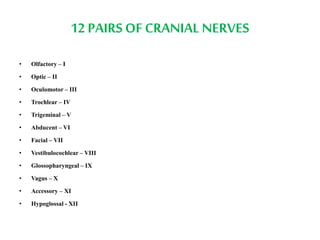
12 PAIRS OF CRANIAL NERVES
• Olfactory – I
• Optic – II
• Oculomotor – III
• Trochlear – IV
• Trigeminal – V
• Abducent – VI
• Facial – VII
• Vestibulocochlear – VIII
• Glossopharyngeal – IX
• Vagus – X
• Accessory – XI
• Hypoglossal - XII
OLFACTORY NERVE - I
• Sensory Function
• Sense of Smell
• Damage causes impairment of smell.
OPTIC NERVE - II
• Sensory Function
• Provides Vision
• Damage causes blindness in visual field.
OCCULOMOTOR NERVE - III
• Somatic and Autonomic Motor Function
• Eye movement, Opening of Eye Lid,
Constrictions of pupil and Visual
accommodations including focusing.
• Damage causes drooping eye lid. Dilated pupil,
inability to move eye in certain directions.
TROCHLEAR NERVE - IV
• Motor Function
• Eye movement (Superior Oblique Muscles)
• Damage causes double vision.
TRIGEMINAL NERVE - V
• It includes 3 branches
• Opthalmic branches: Sensations from nasal
cavity, skin of forehead, upper eye lid, eye brow
and nose.
• Maxillary branches: sensations from lower eye
lid, upper lips and gums, teeth of maxilla, cheek,
nose, palate and pharynx.
• Mandibular Branches: sensations from teeth of
the mandibles, lower gums, lips, tongue
• Damage causes loss of sensation and chewing
impairment.
ABDUCENT NERVE - VI
• Motor Function
• Provides eye movements
• Damage results in inability to rotate eye
movements laterally and medially.
FACIAL NERVE - VII
• Sensory & Motor Function
• Facial expressions
• Taste on anterior 2/3rd s of tongue.
• Damage results sagging facial expressions and
disturbed sense of taste.
VESTIBULOCOCHLEAR NERVE - VIII
• Sensory Function
• Aids in hearing and sense of balance.
• Taste on anterior 2/3rd s of tongue.
• Damage produces deafness, dizziness, nausea
and loss of balance.
GLOSSOPHARYNGEAL NERVE - IX
• Motor & Sensory Function
• Aids in swallowing and voice production via
pharyngeal muscles.
• Salivation, control of BP and Respiration
• Gagging
• Sensation from baro and chemo receptors.
• Damage results in loss of bitter & sour taste and
impairment of swallowing & blood pressure
VAGUS NERVE - X
• Motor & Sensory Function
• Sensations from skin at back of ear, larynx,
trachea, esophagus.
• Sensations from baroreceptors and
chemoreceptors.
• Swallowing and voice productions.
• Relaxation of airway, decreased heartrate.
• Damage causes loss of voice, hoarseness,
impaired swallowing, GI dysfunction and blood
pressure anomalies.
ACESSORY NERVE - XI
• Motor Function
• Swallowing, head, neck and shoulder
movements.
• Damage causes impaired, head, neck and
shoulder movements.
HYPOGLOSSAL NERVE - XI
• Motor Function
• Tongue movements for speech, food,
manipulation and swallowing.
• Damage causes impairment in tongue
protrusion,
END OF PART - 1
Anatomy & Physiology Question Paper Revision Tutorial

Anatomy & Physiology Question Paper Revision Tutorial

  • 2.
    ANATOMY& PHYSIOLOGY Year :2017 University Annual Exam Revision Video Tutorial – Part - I
  • 3.
    PART – A(ANATOMY) • Write Short Notes on a. Blood supply of the heart (4) b. Types of Muscles (4) c. Cranial nerves (6)
  • 4.
    BLOOD SUPPLY OFTHE HEART • Blood is supplied to the heart by its own vascular system, called coronary circulation.
  • 5.
    • The aorta(the main blood supplier to the body) branches off into two main coronary blood vessels (also called arteries). • These coronary arteries branch off into smaller arteries, which supply oxygen-rich blood to the entire heart muscle.
  • 6.
    CORONARY ARTERY BRANCHES •Right Coronary Artery • Right posterior descending artery. • Large marginal branch. • Left Coronary Artery • Left anterior descending artery. • The circumflex branch.
  • 7.
    • LCA islarger than the RCA. • RCA arises from anterior coronary sinus. • LCA arises from the left posterior aortic sinus. • Area of Distribution • RCA – Rt. Atrium, Greater part of Rt Ventricle & small part of left ventricle, posterior part of inter-ventricular septum and whole conducting system of heart except a part of left branch of AV bundle.
  • 8.
    .Area of Distribution •LCA – Rt. Atrium, Greater part of Lt Ventricle & small part of right ventricle, anterior part of inter-ventricular septum and left branch of AV bundle.
  • 9.
    VENOUS DRAINAGE • Thevenous drainage of the heart is by means of three veins. • Coronary Sinus • Anterior Cardiac Veins • Venae Cordis Minimae
  • 10.
  • 11.
    APPLIED ANATOMY • CoronaryArtery Disease: – Angina Pectoris: Severe chest pain behind the sternum due to ischemia of the cardiac muscles. – Myocardial Infraction: Necrosis of a part of the myocardium due to severe and prolonged ischemia due to narrowing of coronary arteries.
  • 12.
    TYPES OF MUSCLES •Muscular system consists of three muscles: • Cardiac muscles, Smooth Muscles and Skeletal Muscles. • Skeletal muscles form 40 – 50% of total body weight. • Human body has more than 430 pairs of skeletal muscles.
  • 13.
    How many musclesare there in our body? 640 muscles Which is the longest, Smallest and biggest muscles in our body? Longest: Sartorius, (This muscles runs outside the hip, down and across inside the knees.) Smallest: Stapedius, (Is located deep in the ear.) Biggest: The Gluteous Maximus (Located in the buttocks)
  • 14.
    MUSCLE CLASSIFICATION • Functionallyit is classified into Voluntarily (Can be moved at will) e.g. Biceps and Triceps and Involuntarily (Can’t move with intention, e.g. Heart Muscles. • Structurally it is of two types. Striated (have stripes across fibers) e.g. Pharyngeal, cardiac and skeletal muscles and Smooth muscles (no striations) e.g. bladder muscles.
  • 15.
    3 TYPES OFMUSCLES
  • 16.
    CARDIAC MUSCLES • Cellsare branched and appears fused to one another. • Has striations. • Each cell has a central nuclei. • Involuntary Muscles
  • 17.
    CARDIAC MUSCLES • Foundonly in the heart. • Contractions of the cardiac muscles pumps blood throughout the body and account for the heart beat. • Healthy cardiac muscles never fatigue.
  • 18.
    SKELETAL MUSCLES • Fibersare long and cylindrical. • Has many nuclei. • Has striations • Have alternating dark and light bands. • Voluntary muscles
  • 19.
    SKELETAL MUSCLES • Attachedto skeleton by tendons. • Cause movement of bones at the joints. • These muscles gets fatigue.
  • 20.
    SMOOTH MUSCLES • Fibersare thin spindle shaped. • No striations • Single Nuclei. • Involuntary. • Contracts Slowly.
  • 21.
    SMOOTH MUSCLES • Theyfatigue but very slowly. • Found in the urinary system – Urinary bladder – Controls urination • Found in the respiratory system – Controls breathing • Found in the digestive system – Esophagus. Stomach and Intestine. – Controls digestion. • Found in the circulatory system. – Lining of the blood vessels. – Helps in the circulation of blood.
  • 22.
    CRANIAL NERVES • Thecranial nerves are a set of 12 paired nerves that arise directly from the brain. • The first two nerves (olfactory and optic) arise from the cerebrum, whereas the remaining ten emerge from the brain stem.
  • 23.
    CRANIAL NERVES • Thenames of the cranial nerves relate to their function and they are also numerically identified in roman numerals (I-XII).
  • 24.
    12 PAIRS OFCRANIAL NERVES • Olfactory – I • Optic – II • Oculomotor – III • Trochlear – IV • Trigeminal – V • Abducent – VI • Facial – VII • Vestibulocochlear – VIII • Glossopharyngeal – IX • Vagus – X • Accessory – XI • Hypoglossal - XII
  • 25.
    OLFACTORY NERVE -I • Sensory Function • Sense of Smell • Damage causes impairment of smell.
  • 26.
    OPTIC NERVE -II • Sensory Function • Provides Vision • Damage causes blindness in visual field.
  • 27.
    OCCULOMOTOR NERVE -III • Somatic and Autonomic Motor Function • Eye movement, Opening of Eye Lid, Constrictions of pupil and Visual accommodations including focusing. • Damage causes drooping eye lid. Dilated pupil, inability to move eye in certain directions.
  • 28.
    TROCHLEAR NERVE -IV • Motor Function • Eye movement (Superior Oblique Muscles) • Damage causes double vision.
  • 29.
    TRIGEMINAL NERVE -V • It includes 3 branches • Opthalmic branches: Sensations from nasal cavity, skin of forehead, upper eye lid, eye brow and nose. • Maxillary branches: sensations from lower eye lid, upper lips and gums, teeth of maxilla, cheek, nose, palate and pharynx. • Mandibular Branches: sensations from teeth of the mandibles, lower gums, lips, tongue • Damage causes loss of sensation and chewing impairment.
  • 30.
    ABDUCENT NERVE -VI • Motor Function • Provides eye movements • Damage results in inability to rotate eye movements laterally and medially.
  • 31.
    FACIAL NERVE -VII • Sensory & Motor Function • Facial expressions • Taste on anterior 2/3rd s of tongue. • Damage results sagging facial expressions and disturbed sense of taste.
  • 32.
    VESTIBULOCOCHLEAR NERVE -VIII • Sensory Function • Aids in hearing and sense of balance. • Taste on anterior 2/3rd s of tongue. • Damage produces deafness, dizziness, nausea and loss of balance.
  • 33.
    GLOSSOPHARYNGEAL NERVE -IX • Motor & Sensory Function • Aids in swallowing and voice production via pharyngeal muscles. • Salivation, control of BP and Respiration • Gagging • Sensation from baro and chemo receptors. • Damage results in loss of bitter & sour taste and impairment of swallowing & blood pressure
  • 34.
    VAGUS NERVE -X • Motor & Sensory Function • Sensations from skin at back of ear, larynx, trachea, esophagus. • Sensations from baroreceptors and chemoreceptors. • Swallowing and voice productions. • Relaxation of airway, decreased heartrate. • Damage causes loss of voice, hoarseness, impaired swallowing, GI dysfunction and blood pressure anomalies.
  • 35.
    ACESSORY NERVE -XI • Motor Function • Swallowing, head, neck and shoulder movements. • Damage causes impaired, head, neck and shoulder movements.
  • 36.
    HYPOGLOSSAL NERVE -XI • Motor Function • Tongue movements for speech, food, manipulation and swallowing. • Damage causes impairment in tongue protrusion,
  • 37.