NON-EXPERIMENTAL RESEARCH
DESIGN
Asokan.R,
Asso. Professor, KINS, KIIT (DU)
Bhubaneswar.
1
RESEARCH DESIGN
(BLUE PRINT OF THE STUDY)
 Guide the research in planning, & implementing the
study
 Overall plan for obtaining answer to research question
 Entire strategy or framework for the study
2
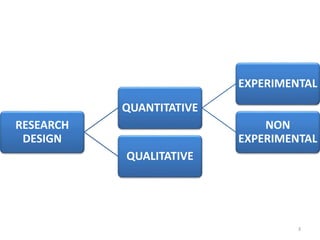
RESEARCH
DESIGN
QUANTITATIVE
EXPERIMENTAL
NON
EXPERIMENTAL
QUALITATIVE
3
Construct a picture of a phenomenon
Make account of events as they naturally occurs
Investigate current status of something
Describe existing phenomena without manipulating the
condition
PURPOSE
4
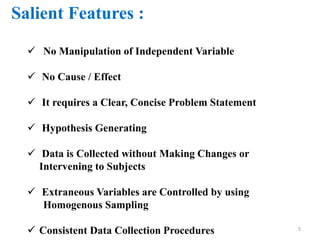
Salient Features :
 No Manipulation of Independent Variable
 No Cause / Effect
 It requires a Clear, Concise Problem Statement
 Hypothesis Generating
 Data is Collected without Making Changes or
Intervening to Subjects
 Extraneous Variables are Controlled by using
Homogenous Sampling
 Consistent Data Collection Procedures 5
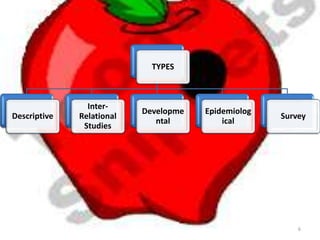
TYPES
Descriptive
Inter-
Relational
Studies
Developme
ntal
Epidemiolog
ical
Survey
6
Descriptive
Univariant
Exploratory
Comparative
7
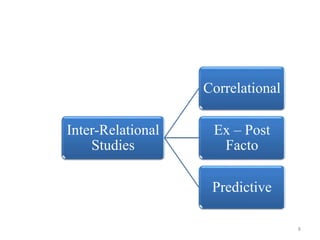
Inter-Relational
Studies
Correlational
Ex – Post
Facto
Predictive
8
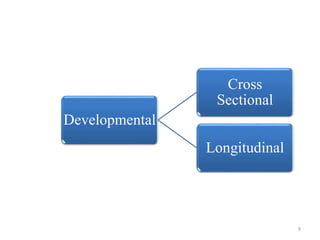
Developmental
Cross
Sectional
Longitudinal
9
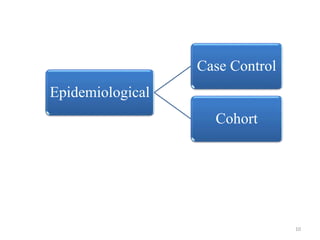
Epidemiological
Case Control
Cohort
10
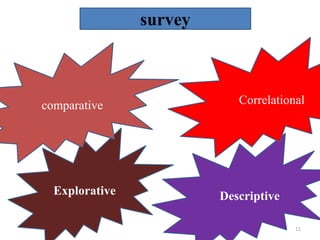
Descriptive
Explorative
Correlational
comparative
survey
11
DESCRIPTIVE
Intend to examine and describe an issue.
Descriptive research design is a scientific method which
involves observing and describing the behavior of a subject
without influencing it in any way.
Use to answer questions in ‘wh’ word :
what occur, how occur, when occur, why occur
12
PURPOSE
To Observe, describe and document aspects of
situation as it naturally occurs.
To serve as starting point for hypothesis generation or
theory development.
13
CHARACTERISTICS
 Describe a Phenomenon
 Especially effective when the area has been previously studied.
Example- Study of nursing action in diabetic foot care
 Data is collected through questionnaire, interview, files,
document or observation.
14
TYPICAL ANALYSIS
Graph, Charts, Tables, Percentages,
Frequencies, Central Tendency, (M M
M), Measures of Variability (SD,
Variance, Range)
15
For example
An apparel brand that wants to understand
the fashion purchasing trends among buyers.
16
UNIVARIANT DESCRIPTIVE DESIGN
 It describe frequency of occurrence of a
phenomenon rather study relationship
 It is not necessary that to study a single
variable, but may be one or more variable
 This design mainly try to identify & describe
perception, awareness, behaviour, attitude,
knowledge and practice.
 Ex: Student nurses awareness on BLS. 17
For example
A researcher is interested to assessing the experiences of
patients suffering with rheumatoid arthritis.
 Frequency of different symptoms experiencing by the
patients
 Type of treatment received during the course of disease,
etc…
There are multiple variables in this study. 18
EXPLORATIVE
 It identify, explore, & describe the existing phenomenon
and related factors.
Ex: Factors and morbidity pattern among LBW Babies
 It simply describe the phenomena and in-depth relate the
cause of phenomena.
 Aims to explain why particular phenomena work in the way
that they do. 19
• Exploratory-descriptive designs, usually field
studies in natural settings, provide the least control
over variables.
• The data collected either contribute to the
development of theory or explain phenomena from
the perspective of the persons being studied.
20
COMPARATIVE
 Compare and contrast two or more variable on same
phenomena
Ex: Perception of Labour Pain among Primipara & Multipara
Mother
 Attribute such as knowledge, practice, perception, attitude,
symptoms, complication are compared
21
For example
An examination body wants to determine the
better method of conducting tests between paper-
based and computer-based tests.
A comparative study on health problems
among rural and urban older people in selected
districts.
22
Why Use Descriptive Research Design?
• Define subject characteristics
• Measure Data Trends
• Comparison
• Validate existing conditions
• Conducted Overtime
23
IMPORTANT ISSUES IN DESCRIPTIVE DESIGN
 Cannot make conclusions about relationships
studies. (snapshot of the current thoughts)
 Subjects and instrumentation must be clearly
identified.
 Watch for graphic distortion.
 Response & Non-Response Bias.
24
INTER RELATIONAL STUDIES/RELATIONAL STUDIES
 It provides a deeper insight into the phenomenon of
interest than descriptive studies.
 It traces the interrelationships between variables.
 A study that investigates the connection between two or
more variables.
25
 Investigate the degree to which differences or
variation in relation to two variables
Ex : Relation between diabetes and development
of hypertension
 It determines degree of relationship.
 It allows description and prediction of
relationships.
Ex : Salary and staff turnover
26
CORRELATIONAL DESIGN /
STUDIES
Measures two Variables.
Examine the strength of relationship between variables
Describe a linear relationship
Do not imply a cause and effect relationship
Do not imply that variables share something in common
Ex: Pill users and ovarian cancer
27
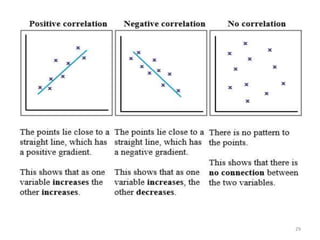
 Indicates the extent to which one variable (x) related to
another (y).
 Magnitude and the direction of relationship are indicated by
correlation coefficient.
 It may be positive or negative ranging from (-1.00) perfect
negative correlation to (1.00) perfect positive correlation and
‘0’ indicate no relation
Ex: Use of support system in labour outcome
28
29
A correlation can be expressed visually. This is done
by drawing a scattergram (scatterplot, scatter graph,
scatter chart, or scatter diagram).
• Example:
Drinking while pregnant with an increased risk of
depression for the teenage child.
Smoking with Alzheimer's disease
30
ADVANTAGES
 Analyse relationship among large number of variables
 Demonstrate degree of relationship between variables
 It opens up a great deal of further research to other scholars.
31
EX- POST FACTO STUDIES
CAUSAL COMPARATIVE STUDY / COMPARATIVE STUDY
 The investigation starts after the fact has occurred without
interference from the researcher.
 It is used when causality is a question and experiment is not
possible to do.
 When they cannot manipulate the independent variables
 But according to cause it compare groups
Ex: Smoker and Lung Cancer
Non Smoker and No Lung Cancer
32
• The assignment of subjects to different groups is
based on whichever variable of interest to
the researchers.
• Pre-existing characteristic (weight) was used to form
the groups.
• Groups with qualities that already exist are compared
on some dependent variable.
33
Cont...
 So the independent variables are identified and the effect on
dependent variable studied.
 Here cause and effect relationships identified by forming
groups of individuals & determine whether groups differ on
dependent variables.
 But there is possibility, group will differ by external variables ,
So need to cautiously evaluate and draw the conclusion.
 It is classified as retrospective (effect to cause) and prospective
(cause to effect)
34
PREDICTIVE STUDY
Aims to identify pre – existing characteristics (independent variable)
that is predictive of a relationship with dependent variable.
Ex : Intelligence level with performance, Obesity with hypertension
It uses retrospective data from one group to make prediction
about similar group.
Shows how one variable predict score on another in time
Allow to calculate the value of one variable (criterion variable/
dependent) based on value of another (predictor
variable/independent)
35
 They allow you to make estimates and devise forecasting
models.
 Correlation coefficient only show relation.
 Result makes more accurate predictions possible.
 Length of prediction – shorter the time more the prediction
 More time =more opportunity for another variable to
influence.
 Major advantage – facilitate intelligence decision making as
objective criteria's available to guide the process.
36
ANALYSIS OF PREDECTIVE STUDIES
 Regression
 Multiple Regression
 Discriminant Analysis (whether heavy, medium and
light users of soft drinks are different in terms of their
consumption of frozen foods
&
price sensitive and non price sensitive buyers of groceries
in terms of their psychological attributes or characteristics.
37
DEVELOPMENTAL STUDIES
 It studies the time perspectives.
 It studies not only present status but also the with related
phenomena, also with changes that result from elapsed
time.
 It is generally used to adjunct research design with other
designs, descriptive, cross sections, cross sectional survey,
longitudinal co-relational study.
38
It is a study of status and is widely used in
education, nutrition, epidemiology, and the behavioral
sciences.
Problems can be solved and practices improved
through observation, analysis, and description.
EX: To assess the differences in academic and
social development in low-income versus high-income
neighborhoods.
39
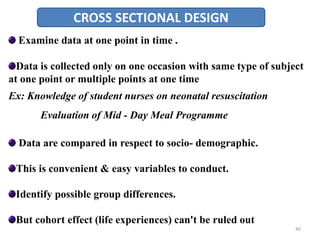
CROSS SECTIONAL DESIGN
Examine data at one point in time .
Data is collected only on one occasion with same type of subject
at one point or multiple points at one time
Ex: Knowledge of student nurses on neonatal resuscitation
Evaluation of Mid - Day Meal Programme
Data are compared in respect to socio- demographic.
This is convenient & easy variables to conduct.
Identify possible group differences.
But cohort effect (life experiences) can't be ruled out
40
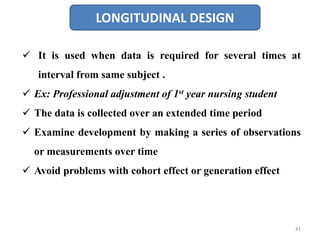
LONGITUDINAL DESIGN
 It is used when data is required for several times at
interval from same subject .
 Ex: Professional adjustment of 1st year nursing student
 The data is collected over an extended time period
 Examine development by making a series of observations
or measurements over time
 Avoid problems with cohort effect or generation effect
41
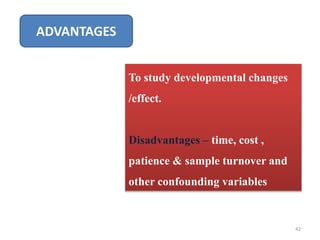
ADVANTAGES
To study developmental changes
/effect.
Disadvantages – time, cost ,
patience & sample turnover and
other confounding variables
42
EPIDEMIOLOGICAL STUDIES
 Study about distribution & causes of diseases in
population.
 Conducted to investigate causes of different diseases
either by retrospective approach /case control studies ,
prospective approach / cohort studies
43
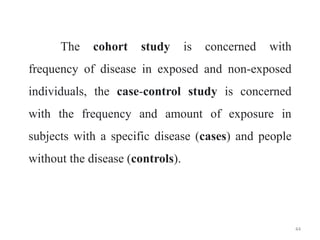
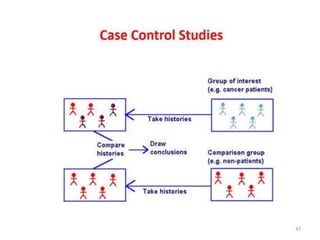
The cohort study is concerned with
frequency of disease in exposed and non-exposed
individuals, the case-control study is concerned
with the frequency and amount of exposure in
subjects with a specific disease (cases) and people
without the disease (controls).
44
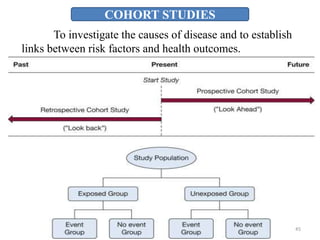
COHORT STUDIES
To investigate the causes of disease and to establish
links between risk factors and health outcomes.
45
CASE CONTROL STUDIES
 Researcher go back to the causes
for a definite occurrence.
 The frequency, incidence, factors
effect were studied for prudent
situation.
46
47
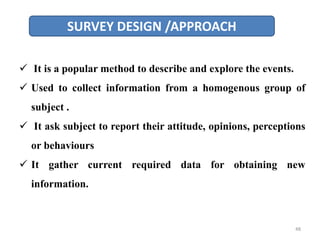
SURVEY DESIGN /APPROACH
 It is a popular method to describe and explore the events.
 Used to collect information from a homogenous group of
subject .
 It ask subject to report their attitude, opinions, perceptions
or behaviours
 It gather current required data for obtaining new
information.
48
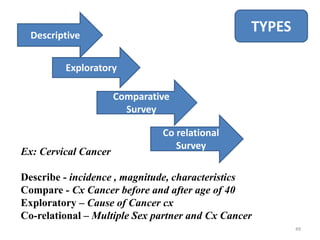
Ex: Cervical Cancer
Describe - incidence , magnitude, characteristics
Compare - Cx Cancer before and after age of 40
Exploratory – Cause of Cancer cx
Co-relational – Multiple Sex partner and Cx Cancer
TYPES
Descriptive
Exploratory
Comparative
Survey
Co relational
Survey
49
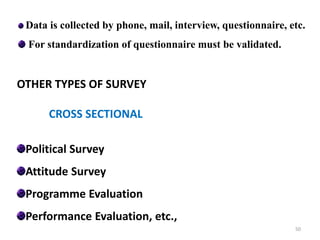
Data is collected by phone, mail, interview, questionnaire, etc.
For standardization of questionnaire must be validated.
OTHER TYPES OF SURVEY
CROSS SECTIONAL
Political Survey
Attitude Survey
Programme Evaluation
Performance Evaluation, etc.,
50
LONGITUDINAL
Study of Morbidity, Mortality, Treatment
Adherence etc.
In a longitudinal study, researchers repeatedly
examine the same individuals to detect any changes that might
occur over a period of time.
Longitudinal studies are a type of correlational
research in which researchers observe and collect data on a
number of variables without trying to influence those
variables.
51
ADVANTAGES OF NON-EXPERIMENTAL DESIGN
Require no experiment, real life situation, manipulation.
Easy and convenient to conduct.
Suitable to many field like psychology, sociology, education,
nursing, etc.
DISADVANTAGES
Data are less reliable.
Cause & effect relationship absolutely not
error free
Improper Interpretation.
52

Non-Experimental Research Design

  • 1.
  • 2.
    RESEARCH DESIGN (BLUE PRINTOF THE STUDY)  Guide the research in planning, & implementing the study  Overall plan for obtaining answer to research question  Entire strategy or framework for the study 2
  • 3.
  • 4.
    Construct a pictureof a phenomenon Make account of events as they naturally occurs Investigate current status of something Describe existing phenomena without manipulating the condition PURPOSE 4
  • 5.
    Salient Features : No Manipulation of Independent Variable  No Cause / Effect  It requires a Clear, Concise Problem Statement  Hypothesis Generating  Data is Collected without Making Changes or Intervening to Subjects  Extraneous Variables are Controlled by using Homogenous Sampling  Consistent Data Collection Procedures 5
  • 6.
  • 7.
  • 8.
  • 9.
  • 10.
  • 11.
  • 12.
    DESCRIPTIVE Intend to examineand describe an issue. Descriptive research design is a scientific method which involves observing and describing the behavior of a subject without influencing it in any way. Use to answer questions in ‘wh’ word : what occur, how occur, when occur, why occur 12
  • 13.
    PURPOSE To Observe, describeand document aspects of situation as it naturally occurs. To serve as starting point for hypothesis generation or theory development. 13
  • 14.
    CHARACTERISTICS  Describe aPhenomenon  Especially effective when the area has been previously studied. Example- Study of nursing action in diabetic foot care  Data is collected through questionnaire, interview, files, document or observation. 14
  • 15.
    TYPICAL ANALYSIS Graph, Charts,Tables, Percentages, Frequencies, Central Tendency, (M M M), Measures of Variability (SD, Variance, Range) 15
  • 16.
    For example An apparelbrand that wants to understand the fashion purchasing trends among buyers. 16
  • 17.
    UNIVARIANT DESCRIPTIVE DESIGN It describe frequency of occurrence of a phenomenon rather study relationship  It is not necessary that to study a single variable, but may be one or more variable  This design mainly try to identify & describe perception, awareness, behaviour, attitude, knowledge and practice.  Ex: Student nurses awareness on BLS. 17
  • 18.
    For example A researcheris interested to assessing the experiences of patients suffering with rheumatoid arthritis.  Frequency of different symptoms experiencing by the patients  Type of treatment received during the course of disease, etc… There are multiple variables in this study. 18
  • 19.
    EXPLORATIVE  It identify,explore, & describe the existing phenomenon and related factors. Ex: Factors and morbidity pattern among LBW Babies  It simply describe the phenomena and in-depth relate the cause of phenomena.  Aims to explain why particular phenomena work in the way that they do. 19
  • 20.
    • Exploratory-descriptive designs,usually field studies in natural settings, provide the least control over variables. • The data collected either contribute to the development of theory or explain phenomena from the perspective of the persons being studied. 20
  • 21.
    COMPARATIVE  Compare andcontrast two or more variable on same phenomena Ex: Perception of Labour Pain among Primipara & Multipara Mother  Attribute such as knowledge, practice, perception, attitude, symptoms, complication are compared 21
  • 22.
    For example An examinationbody wants to determine the better method of conducting tests between paper- based and computer-based tests. A comparative study on health problems among rural and urban older people in selected districts. 22
  • 23.
    Why Use DescriptiveResearch Design? • Define subject characteristics • Measure Data Trends • Comparison • Validate existing conditions • Conducted Overtime 23
  • 24.
    IMPORTANT ISSUES INDESCRIPTIVE DESIGN  Cannot make conclusions about relationships studies. (snapshot of the current thoughts)  Subjects and instrumentation must be clearly identified.  Watch for graphic distortion.  Response & Non-Response Bias. 24
  • 25.
    INTER RELATIONAL STUDIES/RELATIONALSTUDIES  It provides a deeper insight into the phenomenon of interest than descriptive studies.  It traces the interrelationships between variables.  A study that investigates the connection between two or more variables. 25
  • 26.
     Investigate thedegree to which differences or variation in relation to two variables Ex : Relation between diabetes and development of hypertension  It determines degree of relationship.  It allows description and prediction of relationships. Ex : Salary and staff turnover 26
  • 27.
    CORRELATIONAL DESIGN / STUDIES Measurestwo Variables. Examine the strength of relationship between variables Describe a linear relationship Do not imply a cause and effect relationship Do not imply that variables share something in common Ex: Pill users and ovarian cancer 27
  • 28.
     Indicates theextent to which one variable (x) related to another (y).  Magnitude and the direction of relationship are indicated by correlation coefficient.  It may be positive or negative ranging from (-1.00) perfect negative correlation to (1.00) perfect positive correlation and ‘0’ indicate no relation Ex: Use of support system in labour outcome 28
  • 29.
  • 30.
    A correlation canbe expressed visually. This is done by drawing a scattergram (scatterplot, scatter graph, scatter chart, or scatter diagram). • Example: Drinking while pregnant with an increased risk of depression for the teenage child. Smoking with Alzheimer's disease 30
  • 31.
    ADVANTAGES  Analyse relationshipamong large number of variables  Demonstrate degree of relationship between variables  It opens up a great deal of further research to other scholars. 31
  • 32.
    EX- POST FACTOSTUDIES CAUSAL COMPARATIVE STUDY / COMPARATIVE STUDY  The investigation starts after the fact has occurred without interference from the researcher.  It is used when causality is a question and experiment is not possible to do.  When they cannot manipulate the independent variables  But according to cause it compare groups Ex: Smoker and Lung Cancer Non Smoker and No Lung Cancer 32
  • 33.
    • The assignmentof subjects to different groups is based on whichever variable of interest to the researchers. • Pre-existing characteristic (weight) was used to form the groups. • Groups with qualities that already exist are compared on some dependent variable. 33
  • 34.
    Cont...  So theindependent variables are identified and the effect on dependent variable studied.  Here cause and effect relationships identified by forming groups of individuals & determine whether groups differ on dependent variables.  But there is possibility, group will differ by external variables , So need to cautiously evaluate and draw the conclusion.  It is classified as retrospective (effect to cause) and prospective (cause to effect) 34
  • 35.
    PREDICTIVE STUDY Aims toidentify pre – existing characteristics (independent variable) that is predictive of a relationship with dependent variable. Ex : Intelligence level with performance, Obesity with hypertension It uses retrospective data from one group to make prediction about similar group. Shows how one variable predict score on another in time Allow to calculate the value of one variable (criterion variable/ dependent) based on value of another (predictor variable/independent) 35
  • 36.
     They allowyou to make estimates and devise forecasting models.  Correlation coefficient only show relation.  Result makes more accurate predictions possible.  Length of prediction – shorter the time more the prediction  More time =more opportunity for another variable to influence.  Major advantage – facilitate intelligence decision making as objective criteria's available to guide the process. 36
  • 37.
    ANALYSIS OF PREDECTIVESTUDIES  Regression  Multiple Regression  Discriminant Analysis (whether heavy, medium and light users of soft drinks are different in terms of their consumption of frozen foods & price sensitive and non price sensitive buyers of groceries in terms of their psychological attributes or characteristics. 37
  • 38.
    DEVELOPMENTAL STUDIES  Itstudies the time perspectives.  It studies not only present status but also the with related phenomena, also with changes that result from elapsed time.  It is generally used to adjunct research design with other designs, descriptive, cross sections, cross sectional survey, longitudinal co-relational study. 38
  • 39.
    It is astudy of status and is widely used in education, nutrition, epidemiology, and the behavioral sciences. Problems can be solved and practices improved through observation, analysis, and description. EX: To assess the differences in academic and social development in low-income versus high-income neighborhoods. 39
  • 40.
    CROSS SECTIONAL DESIGN Examinedata at one point in time . Data is collected only on one occasion with same type of subject at one point or multiple points at one time Ex: Knowledge of student nurses on neonatal resuscitation Evaluation of Mid - Day Meal Programme Data are compared in respect to socio- demographic. This is convenient & easy variables to conduct. Identify possible group differences. But cohort effect (life experiences) can't be ruled out 40
  • 41.
    LONGITUDINAL DESIGN  Itis used when data is required for several times at interval from same subject .  Ex: Professional adjustment of 1st year nursing student  The data is collected over an extended time period  Examine development by making a series of observations or measurements over time  Avoid problems with cohort effect or generation effect 41
  • 42.
    ADVANTAGES To study developmentalchanges /effect. Disadvantages – time, cost , patience & sample turnover and other confounding variables 42
  • 43.
    EPIDEMIOLOGICAL STUDIES  Studyabout distribution & causes of diseases in population.  Conducted to investigate causes of different diseases either by retrospective approach /case control studies , prospective approach / cohort studies 43
  • 44.
    The cohort studyis concerned with frequency of disease in exposed and non-exposed individuals, the case-control study is concerned with the frequency and amount of exposure in subjects with a specific disease (cases) and people without the disease (controls). 44
  • 45.
    COHORT STUDIES To investigatethe causes of disease and to establish links between risk factors and health outcomes. 45
  • 46.
    CASE CONTROL STUDIES Researcher go back to the causes for a definite occurrence.  The frequency, incidence, factors effect were studied for prudent situation. 46
  • 47.
  • 48.
    SURVEY DESIGN /APPROACH It is a popular method to describe and explore the events.  Used to collect information from a homogenous group of subject .  It ask subject to report their attitude, opinions, perceptions or behaviours  It gather current required data for obtaining new information. 48
  • 49.
    Ex: Cervical Cancer Describe- incidence , magnitude, characteristics Compare - Cx Cancer before and after age of 40 Exploratory – Cause of Cancer cx Co-relational – Multiple Sex partner and Cx Cancer TYPES Descriptive Exploratory Comparative Survey Co relational Survey 49
  • 50.
    Data is collectedby phone, mail, interview, questionnaire, etc. For standardization of questionnaire must be validated. OTHER TYPES OF SURVEY CROSS SECTIONAL Political Survey Attitude Survey Programme Evaluation Performance Evaluation, etc., 50
  • 51.
    LONGITUDINAL Study of Morbidity,Mortality, Treatment Adherence etc. In a longitudinal study, researchers repeatedly examine the same individuals to detect any changes that might occur over a period of time. Longitudinal studies are a type of correlational research in which researchers observe and collect data on a number of variables without trying to influence those variables. 51
  • 52.
    ADVANTAGES OF NON-EXPERIMENTALDESIGN Require no experiment, real life situation, manipulation. Easy and convenient to conduct. Suitable to many field like psychology, sociology, education, nursing, etc. DISADVANTAGES Data are less reliable. Cause & effect relationship absolutely not error free Improper Interpretation. 52