CASE STUDY
METHODS
presented by
Shafeek.s
9995653538
MEANING
 A detailed intensive study of a unit, such
as a corporation or a corporate division,
that stresses factors contributing to its
success or failure.
A detailed analysis of a person or group,
especially as a model of medical,
psychiatric, psychological, or social
phenomena
DEFINITION
Case studies are analyses of persons, events,
decisions, periods, projects, policies, institutions,
or other systems that are studied holistically by
one or more methods. The case that is
the subject of the inquiry will be an instance of a
class of phenomena that provides an analytical
frame — an object — within which the study is
conducted and which the case illuminates and
explicates”.
-G. Thomas, 2011
ADVANTAGES
1. make decision making easier
2. improve the analytical quality of decisions
3. reduce the time required to make decisions
4. increase the frequency of correct decisions.
5. Deeper understanding
6. Fact-driven
DISADVANTAGESS
1. Lack of generalization
2. Lack of clearly defined methods
3. Time-consuming
4. Costs
5. Bias in data collection and analysis
PROCESS
• Preliminary theory & blueprint of the study
⇋ Initial theory & understanding of what is being studied is necessary
before any field contacts; the complete research design embodies a
“theory” of what is being studied.
• Deciding between explanatory, exploratory and descriptive designs
– Search for theoretical propositions that can be elaborated to cover study
questions, propositions, units of analysis, data-proposition links &
criteria of interpretation
– Reviewing literature, discussing with investigators, asking challenging
questions, thinking what is to be learned from the study
– -Being aware of the range of theories & selecting the required level
(individual, organization, societal)
– Construction of the design / conceptual framework takes time & can be
difficult, but is a crucial step for the success of the study
• Selection of the cases
☞Cases should be selected in the same way as the topic of an experiment
is selected
☞Developed preliminary theory is used as a template with which to
compare the characteristics & empirical findings from the case(s)
☞Selected cases should reflect characteristics & problems identified in
the underlying theoretical propositions / conceptual framework
• The level of generalization of the study results
» Appropriately developed preliminary theory / study design
» Mode of generalization = theory-related analytic generalization, not
statistical
» Analytic generalization possible from one or more cases.
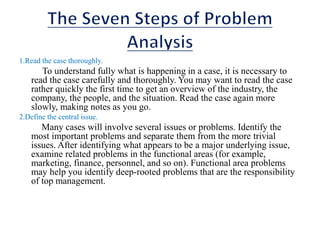
1.Read the case thoroughly.
To understand fully what is happening in a case, it is necessary to
read the case carefully and thoroughly. You may want to read the case
rather quickly the first time to get an overview of the industry, the
company, the people, and the situation. Read the case again more
slowly, making notes as you go.
2.Define the central issue.
Many cases will involve several issues or problems. Identify the
most important problems and separate them from the more trivial
issues. After identifying what appears to be a major underlying issue,
examine related problems in the functional areas (for example,
marketing, finance, personnel, and so on). Functional area problems
may help you identify deep-rooted problems that are the responsibility
of top management.
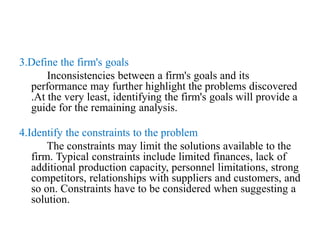
3.Define the firm's goals
Inconsistencies between a firm's goals and its
performance may further highlight the problems discovered
.At the very least, identifying the firm's goals will provide a
guide for the remaining analysis.
4.Identify the constraints to the problem
The constraints may limit the solutions available to the
firm. Typical constraints include limited finances, lack of
additional production capacity, personnel limitations, strong
competitors, relationships with suppliers and customers, and
so on. Constraints have to be considered when suggesting a
solution.
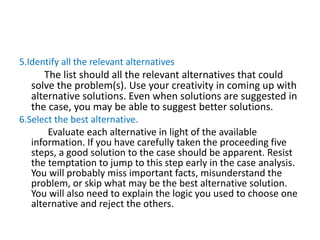
5.Identify all the relevant alternatives
The list should all the relevant alternatives that could
solve the problem(s). Use your creativity in coming up with
alternative solutions. Even when solutions are suggested in
the case, you may be able to suggest better solutions.
6.Select the best alternative.
Evaluate each alternative in light of the available
information. If you have carefully taken the proceeding five
steps, a good solution to the case should be apparent. Resist
the temptation to jump to this step early in the case analysis.
You will probably miss important facts, misunderstand the
problem, or skip what may be the best alternative solution.
You will also need to explain the logic you used to choose one
alternative and reject the others.
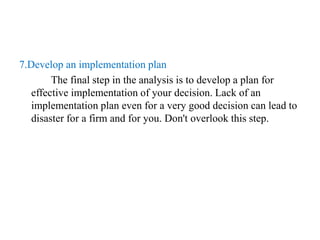
7.Develop an implementation plan
The final step in the analysis is to develop a plan for
effective implementation of your decision. Lack of an
implementation plan even for a very good decision can lead to
disaster for a firm and for you. Don't overlook this step.
SURVEY METHOD
DEFINITION
• Survey Research may be defined as a technique
whereby the researcher studies the whole population
with respect to certain sociological and psychological
variables.
• E.g., If the researcher wants to study the factors
affecting the interest of the students in mathematics..
(questionnaire, students from diff schools)
• Survey Research is a new technique for Social Science
Research.
• It is used to study opinions, attitudes and social facts.
The survey researcher is primarily interested in
assessing the characteristics of the whole
population. It’s not possible (PRACTICALLY).
So, a random sample ( representative of the
population is taken).
TYPES OF SURVEY RESEARCH
• Personal Interview
• Questionnaire Survey
• Telephone Survey
• Panel Technique
PERSONAL INTERVIEW
• It is a one to one interaction between two people. One
is an INTERVIEWER ( who asks the questions) and the
other one is the INTERVIEWEE (or respondent, who
answers the questions).
• Success of any interview depends on three factors –
1. Accessibility in terms of information required from
the respondent. She/he must be able to convey.
2. Cognition – The respondent is able to understand
what is required of him.
3. Motivation of the respondent to answer accurately.
Types of interview ( based on type of
preparation we make before conducting
the interview)
• STRUCTURED
• UN STRUTURED
QUESTIONNAIRE
• It’s one of the most simple, versatile and low cost self
reporting method.
• Consists of pre-determined set of questions
• In other words, these are HIGHLY STRUCTURED
INTERVIEWS.
• Questionnaire is used for collecting demographic info,
attitudes, knowledge etc.
• Types of questions used in a survey :
1. Open Ended : E.g. What is friendship to you?
2. Close Ended : E.g. Friendship is a) Love b)Family
3. Rating method : From most preferred to the least.
TELEPHONE SURVEY
• E.g., TV Programmers asking you to send your
views through SMS.
• ADVANTAGES : Time saving.
• DISADVANTAGES : Reluctance
Uncooperativeness
PANEL TECHNIQUE
• Successive interview of the same sample.
• Purpose is wide and expensive.
• ADVANTAGE:
1. Helps the investigator to know the various
factors leading to the change
2. More Accuracy and consistency.
• DISADVANTAGE:
1. 1.Loss of sample : Urgent work, death,
relocation, Migration.
2. 2. Social Desirability.
Survey Research depends upon 3
important factors :
1) Direct contact with the sample
2) Success of survey research depends upon the
willingness and cooperativeness of the
sample selected for study.
3) Researcher must be a trained personnel.
• Social Intelligence
• Manipulative skill
• Research insight
Advantages of survey research
1. Wide Scope, Great deal of information can be
obtained.
2. Inter- disciplinary value.
3. Can study topics like – Attitude, Beliefs,
values etc.
4. Maximal Accuracy at Economical rate.
Disadvantages
• Research remains at the survey. ( Not In-
depth)
• Practical Problems- Time Consuming
• Prone to sampling errors: Minor fluctuations
of chance.
• Survey research demands- Expertise,
Knowledge on part of the Researcher to
conduct a survey, Technical know how.

case study methods and survey method by shafeek

  • 1.
  • 2.
    MEANING  A detailedintensive study of a unit, such as a corporation or a corporate division, that stresses factors contributing to its success or failure. A detailed analysis of a person or group, especially as a model of medical, psychiatric, psychological, or social phenomena
  • 3.
    DEFINITION Case studies areanalyses of persons, events, decisions, periods, projects, policies, institutions, or other systems that are studied holistically by one or more methods. The case that is the subject of the inquiry will be an instance of a class of phenomena that provides an analytical frame — an object — within which the study is conducted and which the case illuminates and explicates”. -G. Thomas, 2011
  • 4.
    ADVANTAGES 1. make decisionmaking easier 2. improve the analytical quality of decisions 3. reduce the time required to make decisions 4. increase the frequency of correct decisions. 5. Deeper understanding 6. Fact-driven
  • 5.
    DISADVANTAGESS 1. Lack ofgeneralization 2. Lack of clearly defined methods 3. Time-consuming 4. Costs 5. Bias in data collection and analysis
  • 6.
    PROCESS • Preliminary theory& blueprint of the study ⇋ Initial theory & understanding of what is being studied is necessary before any field contacts; the complete research design embodies a “theory” of what is being studied. • Deciding between explanatory, exploratory and descriptive designs – Search for theoretical propositions that can be elaborated to cover study questions, propositions, units of analysis, data-proposition links & criteria of interpretation – Reviewing literature, discussing with investigators, asking challenging questions, thinking what is to be learned from the study – -Being aware of the range of theories & selecting the required level (individual, organization, societal) – Construction of the design / conceptual framework takes time & can be difficult, but is a crucial step for the success of the study
  • 7.
    • Selection ofthe cases ☞Cases should be selected in the same way as the topic of an experiment is selected ☞Developed preliminary theory is used as a template with which to compare the characteristics & empirical findings from the case(s) ☞Selected cases should reflect characteristics & problems identified in the underlying theoretical propositions / conceptual framework • The level of generalization of the study results » Appropriately developed preliminary theory / study design » Mode of generalization = theory-related analytic generalization, not statistical » Analytic generalization possible from one or more cases.
  • 8.
    1.Read the casethoroughly. To understand fully what is happening in a case, it is necessary to read the case carefully and thoroughly. You may want to read the case rather quickly the first time to get an overview of the industry, the company, the people, and the situation. Read the case again more slowly, making notes as you go. 2.Define the central issue. Many cases will involve several issues or problems. Identify the most important problems and separate them from the more trivial issues. After identifying what appears to be a major underlying issue, examine related problems in the functional areas (for example, marketing, finance, personnel, and so on). Functional area problems may help you identify deep-rooted problems that are the responsibility of top management.
  • 9.
    3.Define the firm'sgoals Inconsistencies between a firm's goals and its performance may further highlight the problems discovered .At the very least, identifying the firm's goals will provide a guide for the remaining analysis. 4.Identify the constraints to the problem The constraints may limit the solutions available to the firm. Typical constraints include limited finances, lack of additional production capacity, personnel limitations, strong competitors, relationships with suppliers and customers, and so on. Constraints have to be considered when suggesting a solution.
  • 10.
    5.Identify all therelevant alternatives The list should all the relevant alternatives that could solve the problem(s). Use your creativity in coming up with alternative solutions. Even when solutions are suggested in the case, you may be able to suggest better solutions. 6.Select the best alternative. Evaluate each alternative in light of the available information. If you have carefully taken the proceeding five steps, a good solution to the case should be apparent. Resist the temptation to jump to this step early in the case analysis. You will probably miss important facts, misunderstand the problem, or skip what may be the best alternative solution. You will also need to explain the logic you used to choose one alternative and reject the others.
  • 11.
    7.Develop an implementationplan The final step in the analysis is to develop a plan for effective implementation of your decision. Lack of an implementation plan even for a very good decision can lead to disaster for a firm and for you. Don't overlook this step.
  • 12.
  • 13.
    DEFINITION • Survey Researchmay be defined as a technique whereby the researcher studies the whole population with respect to certain sociological and psychological variables. • E.g., If the researcher wants to study the factors affecting the interest of the students in mathematics.. (questionnaire, students from diff schools) • Survey Research is a new technique for Social Science Research. • It is used to study opinions, attitudes and social facts.
  • 14.
    The survey researcheris primarily interested in assessing the characteristics of the whole population. It’s not possible (PRACTICALLY). So, a random sample ( representative of the population is taken).
  • 15.
    TYPES OF SURVEYRESEARCH • Personal Interview • Questionnaire Survey • Telephone Survey • Panel Technique
  • 16.
    PERSONAL INTERVIEW • Itis a one to one interaction between two people. One is an INTERVIEWER ( who asks the questions) and the other one is the INTERVIEWEE (or respondent, who answers the questions). • Success of any interview depends on three factors – 1. Accessibility in terms of information required from the respondent. She/he must be able to convey. 2. Cognition – The respondent is able to understand what is required of him. 3. Motivation of the respondent to answer accurately.
  • 17.
    Types of interview( based on type of preparation we make before conducting the interview) • STRUCTURED • UN STRUTURED
  • 18.
    QUESTIONNAIRE • It’s oneof the most simple, versatile and low cost self reporting method. • Consists of pre-determined set of questions • In other words, these are HIGHLY STRUCTURED INTERVIEWS. • Questionnaire is used for collecting demographic info, attitudes, knowledge etc. • Types of questions used in a survey : 1. Open Ended : E.g. What is friendship to you? 2. Close Ended : E.g. Friendship is a) Love b)Family 3. Rating method : From most preferred to the least.
  • 19.
    TELEPHONE SURVEY • E.g.,TV Programmers asking you to send your views through SMS. • ADVANTAGES : Time saving. • DISADVANTAGES : Reluctance Uncooperativeness
  • 20.
    PANEL TECHNIQUE • Successiveinterview of the same sample. • Purpose is wide and expensive. • ADVANTAGE: 1. Helps the investigator to know the various factors leading to the change 2. More Accuracy and consistency. • DISADVANTAGE: 1. 1.Loss of sample : Urgent work, death, relocation, Migration. 2. 2. Social Desirability.
  • 21.
    Survey Research dependsupon 3 important factors : 1) Direct contact with the sample 2) Success of survey research depends upon the willingness and cooperativeness of the sample selected for study. 3) Researcher must be a trained personnel. • Social Intelligence • Manipulative skill • Research insight
  • 22.
    Advantages of surveyresearch 1. Wide Scope, Great deal of information can be obtained. 2. Inter- disciplinary value. 3. Can study topics like – Attitude, Beliefs, values etc. 4. Maximal Accuracy at Economical rate.
  • 23.
    Disadvantages • Research remainsat the survey. ( Not In- depth) • Practical Problems- Time Consuming • Prone to sampling errors: Minor fluctuations of chance. • Survey research demands- Expertise, Knowledge on part of the Researcher to conduct a survey, Technical know how.