Syed H. Qasim
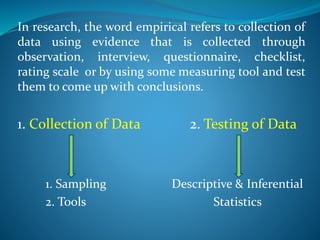
In research, the word empirical refers to collection of
data using evidence that is collected through
observation, interview, questionnaire, checklist,
rating scale or by using some measuring tool and test
them to come up with conclusions.
1. Collection of Data 2. Testing of Data
1. Sampling Descriptive & Inferential
2. Tools Statistics
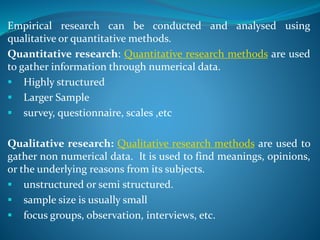
Empirical research can be conducted and analysed using
qualitative or quantitative methods.
Quantitative research: Quantitative research methods are used
to gather information through numerical data.
 Highly structured
 Larger Sample
 survey, questionnaire, scales ,etc
Qualitative research: Qualitative research methods are used to
gather non numerical data. It is used to find meanings, opinions,
or the underlying reasons from its subjects.
 unstructured or semi structured.
 sample size is usually small
 focus groups, observation, interviews, etc.
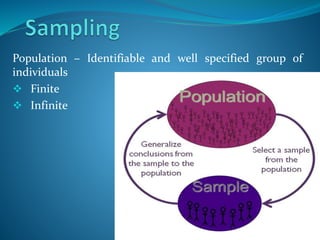
Population – Identifiable and well specified group of
individuals
 Finite
 Infinite
Representative of the population
A good sample
Large in size [30+]
Represent all the parts
M1
M0
As M1 approaches M0, estimate is better
Population Parameter
Sample Statistic
What is Probability?
Conditions
 Size of population
 Equal chance of being selected
 Sample size must be clearly specified
Simple Random Sampling
Stratified Random Sampling
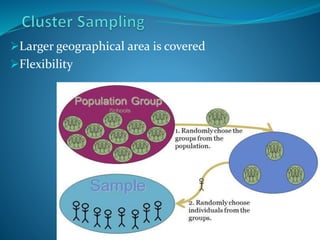
Cluster or Area Sampling
Equal chance of being selected.
 Sampling without replacement
 Sampling with replacement
Types
 Fishbowl method
 Table of Random numbers
 Computer determined randomness
Gender
SES
Religion
One strata
Two strata Non overlapping &
Multiple strata Homogeneous
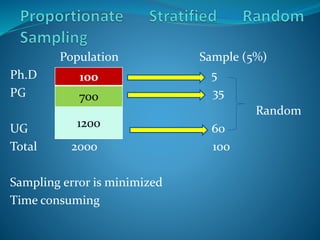
Proportionate stratified sampling
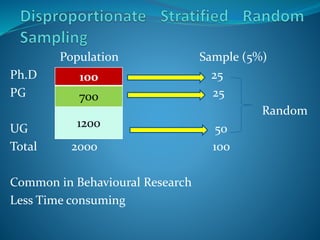
Disproportionate stratified sampling
Population Sample (5%)
Ph.D 5
PG 35
Random
UG 60
Total 2000 100
Sampling error is minimized
Time consuming
100
700
1200
Population Sample (5%)
Ph.D 25
PG 25
Random
UG 50
Total 2000 100
Common in Behavioural Research
Less Time consuming
100
700
1200
Larger geographical area is covered
Flexibility
No way of assessing the probability of elements of
population being included in the sample.
Quota Sampling
Purposive Sampling
Accidental Sampling
Systematic Sampling
Snowball Sampling
Quota Sampling
Similar to stratified random sampling but final
selection is not random but according to investigator
convenience.
Purposive Sampling
Investigator makes a judgment regarding selection.
Purpose should be solved
Accidental Sampling
Investigator select according to his convenience
Systematic Sample
Selecting every nth person from predetermined list
Snowball Sampling
Sociometric technique
Man-Made Tool/Test
Standardized Tool/Test
Interview
Observation
Questionnaire
Rating Scale
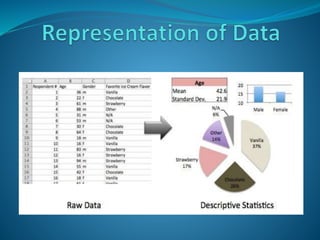
Descriptive statistics give information that
describes the data in some manner. A graphical
representation of data is another method of
descriptive statistics. Descriptive statistics do not,
allow us to reach conclusions regarding any
hypotheses we might have made. They are simply a
way to describe our data.
Example
Measures of Central Tendency – Mean, Median,
Mode
Measures of Variability – Range, Quartile, Standard
Deviation
Inferential statistics is to draw conclusions from a
sample and generalize them to the population. The
most common methodologies used are
z-test
t-tests
Analysis of Variance (ANOVA)
Chi-square
Correlation
Factor Analysis
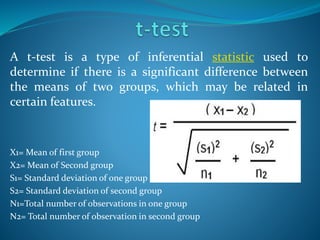
A t-test is a type of inferential statistic used to
determine if there is a significant difference between
the means of two groups, which may be related in
certain features.
X1= Mean of first group
X2= Mean of Second group
S1= Standard deviation of one group
S2= Standard deviation of second group
N1=Total number of observations in one group
N2= Total number of observation in second group
 simple random sample, that the data is collected
from a representative, randomly selected portion
of the total population.
 the data, when plotted, results in a normal
distribution, bell-shaped distribution curve.
 large sample size is used.
 Homogeneous, or equal, variance exists when the
standard deviations of samples are approximately
equal.
Analysis of Variance (ANOVA) is a statistical
technique applied where more than two samples are
meant to be compared. It is also called F-test
One way analysis: When we are comparing more
than three groups based on one factor variable.
Two way analysis: When factor variables are more
than two.
Chi-square is a statistical test commonly used to
compare observed data with data we would expect to
obtain according to a specific hypothesis. It is used to
determine whether there is a significant association
between the two variables.
Example: In an election survey, voters might be
classified by gender (male or female) and voting
preference (Democrat, Republican, or Independent).
We could use a chi-square test for independence to
determine whether gender is related to voting
preference.
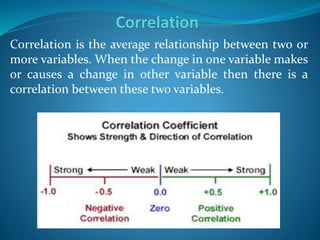
Correlation is the average relationship between two or
more variables. When the change in one variable makes
or causes a change in other variable then there is a
correlation between these two variables.
THANK YOU

Empirical research & Statistics

  • 1.
  • 2.
    In research, theword empirical refers to collection of data using evidence that is collected through observation, interview, questionnaire, checklist, rating scale or by using some measuring tool and test them to come up with conclusions. 1. Collection of Data 2. Testing of Data 1. Sampling Descriptive & Inferential 2. Tools Statistics
  • 3.
    Empirical research canbe conducted and analysed using qualitative or quantitative methods. Quantitative research: Quantitative research methods are used to gather information through numerical data.  Highly structured  Larger Sample  survey, questionnaire, scales ,etc Qualitative research: Qualitative research methods are used to gather non numerical data. It is used to find meanings, opinions, or the underlying reasons from its subjects.  unstructured or semi structured.  sample size is usually small  focus groups, observation, interviews, etc.
  • 4.
    Population – Identifiableand well specified group of individuals  Finite  Infinite
  • 5.
    Representative of thepopulation A good sample Large in size [30+] Represent all the parts M1 M0 As M1 approaches M0, estimate is better Population Parameter Sample Statistic
  • 6.
    What is Probability? Conditions Size of population  Equal chance of being selected  Sample size must be clearly specified Simple Random Sampling Stratified Random Sampling Cluster or Area Sampling
  • 7.
    Equal chance ofbeing selected.  Sampling without replacement  Sampling with replacement Types  Fishbowl method  Table of Random numbers  Computer determined randomness
  • 8.
    Gender SES Religion One strata Two strataNon overlapping & Multiple strata Homogeneous Proportionate stratified sampling Disproportionate stratified sampling
  • 9.
    Population Sample (5%) Ph.D5 PG 35 Random UG 60 Total 2000 100 Sampling error is minimized Time consuming 100 700 1200
  • 10.
    Population Sample (5%) Ph.D25 PG 25 Random UG 50 Total 2000 100 Common in Behavioural Research Less Time consuming 100 700 1200
  • 11.
    Larger geographical areais covered Flexibility
  • 12.
    No way ofassessing the probability of elements of population being included in the sample. Quota Sampling Purposive Sampling Accidental Sampling Systematic Sampling Snowball Sampling
  • 13.
    Quota Sampling Similar tostratified random sampling but final selection is not random but according to investigator convenience. Purposive Sampling Investigator makes a judgment regarding selection. Purpose should be solved Accidental Sampling Investigator select according to his convenience
  • 14.
    Systematic Sample Selecting everynth person from predetermined list Snowball Sampling Sociometric technique
  • 15.
  • 16.
    Descriptive statistics giveinformation that describes the data in some manner. A graphical representation of data is another method of descriptive statistics. Descriptive statistics do not, allow us to reach conclusions regarding any hypotheses we might have made. They are simply a way to describe our data. Example Measures of Central Tendency – Mean, Median, Mode Measures of Variability – Range, Quartile, Standard Deviation
  • 18.
    Inferential statistics isto draw conclusions from a sample and generalize them to the population. The most common methodologies used are z-test t-tests Analysis of Variance (ANOVA) Chi-square Correlation Factor Analysis
  • 19.
    A t-test isa type of inferential statistic used to determine if there is a significant difference between the means of two groups, which may be related in certain features. X1= Mean of first group X2= Mean of Second group S1= Standard deviation of one group S2= Standard deviation of second group N1=Total number of observations in one group N2= Total number of observation in second group
  • 20.
     simple randomsample, that the data is collected from a representative, randomly selected portion of the total population.  the data, when plotted, results in a normal distribution, bell-shaped distribution curve.  large sample size is used.  Homogeneous, or equal, variance exists when the standard deviations of samples are approximately equal.
  • 21.
    Analysis of Variance(ANOVA) is a statistical technique applied where more than two samples are meant to be compared. It is also called F-test One way analysis: When we are comparing more than three groups based on one factor variable. Two way analysis: When factor variables are more than two.
  • 22.
    Chi-square is astatistical test commonly used to compare observed data with data we would expect to obtain according to a specific hypothesis. It is used to determine whether there is a significant association between the two variables. Example: In an election survey, voters might be classified by gender (male or female) and voting preference (Democrat, Republican, or Independent). We could use a chi-square test for independence to determine whether gender is related to voting preference.
  • 23.
    Correlation is theaverage relationship between two or more variables. When the change in one variable makes or causes a change in other variable then there is a correlation between these two variables.
  • 24.