Common
Statistical Tools
Presented by: Daian P. Moreno
Victorias National High School
Victorias City, Negros Occidental
Arithmetic Mean
• The arithmetic mean, more commonly known as “the
average,” is the sum of a list of numbers divided by the
number of items on the list.
• The mean is useful in determining the overall trend of a
data or providing a rapid snapshot of your data.
• Another advantage of the mean is that it’s very easy and
quick to calculate.
Arithmetic Mean
• The arithmetic mean allows investors to gain some
insight into stock prices, economic data, and a host of
other information.
• For instance, if Company XYZ's stock price is trading
above its arithmetic mean, it could be that the stock is
overvalued.
Frequency Distribution
• Is presented in tables or charts that show how many of
your evaluation participants fall into various categories of
interest (Wilder Research, 2009).
• A graph or data set organized to show the frequency of
occurrence of each possible outcome of a repeatable
event observed many times.
• A frequency distribution can be graphed as a histogram or
pie chart.
Pie Chart
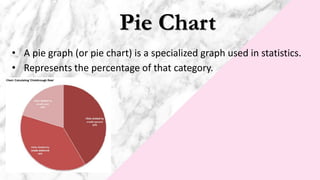
• A pie graph (or pie chart) is a specialized graph used in statistics.
• Represents the percentage of that category.
Bar Graph
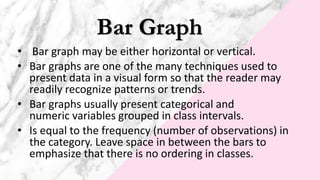
• Bar graph may be either horizontal or vertical.
• Bar graphs are one of the many techniques used to
present data in a visual form so that the reader may
readily recognize patterns or trends.
• Bar graphs usually present categorical and
numeric variables grouped in class intervals.
• Is equal to the frequency (number of observations) in
the category. Leave space in between the bars to
emphasize that there is no ordering in classes.
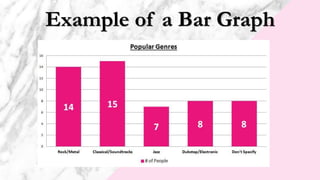
Example of a Bar Graph
Standard Deviation
• Often represented with the Greek letter sigma (σ),
is the measure of a spread of data around the
mean.
• A high standard deviation signifies that data is
spread more widely from the mean, where a low
standard deviation signals that more data align with
the mean.
T-Tests
• Are used to test if the difference of means is
statistically significant. It test if the sample is
representative of populations.
• For example, if the mean for variable 1 is 40
and the mean for variable 2 is 56, you may
say the means are different.
Pearson’s Correlation Coefficient (r)
• Pearson’s correlation coefficient is the test statistics that
measures the statistical relationship, or association,
between two continuous variables.
• It is known as the best method of measuring the
association between variables of interest because it is
based on the method of covariance.
• It gives information about the magnitude of the
association, or correlation, as well as the direction of the
relationship.
Chi-square Test
• The Chi Square statistic is commonly used for testing
relationships between categorical variables. Compares the
frequency count of what is expected in theory against what is
actually observed.
• The null hypothesis of the Chi-Square test is that no relationship
exists on the categorical variables in the population; they are
independent.
• An example research question that could be answered using a
Chi-Square analysis would be: Is there a significant relationship
between voter intent and political party membership?
References
• https://investinganswers.com/financial-dictionary/ratio-
analysis/arithmetic-mean-2546
• https://www.britannica.com/technology/frequency-distribution
• https://whatis.techtarget.com/definition/pie-graph-or-pie-chart
• https://www.statcan.gc.ca/edu/power-pouvoir/ch9/bargraph-
diagrammeabarres/5214818-eng.htm
• http://www.statisticssolutions.com/pearsons-correlation-
coefficient/
• http://www.statisticssolutions.com/using-chi-square-statistic-in-
research/

Practical Research 2 Chapter 3: Common Statistical Tools

  • 1.
    Common Statistical Tools Presented by:Daian P. Moreno Victorias National High School Victorias City, Negros Occidental
  • 2.
    Arithmetic Mean • Thearithmetic mean, more commonly known as “the average,” is the sum of a list of numbers divided by the number of items on the list. • The mean is useful in determining the overall trend of a data or providing a rapid snapshot of your data. • Another advantage of the mean is that it’s very easy and quick to calculate.
  • 3.
    Arithmetic Mean • Thearithmetic mean allows investors to gain some insight into stock prices, economic data, and a host of other information. • For instance, if Company XYZ's stock price is trading above its arithmetic mean, it could be that the stock is overvalued.
  • 4.
    Frequency Distribution • Ispresented in tables or charts that show how many of your evaluation participants fall into various categories of interest (Wilder Research, 2009). • A graph or data set organized to show the frequency of occurrence of each possible outcome of a repeatable event observed many times. • A frequency distribution can be graphed as a histogram or pie chart.
  • 5.
    Pie Chart • Apie graph (or pie chart) is a specialized graph used in statistics. • Represents the percentage of that category.
  • 6.
    Bar Graph • Bargraph may be either horizontal or vertical. • Bar graphs are one of the many techniques used to present data in a visual form so that the reader may readily recognize patterns or trends. • Bar graphs usually present categorical and numeric variables grouped in class intervals. • Is equal to the frequency (number of observations) in the category. Leave space in between the bars to emphasize that there is no ordering in classes.
  • 7.
    Example of aBar Graph
  • 8.
    Standard Deviation • Oftenrepresented with the Greek letter sigma (σ), is the measure of a spread of data around the mean. • A high standard deviation signifies that data is spread more widely from the mean, where a low standard deviation signals that more data align with the mean.
  • 9.
    T-Tests • Are usedto test if the difference of means is statistically significant. It test if the sample is representative of populations. • For example, if the mean for variable 1 is 40 and the mean for variable 2 is 56, you may say the means are different.
  • 10.
    Pearson’s Correlation Coefficient(r) • Pearson’s correlation coefficient is the test statistics that measures the statistical relationship, or association, between two continuous variables. • It is known as the best method of measuring the association between variables of interest because it is based on the method of covariance. • It gives information about the magnitude of the association, or correlation, as well as the direction of the relationship.
  • 11.
    Chi-square Test • TheChi Square statistic is commonly used for testing relationships between categorical variables. Compares the frequency count of what is expected in theory against what is actually observed. • The null hypothesis of the Chi-Square test is that no relationship exists on the categorical variables in the population; they are independent. • An example research question that could be answered using a Chi-Square analysis would be: Is there a significant relationship between voter intent and political party membership?
  • 12.
    References • https://investinganswers.com/financial-dictionary/ratio- analysis/arithmetic-mean-2546 • https://www.britannica.com/technology/frequency-distribution •https://whatis.techtarget.com/definition/pie-graph-or-pie-chart • https://www.statcan.gc.ca/edu/power-pouvoir/ch9/bargraph- diagrammeabarres/5214818-eng.htm • http://www.statisticssolutions.com/pearsons-correlation- coefficient/ • http://www.statisticssolutions.com/using-chi-square-statistic-in- research/