Date Analysis and Interpretation
- It may be defined as the examination of
data or fact in terms of quantity, quality,
attribute, trait, pattern, trend, relationship
among others so as to answer research
questions which involve statistical
techniques and procedures.
- Tests a single variable to determine
whether the sample is similar to the
population from which it has been
drawn.
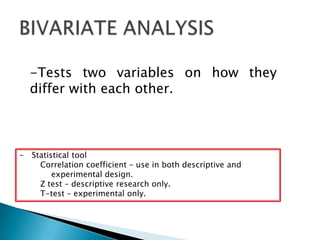
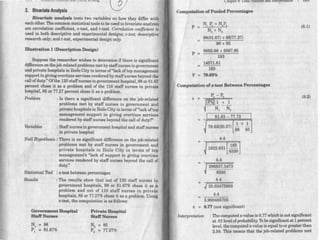
-Tests two variables on how they
differ with each other.
- Statistical tool
Correlation coefficient – use in both descriptive and
experimental design.
Z test – descriptive research only.
T-test – experimental only.
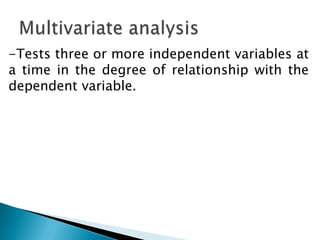
-Tests three or more independent variables at
a time in the degree of relationship with the
dependent variable.
• Also known as “MANOVA”.
• This examine several variable and their
relationships simultaneously
• In contrast to bivariate analysis which examine
relationship between 2 variables, and univariate
analyses where one variable at a time is
examined for generalization from the sample to
the population.
• MANOVA test means differences among groups
across several dependent variables
simultaneously, by using sums of squares and
cross product matrices.
• In MANOVA test the independent variable is
measured on a nominal scale and the
dependent variables on an interval or ratio
scale
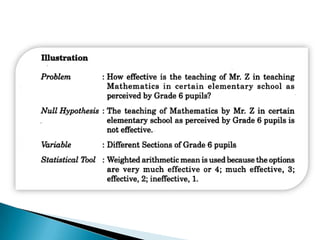
Illustration 1: Experimental design
Illustration 2 ( Experimental design
Computation of sum of squares for samples (SS)
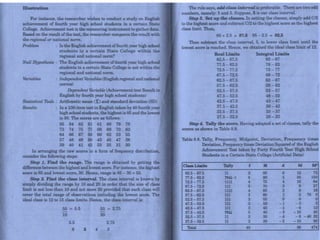
 Is a type of data analysis wherein the
results of the study is compared with the
norm or standard. the statistical tools
used in this type are the arithmetic mean
and the standard deviation.
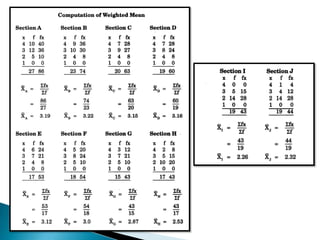
Computation of arithmetic mean
Chapter 8 Data analysis and interpretation ( 2007 book )

Chapter 8 Data analysis and interpretation ( 2007 book )

  • 1.
    Date Analysis andInterpretation
  • 2.
    - It maybe defined as the examination of data or fact in terms of quantity, quality, attribute, trait, pattern, trend, relationship among others so as to answer research questions which involve statistical techniques and procedures.
  • 3.
    - Tests asingle variable to determine whether the sample is similar to the population from which it has been drawn.
  • 7.
    -Tests two variableson how they differ with each other. - Statistical tool Correlation coefficient – use in both descriptive and experimental design. Z test – descriptive research only. T-test – experimental only.
  • 9.
    -Tests three ormore independent variables at a time in the degree of relationship with the dependent variable.
  • 10.
    • Also knownas “MANOVA”. • This examine several variable and their relationships simultaneously • In contrast to bivariate analysis which examine relationship between 2 variables, and univariate analyses where one variable at a time is examined for generalization from the sample to the population.
  • 11.
    • MANOVA testmeans differences among groups across several dependent variables simultaneously, by using sums of squares and cross product matrices. • In MANOVA test the independent variable is measured on a nominal scale and the dependent variables on an interval or ratio scale
  • 12.
  • 14.
    Illustration 2 (Experimental design
  • 16.
    Computation of sumof squares for samples (SS)
  • 21.
     Is atype of data analysis wherein the results of the study is compared with the norm or standard. the statistical tools used in this type are the arithmetic mean and the standard deviation.
  • 23.