RENAISSANCE ARCHITECTURE
Renaissance architecture is the architecture of the period between the early
15th and early 17th centuries in different regions of Europe, in which there was
a conscious revival and development of certain elements of ancient Greek and
roman thought and material culture. Stylistically, Renaissance architecture
followed gothic architecture and was succeeded by baroque architecture.
emphasis on
•symmetry,
•proportion ,
•geometry and
•the regularity of parts .
Orderly arrangements of columns, pilasters and lintels, as well as the use of
semicircular arches, hemispherical domes, and niches .
Developed first in Florence, with Filippo Brunelleschi as one of its innovators,
the Renaissance style quickly spread to other Italian cities and then to France,
Germany, England, Russia and elsewhere.
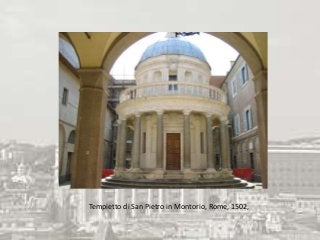
Tempietto di San Pietro in Montorio, Rome, 1502,
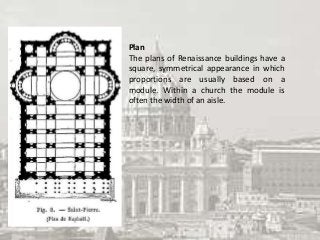
Plan
The plans of Renaissance buildings have a
square, symmetrical appearance in which
proportions are usually based on a
module. Within a church the module is
often the width of an aisle.
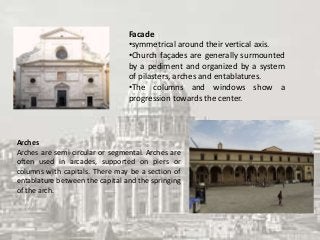
Facade
•symmetrical around their vertical axis.
•Church façades are generally surmounted
by a pediment and organized by a system
of pilasters, arches and entablatures.
•The columns and windows show a
progression towards the center.
Arches
Arches are semi-circular or segmental. Arches are
often used in arcades, supported on piers or
columns with capitals. There may be a section of
entablature between the capital and the springing
of the arch.
The Roman orders of columns are used:-
Tuscan, Doric, Ionic, Corinthian and
Composite. The orders can either be
structural, supporting an arcade or
architrave, or purely decorative, set
against a wall in the form of pilasters.
During the Renaissance, architects aimed
to use columns, pilasters, and
entablatures as an integrated system.
Columns and Pilasters
Vaults
Vaults do not have ribs. They are semi-circular
or segmental and on a square plan, unlike the
Gothic vault which is frequently rectangular.
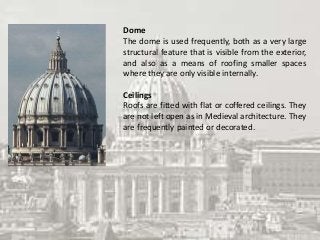
Dome
The dome is used frequently, both as a very large
structural feature that is visible from the exterior,
and also as a means of roofing smaller spaces
where they are only visible internally.
Ceilings
Roofs are fitted with flat or coffered ceilings. They
are not left open as in Medieval architecture. They
are frequently painted or decorated.
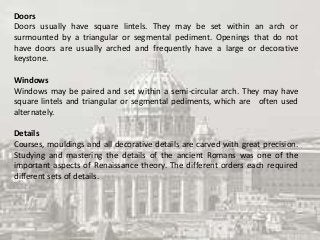
Doors
Doors usually have square lintels. They may be set within an arch or
surmounted by a triangular or segmental pediment. Openings that do not
have doors are usually arched and frequently have a large or decorative
keystone.
Windows
Windows may be paired and set within a semi-circular arch. They may have
square lintels and triangular or segmental pediments, which are often used
alternately.
Details
Courses, mouldings and all decorative details are carved with great precision.
Studying and mastering the details of the ancient Romans was one of the
important aspects of Renaissance theory. The different orders each required
different sets of details.
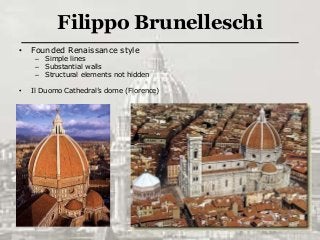
Filippo Brunelleschi
• Founded Renaissance style
– Simple lines
– Substantial walls
– Structural elements not hidden
• Il Duomo Cathedral’s dome (Florence)
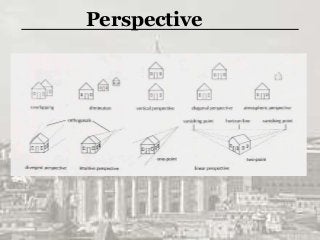
Perspective
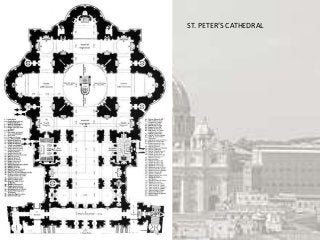
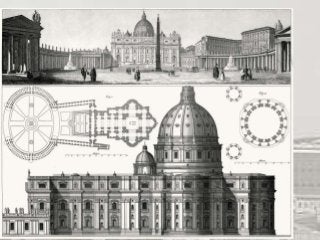
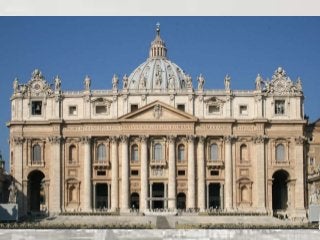
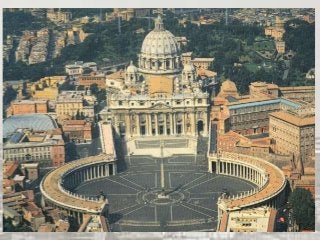
ST. PETER’S CATHEDRAL
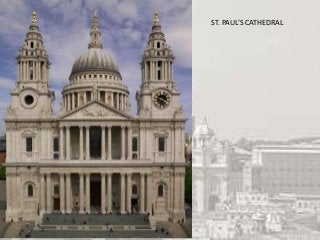
ST. PAUL’S CATHEDRAL
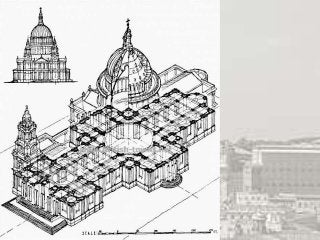
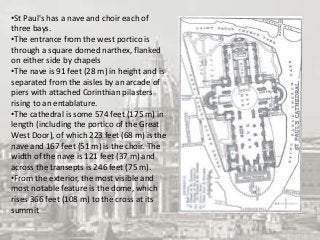
•St Paul's has a nave and choir each of
three bays.
•The entrance from the west portico is
through a square domed narthex, flanked
on either side by chapels
•The nave is 91 feet (28 m) in height and is
separated from the aisles by an arcade of
piers with attached Corinthian pilasters
rising to an entablature.
•The cathedral is some 574 feet (175 m) in
length (including the portico of the Great
West Door), of which 223 feet (68 m) is the
nave and 167 feet (51 m) is the choir. The
width of the nave is 121 feet (37 m) and
across the transepts is 246 feet (75 m).
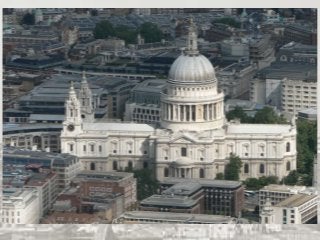
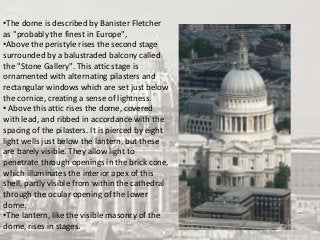
•From the exterior, the most visible and
most notable feature is the dome, which
rises 366 feet (108 m) to the cross at its
summit
•The dome is described by Banister Fletcher
as "probably the finest in Europe",
•Above the peristyle rises the second stage
surrounded by a balustraded balcony called
the "Stone Gallery". This attic stage is
ornamented with alternating pilasters and
rectangular windows which are set just below
the cornice, creating a sense of lightness.
• Above this attic rises the dome, covered
with lead, and ribbed in accordance with the
spacing of the pilasters. It is pierced by eight
light wells just below the lantern, but these
are barely visible. They allow light to
penetrate through openings in the brick cone,
which illuminates the interior apex of this
shell, partly visible from within the cathedral
through the ocular opening of the lower
dome.
•The lantern, like the visible masonry of the
dome, rises in stages.

Renaissance

  • 1.
  • 2.
    Renaissance architecture isthe architecture of the period between the early 15th and early 17th centuries in different regions of Europe, in which there was a conscious revival and development of certain elements of ancient Greek and roman thought and material culture. Stylistically, Renaissance architecture followed gothic architecture and was succeeded by baroque architecture. emphasis on •symmetry, •proportion , •geometry and •the regularity of parts . Orderly arrangements of columns, pilasters and lintels, as well as the use of semicircular arches, hemispherical domes, and niches . Developed first in Florence, with Filippo Brunelleschi as one of its innovators, the Renaissance style quickly spread to other Italian cities and then to France, Germany, England, Russia and elsewhere.
  • 3.
    Tempietto di SanPietro in Montorio, Rome, 1502,
  • 4.
    Plan The plans ofRenaissance buildings have a square, symmetrical appearance in which proportions are usually based on a module. Within a church the module is often the width of an aisle.
  • 5.
    Facade •symmetrical around theirvertical axis. •Church façades are generally surmounted by a pediment and organized by a system of pilasters, arches and entablatures. •The columns and windows show a progression towards the center. Arches Arches are semi-circular or segmental. Arches are often used in arcades, supported on piers or columns with capitals. There may be a section of entablature between the capital and the springing of the arch.
  • 6.
    The Roman ordersof columns are used:- Tuscan, Doric, Ionic, Corinthian and Composite. The orders can either be structural, supporting an arcade or architrave, or purely decorative, set against a wall in the form of pilasters. During the Renaissance, architects aimed to use columns, pilasters, and entablatures as an integrated system. Columns and Pilasters Vaults Vaults do not have ribs. They are semi-circular or segmental and on a square plan, unlike the Gothic vault which is frequently rectangular.
  • 7.
    Dome The dome isused frequently, both as a very large structural feature that is visible from the exterior, and also as a means of roofing smaller spaces where they are only visible internally. Ceilings Roofs are fitted with flat or coffered ceilings. They are not left open as in Medieval architecture. They are frequently painted or decorated.
  • 8.
    Doors Doors usually havesquare lintels. They may be set within an arch or surmounted by a triangular or segmental pediment. Openings that do not have doors are usually arched and frequently have a large or decorative keystone. Windows Windows may be paired and set within a semi-circular arch. They may have square lintels and triangular or segmental pediments, which are often used alternately. Details Courses, mouldings and all decorative details are carved with great precision. Studying and mastering the details of the ancient Romans was one of the important aspects of Renaissance theory. The different orders each required different sets of details.
  • 9.
    Filippo Brunelleschi • FoundedRenaissance style – Simple lines – Substantial walls – Structural elements not hidden • Il Duomo Cathedral’s dome (Florence)
  • 10.
  • 11.
  • 15.
  • 18.
    •St Paul's hasa nave and choir each of three bays. •The entrance from the west portico is through a square domed narthex, flanked on either side by chapels •The nave is 91 feet (28 m) in height and is separated from the aisles by an arcade of piers with attached Corinthian pilasters rising to an entablature. •The cathedral is some 574 feet (175 m) in length (including the portico of the Great West Door), of which 223 feet (68 m) is the nave and 167 feet (51 m) is the choir. The width of the nave is 121 feet (37 m) and across the transepts is 246 feet (75 m). •From the exterior, the most visible and most notable feature is the dome, which rises 366 feet (108 m) to the cross at its summit
  • 19.
    •The dome isdescribed by Banister Fletcher as "probably the finest in Europe", •Above the peristyle rises the second stage surrounded by a balustraded balcony called the "Stone Gallery". This attic stage is ornamented with alternating pilasters and rectangular windows which are set just below the cornice, creating a sense of lightness. • Above this attic rises the dome, covered with lead, and ribbed in accordance with the spacing of the pilasters. It is pierced by eight light wells just below the lantern, but these are barely visible. They allow light to penetrate through openings in the brick cone, which illuminates the interior apex of this shell, partly visible from within the cathedral through the ocular opening of the lower dome. •The lantern, like the visible masonry of the dome, rises in stages.