The Renaissance
•from French Renaissance, meaning "rebirth"
•was a cultural movement that spanned roughly the 14th to the 17th century
• beginning in Italy in the late Middle ages and later spreading to the rest of Europe.
•They exceelled in Architecture Dance Music Literature philosphy technology and warfare.
•Flourished in France Germany Italy England Netherland poland northern Europe and spain
•As a cultural movement, it encompassed a revival of learning based on classical sources,
•Traditionally, this intellectual transformation has resulted in the Renaissance being viewed
as a bridge between the Middle Ages and the Modern era.
•Best known for the development of Art.
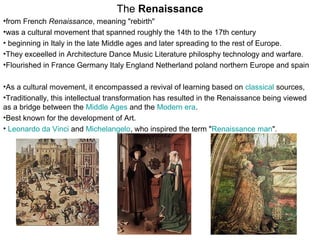
• Leonardo da Vinci and Michelangelo, who inspired the term "Renaissance man".
Art & Architeccture
Renaissance art develoed highly realistic linear perspective.
The development of perspective was part of a wider trend towards realism in the arts.[31]
painters also developed other techniques, studying light, shadow, and, famously in the case of
Leonardo da Vinci, human anatomy.
development of painting in Italy, both technically with the introduction of oil paint and canvas, and
stylistically in terms of naturalism in representation.
In architecture, Filippo Brunelleschi was foremost in studying the ancient Classical buildings
and with rediscovered knowledge from the 1st-century writer Vitruvius and the
flourishing discipline of mathematics, formulated the Renaissance style which emulated and improved
on classical forms.
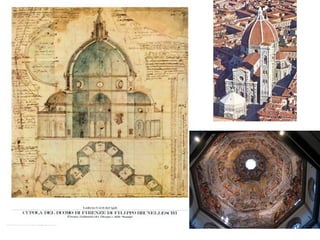
Brunelleschi's major feat of engineering was the building of the dome of Florence Cathedral.[34] The first
building to demonstrate this is claimed to be the church of St. Andrew built by Alberti in Mantua.
The outstanding architectural work of the High Renaissance was the rebuilding of St. Peter's Basilica,
combining the skills of Bramante, Michelangelo, Raphael, Sangallo and Maderno.
The Roman orders types of columns are used: Tuscan, Doric, Ionic, Corinthian and Composite. These
can either be structural, supporting an arcade or architrave, or purely decorative, set against a wall in the
form of pilasters.
Characteristics of Renaissance architecture
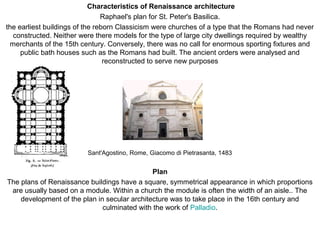
Raphael's plan for St. Peter's Basilica.
the earliest buildings of the reborn Classicism were churches of a type that the Romans had never
constructed. Neither were there models for the type of large city dwellings required by wealthy
merchants of the 15th century. Conversely, there was no call for enormous sporting fixtures and
public bath houses such as the Romans had built. The ancient orders were analysed and
reconstructed to serve new purposes
Sant'Agostino, Rome, Giacomo di Pietrasanta, 1483
Plan
The plans of Renaissance buildings have a square, symmetrical appearance in which proportions
are usually based on a module. Within a church the module is often the width of an aisle.. The
development of the plan in secular architecture was to take place in the 16th century and
culminated with the work of Palladio.
Facade
Façades are symmetrical around their vertical axis. Church facades are generally surmounted by a
pediment and organized by a system of pilasters, arches and entablatures. The columns and
windows show a progression towards the center. One of the first true Renaissance facades was the
Cathedral of Pienza (1459–62), which has been attributed to the Florentine architect Bernardo
Gambarelli (known as Rossellino) with Alberti perhaps having some responsibility in its design as
well.
Domestic buildings are often surmounted by a cornice. There is a regular repetition of openings on
each floor, and the centrally placed door is marked by a feature such as a balcony, or rusticated
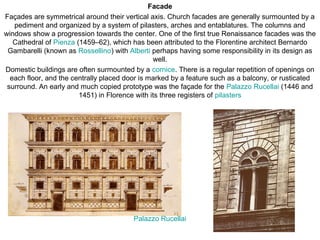
surround. An early and much copied prototype was the façade for the Palazzo Rucellai (1446 and
1451) in Florence with its three registers of pilasters
`
Palazzo Rucellai
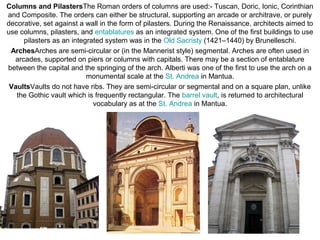
Columns and PilastersThe Roman orders of columns are used:- Tuscan, Doric, Ionic, Corinthian
and Composite. The orders can either be structural, supporting an arcade or architrave, or purely
decorative, set against a wall in the form of pilasters. During the Renaissance, architects aimed to
use columns, pilasters, and entablatures as an integrated system. One of the first buildings to use
pilasters as an integrated system was in the Old Sacristy (1421–1440) by Brunelleschi.
ArchesArches are semi-circular or (in the Mannerist style) segmental. Arches are often used in
arcades, supported on piers or columns with capitals. There may be a section of entablature
between the capital and the springing of the arch. Alberti was one of the first to use the arch on a
monumental scale at the St. Andrea in Mantua.
VaultsVaults do not have ribs. They are semi-circular or segmental and on a square plan, unlike
the Gothic vault which is frequently rectangular. The barrel vault, is returned to architectural
vocabulary as at the St. Andrea in Mantua.
Domes
The Dome of St Peter's Basilica, Rome. photo- Wolgang Stuck, 2004
The dome is used frequently, both as a very large structural feature that is visible from the exterior,
and also as a means of roofing smaller spaces where they are only visible internally. Domes had
been used only rarely in the Middle Ages, but after the success of the dome in Brunelleschi’s design
for the Basilica di Santa Maria del Fiore and its use in Bramante’s plan for St. Peter's Basilica
(1506) in Rome, the dome became an indispensable element in church architecture and later even
for secular architecture, such as Palladio's Villa Rotonda.[12]
Ceilings
Roofs are fitted with flat or coffered ceilings. They are not left open as in Medieval architecture.
They are frequently painted or decorated.
The Dome of St Peter's Basilica, Rome
Doors
Doors usually have square lintels. They may be set within
an arch or surmounted by a triangular or segmental pediment.
Openings that do not have doors are usually arched and
frequently have a large or decorative keystone.
Windows
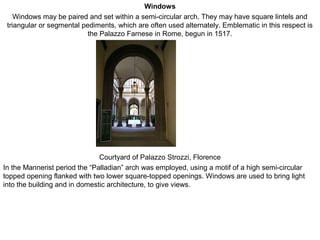
Windows may be paired and set within a semi-circular arch. They may have square lintels and
triangular or segmental pediments, which are often used alternately. Emblematic in this respect is
the Palazzo Farnese in Rome, begun in 1517.
Courtyard of Palazzo Strozzi, Florence
In the Mannerist period the “Palladian” arch was employed, using a motif of a high semi-circular
topped opening flanked with two lower square-topped openings. Windows are used to bring light
into the building and in domestic architecture, to give views.
Walls
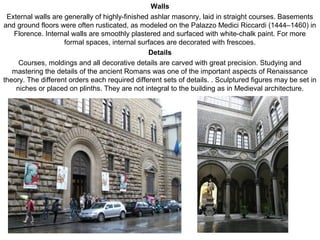
External walls are generally of highly-finished ashlar masonry, laid in straight courses. Basements
and ground floors were often rusticated, as modeled on the Palazzo Medici Riccardi (1444–1460) in
Florence. Internal walls are smoothly plastered and surfaced with white-chalk paint. For more
formal spaces, internal surfaces are decorated with frescoes.
Details
Courses, moldings and all decorative details are carved with great precision. Studying and
mastering the details of the ancient Romans was one of the important aspects of Renaissance
theory. The different orders each required different sets of details. . Sculptured figures may be set in
niches or placed on plinths. They are not integral to the building as in Medieval architecture.
Walls
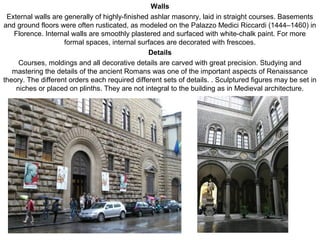
External walls are generally of highly-finished ashlar masonry, laid in straight courses. Basements
and ground floors were often rusticated, as modeled on the Palazzo Medici Riccardi (1444–1460) in
Florence. Internal walls are smoothly plastered and surfaced with white-chalk paint. For more
formal spaces, internal surfaces are decorated with frescoes.
Details
Courses, moldings and all decorative details are carved with great precision. Studying and
mastering the details of the ancient Romans was one of the important aspects of Renaissance
theory. The different orders each required different sets of details. . Sculptured figures may be set in
niches or placed on plinths. They are not integral to the building as in Medieval architecture.

Renaissance

  • 1.
    The Renaissance •from FrenchRenaissance, meaning "rebirth" •was a cultural movement that spanned roughly the 14th to the 17th century • beginning in Italy in the late Middle ages and later spreading to the rest of Europe. •They exceelled in Architecture Dance Music Literature philosphy technology and warfare. •Flourished in France Germany Italy England Netherland poland northern Europe and spain •As a cultural movement, it encompassed a revival of learning based on classical sources, •Traditionally, this intellectual transformation has resulted in the Renaissance being viewed as a bridge between the Middle Ages and the Modern era. •Best known for the development of Art. • Leonardo da Vinci and Michelangelo, who inspired the term "Renaissance man".
  • 2.
    Art & Architeccture Renaissanceart develoed highly realistic linear perspective. The development of perspective was part of a wider trend towards realism in the arts.[31] painters also developed other techniques, studying light, shadow, and, famously in the case of Leonardo da Vinci, human anatomy. development of painting in Italy, both technically with the introduction of oil paint and canvas, and stylistically in terms of naturalism in representation. In architecture, Filippo Brunelleschi was foremost in studying the ancient Classical buildings and with rediscovered knowledge from the 1st-century writer Vitruvius and the flourishing discipline of mathematics, formulated the Renaissance style which emulated and improved on classical forms. Brunelleschi's major feat of engineering was the building of the dome of Florence Cathedral.[34] The first building to demonstrate this is claimed to be the church of St. Andrew built by Alberti in Mantua. The outstanding architectural work of the High Renaissance was the rebuilding of St. Peter's Basilica, combining the skills of Bramante, Michelangelo, Raphael, Sangallo and Maderno. The Roman orders types of columns are used: Tuscan, Doric, Ionic, Corinthian and Composite. These can either be structural, supporting an arcade or architrave, or purely decorative, set against a wall in the form of pilasters.
  • 4.
    Characteristics of Renaissancearchitecture Raphael's plan for St. Peter's Basilica. the earliest buildings of the reborn Classicism were churches of a type that the Romans had never constructed. Neither were there models for the type of large city dwellings required by wealthy merchants of the 15th century. Conversely, there was no call for enormous sporting fixtures and public bath houses such as the Romans had built. The ancient orders were analysed and reconstructed to serve new purposes Sant'Agostino, Rome, Giacomo di Pietrasanta, 1483 Plan The plans of Renaissance buildings have a square, symmetrical appearance in which proportions are usually based on a module. Within a church the module is often the width of an aisle.. The development of the plan in secular architecture was to take place in the 16th century and culminated with the work of Palladio.
  • 5.
    Facade Façades are symmetricalaround their vertical axis. Church facades are generally surmounted by a pediment and organized by a system of pilasters, arches and entablatures. The columns and windows show a progression towards the center. One of the first true Renaissance facades was the Cathedral of Pienza (1459–62), which has been attributed to the Florentine architect Bernardo Gambarelli (known as Rossellino) with Alberti perhaps having some responsibility in its design as well. Domestic buildings are often surmounted by a cornice. There is a regular repetition of openings on each floor, and the centrally placed door is marked by a feature such as a balcony, or rusticated surround. An early and much copied prototype was the façade for the Palazzo Rucellai (1446 and 1451) in Florence with its three registers of pilasters ` Palazzo Rucellai
  • 6.
    Columns and PilastersTheRoman orders of columns are used:- Tuscan, Doric, Ionic, Corinthian and Composite. The orders can either be structural, supporting an arcade or architrave, or purely decorative, set against a wall in the form of pilasters. During the Renaissance, architects aimed to use columns, pilasters, and entablatures as an integrated system. One of the first buildings to use pilasters as an integrated system was in the Old Sacristy (1421–1440) by Brunelleschi. ArchesArches are semi-circular or (in the Mannerist style) segmental. Arches are often used in arcades, supported on piers or columns with capitals. There may be a section of entablature between the capital and the springing of the arch. Alberti was one of the first to use the arch on a monumental scale at the St. Andrea in Mantua. VaultsVaults do not have ribs. They are semi-circular or segmental and on a square plan, unlike the Gothic vault which is frequently rectangular. The barrel vault, is returned to architectural vocabulary as at the St. Andrea in Mantua.
  • 7.
    Domes The Dome ofSt Peter's Basilica, Rome. photo- Wolgang Stuck, 2004 The dome is used frequently, both as a very large structural feature that is visible from the exterior, and also as a means of roofing smaller spaces where they are only visible internally. Domes had been used only rarely in the Middle Ages, but after the success of the dome in Brunelleschi’s design for the Basilica di Santa Maria del Fiore and its use in Bramante’s plan for St. Peter's Basilica (1506) in Rome, the dome became an indispensable element in church architecture and later even for secular architecture, such as Palladio's Villa Rotonda.[12] Ceilings Roofs are fitted with flat or coffered ceilings. They are not left open as in Medieval architecture. They are frequently painted or decorated. The Dome of St Peter's Basilica, Rome Doors Doors usually have square lintels. They may be set within an arch or surmounted by a triangular or segmental pediment. Openings that do not have doors are usually arched and frequently have a large or decorative keystone.
  • 8.
    Windows Windows may bepaired and set within a semi-circular arch. They may have square lintels and triangular or segmental pediments, which are often used alternately. Emblematic in this respect is the Palazzo Farnese in Rome, begun in 1517. Courtyard of Palazzo Strozzi, Florence In the Mannerist period the “Palladian” arch was employed, using a motif of a high semi-circular topped opening flanked with two lower square-topped openings. Windows are used to bring light into the building and in domestic architecture, to give views.
  • 9.
    Walls External walls aregenerally of highly-finished ashlar masonry, laid in straight courses. Basements and ground floors were often rusticated, as modeled on the Palazzo Medici Riccardi (1444–1460) in Florence. Internal walls are smoothly plastered and surfaced with white-chalk paint. For more formal spaces, internal surfaces are decorated with frescoes. Details Courses, moldings and all decorative details are carved with great precision. Studying and mastering the details of the ancient Romans was one of the important aspects of Renaissance theory. The different orders each required different sets of details. . Sculptured figures may be set in niches or placed on plinths. They are not integral to the building as in Medieval architecture.
  • 10.
    Walls External walls aregenerally of highly-finished ashlar masonry, laid in straight courses. Basements and ground floors were often rusticated, as modeled on the Palazzo Medici Riccardi (1444–1460) in Florence. Internal walls are smoothly plastered and surfaced with white-chalk paint. For more formal spaces, internal surfaces are decorated with frescoes. Details Courses, moldings and all decorative details are carved with great precision. Studying and mastering the details of the ancient Romans was one of the important aspects of Renaissance theory. The different orders each required different sets of details. . Sculptured figures may be set in niches or placed on plinths. They are not integral to the building as in Medieval architecture.