Early Renaissance Architecture
INTRODUCTION
• REBIRTH/ REVIVAL
• DISSATISFACTION WITH MEDIEVAL LIFE LED TO NEW
DISCOVERIES
• MAJOR REMAINS OF ARCHITECTURAL MONUMENTS
WERE IN ITALY SO THE BIRTH OF RENAISSANCE TOOK
PLACE IN ITALY
• ARTISTS AND ARCHITECTS GOT RECOGNITION AND
BECAME IMPORTANT SYMBOLS OF SOCIETY
• ROME WAS THE MAIN HUB OF ARCHITECTURAL
ACTIVITY
INTRODUCTION
• The Renaissance came to be after People started to
think of different things in life. People took the ideas
of the Romans and Greeks and followed their
examples. The arts and sciences flourished, never
before had so many people in Christendom studied
and worked for glory and personal achievement. The
Renaissance was essentially the birth of the modern
age, where the mindset of the people become
increasingly based on the world that they tread on.
RENAISSANCE?
• RENAISSANCE IS A FRENCH WORD…IT MEANS “REBIRTH”
• IT WAS NOT TILL 1830 THAT THE TERM WAS USED…BY A SWISS
HISTORIAN JACOB BURCKHARDT
• THE RENAISSANCE ONLY AFFECTED THE WEALTHY ELITE. A
SMALL ELITE. HE MAJORITY OF EUROPEANS WERE NOT
TOUCHED BY IT.
• PEASANTS CONTINUED TO SUFFER.
• MOST CHANGES WERE IN THE ARTS AND IN LEARNING
• IT WAS THE PRINTING PRESS, GUTENBERG’S MOVEABLE TYPE.
THAT IS RESPONSIBLE FOR THE SPREAD OF RENAISSANCE
IDEAS.
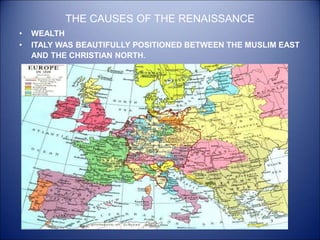
THE CAUSES OF THE RENAISSANCE
• WEALTH
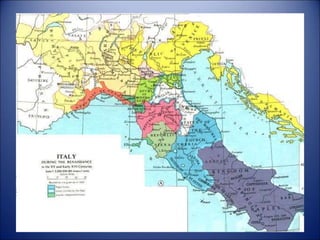
• ITALY WAS BEAUTIFULLY POSITIONED BETWEEN THE MUSLIM EAST
AND THE CHRISTIAN NORTH.
• ITALY USED TO TRADE THE SPICES PRODUCED IN THE EAST TO
THE CHRISTIAN NORTH AS CHRISTIANS DID NOT WANT TO
DEAL WITH MUSLIMS
• SPICES…SUCH AS PEPPER, GINGER, CURRY, CINNAMON,
ETC…WAS OUNCE FOR OUNCE MORE VALUABLE THAN GOLD
• DURING THE MIDDLE AGES IN EUROPE, A POUND OF GINGER
WAS WORTH THE PRICE OF A SHEEP; A POUND OF MACE
• WOULD BUY THREE SHEEP OR HALF A COW; CLOVES COST THE
EQUIVALENT OF ABOUT $50 A POUND
•PEPPER, ALWAYS THE GREATEST PRIZE, WAS
COUNTED OUT PEPPERCORN BY PEPPERCORN.
•THE GUARDS ON LONDON DOCKS EVEN DOWN TO
ELIZABETHAN TIMES, HAD TO HAVE THEIR
POCKETS SEWN UP TO MAKE SURE THEY DIDN'T
STEAL ANY SPICES.
•IN THE 11TH CENTURY, MANY TOWNS KEPT THEIR
ACCOUNTS IN PEPPER; TAXES AND RENTS WERE
ASSESSED AND PAID IN THIS SPICE AND A SACK OF
PEPPER WAS WORTH A MAN'S LIFE
Why Renaissance Architecture?
• Human history was realized, not as a divinely
ordained continuum, but as successive
overlapping periods
• Architectural styles were reaching a stage
where they could no longer yield anything new.
9
Renaissance Architecture
• Architects and Patrons desired a new
architecture, not based on the traditions of
the church but expressing perceived
mathematical clarity and the rationality of
the divine order of the universe
• Harmonic ratios could be the same as physical ratios =
a rule on which to base proportions; buildings could
_ reflect the fundamental laws of nature
10
Renaissance Architects
. . . endeavored to create new rational forms
based on what they understood of the
Classical architecture of ancient Rome through
the discovery of “De Architectura” , the one
surviving treatise by the Roman architect
Vitruvius.
New confidence in their intellectual capacity
11
Humanist Architecture
• An architecture rooted in the human intellect
to provide human needs
• The artist (architect) as a humanist scholar
and philosopher in paint and stone, not simply
an artisan or a craftsman
• A “rebirth” of Classical solidity of form and
human expression. The Italian rinascinta
translates into French as renaissance
12
INTRODUCTION
• EARLY RENAISSANCE 15TH CENTURY
• HIGH RENAISSANCE AND 16TH CENTURY
PROTO BAROQUE
• BAROQUE AND ROCOCCO 17TH AND
EARLY 18TH
CENTURY
Filippo Brunelleschi
The Architect of Florence
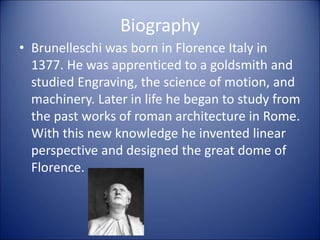
Biography
• Brunelleschi was born in Florence Italy in
1377. He was apprenticed to a goldsmith and
studied Engraving, the science of motion, and
machinery. Later in life he began to study from
the past works of roman architecture in Rome.
With this new knowledge he invented linear
perspective and designed the great dome of
Florence.
Works
• The Dome of Santa Maria Del
Fiore Cathedral: His greatest
work was the designing and
building of the dome. Using
Unorthodox methods for
construction and design, he
created the largest
freestanding dome in the
world at the time. Funded by
the Medici and inspired by the
romans, the dome was built
over 16 years and is the most
iconic part of Florence.
• Linear perspective: In the early
stages of his architectural
learning, he began to
rediscover the principal of
linear perspective. Studying
old works from the Romans he
noticed the lack of it in
medieval times. It enabled the
3D perspective of renaissance
artists and architects to bring
flat drawings to life.
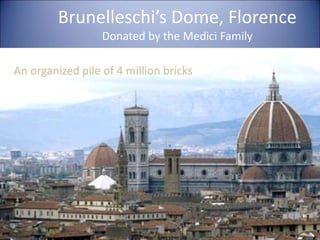
Brunelleschi’s Dome, Florence
Donated by the Medici Family
An organized pile of 4 million bricks
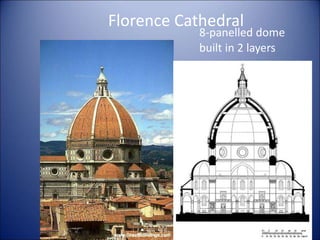
Florence Cathedral
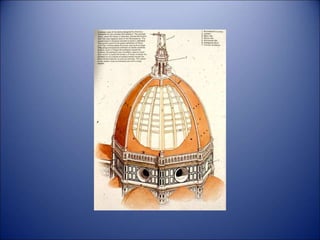
8-panelled dome
built in 2 layers
18
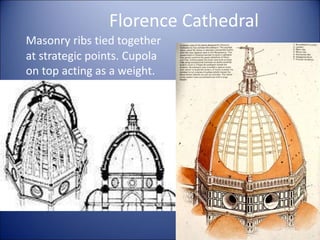
Florence Cathedral
Masonry ribs tied together
at strategic points. Cupola
on top acting as a weight.
19
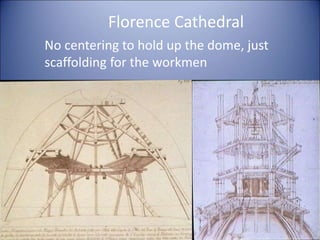
Florence Cathedral
No centering to hold up the dome, just
scaffolding for the workmen
20
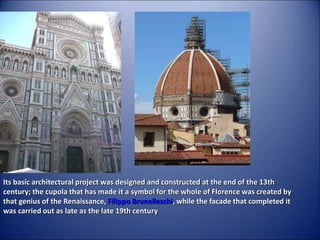
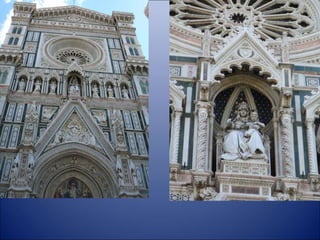
Its basic architectural project was designed and constructed at the end of the 13th
century; the cupola that has made it a symbol for the whole of Florence was created by
that genius of the Renaissance, Filippo Brunelleschi, while the facade that completed it
was carried out as late as the late 19th century
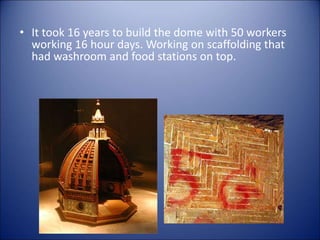
• It took 16 years to build the dome with 50 workers
working 16 hour days. Working on scaffolding that
had washroom and food stations on top.
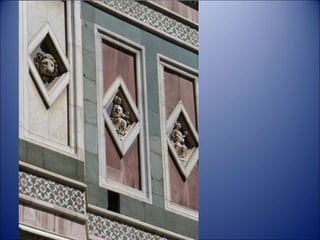
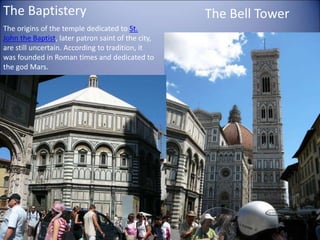
The Bell Tower
The Baptistery
The origins of the temple dedicated to St.
John the Baptist, later patron saint of the city,
are still uncertain. According to tradition, it
was founded in Roman times and dedicated to
the god Mars.
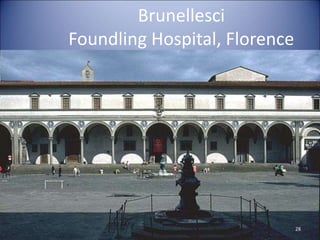
Brunellesci
Foundling Hospital, Florence
28
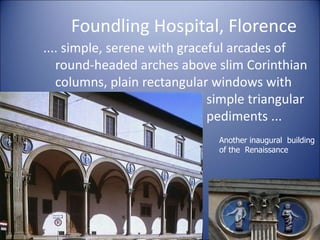
Foundling Hospital, Florence
.... simple, serene with graceful arcades of
round-headed arches above slim Corinthian
columns, plain rectangular windows with
simple triangular
pediments ...
29
Another inaugural building
of the Renaissance
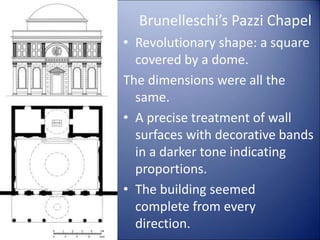
Brunelleschi’s Pazzi Chapel
• Revolutionary shape: a square
covered by a dome.
The dimensions were all the
same.
• A precise treatment of wall
surfaces with decorative bands
in a darker tone indicating
proportions.
• The building seemed
complete from every
direction.
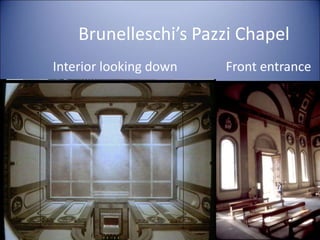
Brunelleschi’s Pazzi Chapel
Interior looking down Front entrance
31
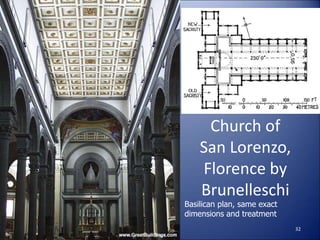
Church of
San Lorenzo,
Florence by
Brunelleschi
32
Basilican plan, same exact
dimensions and treatment
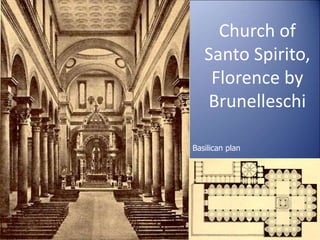
Church of
Santo Spirito,
Florence by
Brunelleschi
33
Basilican plan
Leon Battista Alberti
• Book: “On Architecture” 1485
• Basic shapes – square, cube, circle, sphere
• Work out ideal proportions of these figures by
doubling and halving
• Beauty is the rational integration of the
proportions of all the parts where nothing
could be added or taken away without
destroying the harmony of the whole.
34
Leon Battista Alberti
• Book: “On Architecture” 1485
• Basic shapes – square, cube, circle, sphere
• Work out ideal proportions of these figures by
doubling and halving
• Beauty is the rational integration of the
proportions of all the parts where nothing
could be added or taken away without
destroying the harmony of the whole.
35
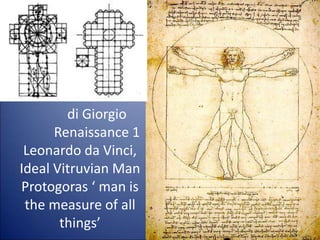
di Giorgio
Renaissance 1
Leonardo da Vinci,
Ideal Vitruvian Man
Protogoras ‘ man is
the measure of all
things’ 36
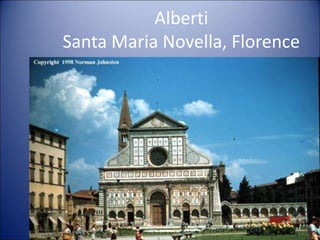
Alberti
Santa Maria Novella, Florence
37
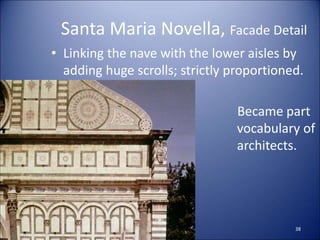
Santa Maria Novella, Facade Detail
• Linking the nave with the lower aisles by
adding huge scrolls; strictly proportioned.
• Became part
of the vocabulary of
later architects.
38
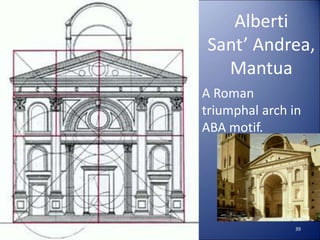
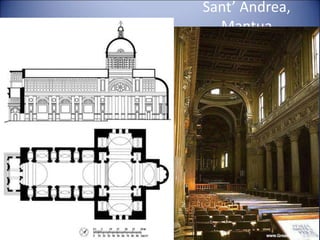
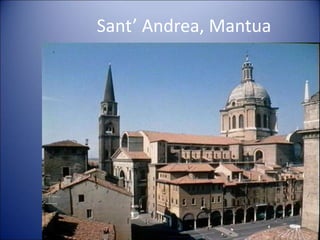
Alberti
Sant’ Andrea,
Mantua
• A Roman
triumphal arch in
ABA motif.
39
Sant’ Andrea,
Mantua
Sant’ Andrea, Mantua
41
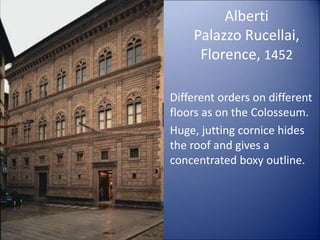
Alberti
Palazzo Rucellai,
Florence, 1452
• Different orders on different
floors as on the Colosseum.
• Huge, jutting cornice hides
the roof and gives a
concentrated boxy outline.
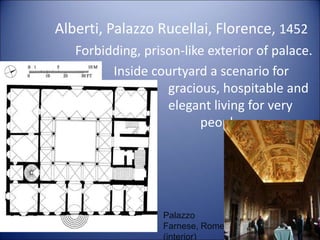
Alberti, Palazzo Rucellai, Florence, 1452
Forbidding, prison-like exterior of palace.
Inside courtyard a scenario for
gracious, hospitable and
elegant living for very
rich people
Palazzo
Farnese, Rome
(interior)
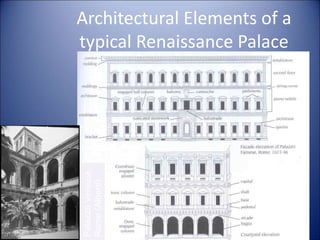
Architectural Elements of a
typical Renaissance Palace
44
Palazzo
Venezia,
Rome
(Alberti)
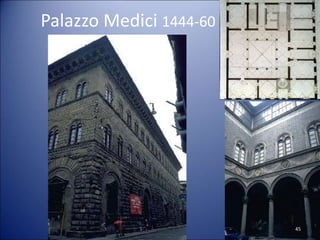
Palazzo Medici 1444-60
45
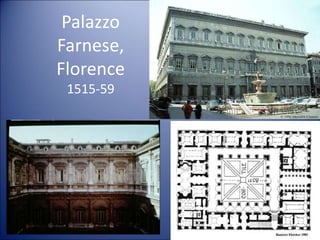
Palazzo
Farnese,
Florence
1515-59
46
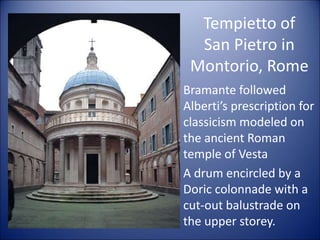
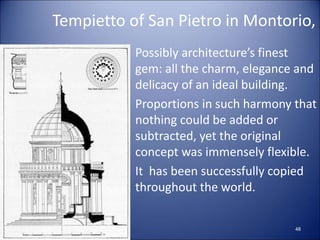
Tempietto of
San Pietro in
Montorio, Rome
• Bramante followed
Alberti’s prescription for
classicism modeled on
the ancient Roman
temple of Vesta
• A drum encircled by a
Doric colonnade with a
cut-out balustrade on
the upper storey.
Tempietto of San Pietro in Montorio,
• Possibly architecture’s finest
gem: all the charm, elegance and
delicacy of an ideal building.
• Proportions in such harmony that
nothing could be added or
subtracted, yet the original
concept was immensely flexible.
• It has been successfully copied
throughout the world.
48
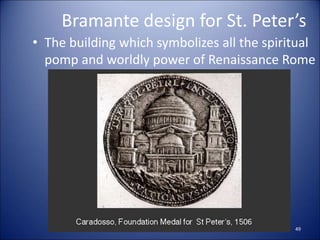
Bramante design for St. Peter’s
• The building which symbolizes all the spiritual
pomp and worldly power of Renaissance Rome
49
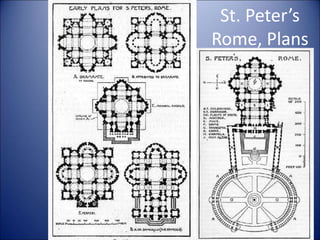
St. Peter’s
Rome, Plans
50
Bramante
Sangallo
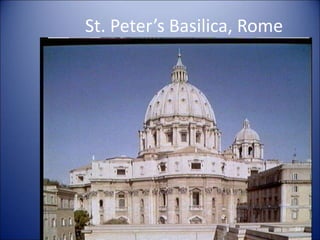
St. Peter’s Basilica, Rome
51
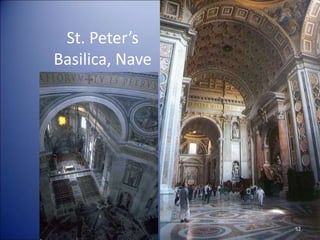
St. Peter’s
Basilica, Nave
52
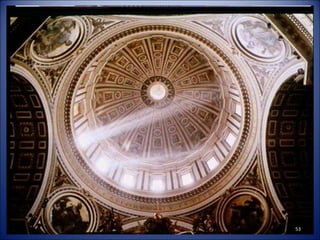
St. Peter’s Basilica, Rome
53
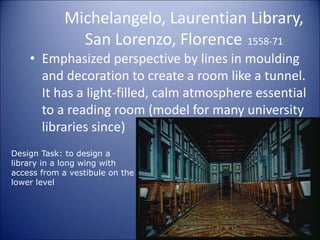
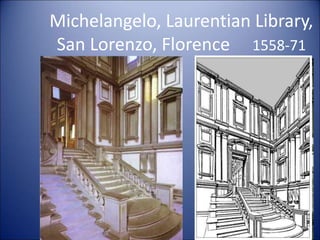
Michelangelo, Laurentian Library,
San Lorenzo, Florence 1558-71
• Emphasized perspective by lines in moulding
and decoration to create a room like a tunnel.
It has a light-filled, calm atmosphere essential
to a reading room (model for many university
libraries since)
Design Task: to design a
library in a long wing with
access from a vestibule on the
lower level
55
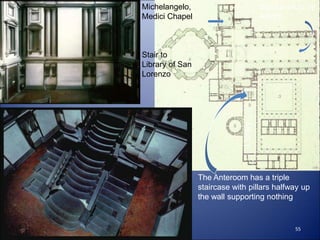
The Anteroom has a triple
staircase with pillars halfway up
the wall supporting nothing
San Lorenzo by
Alberti
Library
Michelangelo,
Medici Chapel
Stair to
Library of San
Lorenzo
Michelangelo, Laurentian Library,
San Lorenzo, Florence 1558-71
56
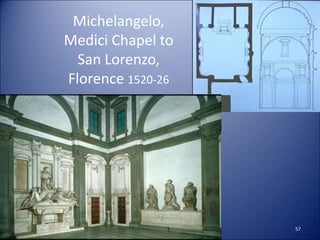
Michelangelo,
Medici Chapel to
San Lorenzo,
Florence 1520-26
57
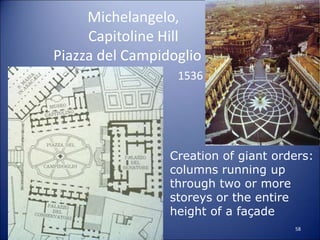
Michelangelo,
Capitoline Hill
Piazza del Campidoglio
1536
• Creation of giant orders:
columns running up
through two or more
storeys or the entire
height of a façade
58
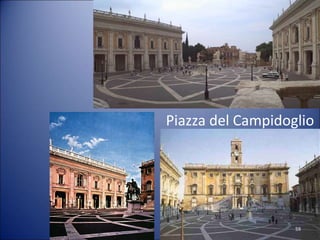
Piazza del Campidoglio
59
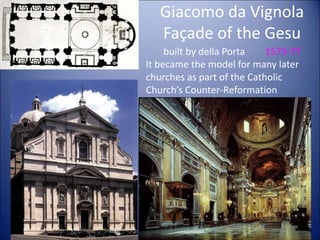
Giacomo da Vignola
Façade of the Gesu
built by della Porta 1573-77
• It became the model for many later
churches as part of the Catholic
Church’s Counter-Reformation
60
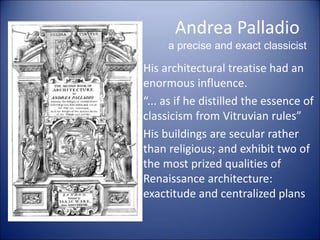
Andrea Palladio
a precise and exact classicist
• His architectural treatise had an
enormous influence.
• “... as if he distilled the essence of
classicism from Vitruvian rules”
• His buildings are secular rather
than religious; and exhibit two of
the most prized qualities of
Renaissance architecture:
exactitude and centralized plans
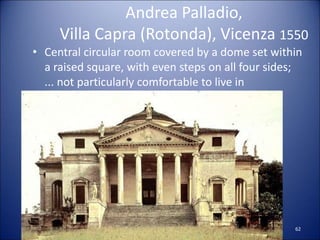
Andrea Palladio,
Villa Capra (Rotonda), Vicenza 1550
• Central circular room covered by a dome set within
a raised square, with even steps on all four sides;
... not particularly comfortable to live in
62
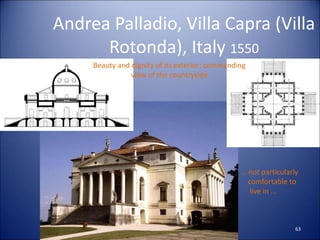
Andrea Palladio, Villa Capra (Villa
Rotonda), Italy 1550
63
Beauty and dignity of its exterior; commanding
view of the countryside
... not particularly
comfortable to
live in ...
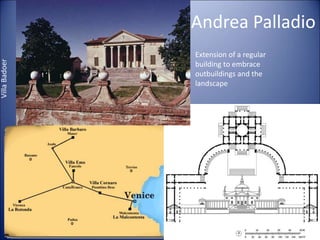
Andrea Palladio
64
Extension of a regular
building to embrace
outbuildings and the
landscape
Villa
Badoer
Palladio, Basilica Vicenza
[Palazzo della Ragione]
• Palladian motif: a central arched window or opening
flanked by a flat-topped window on each side
65
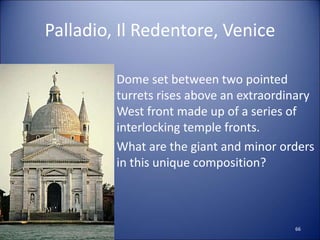
Palladio, Il Redentore, Venice
• Dome set between two pointed
turrets rises above an extraordinary
West front made up of a series of
interlocking temple fronts.
• What are the giant and minor orders
in this unique composition?
66
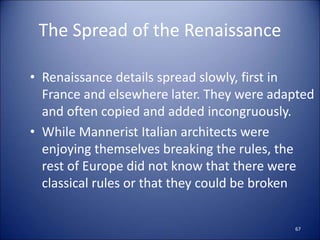
The Spread of the Renaissance
• Renaissance details spread slowly, first in
France and elsewhere later. They were adapted
and often copied and added incongruously.
• While Mannerist Italian architects were
enjoying themselves breaking the rules, the
rest of Europe did not know that there were
classical rules or that they could be broken
67
An Architecture of Humanist Ideals
• New architecture to be rationally comprehensible
• Formed of planes and spaces organized to show
clear, numerical proportions
• Edges and intervals delineated by crisp elements
of ancient architectural orders [classical]
• A celebration of human intellectual powers and
inviting pleasurable human response
68

Early Renaissance Architecture.ppt

  • 1.
  • 2.
    INTRODUCTION • REBIRTH/ REVIVAL •DISSATISFACTION WITH MEDIEVAL LIFE LED TO NEW DISCOVERIES • MAJOR REMAINS OF ARCHITECTURAL MONUMENTS WERE IN ITALY SO THE BIRTH OF RENAISSANCE TOOK PLACE IN ITALY • ARTISTS AND ARCHITECTS GOT RECOGNITION AND BECAME IMPORTANT SYMBOLS OF SOCIETY • ROME WAS THE MAIN HUB OF ARCHITECTURAL ACTIVITY
  • 3.
    INTRODUCTION • The Renaissancecame to be after People started to think of different things in life. People took the ideas of the Romans and Greeks and followed their examples. The arts and sciences flourished, never before had so many people in Christendom studied and worked for glory and personal achievement. The Renaissance was essentially the birth of the modern age, where the mindset of the people become increasingly based on the world that they tread on.
  • 4.
    RENAISSANCE? • RENAISSANCE ISA FRENCH WORD…IT MEANS “REBIRTH” • IT WAS NOT TILL 1830 THAT THE TERM WAS USED…BY A SWISS HISTORIAN JACOB BURCKHARDT • THE RENAISSANCE ONLY AFFECTED THE WEALTHY ELITE. A SMALL ELITE. HE MAJORITY OF EUROPEANS WERE NOT TOUCHED BY IT. • PEASANTS CONTINUED TO SUFFER. • MOST CHANGES WERE IN THE ARTS AND IN LEARNING • IT WAS THE PRINTING PRESS, GUTENBERG’S MOVEABLE TYPE. THAT IS RESPONSIBLE FOR THE SPREAD OF RENAISSANCE IDEAS.
  • 6.
    THE CAUSES OFTHE RENAISSANCE • WEALTH • ITALY WAS BEAUTIFULLY POSITIONED BETWEEN THE MUSLIM EAST AND THE CHRISTIAN NORTH.
  • 7.
    • ITALY USEDTO TRADE THE SPICES PRODUCED IN THE EAST TO THE CHRISTIAN NORTH AS CHRISTIANS DID NOT WANT TO DEAL WITH MUSLIMS • SPICES…SUCH AS PEPPER, GINGER, CURRY, CINNAMON, ETC…WAS OUNCE FOR OUNCE MORE VALUABLE THAN GOLD • DURING THE MIDDLE AGES IN EUROPE, A POUND OF GINGER WAS WORTH THE PRICE OF A SHEEP; A POUND OF MACE • WOULD BUY THREE SHEEP OR HALF A COW; CLOVES COST THE EQUIVALENT OF ABOUT $50 A POUND
  • 8.
    •PEPPER, ALWAYS THEGREATEST PRIZE, WAS COUNTED OUT PEPPERCORN BY PEPPERCORN. •THE GUARDS ON LONDON DOCKS EVEN DOWN TO ELIZABETHAN TIMES, HAD TO HAVE THEIR POCKETS SEWN UP TO MAKE SURE THEY DIDN'T STEAL ANY SPICES. •IN THE 11TH CENTURY, MANY TOWNS KEPT THEIR ACCOUNTS IN PEPPER; TAXES AND RENTS WERE ASSESSED AND PAID IN THIS SPICE AND A SACK OF PEPPER WAS WORTH A MAN'S LIFE
  • 9.
    Why Renaissance Architecture? •Human history was realized, not as a divinely ordained continuum, but as successive overlapping periods • Architectural styles were reaching a stage where they could no longer yield anything new. 9
  • 10.
    Renaissance Architecture • Architectsand Patrons desired a new architecture, not based on the traditions of the church but expressing perceived mathematical clarity and the rationality of the divine order of the universe • Harmonic ratios could be the same as physical ratios = a rule on which to base proportions; buildings could _ reflect the fundamental laws of nature 10
  • 11.
    Renaissance Architects . .. endeavored to create new rational forms based on what they understood of the Classical architecture of ancient Rome through the discovery of “De Architectura” , the one surviving treatise by the Roman architect Vitruvius. New confidence in their intellectual capacity 11
  • 12.
    Humanist Architecture • Anarchitecture rooted in the human intellect to provide human needs • The artist (architect) as a humanist scholar and philosopher in paint and stone, not simply an artisan or a craftsman • A “rebirth” of Classical solidity of form and human expression. The Italian rinascinta translates into French as renaissance 12
  • 13.
    INTRODUCTION • EARLY RENAISSANCE15TH CENTURY • HIGH RENAISSANCE AND 16TH CENTURY PROTO BAROQUE • BAROQUE AND ROCOCCO 17TH AND EARLY 18TH CENTURY
  • 14.
  • 15.
    Biography • Brunelleschi wasborn in Florence Italy in 1377. He was apprenticed to a goldsmith and studied Engraving, the science of motion, and machinery. Later in life he began to study from the past works of roman architecture in Rome. With this new knowledge he invented linear perspective and designed the great dome of Florence.
  • 16.
    Works • The Domeof Santa Maria Del Fiore Cathedral: His greatest work was the designing and building of the dome. Using Unorthodox methods for construction and design, he created the largest freestanding dome in the world at the time. Funded by the Medici and inspired by the romans, the dome was built over 16 years and is the most iconic part of Florence. • Linear perspective: In the early stages of his architectural learning, he began to rediscover the principal of linear perspective. Studying old works from the Romans he noticed the lack of it in medieval times. It enabled the 3D perspective of renaissance artists and architects to bring flat drawings to life.
  • 17.
    Brunelleschi’s Dome, Florence Donatedby the Medici Family An organized pile of 4 million bricks
  • 18.
  • 19.
    Florence Cathedral Masonry ribstied together at strategic points. Cupola on top acting as a weight. 19
  • 20.
    Florence Cathedral No centeringto hold up the dome, just scaffolding for the workmen 20
  • 21.
    Its basic architecturalproject was designed and constructed at the end of the 13th century; the cupola that has made it a symbol for the whole of Florence was created by that genius of the Renaissance, Filippo Brunelleschi, while the facade that completed it was carried out as late as the late 19th century
  • 22.
    • It took16 years to build the dome with 50 workers working 16 hour days. Working on scaffolding that had washroom and food stations on top.
  • 27.
    The Bell Tower TheBaptistery The origins of the temple dedicated to St. John the Baptist, later patron saint of the city, are still uncertain. According to tradition, it was founded in Roman times and dedicated to the god Mars.
  • 28.
  • 29.
    Foundling Hospital, Florence ....simple, serene with graceful arcades of round-headed arches above slim Corinthian columns, plain rectangular windows with simple triangular pediments ... 29 Another inaugural building of the Renaissance
  • 30.
    Brunelleschi’s Pazzi Chapel •Revolutionary shape: a square covered by a dome. The dimensions were all the same. • A precise treatment of wall surfaces with decorative bands in a darker tone indicating proportions. • The building seemed complete from every direction.
  • 31.
    Brunelleschi’s Pazzi Chapel Interiorlooking down Front entrance 31
  • 32.
    Church of San Lorenzo, Florenceby Brunelleschi 32 Basilican plan, same exact dimensions and treatment
  • 33.
    Church of Santo Spirito, Florenceby Brunelleschi 33 Basilican plan
  • 34.
    Leon Battista Alberti •Book: “On Architecture” 1485 • Basic shapes – square, cube, circle, sphere • Work out ideal proportions of these figures by doubling and halving • Beauty is the rational integration of the proportions of all the parts where nothing could be added or taken away without destroying the harmony of the whole. 34
  • 35.
    Leon Battista Alberti •Book: “On Architecture” 1485 • Basic shapes – square, cube, circle, sphere • Work out ideal proportions of these figures by doubling and halving • Beauty is the rational integration of the proportions of all the parts where nothing could be added or taken away without destroying the harmony of the whole. 35
  • 36.
    di Giorgio Renaissance 1 Leonardoda Vinci, Ideal Vitruvian Man Protogoras ‘ man is the measure of all things’ 36
  • 37.
  • 38.
    Santa Maria Novella,Facade Detail • Linking the nave with the lower aisles by adding huge scrolls; strictly proportioned. • Became part of the vocabulary of later architects. 38
  • 39.
    Alberti Sant’ Andrea, Mantua • ARoman triumphal arch in ABA motif. 39
  • 40.
  • 41.
  • 42.
    Alberti Palazzo Rucellai, Florence, 1452 •Different orders on different floors as on the Colosseum. • Huge, jutting cornice hides the roof and gives a concentrated boxy outline.
  • 43.
    Alberti, Palazzo Rucellai,Florence, 1452 Forbidding, prison-like exterior of palace. Inside courtyard a scenario for gracious, hospitable and elegant living for very rich people Palazzo Farnese, Rome (interior)
  • 44.
    Architectural Elements ofa typical Renaissance Palace 44 Palazzo Venezia, Rome (Alberti)
  • 45.
  • 46.
  • 47.
    Tempietto of San Pietroin Montorio, Rome • Bramante followed Alberti’s prescription for classicism modeled on the ancient Roman temple of Vesta • A drum encircled by a Doric colonnade with a cut-out balustrade on the upper storey.
  • 48.
    Tempietto of SanPietro in Montorio, • Possibly architecture’s finest gem: all the charm, elegance and delicacy of an ideal building. • Proportions in such harmony that nothing could be added or subtracted, yet the original concept was immensely flexible. • It has been successfully copied throughout the world. 48
  • 49.
    Bramante design forSt. Peter’s • The building which symbolizes all the spiritual pomp and worldly power of Renaissance Rome 49
  • 50.
  • 51.
  • 52.
  • 53.
  • 54.
    Michelangelo, Laurentian Library, SanLorenzo, Florence 1558-71 • Emphasized perspective by lines in moulding and decoration to create a room like a tunnel. It has a light-filled, calm atmosphere essential to a reading room (model for many university libraries since) Design Task: to design a library in a long wing with access from a vestibule on the lower level
  • 55.
    55 The Anteroom hasa triple staircase with pillars halfway up the wall supporting nothing San Lorenzo by Alberti Library Michelangelo, Medici Chapel Stair to Library of San Lorenzo
  • 56.
    Michelangelo, Laurentian Library, SanLorenzo, Florence 1558-71 56
  • 57.
    Michelangelo, Medici Chapel to SanLorenzo, Florence 1520-26 57
  • 58.
    Michelangelo, Capitoline Hill Piazza delCampidoglio 1536 • Creation of giant orders: columns running up through two or more storeys or the entire height of a façade 58
  • 59.
  • 60.
    Giacomo da Vignola Façadeof the Gesu built by della Porta 1573-77 • It became the model for many later churches as part of the Catholic Church’s Counter-Reformation 60
  • 61.
    Andrea Palladio a preciseand exact classicist • His architectural treatise had an enormous influence. • “... as if he distilled the essence of classicism from Vitruvian rules” • His buildings are secular rather than religious; and exhibit two of the most prized qualities of Renaissance architecture: exactitude and centralized plans
  • 62.
    Andrea Palladio, Villa Capra(Rotonda), Vicenza 1550 • Central circular room covered by a dome set within a raised square, with even steps on all four sides; ... not particularly comfortable to live in 62
  • 63.
    Andrea Palladio, VillaCapra (Villa Rotonda), Italy 1550 63 Beauty and dignity of its exterior; commanding view of the countryside ... not particularly comfortable to live in ...
  • 64.
    Andrea Palladio 64 Extension ofa regular building to embrace outbuildings and the landscape Villa Badoer
  • 65.
    Palladio, Basilica Vicenza [Palazzodella Ragione] • Palladian motif: a central arched window or opening flanked by a flat-topped window on each side 65
  • 66.
    Palladio, Il Redentore,Venice • Dome set between two pointed turrets rises above an extraordinary West front made up of a series of interlocking temple fronts. • What are the giant and minor orders in this unique composition? 66
  • 67.
    The Spread ofthe Renaissance • Renaissance details spread slowly, first in France and elsewhere later. They were adapted and often copied and added incongruously. • While Mannerist Italian architects were enjoying themselves breaking the rules, the rest of Europe did not know that there were classical rules or that they could be broken 67
  • 68.
    An Architecture ofHumanist Ideals • New architecture to be rationally comprehensible • Formed of planes and spaces organized to show clear, numerical proportions • Edges and intervals delineated by crisp elements of ancient architectural orders [classical] • A celebration of human intellectual powers and inviting pleasurable human response 68