A r c h i t e c t u r e O f T h e R e n a i s s a n c e….
Lecture by Ar. Ketki S Darp
Renaissance Architecture is the architecture of
the period between the early 15th and early
17th centuries in different regions of Europe,
demonstrating a conscious revival and
development of certain elements of ancient
Greek and Roman thought and material culture.
Began in Italy in the city of Florence.
It substituted itself to Gothic architecture to
return to the Antique architecture at the apogee
of all arts.
The Renaissance artists were versatile, they
searched of the absolute knowledge
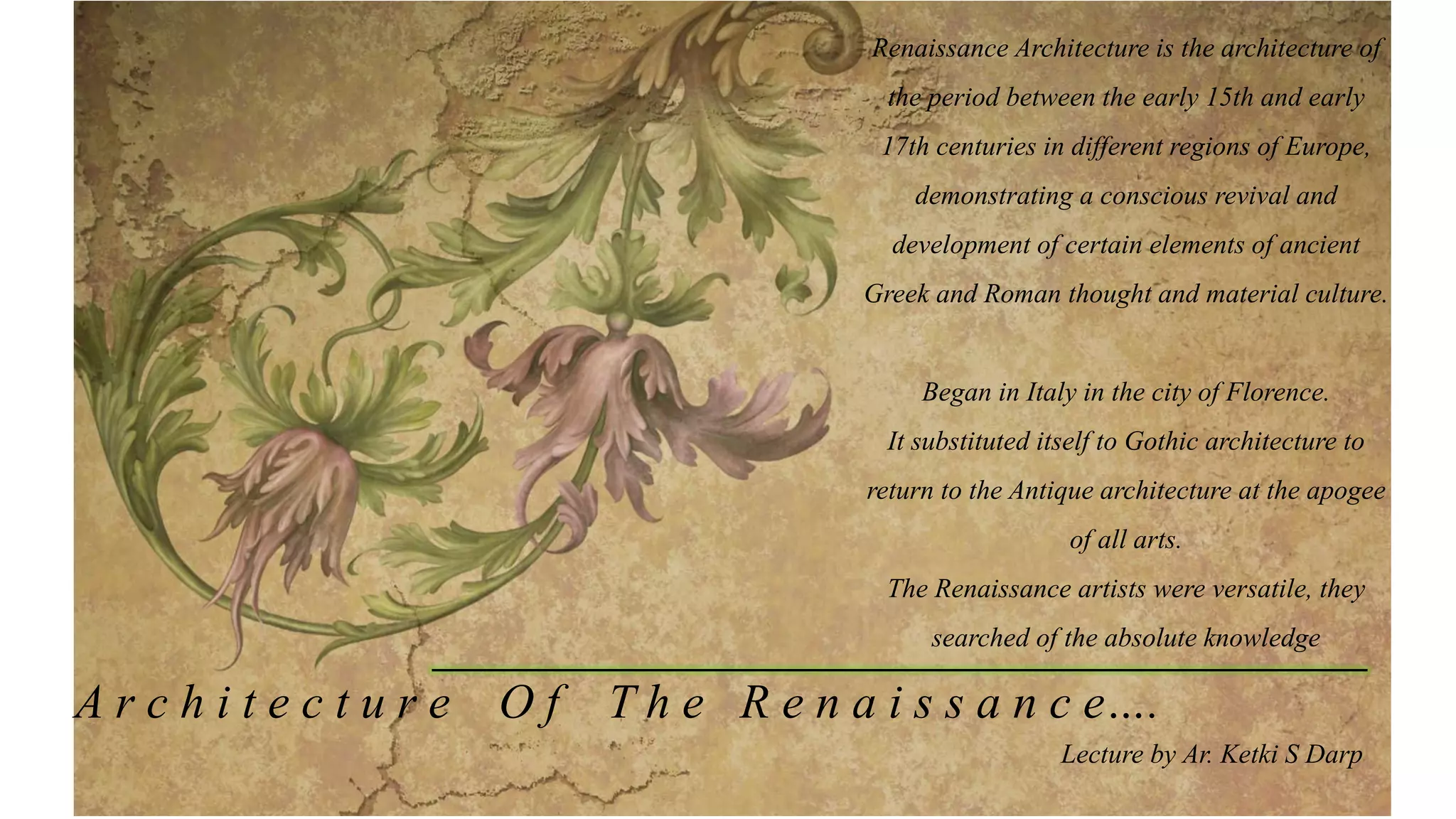
The Romanesque Baptistry at Florence Scuola Grande di San Marco, Venice. Dome of St. Peter's Basilica
Architecture intellectualized and became thus a science in itself and the architect is a synthesis person that must not only master
drawings, but also perspective, geometry and specific language of architecture.
Historians often divide the Renaissance in Italy into three phases.
Renaissance (ca. 1400–1500); also known as the Quattrocento and sometimes Early Renaissance
High Renaissance (ca.1500–1525)
Mannerism (ca. 1520–1600)
In the Quattrocento, concepts of architectural order were explored and rules were formulated.
The study of classical antiquity led in particular to the adoption of Classical detail and
Ornamentation.
FILLIPO BRUNELLESCHI
One of the foremost architects & engineers of Italian Renaissance.
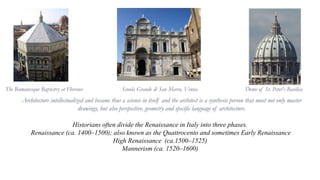
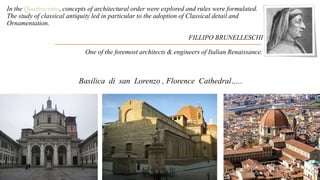
Basilica di san Lorenzo , Florence Cathedral…..
LEON BATTISTA ALBERTI…
An Italian humanist author , artist , architect , poet , priest , linguist , philosopher &
cryptographer ; epitomized the renaissance man.
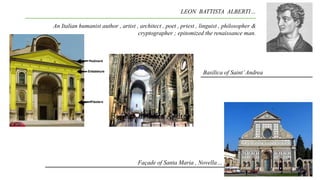
Basilica of Saint’Andrea
Façade of Santa Maria , Novella…
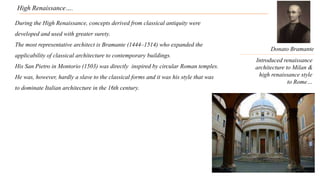
During the High Renaissance, concepts derived from classical antiquity were
developed and used with greater surety.
The most representative architect is Bramante (1444–1514) who expanded the
applicability of classical architecture to contemporary buildings.
His San Pietro in Montorio (1503) was directly inspired by circular Roman temples.
He was, however, hardly a slave to the classical forms and it was his style that was
to dominate Italian architecture in the 16th century.
High Renaissance….
Donato Bramante
Introduced renaissance
architecture to Milan &
high renaissance style
to Rome…
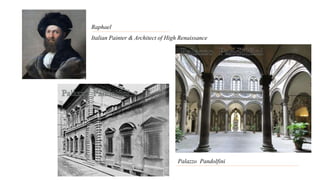
Raphael
Italian Painter & Architect of High Renaissance
Palazzo Pandolfini
Mannerism….
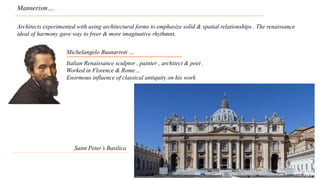
Architects experimented with using architectural forms to emphasize solid & spatial relationships . The renaissance
ideal of harmony gave way to freer & more imaginative rhythmns.
Michelangelo Buanarroti …
Italian Renaissance sculptor , painter , architect & poet .
Worked in Florence & Rome…
Enormous influence of classical antiquity on his work
Saint Peter’s Basilica
Renaissance Architecture :
Components –
• Symmetry
• Proportion
• Geometry
• Regularity of Parts as demonstrated in classical Antiquity Architecture.
• Orderly arrangements of Columns , pilasters , lintels
• Semicircular arches , niches , hemispherical domes.
Plan –
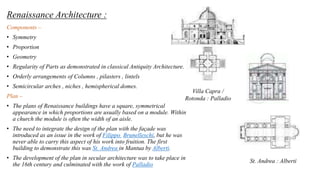
• The plans of Renaissance buildings have a square, symmetrical
appearance in which proportions are usually based on a module. Within
a church the module is often the width of an aisle.
• The need to integrate the design of the plan with the façade was
introduced as an issue in the work of Filippo Brunelleschi, but he was
never able to carry this aspect of his work into fruition. The first
building to demonstrate this was St. Andrea in Mantua by Alberti.
• The development of the plan in secular architecture was to take place in
the 16th century and culminated with the work of Palladio
St. Andrea : Alberti
Villa Capra /
Rotonda : Palladio
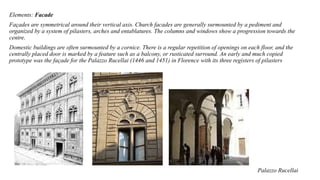
Elements: Facade
Façades are symmetrical around their vertical axis. Church facades are generally surmounted by a pediment and
organized by a system of pilasters, arches and entablatures. The columns and windows show a progression towards the
centre.
Domestic buildings are often surmounted by a cornice. There is a regular repetition of openings on each floor, and the
centrally placed door is marked by a feature such as a balcony, or rusticated surround. An early and much copied
prototype was the façade for the Palazzo Rucellai (1446 and 1451) in Florence with its three registers of pilasters
Palazzo Rucellai
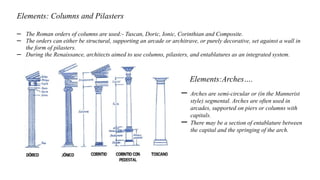
Elements: Columns and Pilasters
– The Roman orders of columns are used:- Tuscan, Doric, Ionic, Corinthian and Composite.
– The orders can either be structural, supporting an arcade or architrave, or purely decorative, set against a wall in
the form of pilasters.
– During the Renaissance, architects aimed to use columns, pilasters, and entablatures as an integrated system.
Elements:Arches….
– Arches are semi-circular or (in the Mannerist
style) segmental. Arches are often used in
arcades, supported on piers or columns with
capitals.
– There may be a section of entablature between
the capital and the springing of the arch.
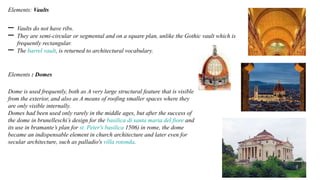
Elements: Vaults
– Vaults do not have ribs.
– They are semi-circular or segmental and on a square plan, unlike the Gothic vault which is
frequently rectangular.
– The barrel vault, is returned to architectural vocabulary.
Elements : Domes
Dome is used frequently, both as A very large structural feature that is visible
from the exterior, and also as A means of roofing smaller spaces where they
are only visible internally.
Domes had been used only rarely in the middle ages, but after the success of
the dome in brunelleschi’s design for the basilica di santa maria del fiore and
its use in bramante’s plan for st. Peter's basilica 1506) in rome, the dome
became an indispensable element in church architecture and later even for
secular architecture, such as palladio's villa rotonda.
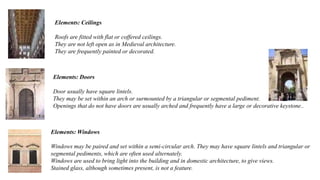
Elements: Ceilings
Roofs are fitted with flat or coffered ceilings.
They are not left open as in Medieval architecture.
They are frequently painted or decorated.
Elements: Doors
Door usually have square lintels.
They may be set within an arch or surmounted by a triangular or segmental pediment.
Openings that do not have doors are usually arched and frequently have a large or decorative keystone..
Elements: Windows
Windows may be paired and set within a semi-circular arch. They may have square lintels and triangular or
segmental pediments, which are often used alternately.
Windows are used to bring light into the building and in domestic architecture, to give views.
Stained glass, although sometimes present, is not a feature.
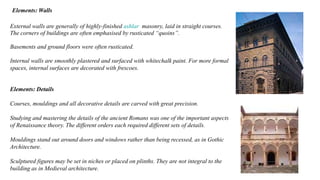
Elements: Walls
External walls are generally of highly-finished ashlar masonry, laid in straight courses.
The corners of buildings are often emphasised by rusticated “quoins”.
Basements and ground floors were often rusticated.
Internal walls are smoothly plastered and surfaced with whitechalk paint. For more formal
spaces, internal surfaces are decorated with frescoes.
Elements: Details
Courses, mouldings and all decorative details are carved with great precision.
Studying and mastering the details of the ancient Romans was one of the important aspects
of Renaissance theory. The different orders each required different sets of details.
Mouldings stand out around doors and windows rather than being recessed, as in Gothic
Architecture.
Sculptured figures may be set in niches or placed on plinths. They are not integral to the
building as in Medieval architecture.
Assignment…
Sketch of St. Peters Basilica ( Plan & Section )
Sketch of Villa Rotonda ( Plan & Section )
Sketch of St. Andrea ( Plan & Section )
Plan Of Florence Cathedral.
Sketches of all roman order columns.

Renaissance_Architecture.pptx

  • 1.
    A r ch i t e c t u r e O f T h e R e n a i s s a n c e…. Lecture by Ar. Ketki S Darp Renaissance Architecture is the architecture of the period between the early 15th and early 17th centuries in different regions of Europe, demonstrating a conscious revival and development of certain elements of ancient Greek and Roman thought and material culture. Began in Italy in the city of Florence. It substituted itself to Gothic architecture to return to the Antique architecture at the apogee of all arts. The Renaissance artists were versatile, they searched of the absolute knowledge
  • 2.
    The Romanesque Baptistryat Florence Scuola Grande di San Marco, Venice. Dome of St. Peter's Basilica Architecture intellectualized and became thus a science in itself and the architect is a synthesis person that must not only master drawings, but also perspective, geometry and specific language of architecture. Historians often divide the Renaissance in Italy into three phases. Renaissance (ca. 1400–1500); also known as the Quattrocento and sometimes Early Renaissance High Renaissance (ca.1500–1525) Mannerism (ca. 1520–1600)
  • 3.
    In the Quattrocento,concepts of architectural order were explored and rules were formulated. The study of classical antiquity led in particular to the adoption of Classical detail and Ornamentation. FILLIPO BRUNELLESCHI One of the foremost architects & engineers of Italian Renaissance. Basilica di san Lorenzo , Florence Cathedral…..
  • 4.
    LEON BATTISTA ALBERTI… AnItalian humanist author , artist , architect , poet , priest , linguist , philosopher & cryptographer ; epitomized the renaissance man. Basilica of Saint’Andrea Façade of Santa Maria , Novella…
  • 5.
    During the HighRenaissance, concepts derived from classical antiquity were developed and used with greater surety. The most representative architect is Bramante (1444–1514) who expanded the applicability of classical architecture to contemporary buildings. His San Pietro in Montorio (1503) was directly inspired by circular Roman temples. He was, however, hardly a slave to the classical forms and it was his style that was to dominate Italian architecture in the 16th century. High Renaissance…. Donato Bramante Introduced renaissance architecture to Milan & high renaissance style to Rome…
  • 6.
    Raphael Italian Painter &Architect of High Renaissance Palazzo Pandolfini
  • 7.
    Mannerism…. Architects experimented withusing architectural forms to emphasize solid & spatial relationships . The renaissance ideal of harmony gave way to freer & more imaginative rhythmns. Michelangelo Buanarroti … Italian Renaissance sculptor , painter , architect & poet . Worked in Florence & Rome… Enormous influence of classical antiquity on his work Saint Peter’s Basilica
  • 8.
    Renaissance Architecture : Components– • Symmetry • Proportion • Geometry • Regularity of Parts as demonstrated in classical Antiquity Architecture. • Orderly arrangements of Columns , pilasters , lintels • Semicircular arches , niches , hemispherical domes. Plan – • The plans of Renaissance buildings have a square, symmetrical appearance in which proportions are usually based on a module. Within a church the module is often the width of an aisle. • The need to integrate the design of the plan with the façade was introduced as an issue in the work of Filippo Brunelleschi, but he was never able to carry this aspect of his work into fruition. The first building to demonstrate this was St. Andrea in Mantua by Alberti. • The development of the plan in secular architecture was to take place in the 16th century and culminated with the work of Palladio St. Andrea : Alberti Villa Capra / Rotonda : Palladio
  • 9.
    Elements: Facade Façades aresymmetrical around their vertical axis. Church facades are generally surmounted by a pediment and organized by a system of pilasters, arches and entablatures. The columns and windows show a progression towards the centre. Domestic buildings are often surmounted by a cornice. There is a regular repetition of openings on each floor, and the centrally placed door is marked by a feature such as a balcony, or rusticated surround. An early and much copied prototype was the façade for the Palazzo Rucellai (1446 and 1451) in Florence with its three registers of pilasters Palazzo Rucellai
  • 10.
    Elements: Columns andPilasters – The Roman orders of columns are used:- Tuscan, Doric, Ionic, Corinthian and Composite. – The orders can either be structural, supporting an arcade or architrave, or purely decorative, set against a wall in the form of pilasters. – During the Renaissance, architects aimed to use columns, pilasters, and entablatures as an integrated system. Elements:Arches…. – Arches are semi-circular or (in the Mannerist style) segmental. Arches are often used in arcades, supported on piers or columns with capitals. – There may be a section of entablature between the capital and the springing of the arch.
  • 11.
    Elements: Vaults – Vaultsdo not have ribs. – They are semi-circular or segmental and on a square plan, unlike the Gothic vault which is frequently rectangular. – The barrel vault, is returned to architectural vocabulary. Elements : Domes Dome is used frequently, both as A very large structural feature that is visible from the exterior, and also as A means of roofing smaller spaces where they are only visible internally. Domes had been used only rarely in the middle ages, but after the success of the dome in brunelleschi’s design for the basilica di santa maria del fiore and its use in bramante’s plan for st. Peter's basilica 1506) in rome, the dome became an indispensable element in church architecture and later even for secular architecture, such as palladio's villa rotonda.
  • 12.
    Elements: Ceilings Roofs arefitted with flat or coffered ceilings. They are not left open as in Medieval architecture. They are frequently painted or decorated. Elements: Doors Door usually have square lintels. They may be set within an arch or surmounted by a triangular or segmental pediment. Openings that do not have doors are usually arched and frequently have a large or decorative keystone.. Elements: Windows Windows may be paired and set within a semi-circular arch. They may have square lintels and triangular or segmental pediments, which are often used alternately. Windows are used to bring light into the building and in domestic architecture, to give views. Stained glass, although sometimes present, is not a feature.
  • 13.
    Elements: Walls External wallsare generally of highly-finished ashlar masonry, laid in straight courses. The corners of buildings are often emphasised by rusticated “quoins”. Basements and ground floors were often rusticated. Internal walls are smoothly plastered and surfaced with whitechalk paint. For more formal spaces, internal surfaces are decorated with frescoes. Elements: Details Courses, mouldings and all decorative details are carved with great precision. Studying and mastering the details of the ancient Romans was one of the important aspects of Renaissance theory. The different orders each required different sets of details. Mouldings stand out around doors and windows rather than being recessed, as in Gothic Architecture. Sculptured figures may be set in niches or placed on plinths. They are not integral to the building as in Medieval architecture.
  • 14.
    Assignment… Sketch of St.Peters Basilica ( Plan & Section ) Sketch of Villa Rotonda ( Plan & Section ) Sketch of St. Andrea ( Plan & Section ) Plan Of Florence Cathedral. Sketches of all roman order columns.