Frank Llyod Wright
FALLIN
G
WATER
Frank Lloyd Wright
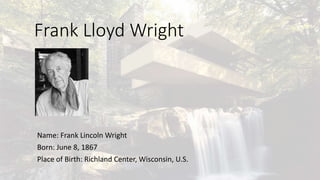
Name: Frank Lincoln Wright
Born: June 8, 1867
Place of Birth: Richland Center, Wisconsin, U.S.
Who is Frank Lloyd Wright?
• the most influential American architect of the 20th century.
• pioneer of the “organic” architecture movement
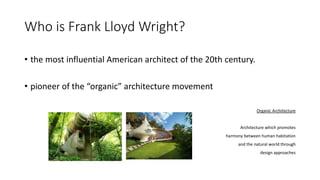
Organic Architecture
Architecture which promotes
harmony between human habitation
and the natural world through
design approaches
Early Life
• Came from a low income family
• Father left his mother after he graduated high school
• Started university at the age of 15
• Worked for the dean to support his tuition fees
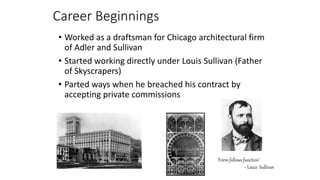
Career Beginnings
• Worked as a draftsman for Chicago architectural firm
of Adler and Sullivan
• Started working directly under Louis Sullivan (Father
of Skyscrapers)
• Parted ways when he breached his contract by
accepting private commissions
`Form follows function’
~ Louis Sullivan
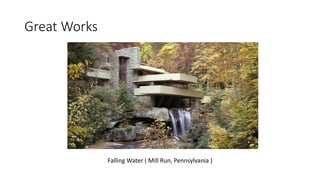
Great Works
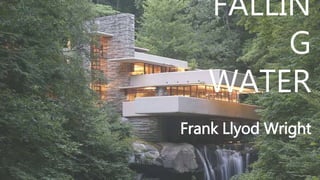
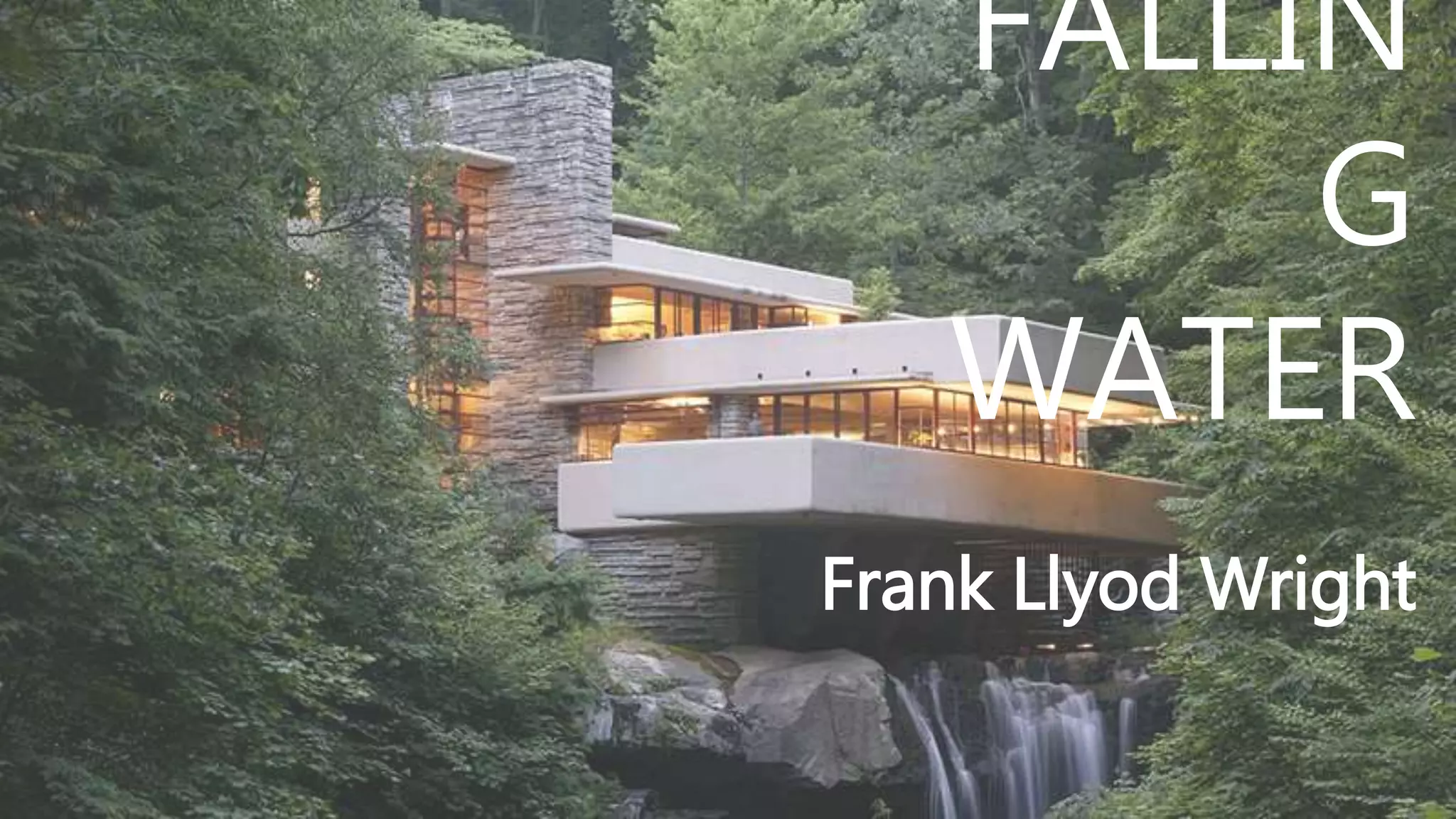
Falling Water ( Mill Run, Pennsylvania )
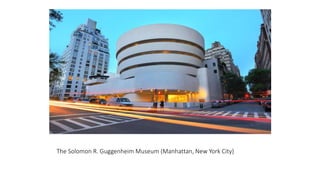
The Solomon R. Guggenheim Museum (Manhattan, New York City)
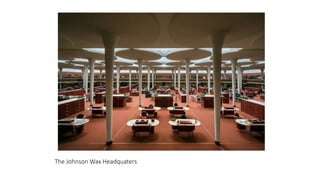
The Johnson Wax Headquaters
Masterpiece introduction
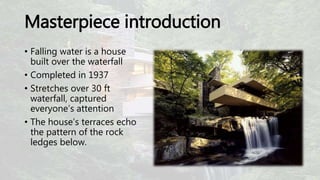
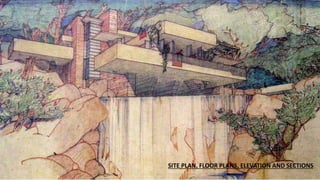
• Falling water is a house
built over the waterfall
• Completed in 1937
• Stretches over 30 ft
waterfall, captured
everyone’s attention
• The house’s terraces echo
the pattern of the rock
ledges below.
Design Concept
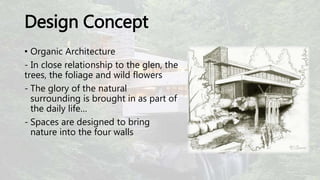
• Organic Architecture
- In close relationship to the glen, the
trees, the foliage and wild flowers
- The glory of the natural
surrounding is brought in as part of
the daily life…
- Spaces are designed to bring
nature into the four walls
Design Concept
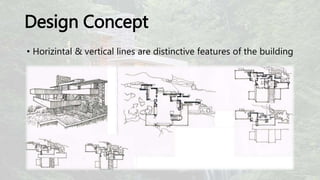
• Horizintal & vertical lines are distinctive features of the building
Architecture Style
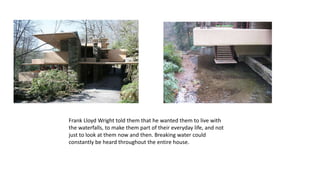
Frank Lloyd Wright told them that he wanted them to live with
the waterfalls, to make them part of their everyday life, and not
just to look at them now and then. Breaking water could
constantly be heard throughout the entire house.
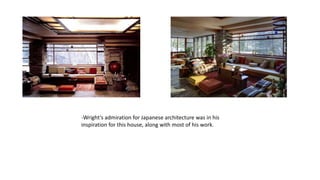
-Wright’s admiration for Japanese architecture was in his
inspiration for this house, along with most of his work.
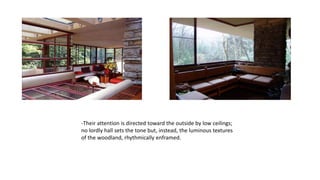
-Their attention is directed toward the outside by low ceilings;
no lordly hall sets the tone but, instead, the luminous textures
of the woodland, rhythmically enframed.
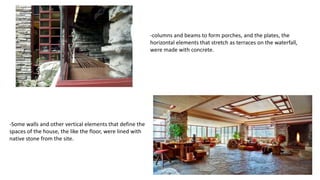
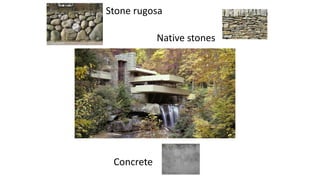
-columns and beams to form porches, and the plates, the
horizontal elements that stretch as terraces on the waterfall,
were made with concrete.
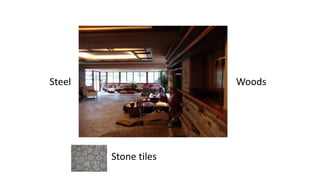
-Some walls and other vertical elements that define the
spaces of the house, the like the floor, were lined with
native stone from the site.
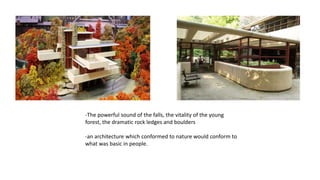
-The powerful sound of the falls, the vitality of the young
forest, the dramatic rock ledges and boulders
-an architecture which conformed to nature would conform to
what was basic in people.
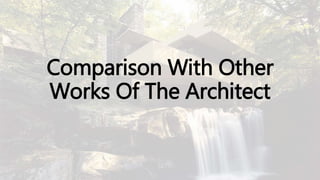
Comparison With Other
Works Of The Architect
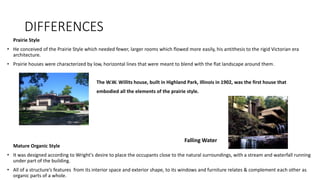
DIFFERENCES
Prairie Style
• He conceived of the Prairie Style which needed fewer, larger rooms which flowed more easily, his antithesis to the rigid Victorian era
architecture.
• Prairie houses were characterized by low, horizontal lines that were meant to blend with the flat landscape around them.
The W.W. Willits house, built in Highland Park, Illinois in 1902, was the first house that
embodied all the elements of the prairie style.
Mature Organic Style
• It was designed according to Wright's desire to place the occupants close to the natural surroundings, with a stream and waterfall running
under part of the building.
• All of a structure’s features from its interior space and exterior shape, to its windows and furniture relates & complement each other as
organic parts of a whole.
Falling Water
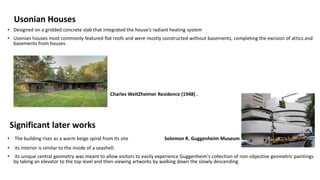
Usonian Houses
• Designed on a gridded concrete slab that integrated the house's radiant heating system
• Usonian houses most commonly featured flat roofs and were mostly constructed without basements, completing the excision of attics and
basements from houses.
Charles WeltZheimer Residence (1948) .
Significant later works
• The building rises as a warm beige spiral from its site Solomon R. Guggenheim Museum
• its interior is similar to the inside of a seashell.
• its unique central geometry was meant to allow visitors to easily experience Guggenheim's collection of non-objective geometric paintings
by taking an elevator to the top level and then viewing artworks by walking down the slowly descending
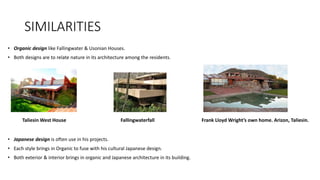
SIMILARITIES
• Organic design like Fallingwater & Usonian Houses.
• Both designs are to relate nature in its architecture among the residents.
Taliesin West House Fallingwaterfall Frank Lloyd Wright’s own home. Arizon, Taliesin.
• Japanese design is often use in his projects.
• Each style brings in Organic to fuse with his cultural Japanese design.
• Both exterior & interior brings in organic and Japanese architecture in its building.
SITE PLAN, FLOOR PLANS, ELEVATION AND SECTIONS
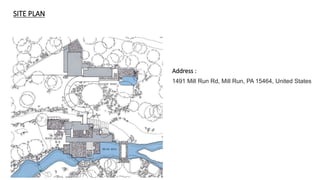
SITE PLAN
1491 Mill Run Rd, Mill Run, PA 15464, United States
Address :
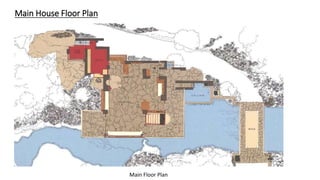
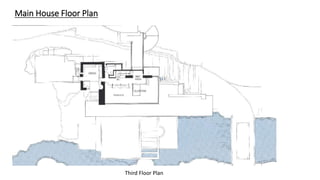
Main House Floor Plan
Main Floor Plan
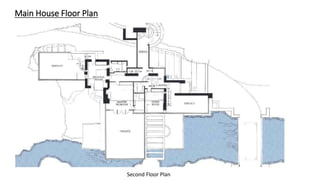
Main House Floor Plan
Second Floor Plan
Main House Floor Plan
Third Floor Plan
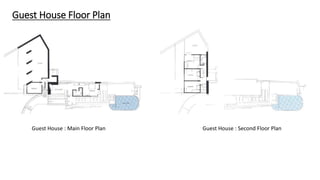
Guest House Floor Plan
Guest House : Main Floor Plan Guest House : Second Floor Plan
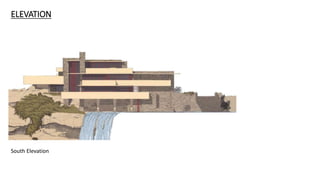
ELEVATION
South Elevation
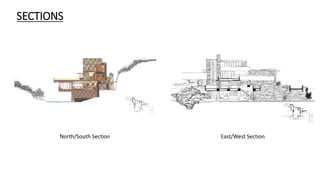
SECTIONS
North/South Section East/West Section
Materials Used For The
Buildings
Stone rugosa
Native stones
Concrete
WoodsSteel
Stone tiles
Final cost-- $155,000 , Included $8,000 architect’s fees, and $4,500 for installed
walnut furnishings
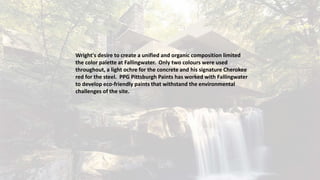
Wright's desire to create a unified and organic composition limited
the color palette at Fallingwater. Only two colours were used
throughout, a light ochre for the concrete and his signature Cherokee
red for the steel. PPG Pittsburgh Paints has worked with Fallingwater
to develop eco-friendly paints that withstand the environmental
challenges of the site.

Falling water

  • 1.
  • 2.
    Frank Lloyd Wright Name:Frank Lincoln Wright Born: June 8, 1867 Place of Birth: Richland Center, Wisconsin, U.S.
  • 3.
    Who is FrankLloyd Wright? • the most influential American architect of the 20th century. • pioneer of the “organic” architecture movement Organic Architecture Architecture which promotes harmony between human habitation and the natural world through design approaches
  • 4.
    Early Life • Camefrom a low income family • Father left his mother after he graduated high school • Started university at the age of 15 • Worked for the dean to support his tuition fees
  • 5.
    Career Beginnings • Workedas a draftsman for Chicago architectural firm of Adler and Sullivan • Started working directly under Louis Sullivan (Father of Skyscrapers) • Parted ways when he breached his contract by accepting private commissions `Form follows function’ ~ Louis Sullivan
  • 6.
    Great Works Falling Water( Mill Run, Pennsylvania )
  • 7.
    The Solomon R.Guggenheim Museum (Manhattan, New York City)
  • 8.
    The Johnson WaxHeadquaters
  • 9.
    Masterpiece introduction • Fallingwater is a house built over the waterfall • Completed in 1937 • Stretches over 30 ft waterfall, captured everyone’s attention • The house’s terraces echo the pattern of the rock ledges below.
  • 10.
    Design Concept • OrganicArchitecture - In close relationship to the glen, the trees, the foliage and wild flowers - The glory of the natural surrounding is brought in as part of the daily life… - Spaces are designed to bring nature into the four walls
  • 11.
    Design Concept • Horizintal& vertical lines are distinctive features of the building
  • 12.
  • 13.
    Frank Lloyd Wrighttold them that he wanted them to live with the waterfalls, to make them part of their everyday life, and not just to look at them now and then. Breaking water could constantly be heard throughout the entire house.
  • 14.
    -Wright’s admiration forJapanese architecture was in his inspiration for this house, along with most of his work.
  • 15.
    -Their attention isdirected toward the outside by low ceilings; no lordly hall sets the tone but, instead, the luminous textures of the woodland, rhythmically enframed.
  • 16.
    -columns and beamsto form porches, and the plates, the horizontal elements that stretch as terraces on the waterfall, were made with concrete. -Some walls and other vertical elements that define the spaces of the house, the like the floor, were lined with native stone from the site.
  • 17.
    -The powerful soundof the falls, the vitality of the young forest, the dramatic rock ledges and boulders -an architecture which conformed to nature would conform to what was basic in people.
  • 18.
  • 19.
    DIFFERENCES Prairie Style • Heconceived of the Prairie Style which needed fewer, larger rooms which flowed more easily, his antithesis to the rigid Victorian era architecture. • Prairie houses were characterized by low, horizontal lines that were meant to blend with the flat landscape around them. The W.W. Willits house, built in Highland Park, Illinois in 1902, was the first house that embodied all the elements of the prairie style. Mature Organic Style • It was designed according to Wright's desire to place the occupants close to the natural surroundings, with a stream and waterfall running under part of the building. • All of a structure’s features from its interior space and exterior shape, to its windows and furniture relates & complement each other as organic parts of a whole. Falling Water
  • 20.
    Usonian Houses • Designedon a gridded concrete slab that integrated the house's radiant heating system • Usonian houses most commonly featured flat roofs and were mostly constructed without basements, completing the excision of attics and basements from houses. Charles WeltZheimer Residence (1948) . Significant later works • The building rises as a warm beige spiral from its site Solomon R. Guggenheim Museum • its interior is similar to the inside of a seashell. • its unique central geometry was meant to allow visitors to easily experience Guggenheim's collection of non-objective geometric paintings by taking an elevator to the top level and then viewing artworks by walking down the slowly descending
  • 21.
    SIMILARITIES • Organic designlike Fallingwater & Usonian Houses. • Both designs are to relate nature in its architecture among the residents. Taliesin West House Fallingwaterfall Frank Lloyd Wright’s own home. Arizon, Taliesin. • Japanese design is often use in his projects. • Each style brings in Organic to fuse with his cultural Japanese design. • Both exterior & interior brings in organic and Japanese architecture in its building.
  • 22.
    SITE PLAN, FLOORPLANS, ELEVATION AND SECTIONS
  • 23.
    SITE PLAN 1491 MillRun Rd, Mill Run, PA 15464, United States Address :
  • 24.
    Main House FloorPlan Main Floor Plan
  • 25.
    Main House FloorPlan Second Floor Plan
  • 26.
    Main House FloorPlan Third Floor Plan
  • 27.
    Guest House FloorPlan Guest House : Main Floor Plan Guest House : Second Floor Plan
  • 28.
  • 29.
  • 30.
    Materials Used ForThe Buildings
  • 31.
  • 32.
  • 33.
    Final cost-- $155,000, Included $8,000 architect’s fees, and $4,500 for installed walnut furnishings
  • 34.
    Wright's desire tocreate a unified and organic composition limited the color palette at Fallingwater. Only two colours were used throughout, a light ochre for the concrete and his signature Cherokee red for the steel. PPG Pittsburgh Paints has worked with Fallingwater to develop eco-friendly paints that withstand the environmental challenges of the site.

Editor's Notes

  • #14 -To feel a sense of relaxation -To be one with nature and away from the busy civilization in the city.
  • #15  To create harmony between man and nature. A feeling of compression when compared to that expansion the closer they get to the outdoors.
  • #16 -Falling water is opened by broad bands of windows, people inside are sheltered as in a deep cave, secure in the sense of hill behind them. -The materials of the structure blend with the colorings of rocks and trees, while occasional accents are provided by bright furnishings, like wildflowers or birds outside.
  • #17 1.The type of structure of the house is aporticado 2.you can see some details of the house in steel and wood.
  • #18 1.these were elements to be interwoven with the serenely soaring spaces of his structure. 2.He understood that people were creatures of nature