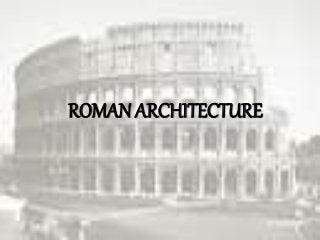
ROMAN ARCHITECTURE
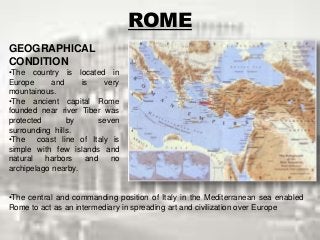
ROME
•The central and commanding position of Italy in the Mediterranean sea enabled
Rome to act as an intermediary in spreading art and civilization over Europe
GEOGRAPHICAL
CONDITION
•The country is located in
Europe and is very
mountainous.
•The ancient capital Rome
founded near river Tiber was
protected by seven
surrounding hills.
•The coast line of Italy is
simple with few islands and
natural harbors and no
archipelago nearby.
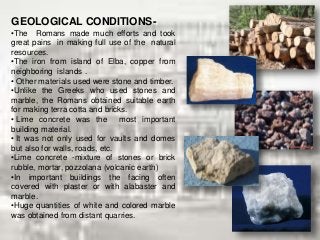
GEOLOGICAL CONDITIONS-
•The Romans made much efforts and took
great pains in making full use of the natural
resources.
•The iron from island of Elba, copper from
neighboring islands .
• Other materials used were stone and timber.
•Unlike the Greeks who used stones and
marble, the Romans obtained suitable earth
for making terra cotta and bricks.
• Lime concrete was the most important
building material.
• It was not only used for vaults and domes
but also for walls, roads, etc.
•Lime concrete -mixture of stones or brick
rubble, mortar, pozzolana (volcanic earth)
•In important buildings the facing often
covered with plaster or with alabaster and
marble.
•Huge quantities of white and colored marble
was obtained from distant quarries.
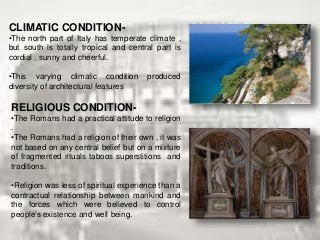
CLIMATIC CONDITION-
•The north part of Italy has temperate climate ,
but south is totally tropical and central part is
cordial , sunny and cheerful.
•This varying climatic condition produced
diversity of architectural features
RELIGIOUS CONDITION-
•The Romans had a practical attitude to religion
.
•The Romans had a religion of their own , it was
not based on any central belief but on a mixture
of fragmented rituals taboos superstitions and
traditions.
•Religion was less of spiritual experience than a
contractual relationship between mankind and
the forces which were believed to control
people’s existence and well being.
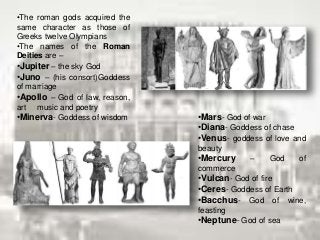
•The roman gods acquired the
same character as those of
Greeks twelve Olympians
•The names of the Roman
Deities are –
•Jupiter – the sky God
•Juno – (his consort)Goddess
of marriage
•Apollo – God of law, reason,
art music and poetry
•Minerva- Goddess of wisdom •Mars- God of war
•Diana- Goddess of chase
•Venus- goddess of love and
beauty
•Mercury – God of
commerce
•Vulcan- God of fire
•Ceres- Goddess of Earth
•Bacchus- God of wine,
feasting
•Neptune- God of sea
•Worship of God was entire a matter of
state policy.
•Though temples were built, Romans paid
more attention for the construction of
public buildings..
•Every house had an altar for family gods.
SOCIAL CONDITION
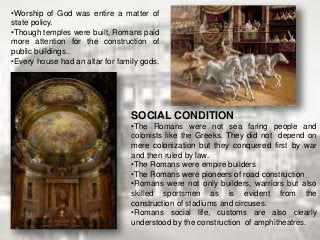
•The Romans were not sea faring people and
colonists like the Greeks. They did not depend on
mere colonization but they conquered first by war
and then ruled by law.
•The Romans were empire builders
•The Romans were pioneers of road construction
•Romans were not only builders, warriors but also
skilled sportsmen as is evident from the
construction of stadiums and circuses.
•Romans social life, customs are also clearly
understood by the construction of amphitheatres.
ROMAN ARCHITECTURE
CHARACTERISTICS-
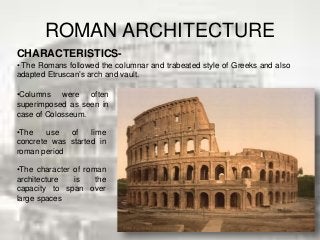
• The Romans followed the columnar and trabeated style of Greeks and also
adapted Etruscan’s arch and vault.
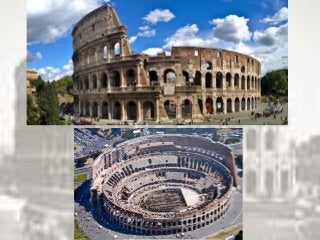
•Columns were often
superimposed as seen in
case of Colosseum.
•The use of lime
concrete was started in
roman period
•The character of roman
architecture is the
capacity to span over
large spaces
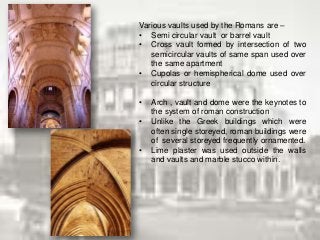
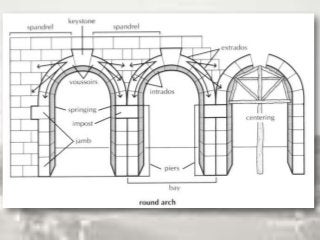
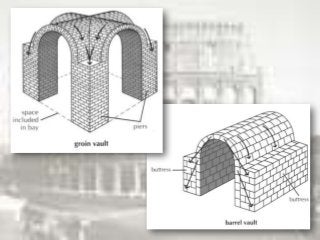
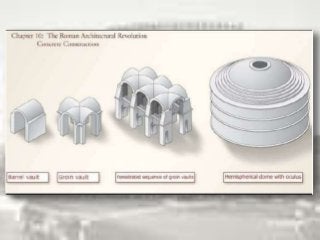
Various vaults used by the Romans are –
• Semi circular vault or barrel vault
• Cross vault formed by intersection of two
semicircular vaults of same span used over
the same apartment
• Cupolas or hemispherical dome used over
circular structure
• Arch , vault and dome were the keynotes to
the system of roman construction
• Unlike the Greek buildings which were
often single storeyed, roman buildings were
of several storeyed frequently ornamented.
• Lime plaster was used outside the walls
and vaults and marble stucco within.
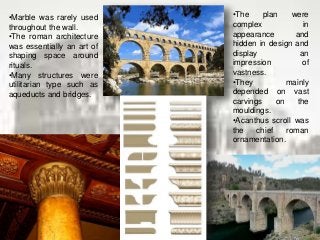
•Marble was rarely used
throughout the wall.
•The roman architecture
was essentially an art of
shaping space around
rituals.
•Many structures were
utilitarian type such as
aqueducts and bridges.
•The plan were
complex in
appearance and
hidden in design and
display an
impression of
vastness.
•They mainly
depended on vast
carvings on the
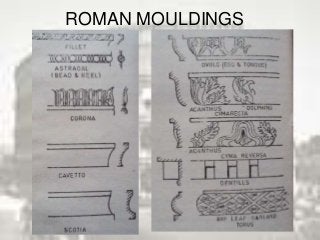
mouldings.
•Acanthus scroll was
the chief roman
ornamentation.
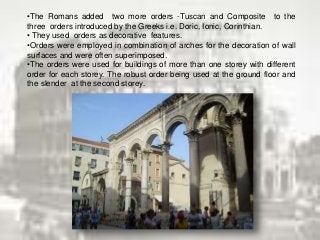
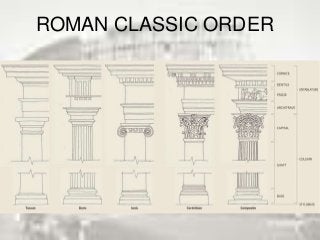
•The Romans added two more orders -Tuscan and Composite to the
three orders introduced by the Greeks i.e. Doric, Ionic, Corinthian.
• They used orders as decorative features.
•Orders were employed in combination of arches for the decoration of wall
surfaces and were often superimposed.
•The orders were used for buildings of more than one storey with different
order for each storey. The robust order being used at the ground floor and
the slender at the second storey.
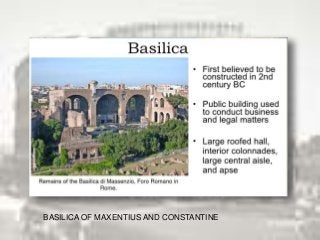
BASILICA OF MAXENTIUS AND CONSTANTINE
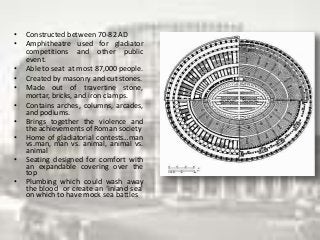
• Constructed between 70-82 AD
• Amphitheatre used for gladiator
competitions and other public
event.
• Able to seat at most 87,000 people.
• Created by masonry and cut stones.
• Made out of travertine stone,
mortar, bricks, and iron clamps.
• Contains arches, columns, arcades,
and podiums.
• Brings together the violence and
the achievements of Roman society
• Home of gladiatorial contests…man
vs.man, man vs. animal, animal vs.
animal
• Seating designed for comfort with
an expandable covering over the
top
• Plumbing which could wash away
the blood or create an ‘inland sea’
on which to have mock sea battles
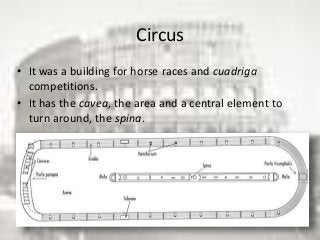
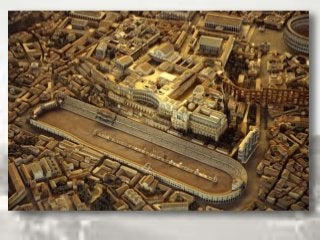
Circus
• It was a building for horse races and cuadriga
competitions.
• It has the cavea, the area and a central element to
turn around, the spina.
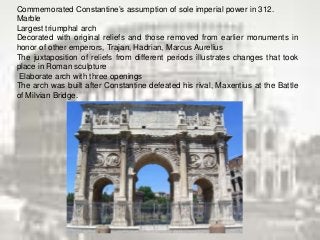
Commemorated Constantine’s assumption of sole imperial power in 312.
Marble
Largest triumphal arch
Decorated with original reliefs and those removed from earlier monuments in
honor of other emperors, Trajan, Hadrian, Marcus Aurelius
The juxtaposition of reliefs from different periods illustrates changes that took
place in Roman sculpture
Elaborate arch with three openings
The arch was built after Constantine defeated his rival, Maxentius at the Battle
of Milvian Bridge.
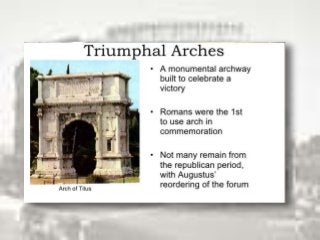
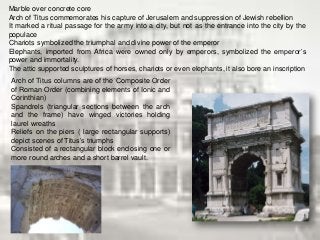
Arch of Titus columns are of the Composite Order
of Roman Order (combining elements of Ionic and
Corinthian)
Spandrels (triangular sections between the arch
and the frame) have winged victories holding
laurel wreaths
Reliefs on the piers ( large rectangular supports)
depict scenes of Titus’s triumphs
Consisted of a rectangular block enclosing one or
more round arches and a short barrel vault.
Marble over concrete core
Arch of Titus commemorates his capture of Jerusalem and suppression of Jewish rebellion
It marked a ritual passage for the army into a city, but not as the entrance into the city by the
populace
Chariots symbolized the triumphal and divine power of the emperor
Elephants, imported from Africa were owned only by emperors, symbolized the emperor’s
power and immortality.
The attic supported sculptures of horses, chariots or even elephants, it also bore an inscription
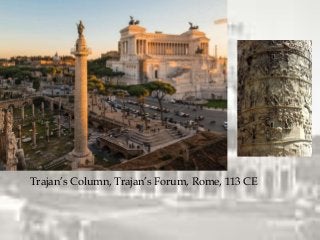
Trajan’s Column, Trajan’s Forum, Rome, 113 CE
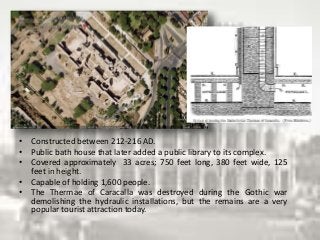
• Constructed between 212-216 AD.
• Public bath house that later added a public library to its complex.
• Covered approximately 33 acres; 750 feet long, 380 feet wide, 125
feet in height.
• Capable of holding 1,600 people.
• The Thermae of Caracalla was destroyed during the Gothic war
demolishing the hydraulic installations, but the remains are a very
popular tourist attraction today.
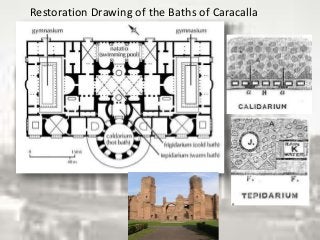
Restoration Drawing of the Baths of Caracalla
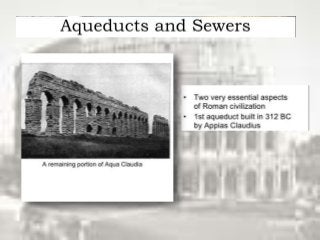
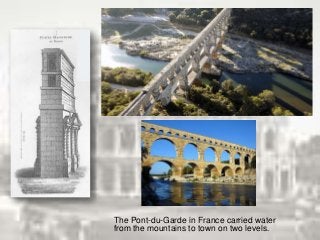
The Pont-du-Garde in France carried water
from the mountains to town on two levels.
ROMAN CLASSIC ORDER
ROMAN MOULDINGS
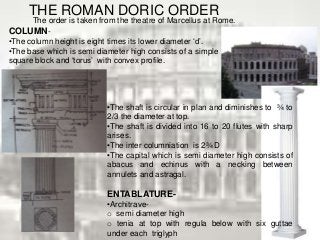
THE ROMAN DORIC ORDER
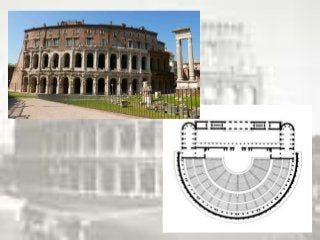
The order is taken from the theatre of Marcellus at Rome.
COLUMN-
•The column height is eight times its lower diameter ‘d’.
•The base which is semi diameter high consists of a simple
square block and ‘torus’ with convex profile.
•The shaft is circular in plan and diminishes to ¾ to
2/3 the diameter at top.
•The shaft is divided into 16 to 20 flutes with sharp
arises.
•The inter columniation is 2¾ D
•The capital which is semi diameter high consists of
abacus and echinus with a necking between
annulets and astragal.
ENTABLATURE-
•Architrave-
o semi diameter high
o tenia at top with regula below with six guttae
under each triglyph
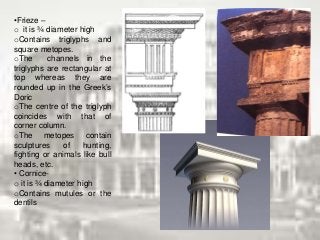
•Frieze –
o it is ¾ diameter high
oContains triglyphs and
square metopes.
oThe channels in the
triglyphs are rectangular at
top whereas they are
rounded up in the Greek’s
Doric
oThe centre of the triglyph
coincides with that of
corner column.
oThe metopes contain
sculptures of hunting,
fighting or animals like bull
heads, etc.
• Cornice-
o it is ¾ diameter high
oContains mutules or the
dentils
THE ROMAN IONIC ORDER
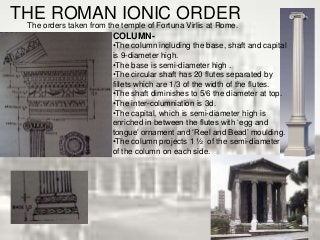
The orders taken from the temple of Fortuna Virlis at Rome.
COLUMN-
•The column including the base, shaft and capital
is 9-diameter high.
•The base is semi-diameter high .
•The circular shaft has 20 flutes separated by
fillets which are 1/3 of the width of the flutes.
•The shaft diminishes to 5/6 the diameter at top.
•The inter-columniation is 3d.
•The capital, which is semi-diameter high is
enriched in between the flutes with ‘egg and
tongue’ ornament and ‘Reel and Bead’ moulding.
•The column projects 1 ½ of the semi-diameter
of the column on each side.
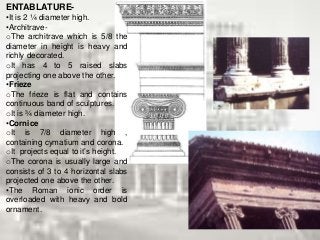
ENTABLATURE-
•It is 2 ¼ diameter high.
•Architrave-
oThe architrave which is 5/8 the
diameter in height is heavy and
richly decorated.
oIt has 4 to 5 raised slabs
projecting one above the other.
•Frieze
oThe frieze is flat and contains
continuous band of sculptures.
oIt is ¾ diameter high.
•Cornice
oIt is 7/8 diameter high ,
containing cymatium and corona.
oIt projects equal to it’s height.
oThe corona is usually large and
consists of 3 to 4 horizontal slabs
projected one above the other.
•The Roman ionic order is
overloaded with heavy and bold
ornament.
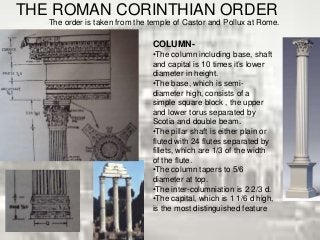
THE ROMAN CORINTHIAN ORDER
The order is taken from the temple of Castor and Pollux at Rome.
COLUMN-
•The column including base, shaft
and capital is 10 times it’s lower
diameter in height.
•The base, which is semi-
diameter high, consists of a
simple square block , the upper
and lower torus separated by
Scotia and double beam.
•The pillar shaft is either plain or
fluted with 24 flutes separated by
fillets, which are 1/3 of the width
of the flute.
•The column tapers to 5/6
diameter at top.
•The inter-columniation is 2 2/3 d.
•The capital, which is 1 1/6 d high,
is the most distinguished feature
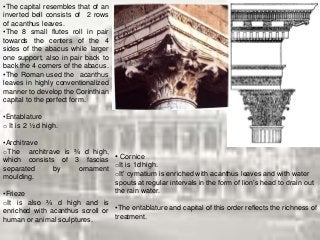
•The capital resembles that of an
inverted bell consists of 2 rows
of acanthus leaves.
•The 8 small flutes roll in pair
towards the centers of the 4
sides of the abacus while larger
one support, also in pair back to
back the 4 corners of the abacus.
•The Roman used the acanthus
leaves in highly conventionalized
manner to develop the Corinthian
capital to the perfect form.
•Entablature
o It is 2 ½ d high.
•Architrave
oThe architrave is ¾ d high,
which consists of 3 fascias
separated by ornament
moulding.
•Frieze
oIt is also ¾ d high and is
enriched with acanthus scroll or
human or animal sculptures.
• Cornice
oIt is 1d high.
oIt’ cymatium is enriched with acanthus leaves and with water
spouts at regular intervals in the form of lion’s head to drain out
the rain water.
•The entablature and capital of this order reflects the richness of
treatment.
THE ROMAN COMPOSITE
ORDER
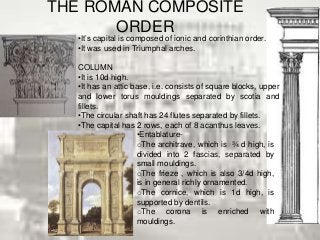
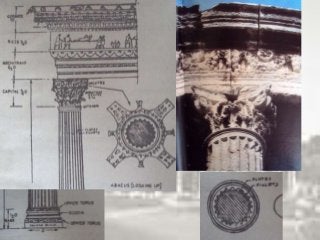
•It’s capital is composed of ionic and corinthian order.
•It was used in Triumphal arches.
COLUMN
•It is 10d high.
•It has an attic base, i.e. consists of square blocks, upper
and lower torus mouldings separated by scotia and
fillets.
•The circular shaft has 24 flutes separated by fillets.
•The capital has 2 rows, each of 8 acanthus leaves.
•Entablature-
oThe architrave, which is ¾ d high, is
divided into 2 fascias, separated by
small mouldings.
oThe frieze , which is also 3/4d high,
is in general richly ornamented.
oThe cornice, which is 1d high, is
supported by dentils.
oThe corona is enriched with
mouldings.
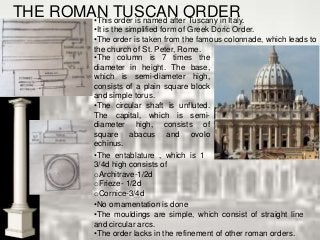
THE ROMAN TUSCAN ORDER
•The entablature , which is 1
3/4d high consists of
oArchitrave-1/2d
oFrieze- 1/2d
oCornice-3/4d
•This order is named after Tuscany in Italy.
•It is the simplified form of Greek Doric Order.
•The order is taken from the famous colonnade, which leads to
the church of St. Peter, Rome.
•The column is 7 times the
diameter in height. The base,
which is semi-diameter high,
consists of a plain square block
and simple torus.
•The circular shaft is unfluted.
The capital, which is semi-
diameter high, consists of
square abacus and ovolo
echinus.
•No ornamentation is done
•The mouldings are simple, which consist of straight line
and circular arcs.
•The order lacks in the refinement of other roman orders.

roman architecture

  • 1.
  • 2.
    ROME •The central andcommanding position of Italy in the Mediterranean sea enabled Rome to act as an intermediary in spreading art and civilization over Europe GEOGRAPHICAL CONDITION •The country is located in Europe and is very mountainous. •The ancient capital Rome founded near river Tiber was protected by seven surrounding hills. •The coast line of Italy is simple with few islands and natural harbors and no archipelago nearby.
  • 3.
    GEOLOGICAL CONDITIONS- •The Romansmade much efforts and took great pains in making full use of the natural resources. •The iron from island of Elba, copper from neighboring islands . • Other materials used were stone and timber. •Unlike the Greeks who used stones and marble, the Romans obtained suitable earth for making terra cotta and bricks. • Lime concrete was the most important building material. • It was not only used for vaults and domes but also for walls, roads, etc. •Lime concrete -mixture of stones or brick rubble, mortar, pozzolana (volcanic earth) •In important buildings the facing often covered with plaster or with alabaster and marble. •Huge quantities of white and colored marble was obtained from distant quarries.
  • 4.
    CLIMATIC CONDITION- •The northpart of Italy has temperate climate , but south is totally tropical and central part is cordial , sunny and cheerful. •This varying climatic condition produced diversity of architectural features RELIGIOUS CONDITION- •The Romans had a practical attitude to religion . •The Romans had a religion of their own , it was not based on any central belief but on a mixture of fragmented rituals taboos superstitions and traditions. •Religion was less of spiritual experience than a contractual relationship between mankind and the forces which were believed to control people’s existence and well being.
  • 5.
    •The roman godsacquired the same character as those of Greeks twelve Olympians •The names of the Roman Deities are – •Jupiter – the sky God •Juno – (his consort)Goddess of marriage •Apollo – God of law, reason, art music and poetry •Minerva- Goddess of wisdom •Mars- God of war •Diana- Goddess of chase •Venus- goddess of love and beauty •Mercury – God of commerce •Vulcan- God of fire •Ceres- Goddess of Earth •Bacchus- God of wine, feasting •Neptune- God of sea
  • 6.
    •Worship of Godwas entire a matter of state policy. •Though temples were built, Romans paid more attention for the construction of public buildings.. •Every house had an altar for family gods. SOCIAL CONDITION •The Romans were not sea faring people and colonists like the Greeks. They did not depend on mere colonization but they conquered first by war and then ruled by law. •The Romans were empire builders •The Romans were pioneers of road construction •Romans were not only builders, warriors but also skilled sportsmen as is evident from the construction of stadiums and circuses. •Romans social life, customs are also clearly understood by the construction of amphitheatres.
  • 7.
    ROMAN ARCHITECTURE CHARACTERISTICS- • TheRomans followed the columnar and trabeated style of Greeks and also adapted Etruscan’s arch and vault. •Columns were often superimposed as seen in case of Colosseum. •The use of lime concrete was started in roman period •The character of roman architecture is the capacity to span over large spaces
  • 8.
    Various vaults usedby the Romans are – • Semi circular vault or barrel vault • Cross vault formed by intersection of two semicircular vaults of same span used over the same apartment • Cupolas or hemispherical dome used over circular structure • Arch , vault and dome were the keynotes to the system of roman construction • Unlike the Greek buildings which were often single storeyed, roman buildings were of several storeyed frequently ornamented. • Lime plaster was used outside the walls and vaults and marble stucco within.
  • 12.
    •Marble was rarelyused throughout the wall. •The roman architecture was essentially an art of shaping space around rituals. •Many structures were utilitarian type such as aqueducts and bridges. •The plan were complex in appearance and hidden in design and display an impression of vastness. •They mainly depended on vast carvings on the mouldings. •Acanthus scroll was the chief roman ornamentation.
  • 13.
    •The Romans addedtwo more orders -Tuscan and Composite to the three orders introduced by the Greeks i.e. Doric, Ionic, Corinthian. • They used orders as decorative features. •Orders were employed in combination of arches for the decoration of wall surfaces and were often superimposed. •The orders were used for buildings of more than one storey with different order for each storey. The robust order being used at the ground floor and the slender at the second storey.
  • 16.
    BASILICA OF MAXENTIUSAND CONSTANTINE
  • 28.
    • Constructed between70-82 AD • Amphitheatre used for gladiator competitions and other public event. • Able to seat at most 87,000 people. • Created by masonry and cut stones. • Made out of travertine stone, mortar, bricks, and iron clamps. • Contains arches, columns, arcades, and podiums. • Brings together the violence and the achievements of Roman society • Home of gladiatorial contests…man vs.man, man vs. animal, animal vs. animal • Seating designed for comfort with an expandable covering over the top • Plumbing which could wash away the blood or create an ‘inland sea’ on which to have mock sea battles
  • 29.
    Circus • It wasa building for horse races and cuadriga competitions. • It has the cavea, the area and a central element to turn around, the spina.
  • 33.
    Commemorated Constantine’s assumptionof sole imperial power in 312. Marble Largest triumphal arch Decorated with original reliefs and those removed from earlier monuments in honor of other emperors, Trajan, Hadrian, Marcus Aurelius The juxtaposition of reliefs from different periods illustrates changes that took place in Roman sculpture Elaborate arch with three openings The arch was built after Constantine defeated his rival, Maxentius at the Battle of Milvian Bridge.
  • 34.
    Arch of Tituscolumns are of the Composite Order of Roman Order (combining elements of Ionic and Corinthian) Spandrels (triangular sections between the arch and the frame) have winged victories holding laurel wreaths Reliefs on the piers ( large rectangular supports) depict scenes of Titus’s triumphs Consisted of a rectangular block enclosing one or more round arches and a short barrel vault. Marble over concrete core Arch of Titus commemorates his capture of Jerusalem and suppression of Jewish rebellion It marked a ritual passage for the army into a city, but not as the entrance into the city by the populace Chariots symbolized the triumphal and divine power of the emperor Elephants, imported from Africa were owned only by emperors, symbolized the emperor’s power and immortality. The attic supported sculptures of horses, chariots or even elephants, it also bore an inscription
  • 36.
    Trajan’s Column, Trajan’sForum, Rome, 113 CE
  • 38.
    • Constructed between212-216 AD. • Public bath house that later added a public library to its complex. • Covered approximately 33 acres; 750 feet long, 380 feet wide, 125 feet in height. • Capable of holding 1,600 people. • The Thermae of Caracalla was destroyed during the Gothic war demolishing the hydraulic installations, but the remains are a very popular tourist attraction today.
  • 39.
    Restoration Drawing ofthe Baths of Caracalla
  • 41.
    The Pont-du-Garde inFrance carried water from the mountains to town on two levels.
  • 42.
  • 43.
  • 44.
    THE ROMAN DORICORDER The order is taken from the theatre of Marcellus at Rome. COLUMN- •The column height is eight times its lower diameter ‘d’. •The base which is semi diameter high consists of a simple square block and ‘torus’ with convex profile. •The shaft is circular in plan and diminishes to ¾ to 2/3 the diameter at top. •The shaft is divided into 16 to 20 flutes with sharp arises. •The inter columniation is 2¾ D •The capital which is semi diameter high consists of abacus and echinus with a necking between annulets and astragal. ENTABLATURE- •Architrave- o semi diameter high o tenia at top with regula below with six guttae under each triglyph
  • 45.
    •Frieze – o itis ¾ diameter high oContains triglyphs and square metopes. oThe channels in the triglyphs are rectangular at top whereas they are rounded up in the Greek’s Doric oThe centre of the triglyph coincides with that of corner column. oThe metopes contain sculptures of hunting, fighting or animals like bull heads, etc. • Cornice- o it is ¾ diameter high oContains mutules or the dentils
  • 46.
    THE ROMAN IONICORDER The orders taken from the temple of Fortuna Virlis at Rome. COLUMN- •The column including the base, shaft and capital is 9-diameter high. •The base is semi-diameter high . •The circular shaft has 20 flutes separated by fillets which are 1/3 of the width of the flutes. •The shaft diminishes to 5/6 the diameter at top. •The inter-columniation is 3d. •The capital, which is semi-diameter high is enriched in between the flutes with ‘egg and tongue’ ornament and ‘Reel and Bead’ moulding. •The column projects 1 ½ of the semi-diameter of the column on each side.
  • 47.
    ENTABLATURE- •It is 2¼ diameter high. •Architrave- oThe architrave which is 5/8 the diameter in height is heavy and richly decorated. oIt has 4 to 5 raised slabs projecting one above the other. •Frieze oThe frieze is flat and contains continuous band of sculptures. oIt is ¾ diameter high. •Cornice oIt is 7/8 diameter high , containing cymatium and corona. oIt projects equal to it’s height. oThe corona is usually large and consists of 3 to 4 horizontal slabs projected one above the other. •The Roman ionic order is overloaded with heavy and bold ornament.
  • 48.
    THE ROMAN CORINTHIANORDER The order is taken from the temple of Castor and Pollux at Rome. COLUMN- •The column including base, shaft and capital is 10 times it’s lower diameter in height. •The base, which is semi- diameter high, consists of a simple square block , the upper and lower torus separated by Scotia and double beam. •The pillar shaft is either plain or fluted with 24 flutes separated by fillets, which are 1/3 of the width of the flute. •The column tapers to 5/6 diameter at top. •The inter-columniation is 2 2/3 d. •The capital, which is 1 1/6 d high, is the most distinguished feature
  • 49.
    •The capital resemblesthat of an inverted bell consists of 2 rows of acanthus leaves. •The 8 small flutes roll in pair towards the centers of the 4 sides of the abacus while larger one support, also in pair back to back the 4 corners of the abacus. •The Roman used the acanthus leaves in highly conventionalized manner to develop the Corinthian capital to the perfect form. •Entablature o It is 2 ½ d high. •Architrave oThe architrave is ¾ d high, which consists of 3 fascias separated by ornament moulding. •Frieze oIt is also ¾ d high and is enriched with acanthus scroll or human or animal sculptures. • Cornice oIt is 1d high. oIt’ cymatium is enriched with acanthus leaves and with water spouts at regular intervals in the form of lion’s head to drain out the rain water. •The entablature and capital of this order reflects the richness of treatment.
  • 50.
    THE ROMAN COMPOSITE ORDER •It’scapital is composed of ionic and corinthian order. •It was used in Triumphal arches. COLUMN •It is 10d high. •It has an attic base, i.e. consists of square blocks, upper and lower torus mouldings separated by scotia and fillets. •The circular shaft has 24 flutes separated by fillets. •The capital has 2 rows, each of 8 acanthus leaves. •Entablature- oThe architrave, which is ¾ d high, is divided into 2 fascias, separated by small mouldings. oThe frieze , which is also 3/4d high, is in general richly ornamented. oThe cornice, which is 1d high, is supported by dentils. oThe corona is enriched with mouldings.
  • 52.
    THE ROMAN TUSCANORDER •The entablature , which is 1 3/4d high consists of oArchitrave-1/2d oFrieze- 1/2d oCornice-3/4d •This order is named after Tuscany in Italy. •It is the simplified form of Greek Doric Order. •The order is taken from the famous colonnade, which leads to the church of St. Peter, Rome. •The column is 7 times the diameter in height. The base, which is semi-diameter high, consists of a plain square block and simple torus. •The circular shaft is unfluted. The capital, which is semi- diameter high, consists of square abacus and ovolo echinus. •No ornamentation is done •The mouldings are simple, which consist of straight line and circular arcs. •The order lacks in the refinement of other roman orders.