Renaissance
architecture
Renaissance architecture is the
architecture of the period between
the early 15th and early 17th
centuries
Demonstrate a conscious revival and
development of certain elements
of ancient Greek and Roman thought
and material culture.
The style was started in Europe and
carried to France, Germany, England,
Russia and other parts of Europe at
different dates and with varying
degrees of impact.
Features of Renaissance Buildings
Renaissance architecture had some distinct features that were fairly
common to major construction:Square - Many buildings were built
as square or rectangle symmetrical shapes.
• Front - The front or "façade" of the buildings were generally
symmetrical around the vertical axis.
• Columns - They used Roman type columns.
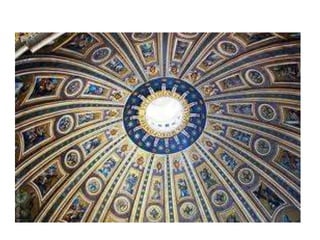
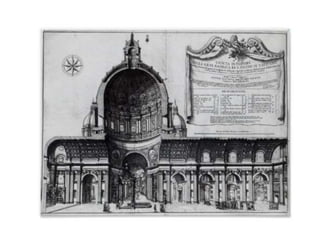
• Arches and Domes - Arches and domes were popular. This was
again taken from Roman and Greek architecture.
• Ceilings - The ceilings of buildings were generally flat. Previously
in the Middle Ages ceilings were often left open.
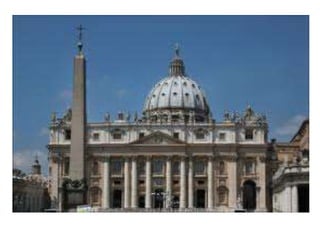
St. Peter's Basilica is a
prime example of
Renaissance architecture
St. Peter's Basilica is a Late
Renaissance church located
within Vatican City, west of
the River Tiber.
Designed principally
by DonatoBramante,
Michelangelo,
Carlo Maderno and
Gian Lorenzo Bernini
St. Peter's is the most
renowned work
of Renaissance architecture
and remains one of
the largest churches in the
world.
While it is neither the mother
church of the Roman Catholic
Church nor the cathedral of
the Bishop of Rome, St. Peter's is
regarded as one of the holiest
Catholic sites.
It has been described as "holding a
unique position in the Christian world“
and as "the greatest of all churches of
Christendom’’.
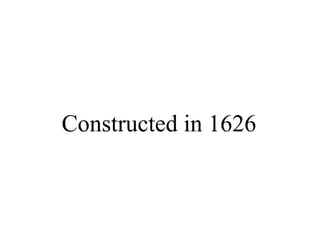
Constructed in 1626
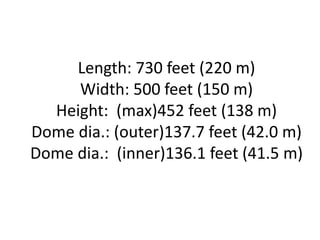
Length: 730 feet (220 m)
Width: 500 feet (150 m)
Height: (max)452 feet (138 m)
Dome dia.: (outer)137.7 feet (42.0 m)
Dome dia.: (inner)136.1 feet (41.5 m)
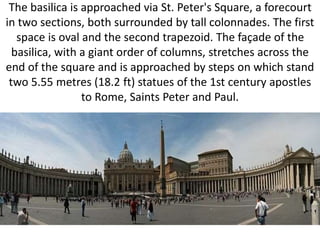
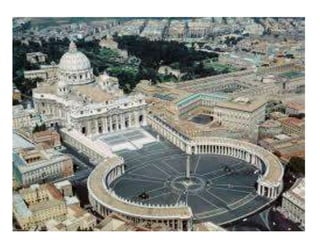
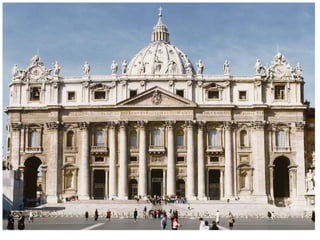
The basilica is approached via St. Peter's Square, a forecourt
in two sections, both surrounded by tall colonnades. The first
space is oval and the second trapezoid. The façade of the
basilica, with a giant order of columns, stretches across the
end of the square and is approached by steps on which stand
two 5.55 metres (18.2 ft) statues of the 1st century apostles
to Rome, Saints Peter and Paul.
Front Facade
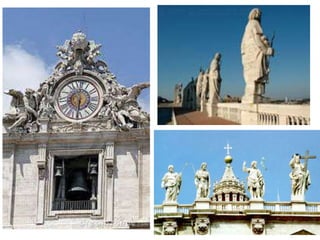
The 45.5 meters (149 ft) high facade is crowned
with 5.7 meter tall statues of Christ, John the
Baptist and the apostles except for St. Peter.
On either side are huge clocks supported by
angels and decorated with ornaments and the
papal crest. They were added in the early
nineteenth century and are the work of
Giuseppe Valadier. Below the clock on the left
you can see the church bells.
Narthex
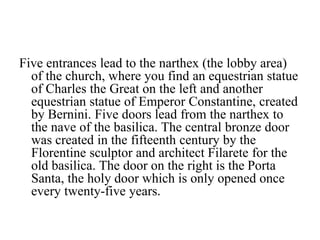
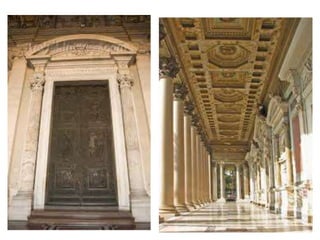
Five entrances lead to the narthex (the lobby area)
of the church, where you find an equestrian statue
of Charles the Great on the left and another
equestrian statue of Emperor Constantine, created
by Bernini. Five doors lead from the narthex to
the nave of the basilica. The central bronze door
was created in the fifteenth century by the
Florentine sculptor and architect Filarete for the
old basilica. The door on the right is the Porta
Santa, the holy door which is only opened once
every twenty-five years.
Interior
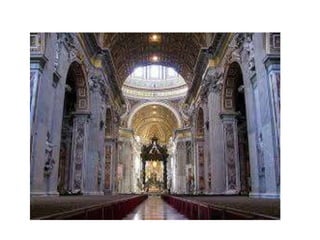
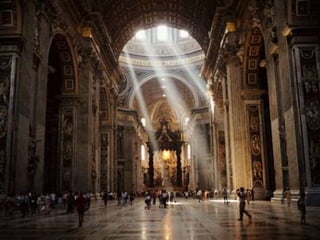
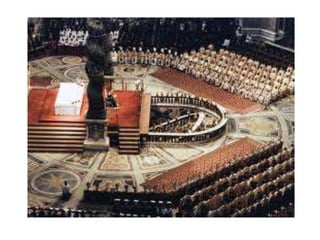
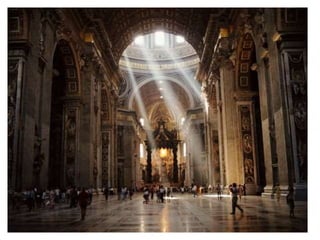
once inside the nave the enormous size of the
church becomes apparent. The basilica has a
surface area of 15,160 square meters, enough
space to accommodate 60,000 visitors. It is
covered by a coffered barrel vault ceiling and a
huge central dome.
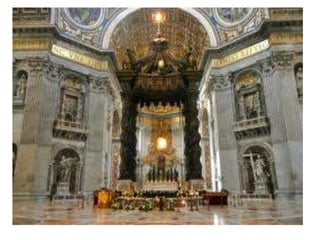
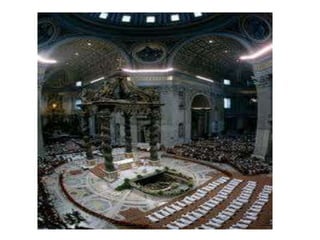
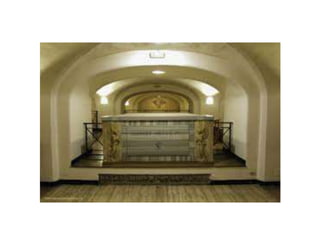
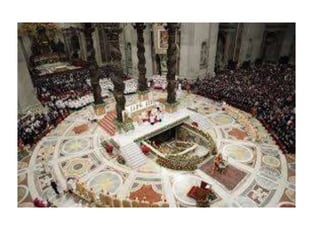
In front of the papal altar is the confessio (burial
crypt) that marks the presumed grave of St.
Peter. It is encircled by a balustrade with
ninety-five bronze oil lamps.
Dome
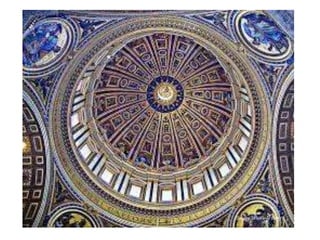
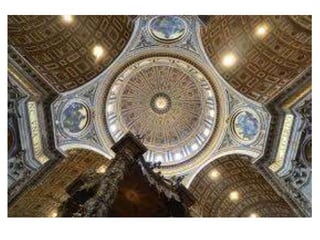
The confessio is located right below the majestic
dome. Look up and you'll see the impressive
colorful vaulting with sixteen ribs that are
supported by four massive pillars. The
triangular spaces where the pillars meet the
dome are decorated with mosaics depicting
the evangelists. Light enters through the
lantern and the sixteen large windows below
the cornice.
Renaissance architecture

Renaissance architecture

  • 1.
  • 2.
    Renaissance architecture isthe architecture of the period between the early 15th and early 17th centuries
  • 3.
    Demonstrate a consciousrevival and development of certain elements of ancient Greek and Roman thought and material culture.
  • 4.
    The style wasstarted in Europe and carried to France, Germany, England, Russia and other parts of Europe at different dates and with varying degrees of impact.
  • 5.
    Features of RenaissanceBuildings Renaissance architecture had some distinct features that were fairly common to major construction:Square - Many buildings were built as square or rectangle symmetrical shapes. • Front - The front or "façade" of the buildings were generally symmetrical around the vertical axis. • Columns - They used Roman type columns. • Arches and Domes - Arches and domes were popular. This was again taken from Roman and Greek architecture. • Ceilings - The ceilings of buildings were generally flat. Previously in the Middle Ages ceilings were often left open.
  • 6.
    St. Peter's Basilicais a prime example of Renaissance architecture
  • 7.
    St. Peter's Basilicais a Late Renaissance church located within Vatican City, west of the River Tiber.
  • 8.
  • 9.
    St. Peter's isthe most renowned work of Renaissance architecture and remains one of the largest churches in the world.
  • 10.
    While it isneither the mother church of the Roman Catholic Church nor the cathedral of the Bishop of Rome, St. Peter's is regarded as one of the holiest Catholic sites. It has been described as "holding a unique position in the Christian world“ and as "the greatest of all churches of Christendom’’.
  • 11.
  • 12.
    Length: 730 feet(220 m) Width: 500 feet (150 m) Height: (max)452 feet (138 m) Dome dia.: (outer)137.7 feet (42.0 m) Dome dia.: (inner)136.1 feet (41.5 m)
  • 13.
    The basilica isapproached via St. Peter's Square, a forecourt in two sections, both surrounded by tall colonnades. The first space is oval and the second trapezoid. The façade of the basilica, with a giant order of columns, stretches across the end of the square and is approached by steps on which stand two 5.55 metres (18.2 ft) statues of the 1st century apostles to Rome, Saints Peter and Paul.
  • 15.
  • 17.
    The 45.5 meters(149 ft) high facade is crowned with 5.7 meter tall statues of Christ, John the Baptist and the apostles except for St. Peter. On either side are huge clocks supported by angels and decorated with ornaments and the papal crest. They were added in the early nineteenth century and are the work of Giuseppe Valadier. Below the clock on the left you can see the church bells.
  • 20.
  • 21.
    Five entrances leadto the narthex (the lobby area) of the church, where you find an equestrian statue of Charles the Great on the left and another equestrian statue of Emperor Constantine, created by Bernini. Five doors lead from the narthex to the nave of the basilica. The central bronze door was created in the fifteenth century by the Florentine sculptor and architect Filarete for the old basilica. The door on the right is the Porta Santa, the holy door which is only opened once every twenty-five years.
  • 23.
  • 24.
    once inside thenave the enormous size of the church becomes apparent. The basilica has a surface area of 15,160 square meters, enough space to accommodate 60,000 visitors. It is covered by a coffered barrel vault ceiling and a huge central dome.
  • 27.
    In front ofthe papal altar is the confessio (burial crypt) that marks the presumed grave of St. Peter. It is encircled by a balustrade with ninety-five bronze oil lamps.
  • 33.
    Dome The confessio islocated right below the majestic dome. Look up and you'll see the impressive colorful vaulting with sixteen ribs that are supported by four massive pillars. The triangular spaces where the pillars meet the dome are decorated with mosaics depicting the evangelists. Light enters through the lantern and the sixteen large windows below the cornice.