GOTHIC
ARCHITECTURE
GothicArchitecture
(12 – 15th century)
Gothic architecture began mainly in France, where architects
were inspired by Romanesque architecture and the pointed arches of
Spanish Moorish architecture.
It's easy to recognise Gothic buildings because of their
arches, ribbed vaulting, flying buttresses, elaborate sculptures (like
gargoyles) and stained glass windows.
Gothic architecture was originally known as “French Style”.
During the period of Renaissance it fell out of fashion and it wasnot
respected by many artists. They marked it as “Gothic” to suggest it
was the crude work of German barbarians (Goths).
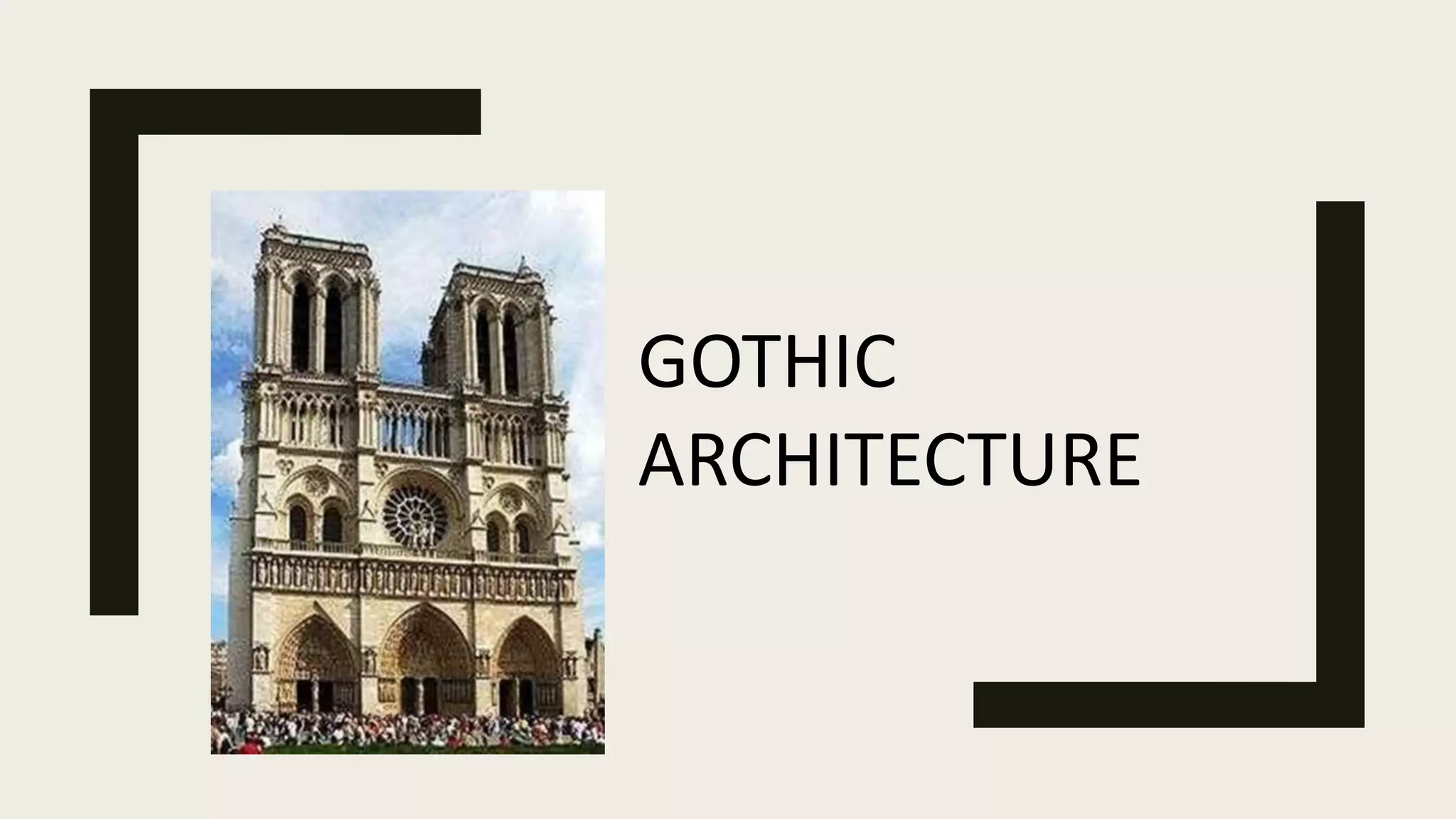
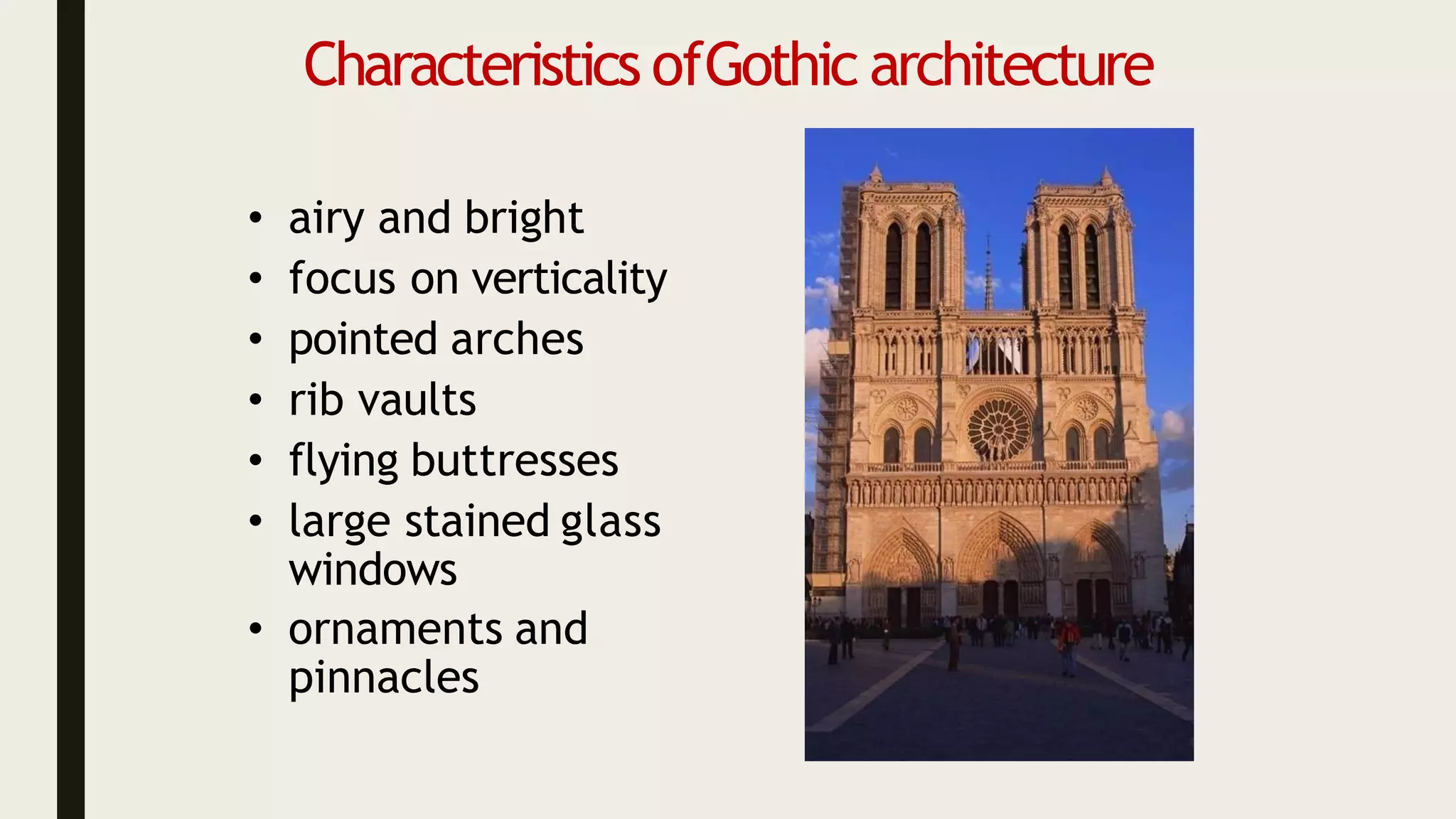
Examples of Gothic architecture: Notre Dame Cathedral in Parisand
St. Patrick's Cathedral in Dublin.
Gothic
Architecture
• Meaning of Gothic
– “DarkAge”
• Invading barbarians from the north ruined
ancient art and replaced it with their own culture
– Goths took Rome in 410
• little damage but became known as the first tribe
of
barbarians and thus thename“Gothic”
GothicArchitecture
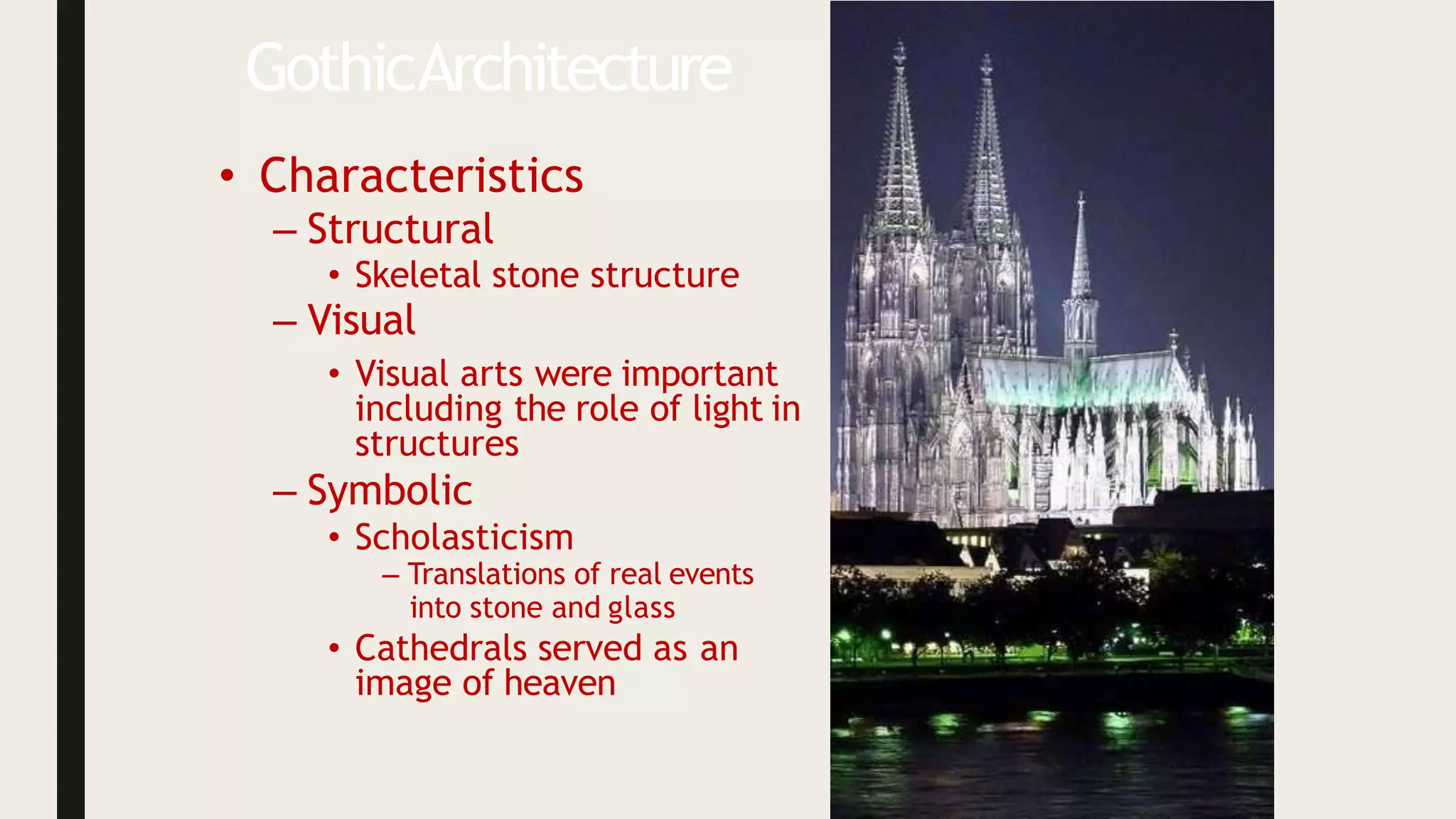
• Characteristics
– Structural
• Skeletal stone structure
– Visual
• Visual arts were important
including the role of light in
structures
– Symbolic
• Scholasticism
– Translations of real events
into stone and glass
• Cathedrals served as an
image of heaven
Structure of a typicalGothic
Church
Characteristics ofGothic architecture
• airy and bright
• focus on verticality
• pointed arches
• rib vaults
• flying buttresses
• large stained glass
windows
• ornaments and
pinnacles
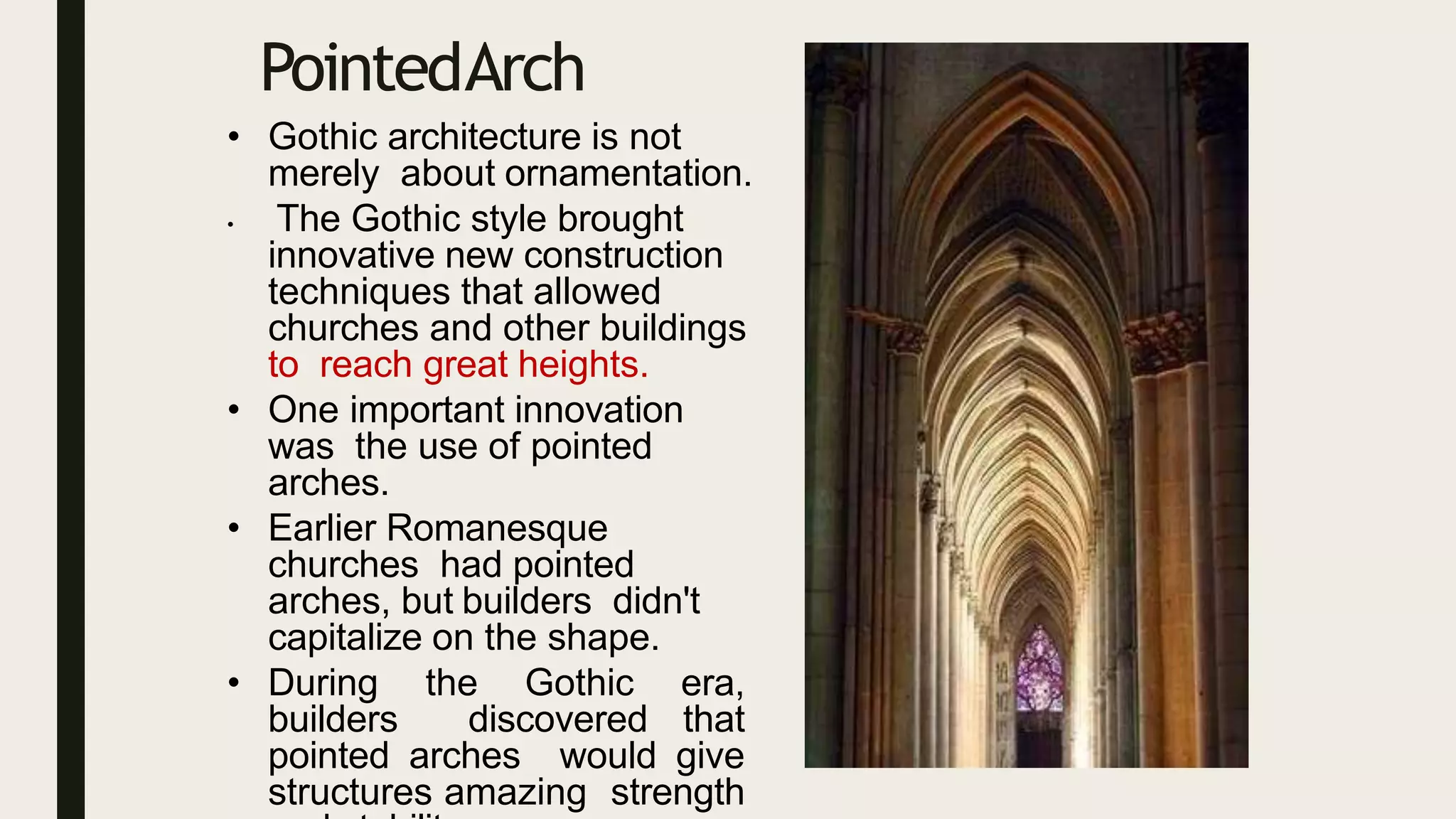
PointedArch
• Gothic architecture is not
merely about ornamentation.
• The Gothic style brought
innovative new construction
techniques that allowed
churches and other buildings
to reach great heights.
• One important innovation
was the use of pointed
arches.
• Earlier Romanesque
churches had pointed
arches, but builders didn't
capitalize on the shape.
• During the Gothic era,
builders discovered that
pointed arches would give
structures amazing strength
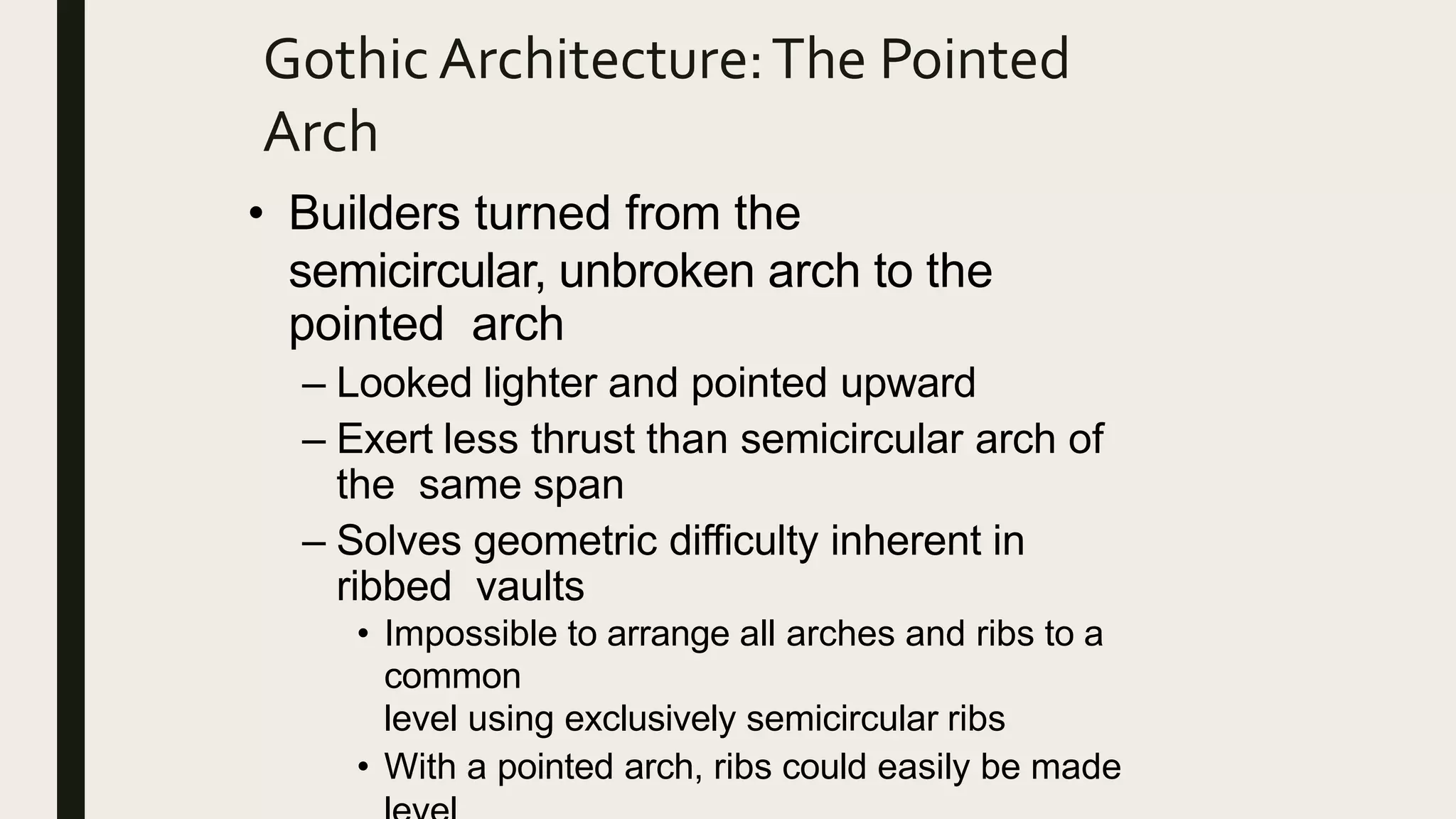
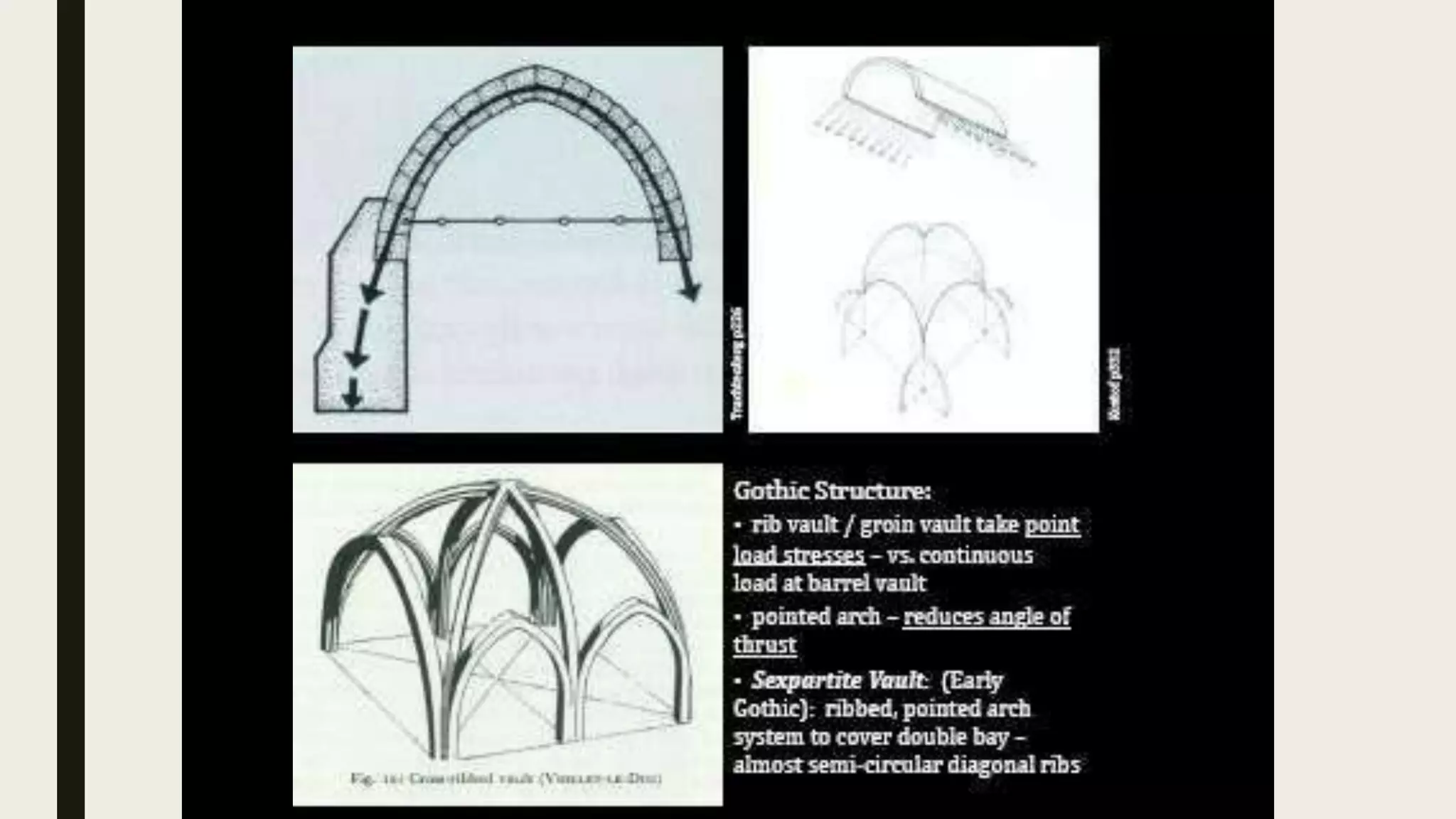
GothicArchitecture:The Pointed
Arch
• Builders turned from the
semicircular, unbroken arch to the
pointed arch
– Looked lighter and pointed upward
– Exert less thrust than semicircular arch of
the same span
– Solves geometric difficulty inherent in
ribbed vaults
• Impossible to arrange all arches and ribs to a
common
level using exclusively semicircular ribs
• With a pointed arch, ribs could easily be made
GothicArchitecture:ThePointed Arch
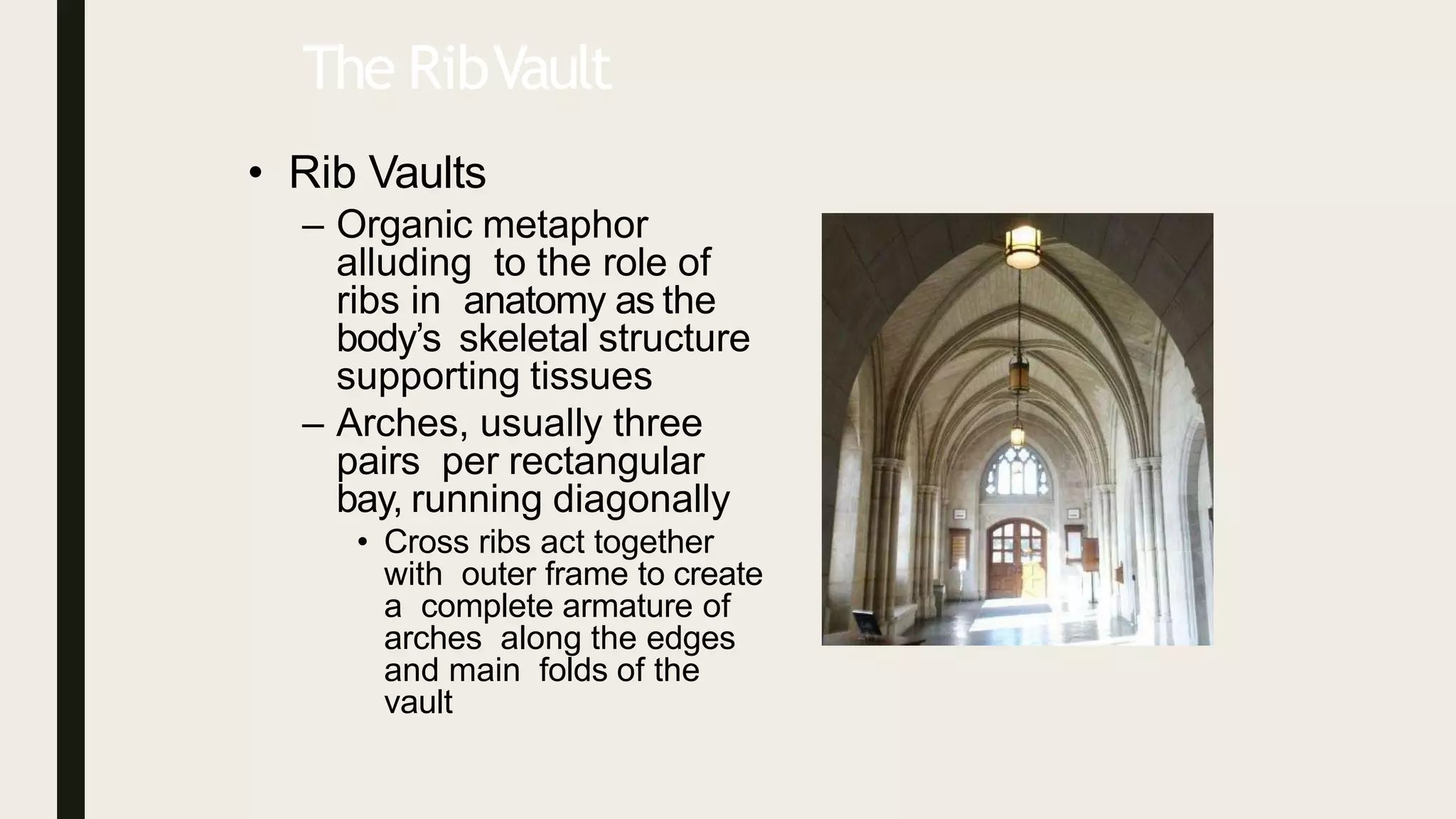
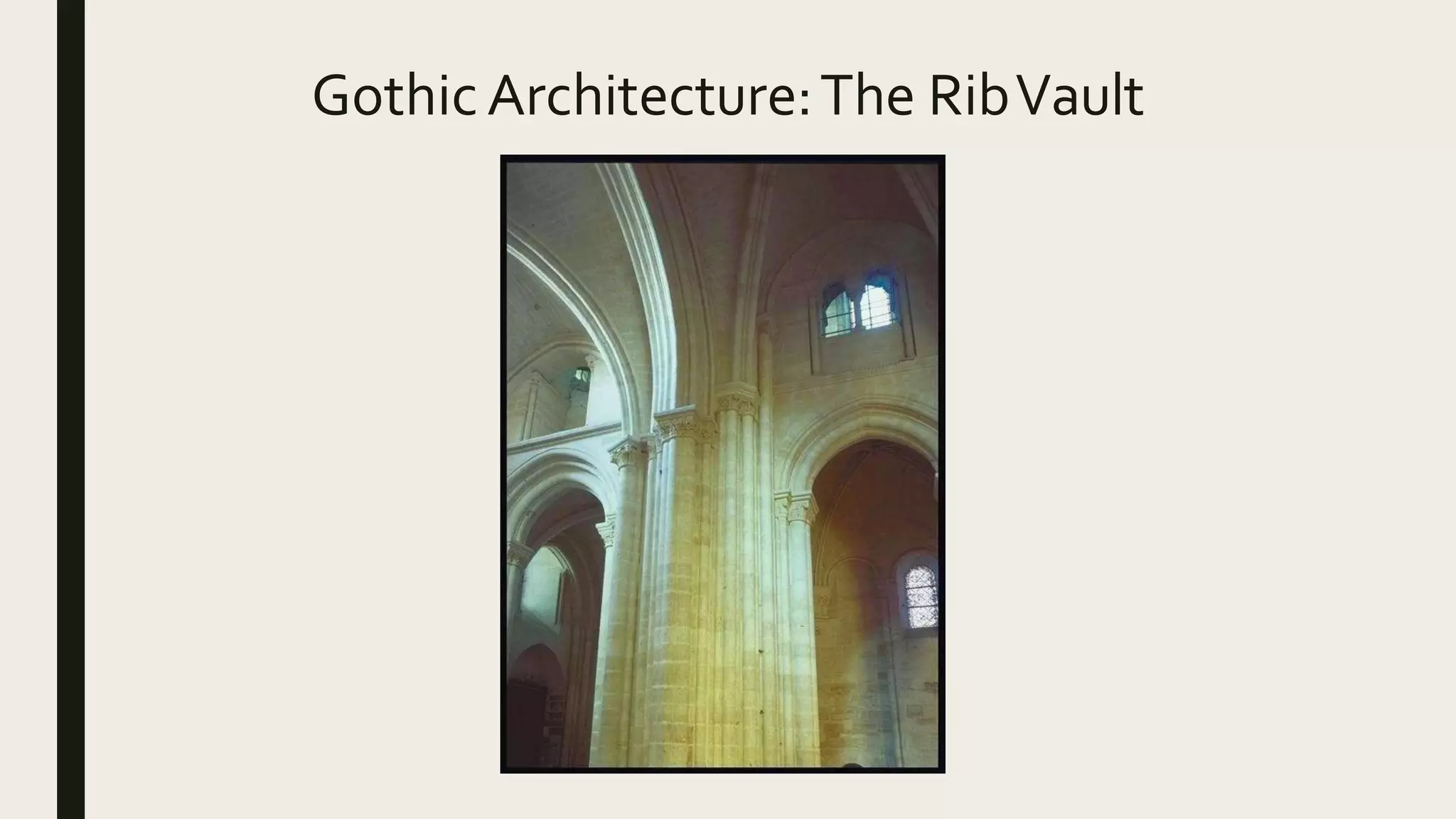
The RibVault
• Rib Vaults
– Organic metaphor
alluding to the role of
ribs in anatomy as the
body’s skeletal structure
supporting tissues
– Arches, usually three
pairs per rectangular
bay, running diagonally
• Cross ribs act together
with outer frame to create
a complete armature of
arches along the edges
and main folds of the
vault
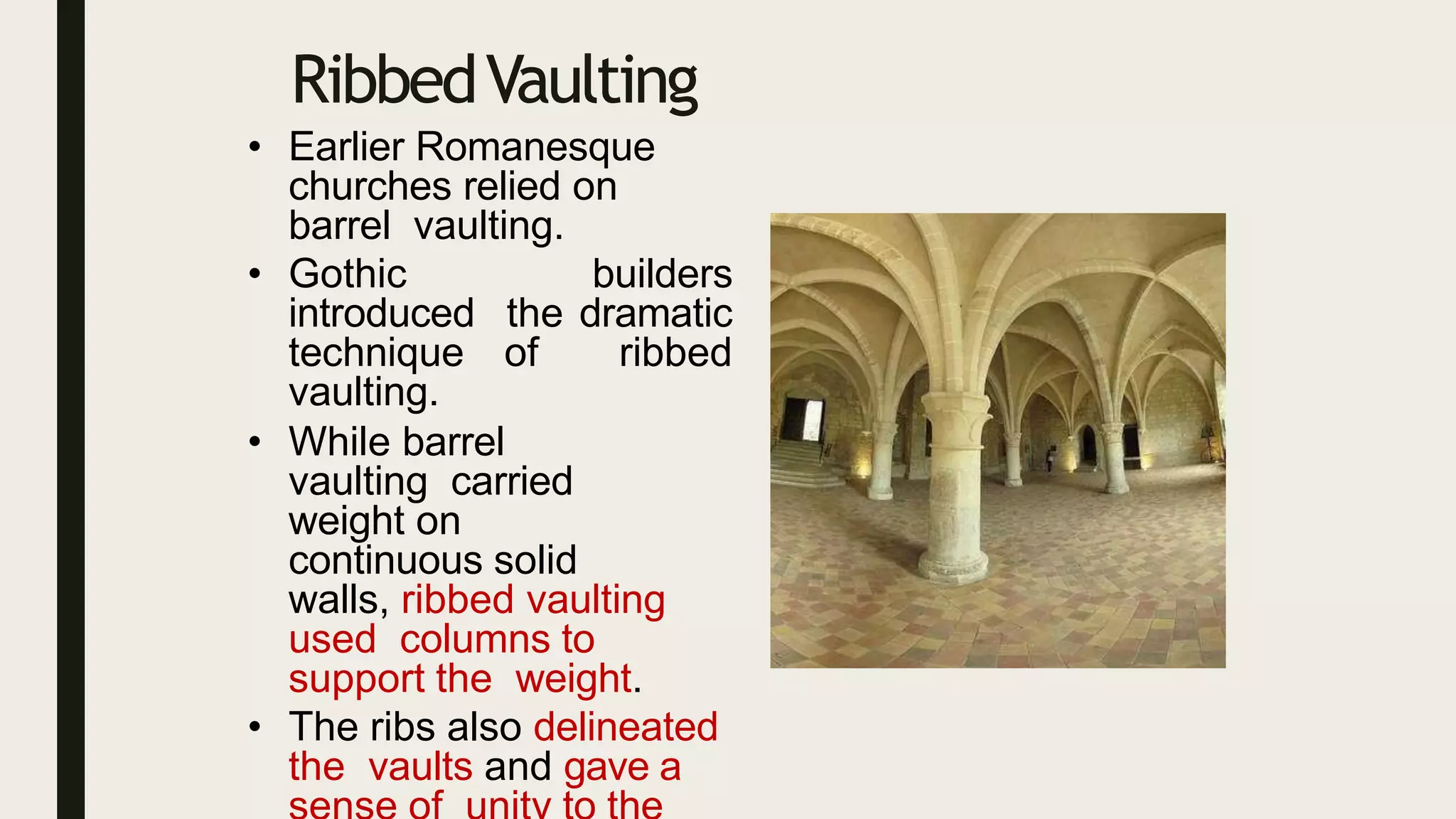
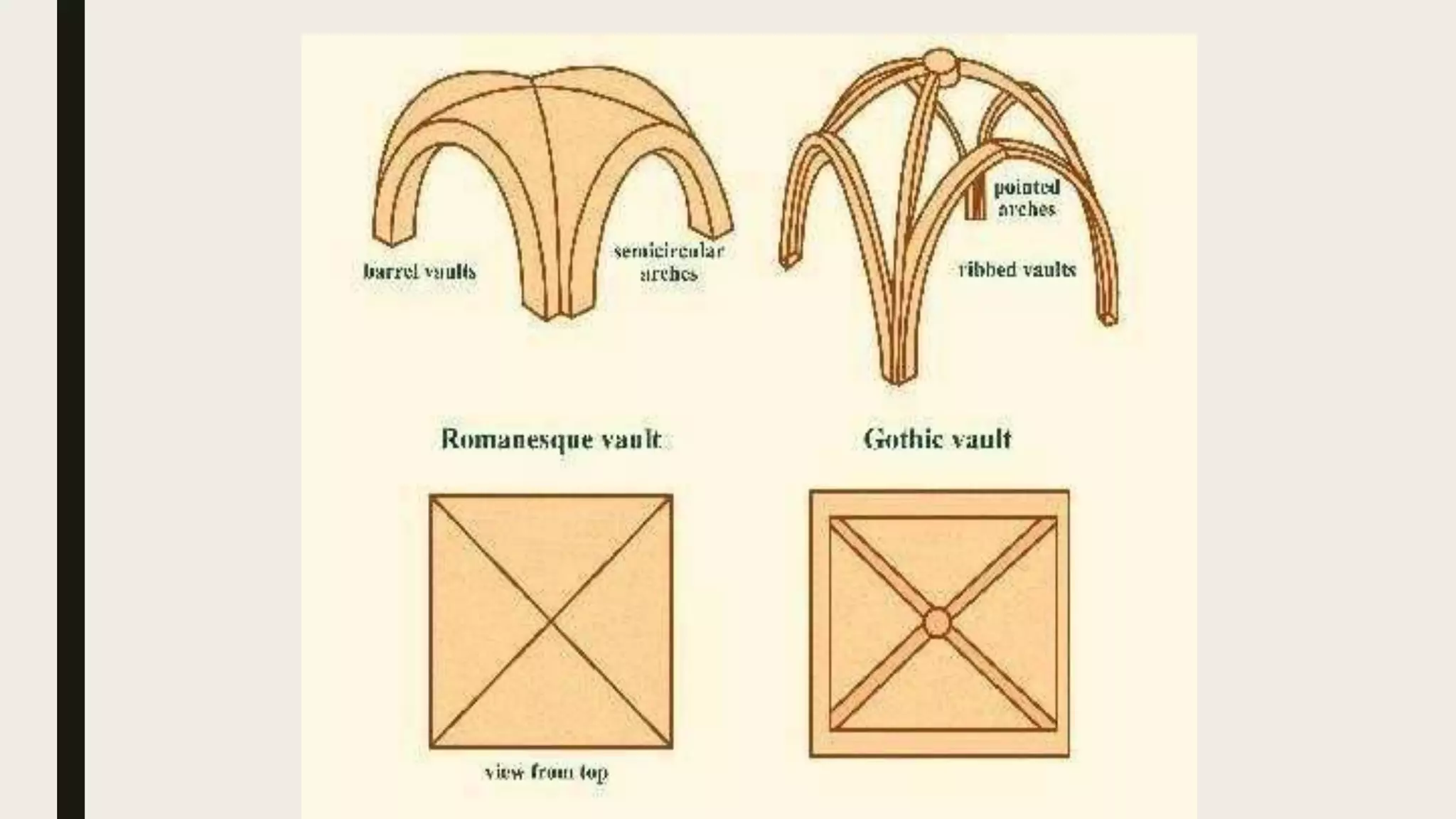
RibbedVaulting
• Earlier Romanesque
churches relied on
barrel vaulting.
• Gothic builders
introduced the dramatic
technique of ribbed
vaulting.
• While barrel
vaulting carried
weight on
continuous solid
walls, ribbed vaulting
used columns to
support the weight.
• The ribs also delineated
the vaults and gave a
GothicArchitecture:The RibVault
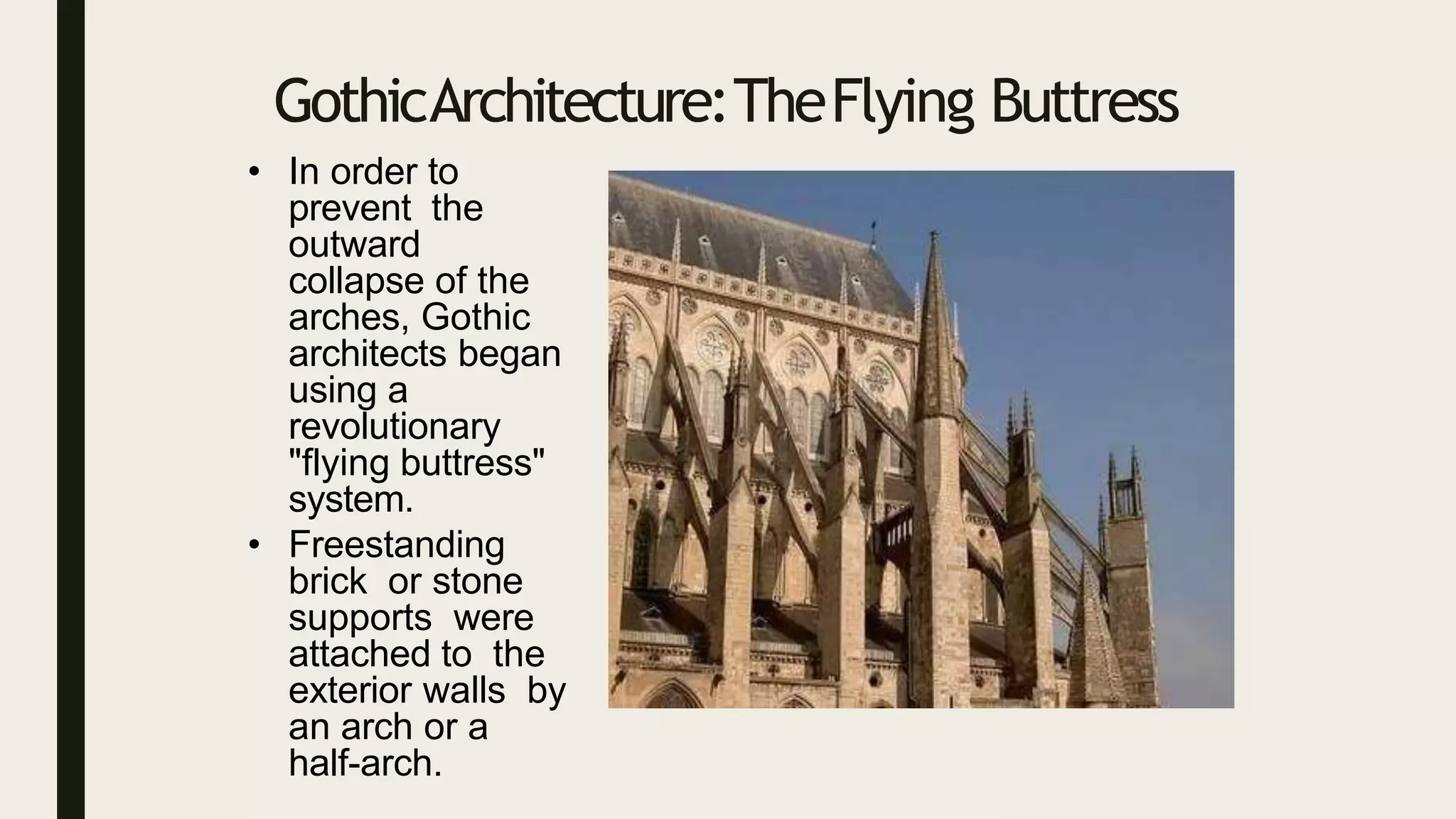
• In order to
prevent the
outward
collapse of the
arches, Gothic
architects began
using a
revolutionary
"flying buttress"
system.
• Freestanding
brick or stone
supports were
attached to the
exterior walls by
an arch or a
half-arch.
GothicArchitecture:TheFlying Buttress
GothicArchitecture:The Flying
Buttress
• Flying Buttress
– Effected by powerful
external arches swung
above the side aisles and
the ambulatory
• Arches rise from
colossal freestanding
piers
– Absorb and channel
disruptive forces, such as
wind and weight, safely to
the ground
– Towering piers could be
erected without much
GothicArchitecture:The Flying
Buttress
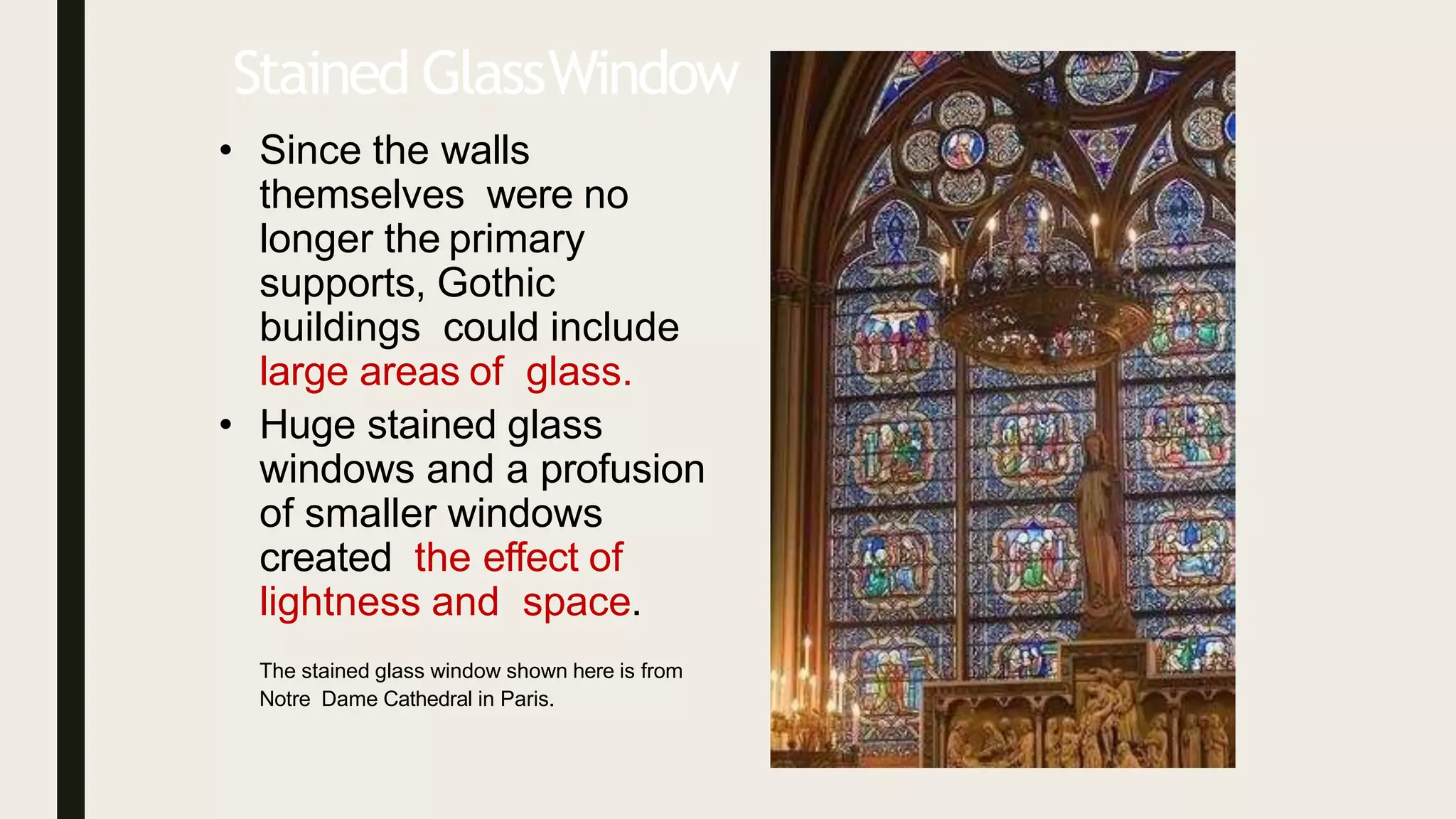
Stained GlassWindow
• Since the walls
themselves were no
longer the primary
supports, Gothic
buildings could include
large areas of glass.
• Huge stained glass
windows and a profusion
of smaller windows
created the effect of
lightness and space.
The stained glass window shown here is from
Notre Dame Cathedral in Paris.
Gargoyle
s
• Cathedrals in the High Gothic
style
became increasingly elaborate.
• Over several centuries, builders
added towers, pinnacles, and
hundreds of sculptures.
• In addition to religious figures,
many Gothic cathedrals are
heavily ornamented with strange,
leering creatures.
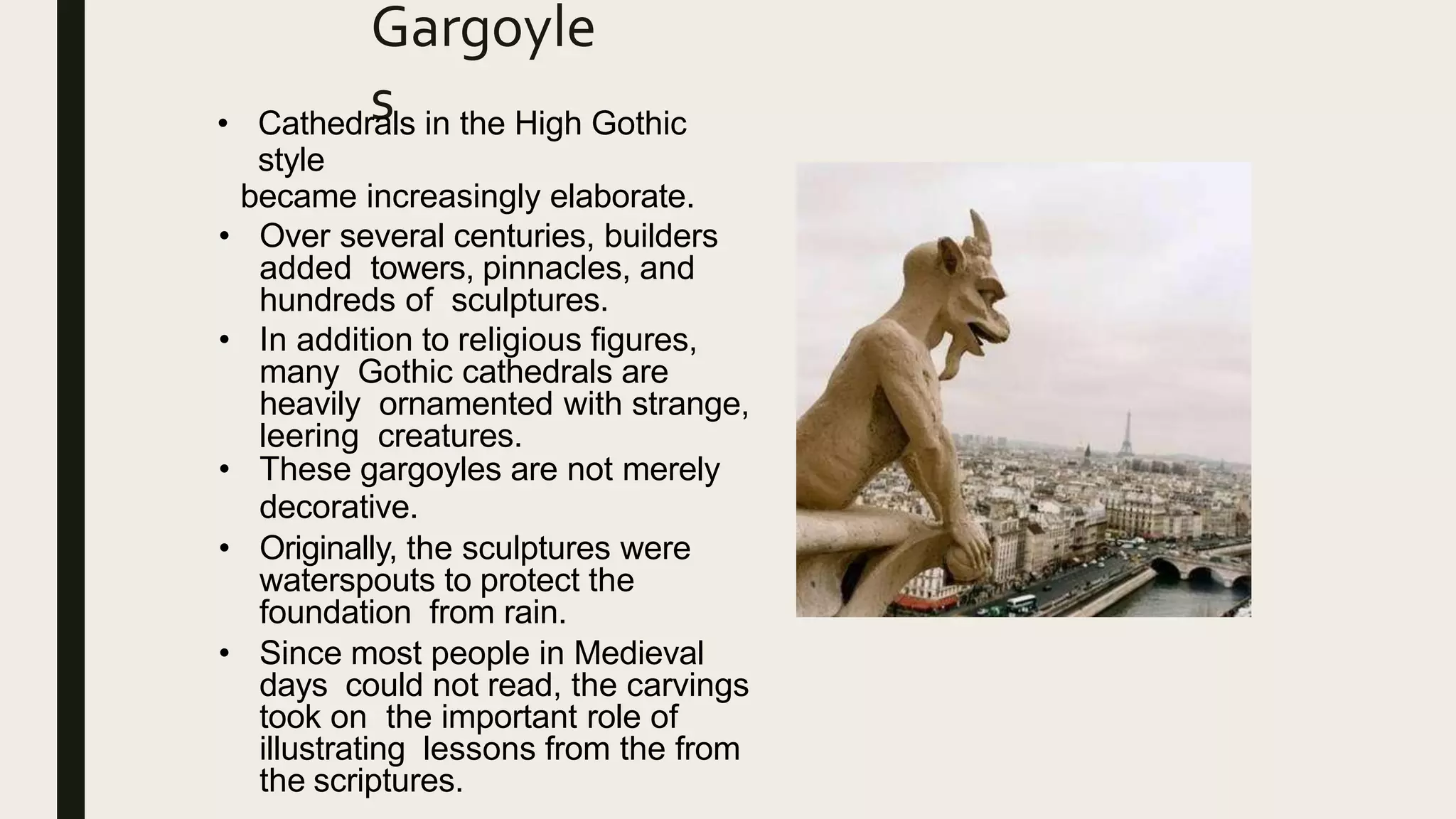
• These gargoyles are not merely
decorative.
• Originally, the sculptures were
waterspouts to protect the
foundation from rain.
• Since most people in Medieval
days could not read, the carvings
took on the important role of
illustrating lessons from the from
the scriptures.
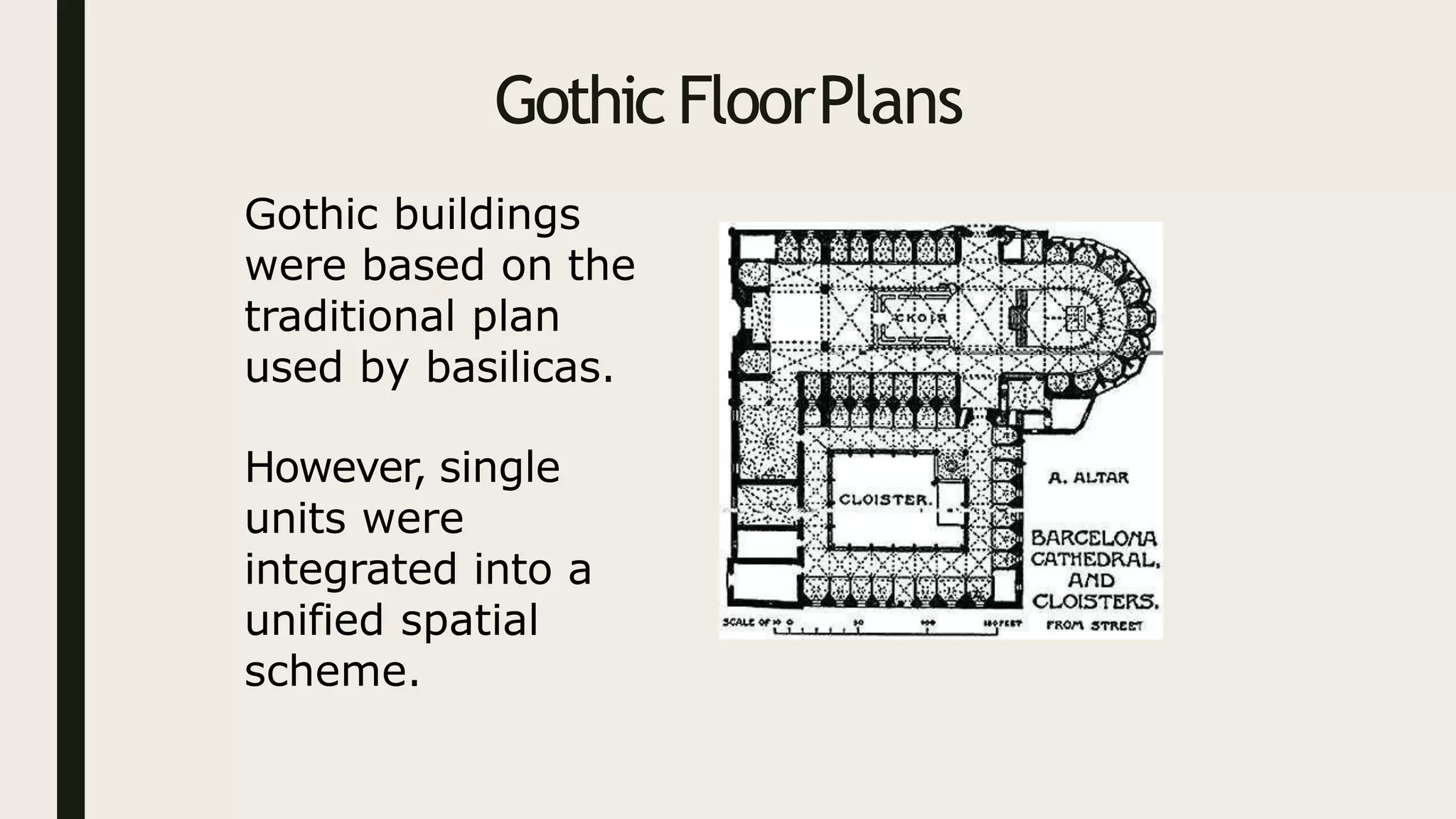
Gothic FloorPlans
Gothic buildings
were based on the
traditional plan
used by basilicas.
However, single
units were
integrated into a
unified spatial
scheme.
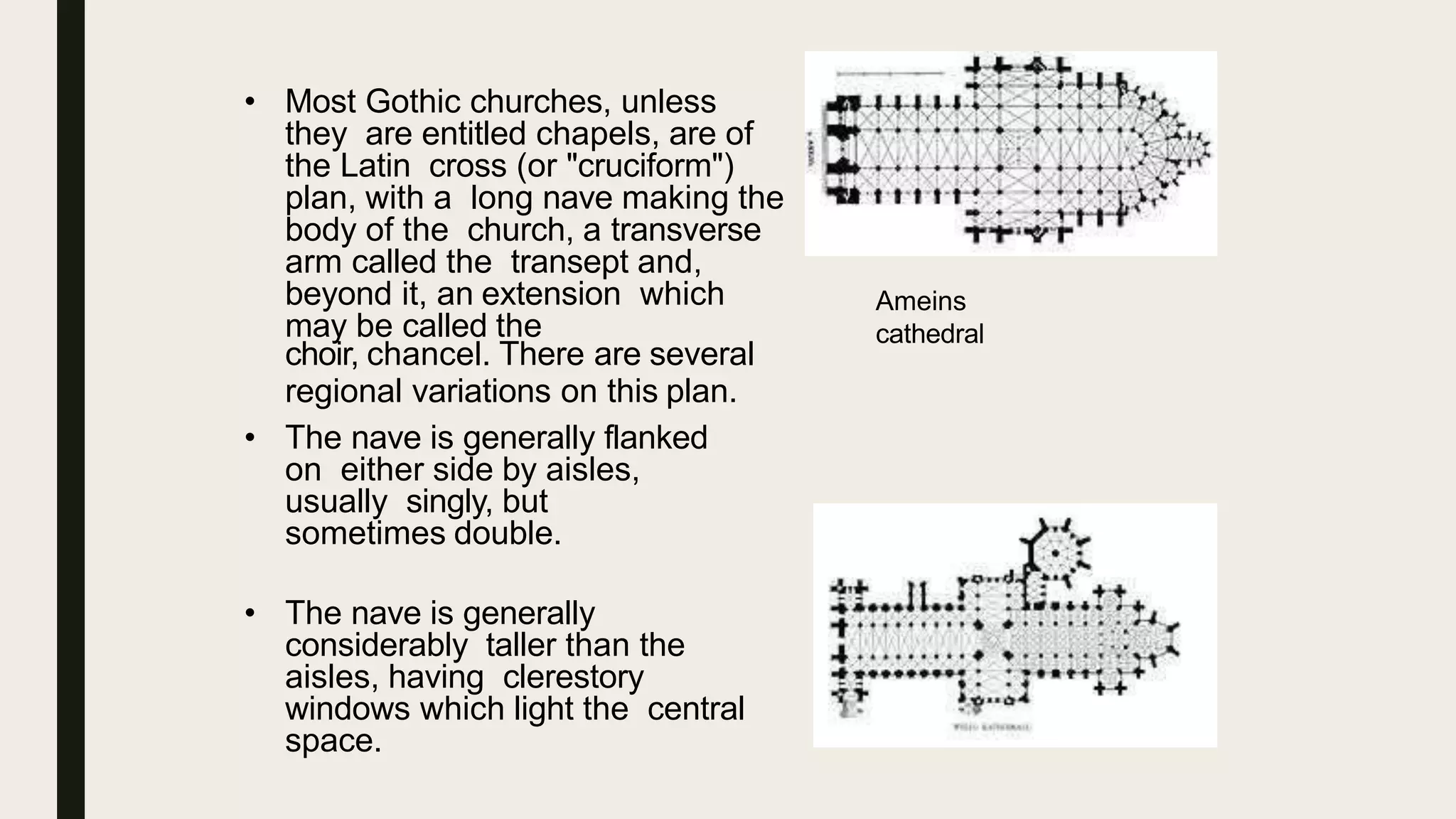
• Most Gothic churches, unless
they are entitled chapels, are of
the Latin cross (or "cruciform")
plan, with a long nave making the
body of the church, a transverse
arm called the transept and,
beyond it, an extension which
may be called the
choir, chancel. There are several
regional variations on this plan.
Ameins
cathedral
• The nave is generally flanked
on either side by aisles,
usually singly, but
sometimes double.
• The nave is generally
considerably taller than the
aisles, having clerestory
windows which light the central
space.
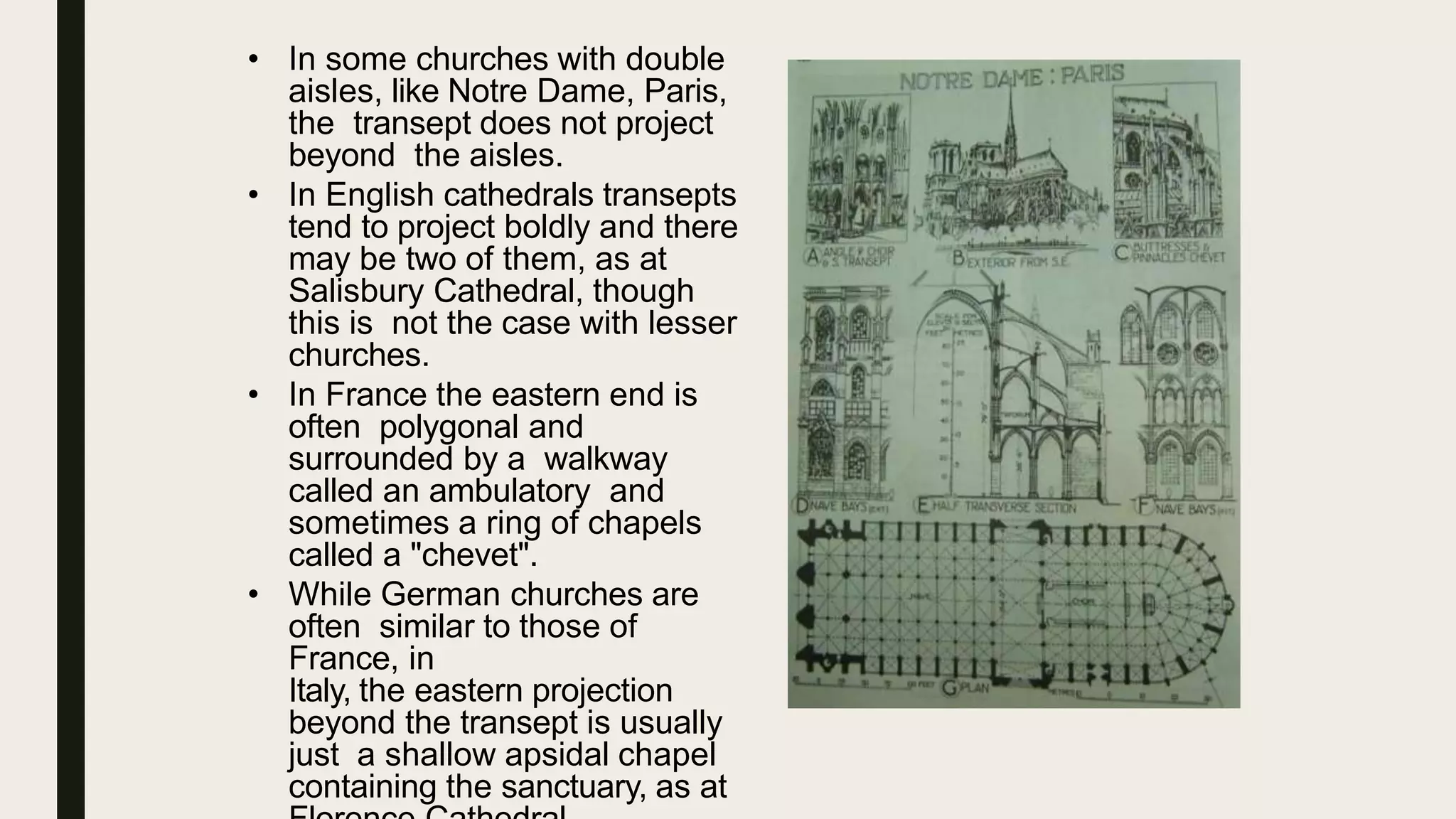
• In some churches with double
aisles, like Notre Dame, Paris,
the transept does not project
beyond the aisles.
• In English cathedrals transepts
tend to project boldly and there
may be two of them, as at
Salisbury Cathedral, though
this is not the case with lesser
churches.
• In France the eastern end is
often polygonal and
surrounded by a walkway
called an ambulatory and
sometimes a ring of chapels
called a "chevet".
• While German churches are
often similar to those of
France, in
Italy, the eastern projection
beyond the transept is usually
just a shallow apsidal chapel
containing the sanctuary, as at
GothicEngineering
• Medieval man considered
himself an imperfect
reflection of the divine light
of God, and Gothic
architecture was the ideal
expression of this view.
• New techniques of
construction permitted
buildings to soar to
amazing new heights,
dwarfing anyone who
stepped inside.
• Moreover, the concept of
divine light was suggested
by the airy quality of
Gothic buildings, which
were much lighter than
churches in the earlier
THANKYOU
BY:VISHAKA BOTHRA

Characteristics of Gothic Architecture

  • 1.
  • 2.
    GothicArchitecture (12 – 15thcentury) Gothic architecture began mainly in France, where architects were inspired by Romanesque architecture and the pointed arches of Spanish Moorish architecture. It's easy to recognise Gothic buildings because of their arches, ribbed vaulting, flying buttresses, elaborate sculptures (like gargoyles) and stained glass windows. Gothic architecture was originally known as “French Style”. During the period of Renaissance it fell out of fashion and it wasnot respected by many artists. They marked it as “Gothic” to suggest it was the crude work of German barbarians (Goths). Examples of Gothic architecture: Notre Dame Cathedral in Parisand St. Patrick's Cathedral in Dublin.
  • 3.
    Gothic Architecture • Meaning ofGothic – “DarkAge” • Invading barbarians from the north ruined ancient art and replaced it with their own culture – Goths took Rome in 410 • little damage but became known as the first tribe of barbarians and thus thename“Gothic”
  • 4.
    GothicArchitecture • Characteristics – Structural •Skeletal stone structure – Visual • Visual arts were important including the role of light in structures – Symbolic • Scholasticism – Translations of real events into stone and glass • Cathedrals served as an image of heaven
  • 5.
    Structure of atypicalGothic Church
  • 6.
    Characteristics ofGothic architecture •airy and bright • focus on verticality • pointed arches • rib vaults • flying buttresses • large stained glass windows • ornaments and pinnacles
  • 7.
    PointedArch • Gothic architectureis not merely about ornamentation. • The Gothic style brought innovative new construction techniques that allowed churches and other buildings to reach great heights. • One important innovation was the use of pointed arches. • Earlier Romanesque churches had pointed arches, but builders didn't capitalize on the shape. • During the Gothic era, builders discovered that pointed arches would give structures amazing strength
  • 8.
    GothicArchitecture:The Pointed Arch • Buildersturned from the semicircular, unbroken arch to the pointed arch – Looked lighter and pointed upward – Exert less thrust than semicircular arch of the same span – Solves geometric difficulty inherent in ribbed vaults • Impossible to arrange all arches and ribs to a common level using exclusively semicircular ribs • With a pointed arch, ribs could easily be made
  • 9.
  • 10.
    The RibVault • RibVaults – Organic metaphor alluding to the role of ribs in anatomy as the body’s skeletal structure supporting tissues – Arches, usually three pairs per rectangular bay, running diagonally • Cross ribs act together with outer frame to create a complete armature of arches along the edges and main folds of the vault
  • 11.
    RibbedVaulting • Earlier Romanesque churchesrelied on barrel vaulting. • Gothic builders introduced the dramatic technique of ribbed vaulting. • While barrel vaulting carried weight on continuous solid walls, ribbed vaulting used columns to support the weight. • The ribs also delineated the vaults and gave a
  • 12.
  • 15.
    • In orderto prevent the outward collapse of the arches, Gothic architects began using a revolutionary "flying buttress" system. • Freestanding brick or stone supports were attached to the exterior walls by an arch or a half-arch. GothicArchitecture:TheFlying Buttress
  • 16.
    GothicArchitecture:The Flying Buttress • FlyingButtress – Effected by powerful external arches swung above the side aisles and the ambulatory • Arches rise from colossal freestanding piers – Absorb and channel disruptive forces, such as wind and weight, safely to the ground – Towering piers could be erected without much
  • 17.
  • 18.
    Stained GlassWindow • Sincethe walls themselves were no longer the primary supports, Gothic buildings could include large areas of glass. • Huge stained glass windows and a profusion of smaller windows created the effect of lightness and space. The stained glass window shown here is from Notre Dame Cathedral in Paris.
  • 19.
    Gargoyle s • Cathedrals inthe High Gothic style became increasingly elaborate. • Over several centuries, builders added towers, pinnacles, and hundreds of sculptures. • In addition to religious figures, many Gothic cathedrals are heavily ornamented with strange, leering creatures. • These gargoyles are not merely decorative. • Originally, the sculptures were waterspouts to protect the foundation from rain. • Since most people in Medieval days could not read, the carvings took on the important role of illustrating lessons from the from the scriptures.
  • 21.
    Gothic FloorPlans Gothic buildings werebased on the traditional plan used by basilicas. However, single units were integrated into a unified spatial scheme.
  • 22.
    • Most Gothicchurches, unless they are entitled chapels, are of the Latin cross (or "cruciform") plan, with a long nave making the body of the church, a transverse arm called the transept and, beyond it, an extension which may be called the choir, chancel. There are several regional variations on this plan. Ameins cathedral • The nave is generally flanked on either side by aisles, usually singly, but sometimes double. • The nave is generally considerably taller than the aisles, having clerestory windows which light the central space.
  • 23.
    • In somechurches with double aisles, like Notre Dame, Paris, the transept does not project beyond the aisles. • In English cathedrals transepts tend to project boldly and there may be two of them, as at Salisbury Cathedral, though this is not the case with lesser churches. • In France the eastern end is often polygonal and surrounded by a walkway called an ambulatory and sometimes a ring of chapels called a "chevet". • While German churches are often similar to those of France, in Italy, the eastern projection beyond the transept is usually just a shallow apsidal chapel containing the sanctuary, as at
  • 24.
    GothicEngineering • Medieval manconsidered himself an imperfect reflection of the divine light of God, and Gothic architecture was the ideal expression of this view. • New techniques of construction permitted buildings to soar to amazing new heights, dwarfing anyone who stepped inside. • Moreover, the concept of divine light was suggested by the airy quality of Gothic buildings, which were much lighter than churches in the earlier
  • 26.