BUDDHISMBUDDHISM
A system of self-sacrifice and self-restraint, preaching the effort to
end human sufferings by living a life free from desires and
passions.
Council of Rajagriha held in 477 B.C. , after the death of Buddha
settled the sacred texts.
Places of pilgrimage grew up, initially around objects associated
with the Buddha, and relics of him and his disciples, most famous
being at Nalanda,Bihar
255 B.C. , Asoka inaugrated Buddhism as the state religion of the
country
Asoka sent his missionaries including his son, Mahindra to foreign
countries to preach the religion
By 13th
century Buddhism was well established in the Far East and
in Indian sub-continent it spread to Sri Lanka & Himalayan valleys.
StupasStupas
The basic form is a solid domical mound crowned
by a parasol.
Contained relics of the Buddha, his disciples or of
saints.
Spherical dome symbolises the infinite sky, the
abode of God
The more monumental stupas were surrounded by
a railing (vedika) with gateways (toranas) at the
cardinal points.
The railing- horizontal bars of lenticular section
mortised into the uprights.
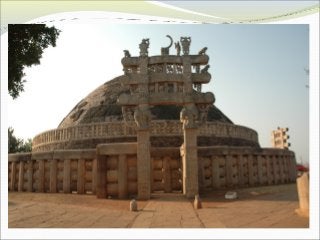
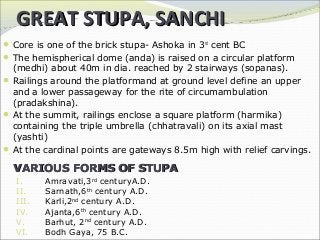
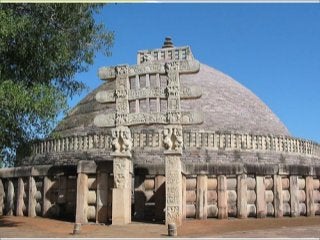
GREAT STUPA, SANCHIGREAT STUPA, SANCHI
Core is one of the brick stupa- Ashoka in 3rd
cent BC
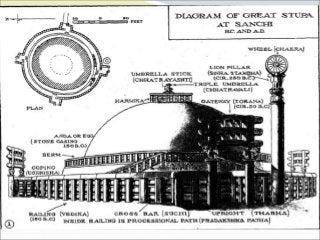
The hemispherical dome (anda) is raised on a circular platform
(medhi) about 40m in dia. reached by 2 stairways (sopanas).
Railings around the platformand at ground level define an upper
and a lower passageway for the rite of circumambulation
(pradakshina).
At the summit, railings enclose a square platform (harmika)
containing the triple umbrella (chhatravali) on its axial mast
(yashti)
At the cardinal points are gateways 8.5m high with relief carvings.
VARIOUS FORMS OF STUPAVARIOUS FORMS OF STUPA
I. Amravati,3rd
centuryA.D.
II. Sarnath,6th
century A.D.
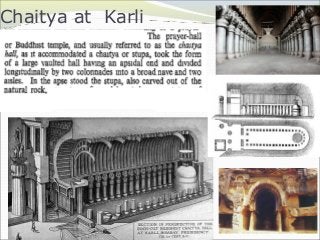
III. Karli,2nd
century A.D.
IV. Ajanta,6th
century A.D.
V. Barhut, 2nd
century A.D.
VI. Bodh Gaya, 75 B.C.
CHAITYASCHAITYAS
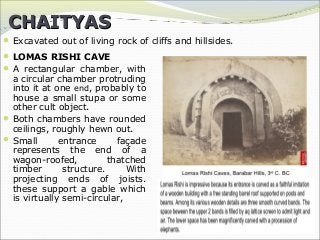
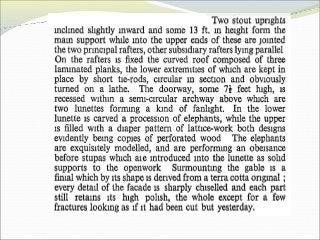
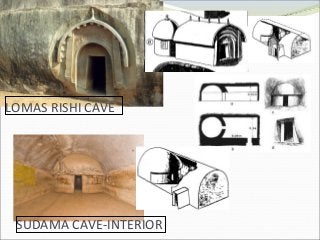
LOMAS RISHI CAVE
A rectangular chamber, with
a circular chamber protruding
into it at one end, probably to
house a small stupa or some
other cult object.
Both chambers have rounded
ceilings, roughly hewn out.
Small entrance façade
represents the end of a
wagon-roofed, thatched
timber structure. With
projecting ends of joists.
these support a gable which
is virtually semi-circular,
Excavated out of living rock of cliffs and hillsides.
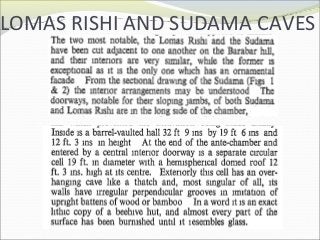
LOMAS RISHI AND SUDAMA CAVES
LOMAS RISHI CAVE
SUDAMA CAVE-INTERIOR
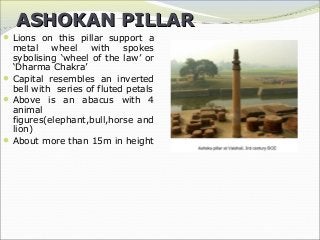
ASHOKAN PILLARASHOKAN PILLAR
Lions on this pillar support a
metal wheel with spokes
sybolising ‘wheel of the law’ or
‘Dharma Chakra’
Capital resembles an inverted
bell with series of fluted petals
Above is an abacus with 4
animal
figures(elephant,bull,horse and
lion)
About more than 15m in height
Chaitya at Karli
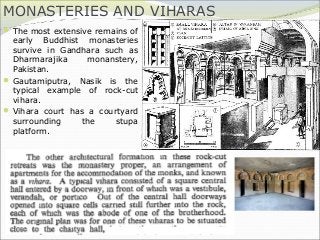
MONASTERIES AND VIHARAS
 The most extensive remains of
early Buddhist monasteries
survive in Gandhara such as
Dharmarajika monanstery,
Pakistan.
 Gautamiputra, Nasik is the
typical example of rock-cut
vihara.
 Vihara court has a courtyard
surrounding the stupa
platform.

Buddhist

  • 2.
    BUDDHISMBUDDHISM A system ofself-sacrifice and self-restraint, preaching the effort to end human sufferings by living a life free from desires and passions. Council of Rajagriha held in 477 B.C. , after the death of Buddha settled the sacred texts. Places of pilgrimage grew up, initially around objects associated with the Buddha, and relics of him and his disciples, most famous being at Nalanda,Bihar 255 B.C. , Asoka inaugrated Buddhism as the state religion of the country Asoka sent his missionaries including his son, Mahindra to foreign countries to preach the religion By 13th century Buddhism was well established in the Far East and in Indian sub-continent it spread to Sri Lanka & Himalayan valleys.
  • 3.
    StupasStupas The basic formis a solid domical mound crowned by a parasol. Contained relics of the Buddha, his disciples or of saints. Spherical dome symbolises the infinite sky, the abode of God The more monumental stupas were surrounded by a railing (vedika) with gateways (toranas) at the cardinal points. The railing- horizontal bars of lenticular section mortised into the uprights.
  • 5.
    GREAT STUPA, SANCHIGREATSTUPA, SANCHI Core is one of the brick stupa- Ashoka in 3rd cent BC The hemispherical dome (anda) is raised on a circular platform (medhi) about 40m in dia. reached by 2 stairways (sopanas). Railings around the platformand at ground level define an upper and a lower passageway for the rite of circumambulation (pradakshina). At the summit, railings enclose a square platform (harmika) containing the triple umbrella (chhatravali) on its axial mast (yashti) At the cardinal points are gateways 8.5m high with relief carvings. VARIOUS FORMS OF STUPAVARIOUS FORMS OF STUPA I. Amravati,3rd centuryA.D. II. Sarnath,6th century A.D. III. Karli,2nd century A.D. IV. Ajanta,6th century A.D. V. Barhut, 2nd century A.D. VI. Bodh Gaya, 75 B.C.
  • 8.
    CHAITYASCHAITYAS LOMAS RISHI CAVE Arectangular chamber, with a circular chamber protruding into it at one end, probably to house a small stupa or some other cult object. Both chambers have rounded ceilings, roughly hewn out. Small entrance façade represents the end of a wagon-roofed, thatched timber structure. With projecting ends of joists. these support a gable which is virtually semi-circular, Excavated out of living rock of cliffs and hillsides.
  • 9.
    LOMAS RISHI ANDSUDAMA CAVES
  • 11.
  • 12.
    ASHOKAN PILLARASHOKAN PILLAR Lionson this pillar support a metal wheel with spokes sybolising ‘wheel of the law’ or ‘Dharma Chakra’ Capital resembles an inverted bell with series of fluted petals Above is an abacus with 4 animal figures(elephant,bull,horse and lion) About more than 15m in height
  • 13.
  • 14.
    MONASTERIES AND VIHARAS The most extensive remains of early Buddhist monasteries survive in Gandhara such as Dharmarajika monanstery, Pakistan.  Gautamiputra, Nasik is the typical example of rock-cut vihara.  Vihara court has a courtyard surrounding the stupa platform.