BAROQUE ARCHITECTURE
Revision
Cronology and geography
• From the end of 16th century until 1750.
• Geography: whole Europe+ America.
• Characteristics of the period:
–
–
–
–

Religious and political conflicts
Geographical colonization
Scientific development
New astrological discoveries Sun centre of Universe
Baroque Style
• The word means imperfection
• New naturalism that reflects the scientific
advances
• Taste for dramatic action and emotion:
–
–
–
–
–

Colour and light contrasted
Rich textures
Asymmetrical spaces
Diagonal plans
New subjects: landscape, genre, still-life
Baroque Style
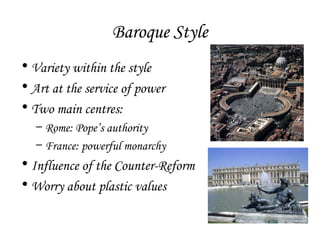
• Variety within the style
• Art at the service of power
• Two main centres:
– Rome: Pope’s authority
– France: powerful monarchy

• Influence of the Counter-Reform
• Worry about plastic values
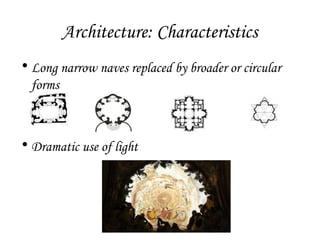
Architecture: Characteristics
• Long narrow naves replaced by broader or circular
forms

• Dramatic use of light
Architecture: Characteristics
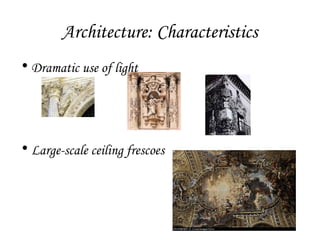
• Dramatic use of light

• Large-scale ceiling frescoes
Architecture: Characteristics
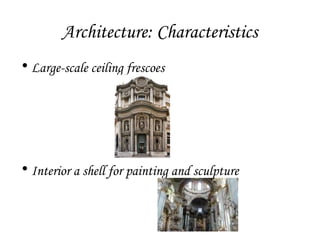
• Large-scale ceiling frescoes

• Interior a shell for painting and sculpture
Architecture: Characteristics
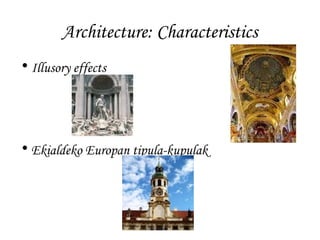
• Illusory effects

• Ekialdeko Europan tipula-kupulak
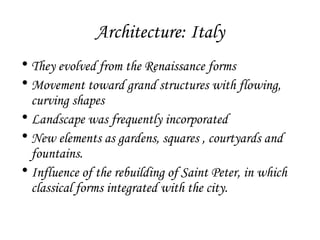
Architecture: Italy
• They evolved from the Renaissance forms
• Movement toward grand structures with flowing,
curving shapes
• Landscape was frequently incorporated
• New elements as gardens, squares , courtyards and
fountains.
• Influence of the rebuilding of Saint Peter, in which
classical forms integrated with the city.
Architecture: Italy
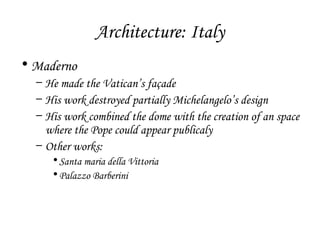
• Maderno
– He made the Vatican’s façade
– His work destroyed partially Michelangelo’s design
– His work combined the dome with the creation of an space
where the Pope could appear publicaly
– Other works:
• Santa maria della Vittoria
• Palazzo Barberini
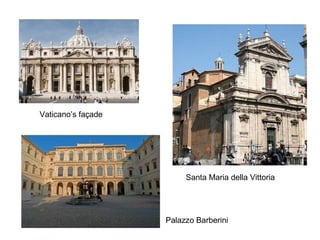
Vaticano’s façade

Santa Maria della Vittoria

Palazzo Barberini
Architecture: Italy
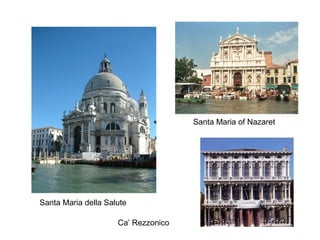
• Longhena
– He worked mainly in Venice
– His design was selected for building Santa Maria della
Salute
– It is building of central plan with a great dome that
became the symbol of Venice.
Santa Maria of Nazaret

Santa Maria della Salute
Ca’ Rezzonico
Architecture: Italy
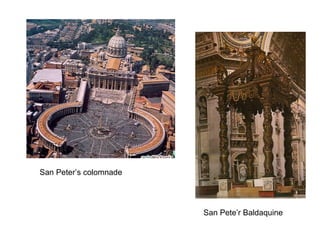
• Bernini
– He created a fusion of architecture, painting and sculpture
– He used false perspective and trompe-l’ oeil to impact
– He used a palace façade that became a model with massive pilasters
above a rusticated base.
– Works:
• Saint Peter’s square
• Baldaquin
San Peter’s colomnade

San Pete’r Baldaquine
Architecture: Italy
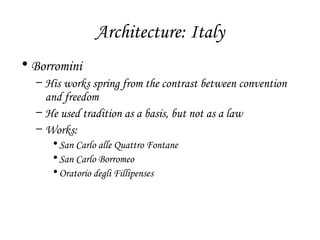
• Borromini
– His works spring from the contrast between convention
and freedom
– He used tradition as a basis, but not as a law
– Works:
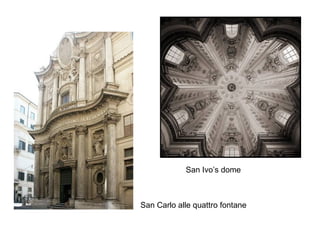
• San Carlo alle Quattro Fontane
• San Carlo Borromeo
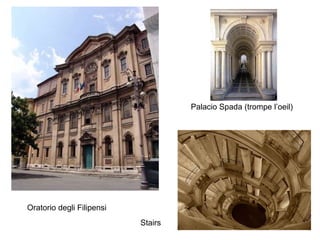
• Oratorio degli Fillipenses
San Ivo’s dome

San Carlo alle quattro fontane
Palacio Spada (trompe l’oeil)

Oratorio degli Filipensi
Stairs
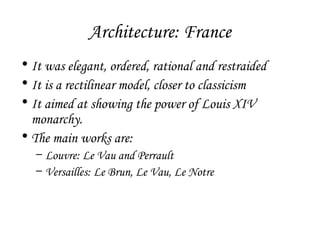
Architecture: France
• It was elegant, ordered, rational and restraided
• It is a rectilinear model, closer to classicism
• It aimed at showing the power of Louis XIV
monarchy.
• The main works are:
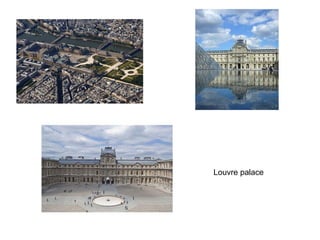
– Louvre: Le Vau and Perrault
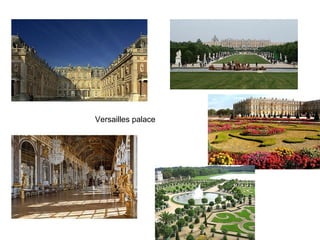
– Versailles: Le Brun, Le Vau, Le Notre
Louvre palace
Versailles palace
Architecture: Central Europe
• It began later due to the Thirty Years’ War
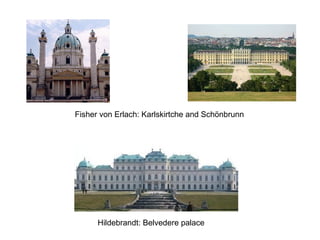
• Austria developed the Imperial style with Fischer von Erlach
and Hildebrandt
• In Germany, in the Catholic South Jesuit models were
followed while in the Protestant North works were less
important
• Palace architecture was important in the whole area
Fisher von Erlach: Karlskirtche and Schönbrunn

Hildebrandt: Belvedere palace
Architecture: England and Russia
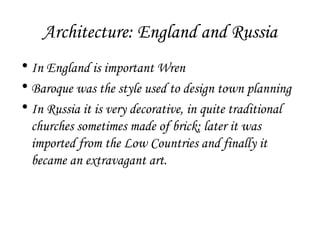
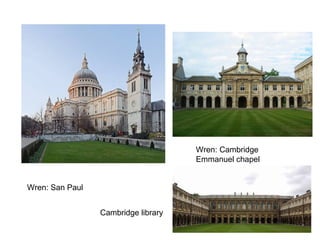
• In England is important Wren
• Baroque was the style used to design town planning
• In Russia it is very decorative, in quite traditional
churches sometimes made of brick; later it was
imported from the Low Countries and finally it
became an extravagant art.
Wren: Cambridge
Emmanuel chapel
Wren: San Paul
Cambridge library
Architecture: Spain
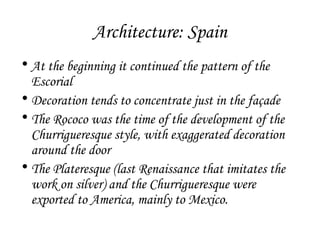
• At the beginning it continued the pattern of the
Escorial
• Decoration tends to concentrate just in the façade
• The Rococo was the time of the development of the
Churrigueresque style, with exaggerated decoration
around the door
• The Plateresque (last Renaissance that imitates the
work on silver) and the Churrigueresque were
exported to America, mainly to Mexico.
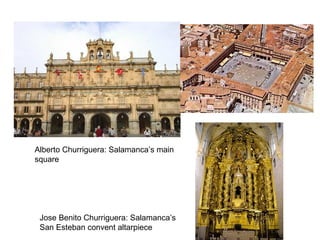
Alberto Churriguera: Salamanca’s main
square

Jose Benito Churriguera: Salamanca’s
San Esteban convent altarpiece
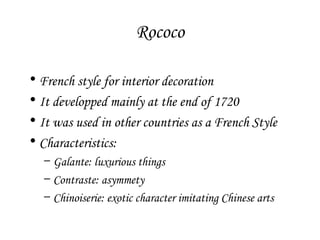
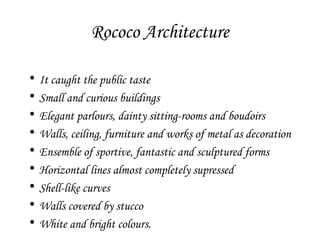
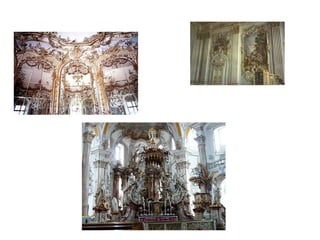
Rococo
• French style for interior decoration
• It developped mainly at the end of 1720
• It was used in other countries as a French Style
• Characteristics:
– Galante: luxurious things
– Contraste: asymmety
– Chinoiserie: exotic character imitating Chinese arts
Rococo Architecture
•
•
•
•
•
•
•
•
•

It caught the public taste
Small and curious buildings
Elegant parlours, dainty sitting-rooms and boudoirs
Walls, ceiling, furniture and works of metal as decoration
Ensemble of sportive, fantastic and sculptured forms
Horizontal lines almost completely supressed
Shell-like curves
Walls covered by stucco
White and bright colours.
Baroque architecture

Baroque architecture

  • 1.
  • 2.
    Cronology and geography •From the end of 16th century until 1750. • Geography: whole Europe+ America. • Characteristics of the period: – – – – Religious and political conflicts Geographical colonization Scientific development New astrological discoveries Sun centre of Universe
  • 3.
    Baroque Style • Theword means imperfection • New naturalism that reflects the scientific advances • Taste for dramatic action and emotion: – – – – – Colour and light contrasted Rich textures Asymmetrical spaces Diagonal plans New subjects: landscape, genre, still-life
  • 4.
    Baroque Style • Varietywithin the style • Art at the service of power • Two main centres: – Rome: Pope’s authority – France: powerful monarchy • Influence of the Counter-Reform • Worry about plastic values
  • 5.
    Architecture: Characteristics • Longnarrow naves replaced by broader or circular forms • Dramatic use of light
  • 6.
    Architecture: Characteristics • Dramaticuse of light • Large-scale ceiling frescoes
  • 7.
    Architecture: Characteristics • Large-scaleceiling frescoes • Interior a shell for painting and sculpture
  • 8.
    Architecture: Characteristics • Illusoryeffects • Ekialdeko Europan tipula-kupulak
  • 9.
    Architecture: Italy • Theyevolved from the Renaissance forms • Movement toward grand structures with flowing, curving shapes • Landscape was frequently incorporated • New elements as gardens, squares , courtyards and fountains. • Influence of the rebuilding of Saint Peter, in which classical forms integrated with the city.
  • 10.
    Architecture: Italy • Maderno –He made the Vatican’s façade – His work destroyed partially Michelangelo’s design – His work combined the dome with the creation of an space where the Pope could appear publicaly – Other works: • Santa maria della Vittoria • Palazzo Barberini
  • 11.
    Vaticano’s façade Santa Mariadella Vittoria Palazzo Barberini
  • 12.
    Architecture: Italy • Longhena –He worked mainly in Venice – His design was selected for building Santa Maria della Salute – It is building of central plan with a great dome that became the symbol of Venice.
  • 13.
    Santa Maria ofNazaret Santa Maria della Salute Ca’ Rezzonico
  • 14.
    Architecture: Italy • Bernini –He created a fusion of architecture, painting and sculpture – He used false perspective and trompe-l’ oeil to impact – He used a palace façade that became a model with massive pilasters above a rusticated base. – Works: • Saint Peter’s square • Baldaquin
  • 15.
    San Peter’s colomnade SanPete’r Baldaquine
  • 16.
    Architecture: Italy • Borromini –His works spring from the contrast between convention and freedom – He used tradition as a basis, but not as a law – Works: • San Carlo alle Quattro Fontane • San Carlo Borromeo • Oratorio degli Fillipenses
  • 17.
    San Ivo’s dome SanCarlo alle quattro fontane
  • 18.
    Palacio Spada (trompel’oeil) Oratorio degli Filipensi Stairs
  • 19.
    Architecture: France • Itwas elegant, ordered, rational and restraided • It is a rectilinear model, closer to classicism • It aimed at showing the power of Louis XIV monarchy. • The main works are: – Louvre: Le Vau and Perrault – Versailles: Le Brun, Le Vau, Le Notre
  • 20.
  • 21.
  • 22.
    Architecture: Central Europe •It began later due to the Thirty Years’ War • Austria developed the Imperial style with Fischer von Erlach and Hildebrandt • In Germany, in the Catholic South Jesuit models were followed while in the Protestant North works were less important • Palace architecture was important in the whole area
  • 23.
    Fisher von Erlach:Karlskirtche and Schönbrunn Hildebrandt: Belvedere palace
  • 24.
    Architecture: England andRussia • In England is important Wren • Baroque was the style used to design town planning • In Russia it is very decorative, in quite traditional churches sometimes made of brick; later it was imported from the Low Countries and finally it became an extravagant art.
  • 25.
    Wren: Cambridge Emmanuel chapel Wren:San Paul Cambridge library
  • 26.
    Architecture: Spain • Atthe beginning it continued the pattern of the Escorial • Decoration tends to concentrate just in the façade • The Rococo was the time of the development of the Churrigueresque style, with exaggerated decoration around the door • The Plateresque (last Renaissance that imitates the work on silver) and the Churrigueresque were exported to America, mainly to Mexico.
  • 27.
    Alberto Churriguera: Salamanca’smain square Jose Benito Churriguera: Salamanca’s San Esteban convent altarpiece
  • 28.
    Rococo • French stylefor interior decoration • It developped mainly at the end of 1720 • It was used in other countries as a French Style • Characteristics: – Galante: luxurious things – Contraste: asymmety – Chinoiserie: exotic character imitating Chinese arts
  • 29.
    Rococo Architecture • • • • • • • • • It caughtthe public taste Small and curious buildings Elegant parlours, dainty sitting-rooms and boudoirs Walls, ceiling, furniture and works of metal as decoration Ensemble of sportive, fantastic and sculptured forms Horizontal lines almost completely supressed Shell-like curves Walls covered by stucco White and bright colours.