• The people of western Europe who were under the roman empire
formed into separate nations, by the end of 12th century.
• Italy, France, Germany, Spain became independent kingdoms.
• During that period Germany was supposed to be the holy empire.
• England came under Norman kings who possessed large territories
in France where as Russia & Norway were less affected
• The style was characterized by the availability of building
materials.
• Thus in Italy white and colored marble that in England , France
coarse grained stone and in N.Germany bricks determined the
character of the architecture of those countries.
CLIMATIC CONDITION
RELIGIOUS & SOCIAL CONDITION
• Immense power was vested in bishops and popes. As such
power of church increased. Churches became dominant.
• In this period, town and cities developed rapidly and
consequently public buildings were constructed. There were
constant disputes between the papacy and the holy roman
empire. City life developed with great freedom.
HISTORICAL CONDITION
• This includes the loss of possession in France , division of
Germany into number of independent kingdoms.
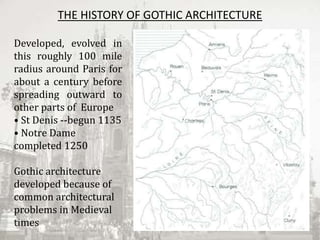
THE HISTORY OF GOTHIC ARCHITECTURE
Developed, evolved in
this roughly 100 mile
radius around Paris for
about a century before
spreading outward to
other parts of Europe
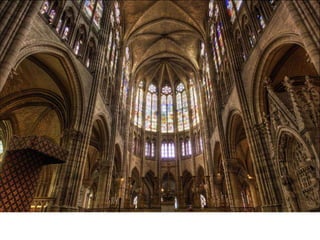
• St Denis ‐‐begun 1135
• Notre Dame
completed 1250
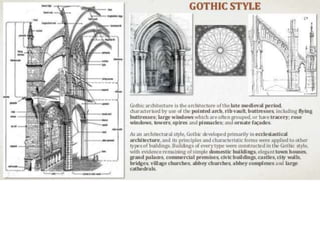
Gothic architecture
developed because of
common architectural
problems in Medieval
times
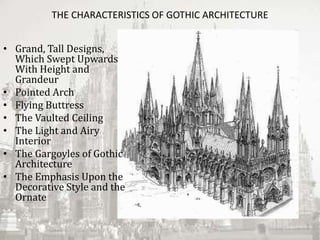
THE CHARACTERISTICS OF GOTHIC ARCHITECTURE
• Grand, Tall Designs,
Which Swept Upwards
With Height and
Grandeur
• Pointed Arch
• Flying Buttress
• The Vaulted Ceiling
• The Light and Airy
Interior
• The Gargoyles of Gothic
Architecture
• The Emphasis Upon the
Decorative Style and the
Ornate
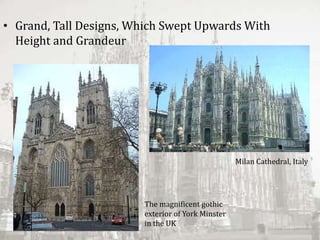
• Grand, Tall Designs, Which Swept Upwards With
Height and Grandeur
The magnificent gothic
exterior of York Minster
in the UK
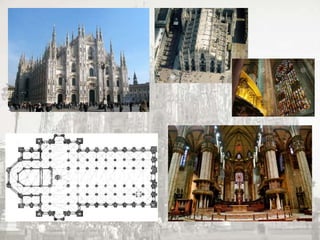
Milan Cathedral, Italy
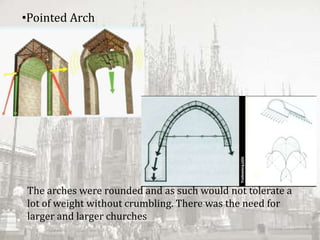
•Pointed Arch
The arches were rounded and as such would not tolerate a
lot of weight without crumbling. There was the need for
larger and larger churches
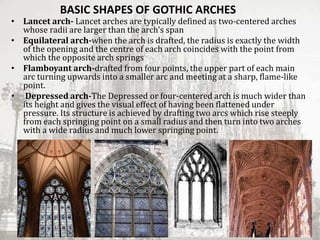
BASIC SHAPES OF GOTHIC ARCHES
• Lancet arch- Lancet arches are typically defined as two-centered arches
whose radii are larger than the arch's span
• Equilateral arch-when the arch is drafted, the radius is exactly the width
of the opening and the centre of each arch coincides with the point from
which the opposite arch springs
• Flamboyant arch-drafted from four points, the upper part of each main
arc turning upwards into a smaller arc and meeting at a sharp, flame-like
point.
• Depressed arch-The Depressed or four-centered arch is much wider than
its height and gives the visual effect of having been flattened under
pressure. Its structure is achieved by drafting two arcs which rise steeply
from each springing point on a small radius and then turn into two arches
with a wide radius and much lower springing point.
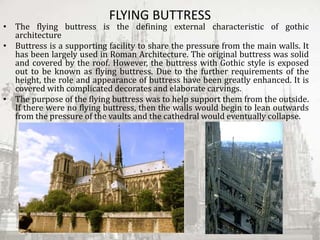
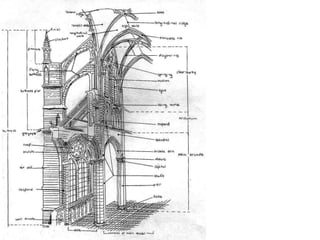
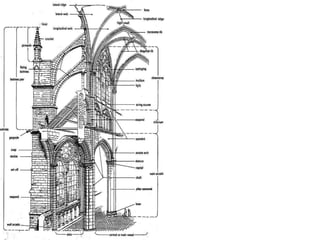
FLYING BUTTRESS
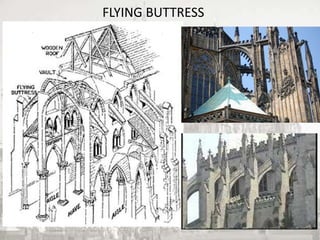
• The flying buttress is the defining external characteristic of gothic
architecture
• Buttress is a supporting facility to share the pressure from the main walls. It
has been largely used in Roman Architecture. The original buttress was solid
and covered by the roof. However, the buttress with Gothic style is exposed
out to be known as flying buttress. Due to the further requirements of the
height, the role and appearance of buttress have been greatly enhanced. It is
covered with complicated decorates and elaborate carvings.
• The purpose of the flying buttress was to help support them from the outside.
If there were no flying buttress, then the walls would begin to lean outwards
from the pressure of the vaults and the cathedral would eventually collapse.
FLYING BUTTRESS
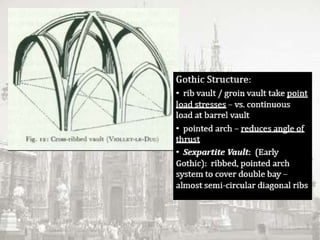
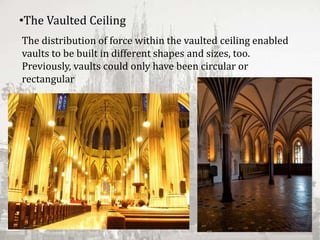
The distribution of force within the vaulted ceiling enabled
vaults to be built in different shapes and sizes, too.
Previously, vaults could only have been circular or
rectangular
•The Vaulted Ceiling
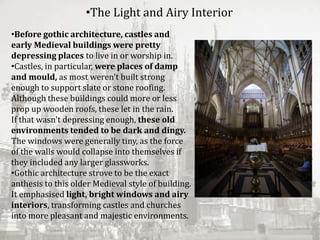
•Before gothic architecture, castles and
early Medieval buildings were pretty
depressing places to live in or worship in.
•Castles, in particular, were places of damp
and mould, as most weren't built strong
enough to support slate or stone roofing.
Although these buildings could more or less
prop up wooden roofs, these let in the rain.
If that wasn't depressing enough, these old
environments tended to be dark and dingy.
The windows were generally tiny, as the force
of the walls would collapse into themselves if
they included any larger glassworks.
•Gothic architecture strove to be the exact
anthesis to this older Medieval style of building.
It emphasised light, bright windows and airy
interiors, transforming castles and churches
into more pleasant and majestic environments.
•The Light and Airy Interior
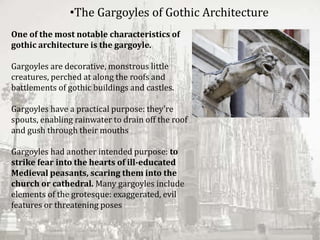
One of the most notable characteristics of
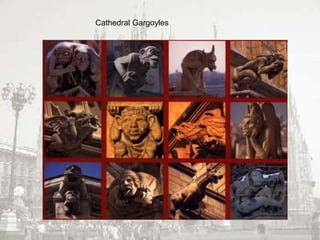
gothic architecture is the gargoyle.
Gargoyles are decorative, monstrous little
creatures, perched at along the roofs and
battlements of gothic buildings and castles.
Gargoyles have a practical purpose: they're
spouts, enabling rainwater to drain off the roof
and gush through their mouths
Gargoyles had another intended purpose: to
strike fear into the hearts of ill-educated
Medieval peasants, scaring them into the
church or cathedral. Many gargoyles include
elements of the grotesque: exaggerated, evil
features or threatening poses
•The Gargoyles of Gothic Architecture
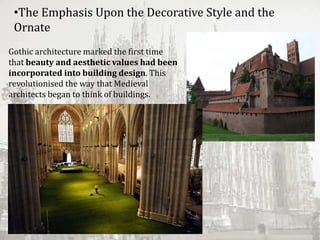
Gothic architecture marked the first time
that beauty and aesthetic values had been
incorporated into building design. This
revolutionised the way that Medieval
architects began to think of buildings.
•The Emphasis Upon the Decorative Style and the
Ornate
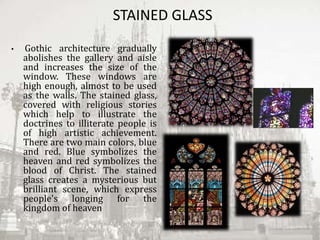
STAINED GLASS
• Gothic architecture gradually
abolishes the gallery and aisle
and increases the size of the
window. These windows are
high enough, almost to be used
as the walls. The stained glass,
covered with religious stories
which help to illustrate the
doctrines to illiterate people is
of high artistic achievement.
There are two main colors, blue
and red. Blue symbolizes the
heaven and red symbolizes the
blood of Christ. The stained
glass creates a mysterious but
brilliant scene, which express
people’s longing for the
kingdom of heaven
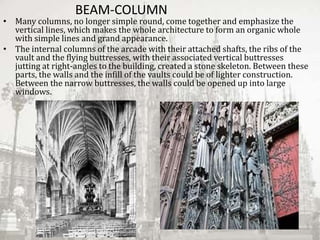
BEAM-COLUMN
• Many columns, no longer simple round, come together and emphasize the
vertical lines, which makes the whole architecture to form an organic whole
with simple lines and grand appearance.
• The internal columns of the arcade with their attached shafts, the ribs of the
vault and the flying buttresses, with their associated vertical buttresses
jutting at right-angles to the building, created a stone skeleton. Between these
parts, the walls and the infill of the vaults could be of lighter construction.
Between the narrow buttresses, the walls could be opened up into large
windows.
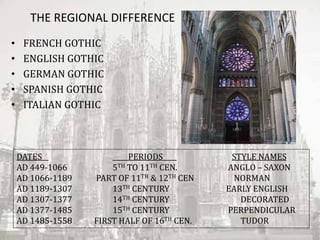
THE REGIONAL DIFFERENCE
• FRENCH GOTHIC
• ENGLISH GOTHIC
• GERMAN GOTHIC
• SPANISH GOTHIC
• ITALIAN GOTHIC
DATES PERIODS STYLE NAMES
AD 449-1066 5TH TO 11TH CEN. ANGLO – SAXON
AD 1066-1189 PART OF 11TH & 12TH CEN NORMAN
AD 1189-1307 13TH CENTURY EARLY ENGLISH
AD 1307-1377 14TH CENTURY DECORATED
AD 1377-1485 15TH CENTURY PERPENDICULAR
AD 1485-1558 FIRST HALF OF 16TH CEN. TUDOR
ANGLO SAXON
• Timber- domestic buildings
• Stone in later time.
• Triangular headed
openings
• Pilaster
• Baluster mullions
NORMAN
• Norman vault- groin or
meeting surfaces of cross
vaults were replaced by
specially constructed
semi- circular ribs.
EARLY ENGLISH
• One pointed arches- less massive
than norman, well defined outlines,
simplicity in ornamentation.
• Tall and narrow openings- height
to design
• Projecting buttresses, pinnacles,
steep pitched roofs
DECORATED
• Geometrical, curvilinear, middle
pointed- more ornate than early
English
• Flowing tracery crowned with
ogee arch-colored glass
windows
• enlarged clerestory, addition of
intermediate ribs.
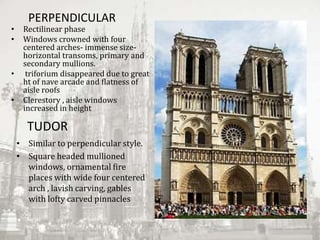
PERPENDICULAR
• Rectilinear phase
• Windows crowned with four
centered arches- immense size-
horizontal transoms, primary and
secondary mullions.
• triforium disappeared due to great
ht of nave arcade and flatness of
aisle roofs
• Clerestory , aisle windows
increased in height
TUDOR
• Similar to perpendicular style.
• Square headed mullioned
windows, ornamental fire
places with wide four centered
arch , lavish carving, gables
with lofty carved pinnacles
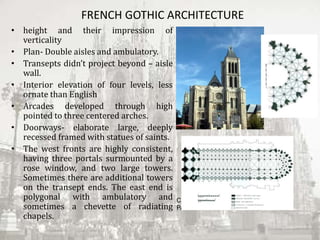
FRENCH GOTHIC ARCHITECTURE
• height and their impression of
verticality
• Plan- Double aisles and ambulatory.
• Transepts didn’t project beyond – aisle
wall.
• Interior elevation of four levels, less
ornate than English
• Arcades developed through high
pointed to three centered arches.
• Doorways- elaborate large, deeply
recessed framed with statues of saints.
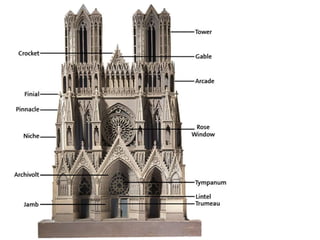
• The west fronts are highly consistent,
having three portals surmounted by a
rose window, and two large towers.
Sometimes there are additional towers
on the transept ends. The east end is
polygonal with ambulatory and
sometimes a chevette of radiating
chapels.
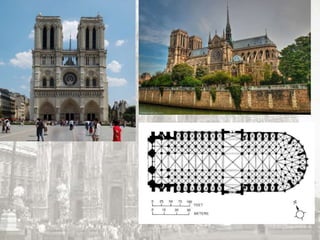
CATHEDRAL OF NOTRE-DAME IN
PARIS
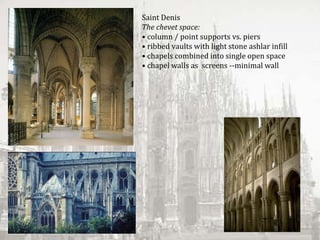
Saint Denis
The chevet space:
• column / point supports vs. piers
• ribbed vaults with light stone ashlar infill
• chapels combined into single open space
• chapel walls as screens ‐‐minimal wall
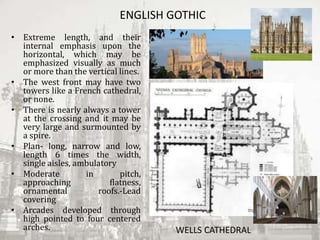
ENGLISH GOTHIC
• Extreme length, and their
internal emphasis upon the
horizontal, which may be
emphasized visually as much
or more than the vertical lines.
• The west front may have two
towers like a French cathedral,
or none.
• There is nearly always a tower
at the crossing and it may be
very large and surmounted by
a spire.
• Plan- long, narrow and low,
length 6 times the width,
single aisles, ambulatory
• Moderate in pitch,
approaching flatness,
ornamental roofs.-Lead
covering
• Arcades developed through
high pointed to four centered
arches. WELLS CATHEDRAL
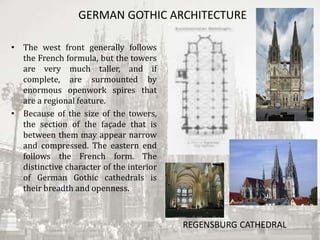
GERMAN GOTHIC ARCHITECTURE
• The west front generally follows
the French formula, but the towers
are very much taller, and if
complete, are surmounted by
enormous openwork spires that
are a regional feature.
• Because of the size of the towers,
the section of the façade that is
between them may appear narrow
and compressed. The eastern end
follows the French form. The
distinctive character of the interior
of German Gothic cathedrals is
their breadth and openness.
REGENSBURG CATHEDRAL
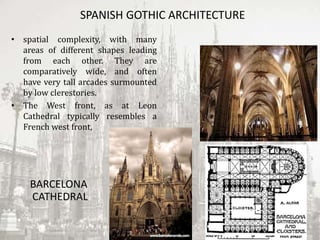
SPANISH GOTHIC ARCHITECTURE
• spatial complexity, with many
areas of different shapes leading
from each other. They are
comparatively wide, and often
have very tall arcades surmounted
by low clerestories.
• The West front, as at Leon
Cathedral typically resembles a
French west front,
BARCELONA
CATHEDRAL
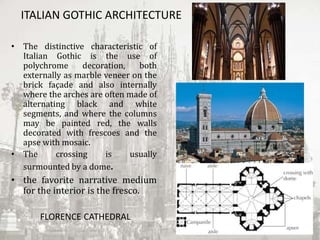
ITALIAN GOTHIC ARCHITECTURE
• The distinctive characteristic of
Italian Gothic is the use of
polychrome decoration, both
externally as marble veneer on the
brick façade and also internally
where the arches are often made of
alternating black and white
segments, and where the columns
may be painted red, the walls
decorated with frescoes and the
apse with mosaic.
• The crossing is usually
surmounted by a dome.
• the favorite narrative medium
for the interior is the fresco.
FLORENCE CATHEDRAL
Cathedral Gargoyles
Gothic mins
Gothic mins
Gothic mins
Gothic mins
Gothic mins
Gothic mins

Gothic mins

  • 2.
    • The peopleof western Europe who were under the roman empire formed into separate nations, by the end of 12th century. • Italy, France, Germany, Spain became independent kingdoms. • During that period Germany was supposed to be the holy empire. • England came under Norman kings who possessed large territories in France where as Russia & Norway were less affected • The style was characterized by the availability of building materials. • Thus in Italy white and colored marble that in England , France coarse grained stone and in N.Germany bricks determined the character of the architecture of those countries.
  • 3.
    CLIMATIC CONDITION RELIGIOUS &SOCIAL CONDITION • Immense power was vested in bishops and popes. As such power of church increased. Churches became dominant. • In this period, town and cities developed rapidly and consequently public buildings were constructed. There were constant disputes between the papacy and the holy roman empire. City life developed with great freedom. HISTORICAL CONDITION • This includes the loss of possession in France , division of Germany into number of independent kingdoms.
  • 4.
    THE HISTORY OFGOTHIC ARCHITECTURE Developed, evolved in this roughly 100 mile radius around Paris for about a century before spreading outward to other parts of Europe • St Denis ‐‐begun 1135 • Notre Dame completed 1250 Gothic architecture developed because of common architectural problems in Medieval times
  • 5.
    THE CHARACTERISTICS OFGOTHIC ARCHITECTURE • Grand, Tall Designs, Which Swept Upwards With Height and Grandeur • Pointed Arch • Flying Buttress • The Vaulted Ceiling • The Light and Airy Interior • The Gargoyles of Gothic Architecture • The Emphasis Upon the Decorative Style and the Ornate
  • 6.
    • Grand, TallDesigns, Which Swept Upwards With Height and Grandeur The magnificent gothic exterior of York Minster in the UK Milan Cathedral, Italy
  • 7.
    •Pointed Arch The archeswere rounded and as such would not tolerate a lot of weight without crumbling. There was the need for larger and larger churches
  • 9.
    BASIC SHAPES OFGOTHIC ARCHES • Lancet arch- Lancet arches are typically defined as two-centered arches whose radii are larger than the arch's span • Equilateral arch-when the arch is drafted, the radius is exactly the width of the opening and the centre of each arch coincides with the point from which the opposite arch springs • Flamboyant arch-drafted from four points, the upper part of each main arc turning upwards into a smaller arc and meeting at a sharp, flame-like point. • Depressed arch-The Depressed or four-centered arch is much wider than its height and gives the visual effect of having been flattened under pressure. Its structure is achieved by drafting two arcs which rise steeply from each springing point on a small radius and then turn into two arches with a wide radius and much lower springing point.
  • 10.
    FLYING BUTTRESS • Theflying buttress is the defining external characteristic of gothic architecture • Buttress is a supporting facility to share the pressure from the main walls. It has been largely used in Roman Architecture. The original buttress was solid and covered by the roof. However, the buttress with Gothic style is exposed out to be known as flying buttress. Due to the further requirements of the height, the role and appearance of buttress have been greatly enhanced. It is covered with complicated decorates and elaborate carvings. • The purpose of the flying buttress was to help support them from the outside. If there were no flying buttress, then the walls would begin to lean outwards from the pressure of the vaults and the cathedral would eventually collapse.
  • 11.
  • 12.
    The distribution offorce within the vaulted ceiling enabled vaults to be built in different shapes and sizes, too. Previously, vaults could only have been circular or rectangular •The Vaulted Ceiling
  • 13.
    •Before gothic architecture,castles and early Medieval buildings were pretty depressing places to live in or worship in. •Castles, in particular, were places of damp and mould, as most weren't built strong enough to support slate or stone roofing. Although these buildings could more or less prop up wooden roofs, these let in the rain. If that wasn't depressing enough, these old environments tended to be dark and dingy. The windows were generally tiny, as the force of the walls would collapse into themselves if they included any larger glassworks. •Gothic architecture strove to be the exact anthesis to this older Medieval style of building. It emphasised light, bright windows and airy interiors, transforming castles and churches into more pleasant and majestic environments. •The Light and Airy Interior
  • 14.
    One of themost notable characteristics of gothic architecture is the gargoyle. Gargoyles are decorative, monstrous little creatures, perched at along the roofs and battlements of gothic buildings and castles. Gargoyles have a practical purpose: they're spouts, enabling rainwater to drain off the roof and gush through their mouths Gargoyles had another intended purpose: to strike fear into the hearts of ill-educated Medieval peasants, scaring them into the church or cathedral. Many gargoyles include elements of the grotesque: exaggerated, evil features or threatening poses •The Gargoyles of Gothic Architecture
  • 15.
    Gothic architecture markedthe first time that beauty and aesthetic values had been incorporated into building design. This revolutionised the way that Medieval architects began to think of buildings. •The Emphasis Upon the Decorative Style and the Ornate
  • 16.
    STAINED GLASS • Gothicarchitecture gradually abolishes the gallery and aisle and increases the size of the window. These windows are high enough, almost to be used as the walls. The stained glass, covered with religious stories which help to illustrate the doctrines to illiterate people is of high artistic achievement. There are two main colors, blue and red. Blue symbolizes the heaven and red symbolizes the blood of Christ. The stained glass creates a mysterious but brilliant scene, which express people’s longing for the kingdom of heaven
  • 17.
    BEAM-COLUMN • Many columns,no longer simple round, come together and emphasize the vertical lines, which makes the whole architecture to form an organic whole with simple lines and grand appearance. • The internal columns of the arcade with their attached shafts, the ribs of the vault and the flying buttresses, with their associated vertical buttresses jutting at right-angles to the building, created a stone skeleton. Between these parts, the walls and the infill of the vaults could be of lighter construction. Between the narrow buttresses, the walls could be opened up into large windows.
  • 18.
    THE REGIONAL DIFFERENCE •FRENCH GOTHIC • ENGLISH GOTHIC • GERMAN GOTHIC • SPANISH GOTHIC • ITALIAN GOTHIC DATES PERIODS STYLE NAMES AD 449-1066 5TH TO 11TH CEN. ANGLO – SAXON AD 1066-1189 PART OF 11TH & 12TH CEN NORMAN AD 1189-1307 13TH CENTURY EARLY ENGLISH AD 1307-1377 14TH CENTURY DECORATED AD 1377-1485 15TH CENTURY PERPENDICULAR AD 1485-1558 FIRST HALF OF 16TH CEN. TUDOR
  • 19.
    ANGLO SAXON • Timber-domestic buildings • Stone in later time. • Triangular headed openings • Pilaster • Baluster mullions NORMAN • Norman vault- groin or meeting surfaces of cross vaults were replaced by specially constructed semi- circular ribs. EARLY ENGLISH • One pointed arches- less massive than norman, well defined outlines, simplicity in ornamentation. • Tall and narrow openings- height to design • Projecting buttresses, pinnacles, steep pitched roofs DECORATED • Geometrical, curvilinear, middle pointed- more ornate than early English • Flowing tracery crowned with ogee arch-colored glass windows • enlarged clerestory, addition of intermediate ribs.
  • 20.
    PERPENDICULAR • Rectilinear phase •Windows crowned with four centered arches- immense size- horizontal transoms, primary and secondary mullions. • triforium disappeared due to great ht of nave arcade and flatness of aisle roofs • Clerestory , aisle windows increased in height TUDOR • Similar to perpendicular style. • Square headed mullioned windows, ornamental fire places with wide four centered arch , lavish carving, gables with lofty carved pinnacles
  • 21.
    FRENCH GOTHIC ARCHITECTURE •height and their impression of verticality • Plan- Double aisles and ambulatory. • Transepts didn’t project beyond – aisle wall. • Interior elevation of four levels, less ornate than English • Arcades developed through high pointed to three centered arches. • Doorways- elaborate large, deeply recessed framed with statues of saints. • The west fronts are highly consistent, having three portals surmounted by a rose window, and two large towers. Sometimes there are additional towers on the transept ends. The east end is polygonal with ambulatory and sometimes a chevette of radiating chapels. CATHEDRAL OF NOTRE-DAME IN PARIS
  • 22.
    Saint Denis The chevetspace: • column / point supports vs. piers • ribbed vaults with light stone ashlar infill • chapels combined into single open space • chapel walls as screens ‐‐minimal wall
  • 25.
    ENGLISH GOTHIC • Extremelength, and their internal emphasis upon the horizontal, which may be emphasized visually as much or more than the vertical lines. • The west front may have two towers like a French cathedral, or none. • There is nearly always a tower at the crossing and it may be very large and surmounted by a spire. • Plan- long, narrow and low, length 6 times the width, single aisles, ambulatory • Moderate in pitch, approaching flatness, ornamental roofs.-Lead covering • Arcades developed through high pointed to four centered arches. WELLS CATHEDRAL
  • 26.
    GERMAN GOTHIC ARCHITECTURE •The west front generally follows the French formula, but the towers are very much taller, and if complete, are surmounted by enormous openwork spires that are a regional feature. • Because of the size of the towers, the section of the façade that is between them may appear narrow and compressed. The eastern end follows the French form. The distinctive character of the interior of German Gothic cathedrals is their breadth and openness. REGENSBURG CATHEDRAL
  • 27.
    SPANISH GOTHIC ARCHITECTURE •spatial complexity, with many areas of different shapes leading from each other. They are comparatively wide, and often have very tall arcades surmounted by low clerestories. • The West front, as at Leon Cathedral typically resembles a French west front, BARCELONA CATHEDRAL
  • 28.
    ITALIAN GOTHIC ARCHITECTURE •The distinctive characteristic of Italian Gothic is the use of polychrome decoration, both externally as marble veneer on the brick façade and also internally where the arches are often made of alternating black and white segments, and where the columns may be painted red, the walls decorated with frescoes and the apse with mosaic. • The crossing is usually surmounted by a dome. • the favorite narrative medium for the interior is the fresco. FLORENCE CATHEDRAL
  • 29.