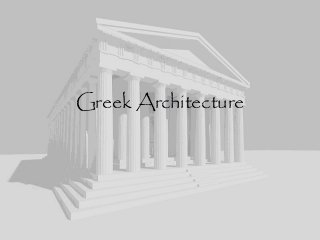
Greek Architecture
Introduction
 Classical art is considered the formal and
aesthetic basis of Occidental Art.
 This art was born in Greece and continued
during the Roman Empire.
 The chronology of Greek Art is:
• Archaic period: 8th to 6th century BC
• Classical period: 5th to 4th century BC
• Hellenistic period: 4th to 2nd century BC
 Geographical
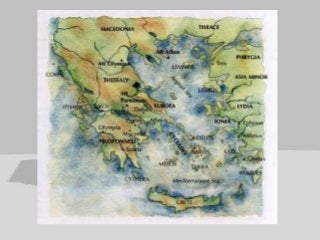
• Island of crete
• Aegean culture spread because of trade
• Rugged and mountainous nature of Greek
peninsula
•Internal communication difficult
•Separated inhabitants into groups or clans
•Aroused rivalry that characterized Greek
states
• Climatic
• Clear atmosphere, good intensity of light
• Most public ceremonies took place in open air
• Limited variety of public buildings (other than
temples)
• Hot summer sun + sudden winter showers + love
for conversation – porticos and colonnades
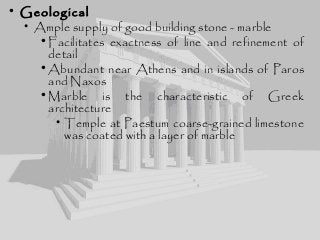
• Geological
• Ample supply of good building stone - marble
•Facilitates exactness of line and refinement of
detail
•Abundant near Athens and in islands of Paros
and Naxos
•Marble is the characteristic of Greek
architecture
• Temple at Paestum coarse-grained limestone
was coated with a layer of marble
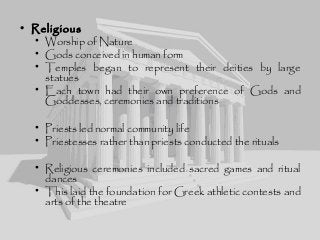
• Religious
• Worship of Nature
• Gods conceived in human form
• Temples began to represent their deities by large
statues
• Each town had their own preference of Gods and
Goddesses, ceremonies and traditions
• Priests led normal community life
• Priestesses rather than priests conducted the rituals
• Religious ceremonies included sacred games and ritual
dances
• This laid the foundation for Greek athletic contests and
arts of the theatre
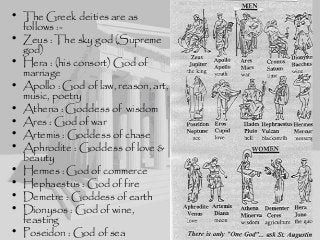
• The Greek deities are as
follows :-
• Zeus : The sky god (Supreme
god)
• Hera : (his consort) God of
marriage
• Apollo : God of law, reason, art,
music, poetry
• Athena : Goddess of wisdom
• Ares : God of war
• Artemis : Goddess of chase
• Aphrodite : Goddess of love &
beauty
• Hermes : God of commerce
• Hephaestus : God of fire
• Demetre : Goddess of earth
• Dionysos : God of wine,
feasting
• Poseidon : God of sea
• Building techniques and processes
• Stone for important buildings, palaces and substantial
houses
• Timber framework was usual
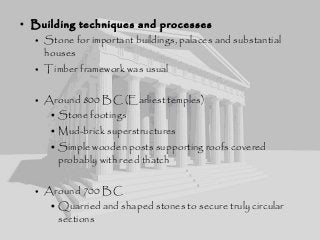
• Around 800 BC (Earliest temples)
• Stone footings
• Mud-brick superstructures
• Simple wooden posts supporting roofs covered
probably with reed thatch
• Around 700 BC
• Quarried and shaped stones to secure truly circular
sections
• By 500 BC, construction had become traditional and fixed
• Blocks of stone delivered trimmed to size
• Surfaces left rough to avoid damage, finished at site
• Monolithic shaft during 600 BC
• Blocks being large retained their position due to mass
and weight, not fixed together in any way except for
important buildings like temples
• Individual blocks and courses dowelled together with iron
dowels from 500 BC onwards
• High level of accuracy in measurement
• Walls usually single blocks in Hellenic (classical) period
• Some entablatures especially when large were made of
• In Hellenistic period gap in between filled with rubble
• Roofs normally on wooden beams and rafters, square
sections
• No evidence of use of trusses
• Pitched roof usually 13-170
• Tiles rested not nailed
• In temples
• Wooden ceilings in the interior
• Stone ceiling resting on stone beams above colonnade
• Light colour work was in practice but very selectively
Architecture: Basis
• The organization of the polis did not help the
development of the palace.
• Temple is the essential building, residence of the
god, not a place for people
• Other constructions combined beauty with
practical solutions:
• Theatres
• Sanctuaries
• Gymnasiums
• Importance of urbanism: Hipodamus from Mileto
created the orthogonal planning
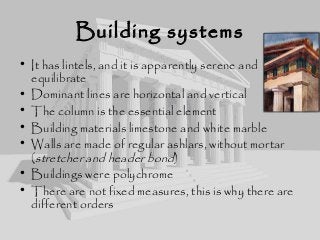
Building systems
• It has lintels, and it is apparently serene and
equilibrate
• Dominant lines are horizontal and vertical
• The column is the essential element
• Building materials limestone and white marble
• Walls are made of regular ashlars, without mortar
(stretcher and header bond)
• Buildings were polychrome
• There are not fixed measures, this is why there are
different orders
• Early period (3000-2000 B.C.)
• Middle period(2000-1600 B.C.)
• Late or Mycenaean period(1600-1050 B.C.)
• Hellinic period(700-146 B.C.)
• Early period:-
People were using handmade earthenware
They had commerce and agriculture as main concern and trading
with its neighbouring islands.
• Middle period:-
In this period trade became less important and houses were simple.
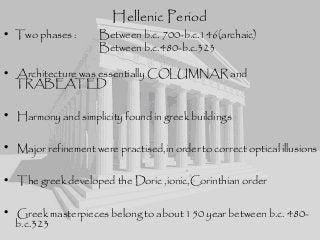
Hellenic Period
• Two phases : Between b.c. 700-b.c.146(archaic)
Between b.c.480-b.c.323
• Architecture was essentially COLUMNAR and
TRABEATED
• Harmony and simplicity found in greek buildings
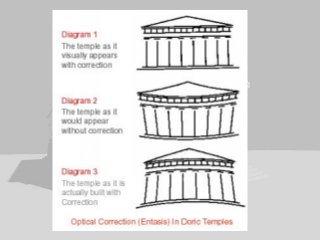
• Major refinement were practised,in order to correct optical illusions
• The greek developed the Doric ,ionic,Corinthian order
• Greek masterpieces belong to about 150 year between b.c. 480-
b.c.323
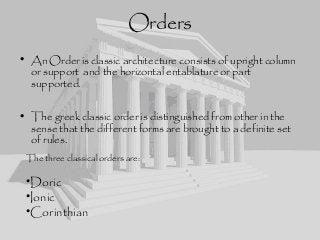
Orders
• An Order is classic architecture consists of upright column
or support and the horizontal entablature or part
supported.
• The greek classic order is distinguished from other in the
sense that the different forms are brought to a definite set
of rules.
The three classical orders are:
•Doric
•Ionic
•Corinthian
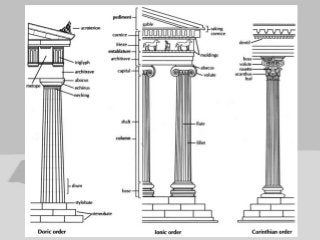
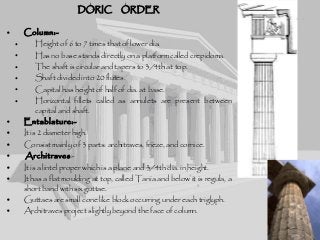
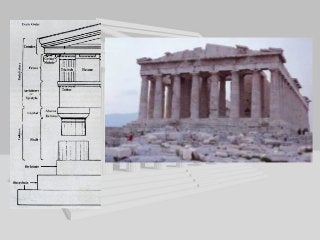
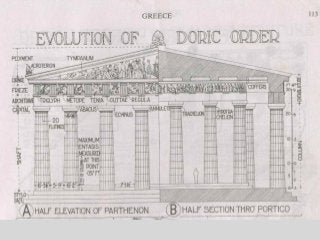
DORIC ORDER
• Column:-
• Height of 6 to 7 times that of lower dia.
• Has no base stands directly on a platform called crepidoma.
• The shaft is circular and tapers to 3/4th at top.
• Shaft divided into 20 flutes.
• Capital has height of half of dia. at base.
• Horizontal fillets called as annulets are present between
capital and shaft.
• Entablature:-
• It is 2 diameter high.
• Consist mainly of 3 parts: architraves, frieze, and cornice.
• Architraves:-
• It is a lintel proper which is a plane and 3/4th dia. in height.
• It has a flat moulding at top, called Tania and below it is regula, a
short band with six guttae.
• Guttaes are small cone like block occurring under each triglyph.
• Architraves project slightly beyond the face of column.
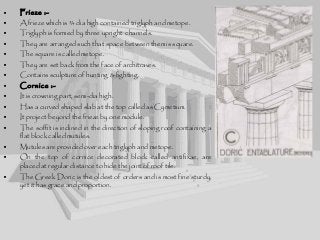
• Frieze :-
• A frieze which is ¾ dia high contained triglyph and metope.
• Triglyph is formed by three upright channels.
• They are arranged such that space between them is square.
• The square is called metope.
• They are set back from the face of architraves.
• Contains sculpture of hunting & fighting.
• Cornice :-
• It is crowning part, semi-dia high.
• Has a curved shaped slab at the top called as Cymetium.
• It project beyond the frieze by one module.
• The soffit is inclined in the direction of sloping roof containing a
flat block called mutules.
• Mutules are provided over each triglyph and metope.
• On the top of cornice decorated block called antifixae, are
placed at regular distance to hide the joint of roof tile.
• The Greek Doric is the oldest of orders and is most fine sturdy,
yet it has grace and proportion.
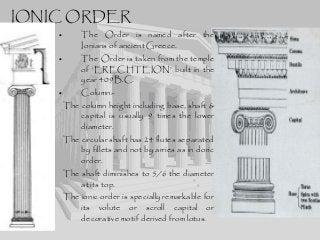
IONIC ORDER
• The Order is named after the
Ionians of ancient Greece.
• The Order is taken from the temple
of ‘ERECHTEION’ built in the
year 409B.C.
• Column:-
The column height including base, shaft &
capital is usually 9 times the lower
diameter.
The circular shaft has 24 flutes separated
by fillets and not by arries as in doric
order.
The shaft diminishes to 5/6 the diameter
at its top.
The ionic order is specially remarkable for
its volute or scroll capital or
decorative motif derived from lotus.
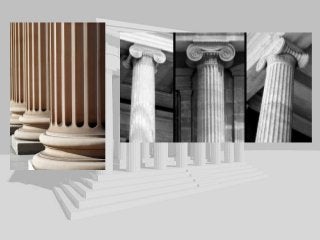
The capital which is 3/4 to 2/3 diameter high has a pair of volutes both on
the front and back of the column and connected at sides by the concave
cushion either plain or ornamented, with flutes, fillets and beads.
• Entablature :-
The entablature varies in height but is usually about 2 diameter high. It
consists of the following:-
• Architrave:-its is ¾ diameter high, it consist of triple fasciae.
• Frieze:-it is either plain or ornamented by a continuous band of
sculptures, it is ¾ diameter high.
• Cornice:- it has a similar treatment like doric order, it is semi-diameter
high.
The Greek Ionic Order is more ornate than the Doric.
It has grace, elegance, and refinement of outlines.
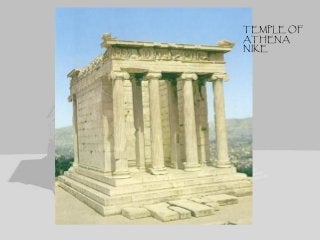
TEMPLE OF
ATHENA
NIKE
Corinthian Order
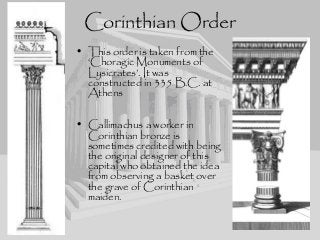
• This order is taken from the
‘Choragic Monuments of
Lysicrates’. It was
constructed in 335 B.C. at
Athens
• Callimachus a worker in
Corinthian bronze is
sometimes credited with being
the original designer of this
capital who obtained the idea
from observing a basket over
the grave of Corinthian
maiden.
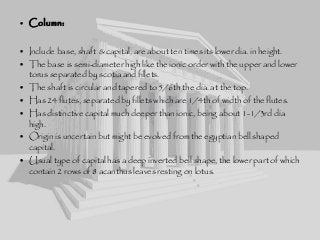
• Column:
• Include base, shaft & capital, are about ten times its lower dia. in height.
• The base is semi-diameter high like the ionic order with the upper and lower
torus separated by scotia and fillets.
• The shaft is circular and tapered to 5/6th the dia. at the top.
• Has 24 flutes, separated by fillets which are 1/4th of width of the flutes.
• Has distinctive capital much deeper than ionic, being about 1-1/3rd dia
high.
• Origin is uncertain but might be evolved from the egyptian bell shaped
capital.
• Usual type of capital has a deep inverted bell shape, the lower part of which
contain 2 rows of 8 acanthus leaves resting on lotus.
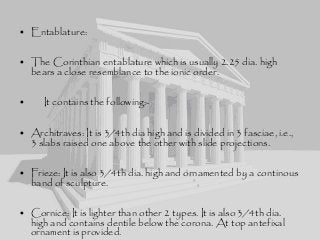
• Entablature:
• The Corinthian entablature which is usually 2.25 dia. high
bears a close resemblance to the ionic order.
• It contains the following:-
• Architraves: It is 3/4th dia high and is divided in 3 fasciae, i.e.,
3 slabs raised one above the other with slide projections.
• Frieze: It is also 3/4th dia. high and ornamented by a continous
band of sculpture.
• Cornice: It is lighter than other 2 types. It is also 3/4th dia.
high and contains dentile below the corona. At top antefixal
ornament is provided.
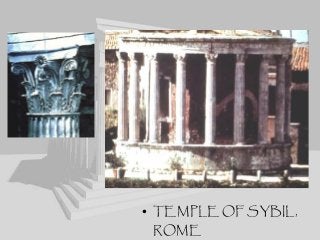
• TEMPLE OF SYBIL,
ROME
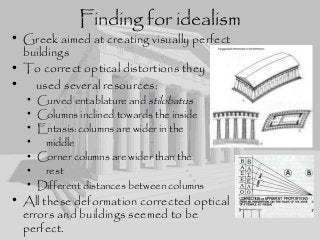
Finding for idealism
• Greek aimed at creating visually perfect
buildings
• To correct optical distortions they
• used several resources:
• Curved entablature and stilobatus
• Columns inclined towards the inside
• Entasis: columns are wider in the
• middle
• Corner columns are wider than the
• rest
• Different distances between columns
• All these deformation corrected optical
errors and buildings seemed to be
perfect.
Greek temple
• It is based on the pre-Hellenic megaron
• Structure:
• Rectangular plan
• Longitudinal axes
• Circular temples existed too: Tholos
• Internal distribution:
• One to three naves
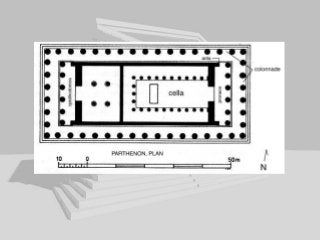
• Pronaos : Open entrance
• Naos or cella: chapel for God’s image
• Opistodomos: room for holding the treasure of the
temple
Greek temple
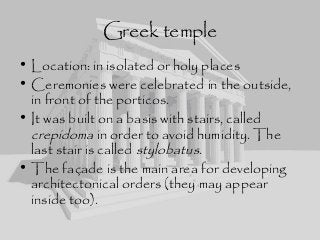
• Location: in isolated or holy places
• Ceremonies were celebrated in the outside,
in front of the porticos.
• It was built on a basis with stairs, called
crepidoma in order to avoid humidity. The
last stair is called stylobatus.
• The façade is the main area for developing
architectonical orders (they may appear
inside too).
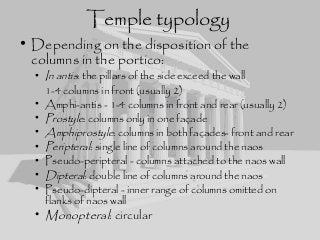
Temple typology
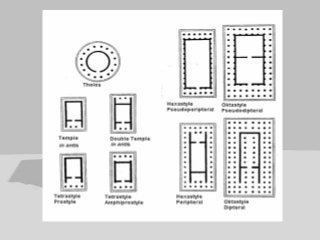
• Depending on the disposition of the
columns in the portico:
• In antis: the pillars of the side exceed the wall
1-4 columns in front (usually 2)
• Amphi-antis - 1-4 columns in front and rear (usually 2)
• Prostyle: columns only in one façade
• Amphiprostyle: columns in both façades- front and rear
• Peripteral: single line of columns around the naos
• Pseudo-peripteral - columns attached to the naos wall
• Dipteral: double line of columns around the naos
• Pseudo-dipteral - inner range of columns omitted on
flanks of naos wall
• Monopteral: circular
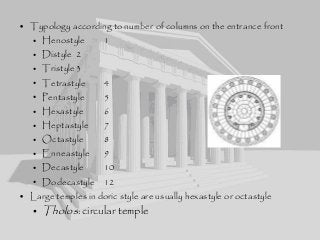
• Typology according to number of columns on the entrance front
• Henostyle 1
• Distyle 2
• Tristyle3
• Tetrastyle 4
• Pentastyle 5
• Hexastyle 6
• Heptastyle 7
• Octastyle 8
• Enneastyle 9
• Decastyle 10
• Dodecastyle 12
• Large temples in doric style are usually hexastyle or octastyle
• Tholos: circular temple
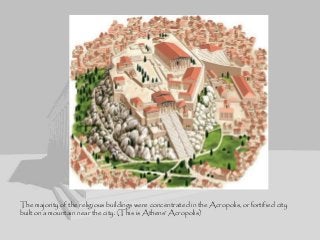
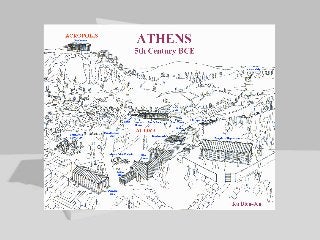
The majority of the religious buildings were concentrated in the Acropolis, or fortified city
built on a mountain near the city. (This is Athens’ Acropolis)
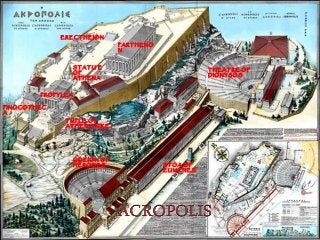
PARTHENO
N
PROPYLEA
PINOCOTHEC
A
STATU E
OF
ATHENA
ERECTHEION
TMPLE OF
ATHENA NIKE
THEATRE OF
DIONYSOS
STOA OF
EUMENES
ODEION OF
HERODES
ACROPOLIS AT ATHENSACROPOLIS AT ATHENS
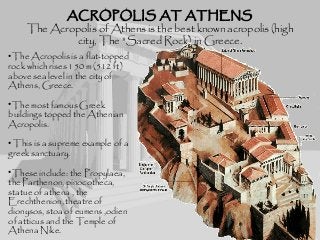
The Acropolis of Athens is the best known acropolis (high
city, The "Sacred Rock) in Greece.
•The Acropolis is a flat-topped
rock which rises 150 m (512 ft)
above sea level in the city of
Athens, Greece.
•The most famous Greek
buildings topped the Athenian
Acropolis.
• This is a supreme example of a
greek sanctuary.
•These include: the Propylaea,
the Parthenon, pinocotheca,
statue of athena , the
Erechthenion, theatre of
dionysos, stoa of eumens ,odien
of atticus and the Temple of
Athena Nike.
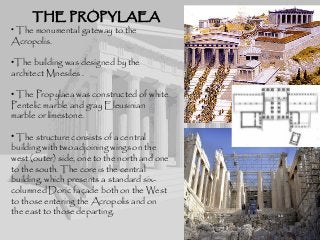
THE PROPYLAEATHE PROPYLAEA
• The monumental gateway to the
Acropolis.
•The building was designed by the
architect Mnesiles .
• The Propylaea was constructed of white
Pentelic marble and gray Eleusinian
marble or limestone.
• The structure consists of a central
building with two adjoining wings on the
west (outer) side, one to the north and one
to the south. The core is the central
building, which presents a standard six-
columned Doric façade both on the West
to those entering the Acropolis and on
the east to those departing.
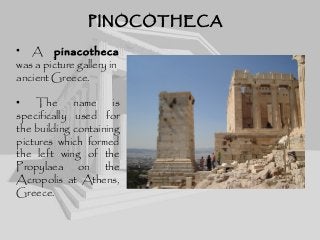
PINOCOTHECAPINOCOTHECA
• A pinacotheca
was a picture gallery in
ancient Greece.
• The name is
specifically used for
the building containing
pictures which formed
the left wing of the
Propylaea on the
Acropolis at Athens,
Greece.
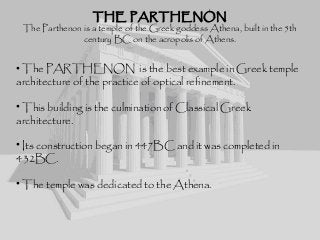
THE PARTHENONTHE PARTHENON
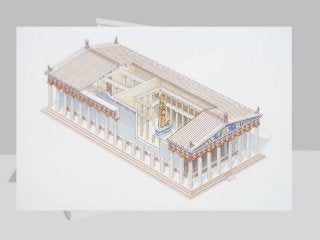
The Parthenon is a temple of the Greek goddess Athena, built in the 5th
century BC on the acropolis of Athens.
• The PARTHENON is the best example in Greek temple
architecture of the practice of optical refinement.
• This building is the culmination of Classical Greek
architecture.
• Its construction began in 447BC and it was completed in
432BC.
• The temple was dedicated to the Athena.
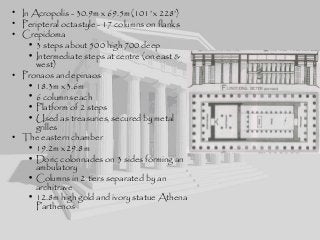
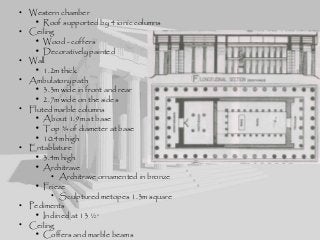
• In Acropolis - 30.9m x 69.5m (101’ x 228’)
• Peripteral octastyle - 17 columns on flanks
• Crepidoma
• 3 steps about 500 high 700 deep
• Intermediate steps at centre (on east &
west)
• Pronaos and epinaos
• 18.3m x 3.6m
• 6 columns each
• Platform of 2 steps
• Used as treasuries, secured by metal
grilles
• The eastern chamber
• 19.2m x 29.8m
• Doric colonnades on 3 sides forming an
ambulatory
• Columns in 2 tiers separated by an
architrave
• 12.8m high gold and ivory statue Athena
Parthenos
• Western chamber
• Roof supported by 4 ionic columns
• Ceiling
• Wood - coffers
• Decoratively painted
• Wall
• 1.2m thick
• Ambulatory path
• 3.3m wide in front and rear
• 2.7m wide on the sides
• Fluted marble columns
• About 1.9m at base
• Top ¾ of diameter at base
• 10.4m high
• Entablature
• 3.4m high
• Architrave
• Architrave ornamented in bronze
• Frieze
• Sculptured metopes 1.3m square
• Pediments
• Inclined at 13 ½o
• Ceiling
• Coffers and marble beams
STATUE OF ATHENASTATUE OF ATHENA
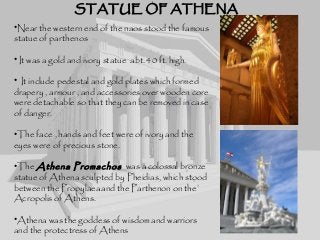
•Near the western end of the naos stood the famous
statue of parthenos
• It was a gold and ivory statue abt. 40 ft. high.
• It include pedestal and gold plates which formed
drapery , armour , and accessories over wooden core
were detachable so that they can be removed in case
of danger.
•The face , hands and feet were of ivory and the
eyes were of precious stone.
•The Athena Promachos was a colossal bronze
statue of Athena sculpted by Pheidias, which stood
between the Propylaeaand the Parthenon on the
Acropolis of Athens.
•Athena was the goddess of wisdom and warriors
and the protectress of Athens
THE ERECHTHEION , ATHENSTHE ERECHTHEION , ATHENS
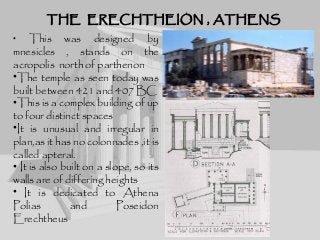
• This was designed by
mnesicles , stands on the
acropolis north of parthenon
•The temple as seen today was
built between 421 and 407 BC
•This is a complex building of up
to four distinct spaces
•It is unusual and irregular in
plan,as it has no colonnades ,it is
called apteral.
• It is also built on a slope, so its
walls are of differing heights
• It is dedicated to Athena
Polias and Poseidon
Erechtheus
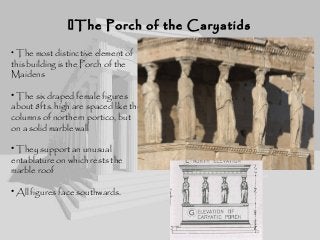
• The most distinctive element of
this building is the Porch of the
Maidens
• The six draped female figures
about 8fts. high are spaced like the
columns of northern portico, but
on a solid marble wall
• They support an unusual
entablature on which rests the
marble roof
• All figures face southwards.
The Porch of the CaryatidsThe Porch of the Caryatids
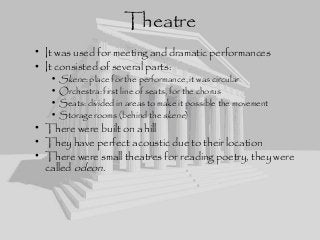
• It was used for meeting and dramatic performances
• It consisted of several parts:
• Skene: place for the performance, it was circular
• Orchestra: first line of seats, for the chorus
• Seats: divided in areas to make it possible the movement
• Storage rooms (behind the skene)
• There were built on a hill
• They have perfect acoustic due to their location
• There were small theatres for reading poetry, they were
called odeon.
Theatre
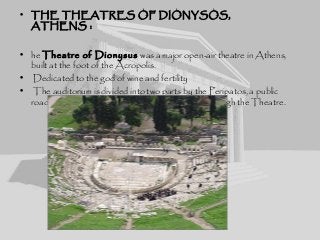
• THE THEATRES OF DIONYSOS,
ATHENS :
• he Theatre of Dionysus was a major open-air theatre in Athens,
built at the foot of the Acropolis.
• Dedicated to the god of wine and fertility
• The auditorium is divided into two parts by the Peripatos, a public
road which also served as a diazoma, a corridor through the Theatre.
Stoa of EumenesStoa of Eumenes
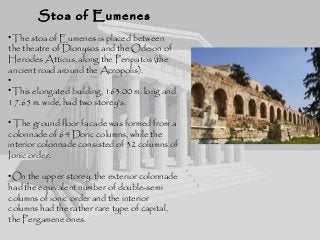
•The stoa of Eumenes is placed between
the theatre of Dionysos and the Odeion of
Herodes Atticus, along the Peripatos (the
ancient road around the Acropolis).
•
•This elongated building, 163.00 m. long and
17.65 m. wide, had two storey's.
• The ground floor facade was formed from a
colonnade of 64 Doric columns, while the
interior colonnade consisted of 32 columns of
Ionic order.
•On the upper storey, the exterior colonnade
had the equivalent number of double-semi
columns of ionic order and the interior
columns had the rather rare type of capital,
the Pergamene ones.
Odeon of Herodes AtticusOdeon of Herodes Atticus
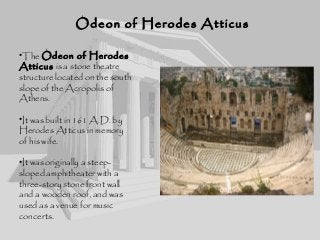
•The Odeon of Herodes
Atticus is a stone theatre
structure located on the south
slope of the Acropolis of
Athens.
•It was built in 161 A.D. by
Herodes Atticus in memory
of his wife.
•It was originally a steep-
sloped amphitheater with a
three-story stone front wall
and a wooden roof, and was
used as a venue for music
concerts.
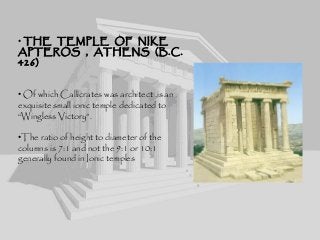
• THE TEMPLE OF NIKE
APTEROS , ATHENS (B.C.
426)
• Of which Callicrates was architect ,is an
exquisite small ionic temple dedicated to
“Wingless Victory”.
•The ratio of height to diameter of the
columns is 7:1 and not the 9:1 or 10:1
generally found in Ionic temples
Public architecture
• Agora: commercial centre of the city
• Fountain houses
• Stoa: long narrow hall with an open
colonnade that was used as exhibition room
• Palestra or gymnasium, the social centre for
male citizens
• Bouleterion or council chamber
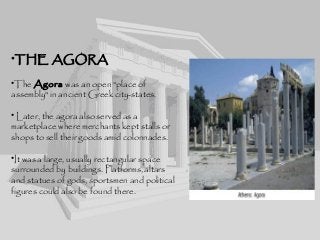
•THE AGORA
•The Agora was an open "place of
assembly" in ancient Greek city-states.
• Later, the agora also served as a
marketplace where merchants kept stalls or
shops to sell their goods amid colonnades.
•It was a large, usually rectangular space
surrounded by buildings. Platforms, altars
and statues of gods, sportsmen and political
figures could also be found there.
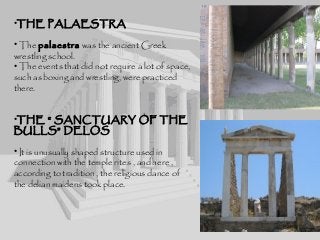
•THE PALAESTRA
• The palaestra was the ancient Greek
wrestling school.
• The events that did not require a lot of space,
such as boxing and wrestling, were practiced
there.
•THE “ SANCTUARY OF THE
BULLS” DELOS
• It is unusually shaped structure used in
connection with the temple rites , and here ,
according to tradition , the religious dance of
the delian maidens took place.
•THE STADION
• The stadion was an ancient foot
racecourse, in cities where games were
celebrated.
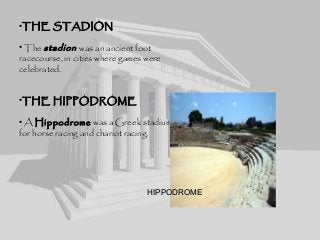
•THE HIPPODROME
• A Hippodrome was a Greek stadium
for horse racing and chariot racing.
HIPPODROMEHIPPODROME
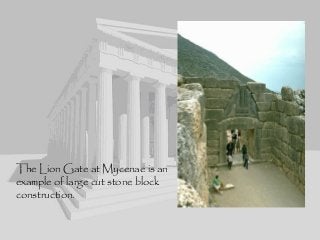
The Lion Gate at Mycenae is an
example of large cut stone block
construction.
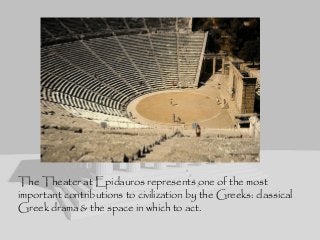
The Theater at Epidauros represents one of the most
important contributions to civilization by the Greeks: classical
Greek drama & the space in which to act.

GREEK ARCHITECTURE

  • 1.
  • 2.
    Introduction  Classical artis considered the formal and aesthetic basis of Occidental Art.  This art was born in Greece and continued during the Roman Empire.  The chronology of Greek Art is: • Archaic period: 8th to 6th century BC • Classical period: 5th to 4th century BC • Hellenistic period: 4th to 2nd century BC
  • 4.
     Geographical • Islandof crete • Aegean culture spread because of trade • Rugged and mountainous nature of Greek peninsula •Internal communication difficult •Separated inhabitants into groups or clans •Aroused rivalry that characterized Greek states • Climatic • Clear atmosphere, good intensity of light • Most public ceremonies took place in open air • Limited variety of public buildings (other than temples) • Hot summer sun + sudden winter showers + love for conversation – porticos and colonnades
  • 5.
    • Geological • Amplesupply of good building stone - marble •Facilitates exactness of line and refinement of detail •Abundant near Athens and in islands of Paros and Naxos •Marble is the characteristic of Greek architecture • Temple at Paestum coarse-grained limestone was coated with a layer of marble
  • 6.
    • Religious • Worshipof Nature • Gods conceived in human form • Temples began to represent their deities by large statues • Each town had their own preference of Gods and Goddesses, ceremonies and traditions • Priests led normal community life • Priestesses rather than priests conducted the rituals • Religious ceremonies included sacred games and ritual dances • This laid the foundation for Greek athletic contests and arts of the theatre
  • 7.
    • The Greekdeities are as follows :- • Zeus : The sky god (Supreme god) • Hera : (his consort) God of marriage • Apollo : God of law, reason, art, music, poetry • Athena : Goddess of wisdom • Ares : God of war • Artemis : Goddess of chase • Aphrodite : Goddess of love & beauty • Hermes : God of commerce • Hephaestus : God of fire • Demetre : Goddess of earth • Dionysos : God of wine, feasting • Poseidon : God of sea
  • 8.
    • Building techniquesand processes • Stone for important buildings, palaces and substantial houses • Timber framework was usual • Around 800 BC (Earliest temples) • Stone footings • Mud-brick superstructures • Simple wooden posts supporting roofs covered probably with reed thatch • Around 700 BC • Quarried and shaped stones to secure truly circular sections
  • 9.
    • By 500BC, construction had become traditional and fixed • Blocks of stone delivered trimmed to size • Surfaces left rough to avoid damage, finished at site • Monolithic shaft during 600 BC • Blocks being large retained their position due to mass and weight, not fixed together in any way except for important buildings like temples • Individual blocks and courses dowelled together with iron dowels from 500 BC onwards • High level of accuracy in measurement • Walls usually single blocks in Hellenic (classical) period • Some entablatures especially when large were made of
  • 10.
    • In Hellenisticperiod gap in between filled with rubble • Roofs normally on wooden beams and rafters, square sections • No evidence of use of trusses • Pitched roof usually 13-170 • Tiles rested not nailed • In temples • Wooden ceilings in the interior • Stone ceiling resting on stone beams above colonnade • Light colour work was in practice but very selectively
  • 11.
    Architecture: Basis • Theorganization of the polis did not help the development of the palace. • Temple is the essential building, residence of the god, not a place for people • Other constructions combined beauty with practical solutions: • Theatres • Sanctuaries • Gymnasiums • Importance of urbanism: Hipodamus from Mileto created the orthogonal planning
  • 12.
    Building systems • Ithas lintels, and it is apparently serene and equilibrate • Dominant lines are horizontal and vertical • The column is the essential element • Building materials limestone and white marble • Walls are made of regular ashlars, without mortar (stretcher and header bond) • Buildings were polychrome • There are not fixed measures, this is why there are different orders
  • 13.
    • Early period(3000-2000 B.C.) • Middle period(2000-1600 B.C.) • Late or Mycenaean period(1600-1050 B.C.) • Hellinic period(700-146 B.C.) • Early period:- People were using handmade earthenware They had commerce and agriculture as main concern and trading with its neighbouring islands. • Middle period:- In this period trade became less important and houses were simple.
  • 14.
    Hellenic Period • Twophases : Between b.c. 700-b.c.146(archaic) Between b.c.480-b.c.323 • Architecture was essentially COLUMNAR and TRABEATED • Harmony and simplicity found in greek buildings • Major refinement were practised,in order to correct optical illusions • The greek developed the Doric ,ionic,Corinthian order • Greek masterpieces belong to about 150 year between b.c. 480- b.c.323
  • 15.
    Orders • An Orderis classic architecture consists of upright column or support and the horizontal entablature or part supported. • The greek classic order is distinguished from other in the sense that the different forms are brought to a definite set of rules. The three classical orders are: •Doric •Ionic •Corinthian
  • 17.
    DORIC ORDER • Column:- •Height of 6 to 7 times that of lower dia. • Has no base stands directly on a platform called crepidoma. • The shaft is circular and tapers to 3/4th at top. • Shaft divided into 20 flutes. • Capital has height of half of dia. at base. • Horizontal fillets called as annulets are present between capital and shaft. • Entablature:- • It is 2 diameter high. • Consist mainly of 3 parts: architraves, frieze, and cornice. • Architraves:- • It is a lintel proper which is a plane and 3/4th dia. in height. • It has a flat moulding at top, called Tania and below it is regula, a short band with six guttae. • Guttaes are small cone like block occurring under each triglyph. • Architraves project slightly beyond the face of column.
  • 18.
    • Frieze :- •A frieze which is ¾ dia high contained triglyph and metope. • Triglyph is formed by three upright channels. • They are arranged such that space between them is square. • The square is called metope. • They are set back from the face of architraves. • Contains sculpture of hunting & fighting. • Cornice :- • It is crowning part, semi-dia high. • Has a curved shaped slab at the top called as Cymetium. • It project beyond the frieze by one module. • The soffit is inclined in the direction of sloping roof containing a flat block called mutules. • Mutules are provided over each triglyph and metope. • On the top of cornice decorated block called antifixae, are placed at regular distance to hide the joint of roof tile. • The Greek Doric is the oldest of orders and is most fine sturdy, yet it has grace and proportion.
  • 21.
    IONIC ORDER • TheOrder is named after the Ionians of ancient Greece. • The Order is taken from the temple of ‘ERECHTEION’ built in the year 409B.C. • Column:- The column height including base, shaft & capital is usually 9 times the lower diameter. The circular shaft has 24 flutes separated by fillets and not by arries as in doric order. The shaft diminishes to 5/6 the diameter at its top. The ionic order is specially remarkable for its volute or scroll capital or decorative motif derived from lotus.
  • 22.
    The capital whichis 3/4 to 2/3 diameter high has a pair of volutes both on the front and back of the column and connected at sides by the concave cushion either plain or ornamented, with flutes, fillets and beads. • Entablature :- The entablature varies in height but is usually about 2 diameter high. It consists of the following:- • Architrave:-its is ¾ diameter high, it consist of triple fasciae. • Frieze:-it is either plain or ornamented by a continuous band of sculptures, it is ¾ diameter high. • Cornice:- it has a similar treatment like doric order, it is semi-diameter high. The Greek Ionic Order is more ornate than the Doric. It has grace, elegance, and refinement of outlines.
  • 24.
  • 25.
    Corinthian Order • Thisorder is taken from the ‘Choragic Monuments of Lysicrates’. It was constructed in 335 B.C. at Athens • Callimachus a worker in Corinthian bronze is sometimes credited with being the original designer of this capital who obtained the idea from observing a basket over the grave of Corinthian maiden.
  • 26.
    • Column: • Includebase, shaft & capital, are about ten times its lower dia. in height. • The base is semi-diameter high like the ionic order with the upper and lower torus separated by scotia and fillets. • The shaft is circular and tapered to 5/6th the dia. at the top. • Has 24 flutes, separated by fillets which are 1/4th of width of the flutes. • Has distinctive capital much deeper than ionic, being about 1-1/3rd dia high. • Origin is uncertain but might be evolved from the egyptian bell shaped capital. • Usual type of capital has a deep inverted bell shape, the lower part of which contain 2 rows of 8 acanthus leaves resting on lotus.
  • 27.
    • Entablature: • TheCorinthian entablature which is usually 2.25 dia. high bears a close resemblance to the ionic order. • It contains the following:- • Architraves: It is 3/4th dia high and is divided in 3 fasciae, i.e., 3 slabs raised one above the other with slide projections. • Frieze: It is also 3/4th dia. high and ornamented by a continous band of sculpture. • Cornice: It is lighter than other 2 types. It is also 3/4th dia. high and contains dentile below the corona. At top antefixal ornament is provided.
  • 28.
    • TEMPLE OFSYBIL, ROME
  • 29.
    Finding for idealism •Greek aimed at creating visually perfect buildings • To correct optical distortions they • used several resources: • Curved entablature and stilobatus • Columns inclined towards the inside • Entasis: columns are wider in the • middle • Corner columns are wider than the • rest • Different distances between columns • All these deformation corrected optical errors and buildings seemed to be perfect.
  • 31.
    Greek temple • Itis based on the pre-Hellenic megaron • Structure: • Rectangular plan • Longitudinal axes • Circular temples existed too: Tholos • Internal distribution: • One to three naves • Pronaos : Open entrance • Naos or cella: chapel for God’s image • Opistodomos: room for holding the treasure of the temple
  • 34.
    Greek temple • Location:in isolated or holy places • Ceremonies were celebrated in the outside, in front of the porticos. • It was built on a basis with stairs, called crepidoma in order to avoid humidity. The last stair is called stylobatus. • The façade is the main area for developing architectonical orders (they may appear inside too).
  • 35.
    Temple typology • Dependingon the disposition of the columns in the portico: • In antis: the pillars of the side exceed the wall 1-4 columns in front (usually 2) • Amphi-antis - 1-4 columns in front and rear (usually 2) • Prostyle: columns only in one façade • Amphiprostyle: columns in both façades- front and rear • Peripteral: single line of columns around the naos • Pseudo-peripteral - columns attached to the naos wall • Dipteral: double line of columns around the naos • Pseudo-dipteral - inner range of columns omitted on flanks of naos wall • Monopteral: circular
  • 37.
    • Typology accordingto number of columns on the entrance front • Henostyle 1 • Distyle 2 • Tristyle3 • Tetrastyle 4 • Pentastyle 5 • Hexastyle 6 • Heptastyle 7 • Octastyle 8 • Enneastyle 9 • Decastyle 10 • Dodecastyle 12 • Large temples in doric style are usually hexastyle or octastyle • Tholos: circular temple
  • 38.
    The majority ofthe religious buildings were concentrated in the Acropolis, or fortified city built on a mountain near the city. (This is Athens’ Acropolis)
  • 39.
    PARTHENO N PROPYLEA PINOCOTHEC A STATU E OF ATHENA ERECTHEION TMPLE OF ATHENANIKE THEATRE OF DIONYSOS STOA OF EUMENES ODEION OF HERODES
  • 40.
    ACROPOLIS AT ATHENSACROPOLISAT ATHENS The Acropolis of Athens is the best known acropolis (high city, The "Sacred Rock) in Greece. •The Acropolis is a flat-topped rock which rises 150 m (512 ft) above sea level in the city of Athens, Greece. •The most famous Greek buildings topped the Athenian Acropolis. • This is a supreme example of a greek sanctuary. •These include: the Propylaea, the Parthenon, pinocotheca, statue of athena , the Erechthenion, theatre of dionysos, stoa of eumens ,odien of atticus and the Temple of Athena Nike.
  • 42.
    THE PROPYLAEATHE PROPYLAEA •The monumental gateway to the Acropolis. •The building was designed by the architect Mnesiles . • The Propylaea was constructed of white Pentelic marble and gray Eleusinian marble or limestone. • The structure consists of a central building with two adjoining wings on the west (outer) side, one to the north and one to the south. The core is the central building, which presents a standard six- columned Doric façade both on the West to those entering the Acropolis and on the east to those departing.
  • 43.
    PINOCOTHECAPINOCOTHECA • A pinacotheca wasa picture gallery in ancient Greece. • The name is specifically used for the building containing pictures which formed the left wing of the Propylaea on the Acropolis at Athens, Greece.
  • 44.
    THE PARTHENONTHE PARTHENON TheParthenon is a temple of the Greek goddess Athena, built in the 5th century BC on the acropolis of Athens. • The PARTHENON is the best example in Greek temple architecture of the practice of optical refinement. • This building is the culmination of Classical Greek architecture. • Its construction began in 447BC and it was completed in 432BC. • The temple was dedicated to the Athena.
  • 45.
    • In Acropolis- 30.9m x 69.5m (101’ x 228’) • Peripteral octastyle - 17 columns on flanks • Crepidoma • 3 steps about 500 high 700 deep • Intermediate steps at centre (on east & west) • Pronaos and epinaos • 18.3m x 3.6m • 6 columns each • Platform of 2 steps • Used as treasuries, secured by metal grilles • The eastern chamber • 19.2m x 29.8m • Doric colonnades on 3 sides forming an ambulatory • Columns in 2 tiers separated by an architrave • 12.8m high gold and ivory statue Athena Parthenos
  • 46.
    • Western chamber •Roof supported by 4 ionic columns • Ceiling • Wood - coffers • Decoratively painted • Wall • 1.2m thick • Ambulatory path • 3.3m wide in front and rear • 2.7m wide on the sides • Fluted marble columns • About 1.9m at base • Top ¾ of diameter at base • 10.4m high • Entablature • 3.4m high • Architrave • Architrave ornamented in bronze • Frieze • Sculptured metopes 1.3m square • Pediments • Inclined at 13 ½o • Ceiling • Coffers and marble beams
  • 47.
    STATUE OF ATHENASTATUEOF ATHENA •Near the western end of the naos stood the famous statue of parthenos • It was a gold and ivory statue abt. 40 ft. high. • It include pedestal and gold plates which formed drapery , armour , and accessories over wooden core were detachable so that they can be removed in case of danger. •The face , hands and feet were of ivory and the eyes were of precious stone. •The Athena Promachos was a colossal bronze statue of Athena sculpted by Pheidias, which stood between the Propylaeaand the Parthenon on the Acropolis of Athens. •Athena was the goddess of wisdom and warriors and the protectress of Athens
  • 48.
    THE ERECHTHEION ,ATHENSTHE ERECHTHEION , ATHENS • This was designed by mnesicles , stands on the acropolis north of parthenon •The temple as seen today was built between 421 and 407 BC •This is a complex building of up to four distinct spaces •It is unusual and irregular in plan,as it has no colonnades ,it is called apteral. • It is also built on a slope, so its walls are of differing heights • It is dedicated to Athena Polias and Poseidon Erechtheus
  • 49.
    • The mostdistinctive element of this building is the Porch of the Maidens • The six draped female figures about 8fts. high are spaced like the columns of northern portico, but on a solid marble wall • They support an unusual entablature on which rests the marble roof • All figures face southwards. The Porch of the CaryatidsThe Porch of the Caryatids
  • 50.
    • It wasused for meeting and dramatic performances • It consisted of several parts: • Skene: place for the performance, it was circular • Orchestra: first line of seats, for the chorus • Seats: divided in areas to make it possible the movement • Storage rooms (behind the skene) • There were built on a hill • They have perfect acoustic due to their location • There were small theatres for reading poetry, they were called odeon. Theatre
  • 51.
    • THE THEATRESOF DIONYSOS, ATHENS : • he Theatre of Dionysus was a major open-air theatre in Athens, built at the foot of the Acropolis. • Dedicated to the god of wine and fertility • The auditorium is divided into two parts by the Peripatos, a public road which also served as a diazoma, a corridor through the Theatre.
  • 52.
    Stoa of EumenesStoaof Eumenes •The stoa of Eumenes is placed between the theatre of Dionysos and the Odeion of Herodes Atticus, along the Peripatos (the ancient road around the Acropolis). • •This elongated building, 163.00 m. long and 17.65 m. wide, had two storey's. • The ground floor facade was formed from a colonnade of 64 Doric columns, while the interior colonnade consisted of 32 columns of Ionic order. •On the upper storey, the exterior colonnade had the equivalent number of double-semi columns of ionic order and the interior columns had the rather rare type of capital, the Pergamene ones.
  • 53.
    Odeon of HerodesAtticusOdeon of Herodes Atticus •The Odeon of Herodes Atticus is a stone theatre structure located on the south slope of the Acropolis of Athens. •It was built in 161 A.D. by Herodes Atticus in memory of his wife. •It was originally a steep- sloped amphitheater with a three-story stone front wall and a wooden roof, and was used as a venue for music concerts.
  • 54.
    • THE TEMPLEOF NIKE APTEROS , ATHENS (B.C. 426) • Of which Callicrates was architect ,is an exquisite small ionic temple dedicated to “Wingless Victory”. •The ratio of height to diameter of the columns is 7:1 and not the 9:1 or 10:1 generally found in Ionic temples
  • 55.
    Public architecture • Agora:commercial centre of the city • Fountain houses • Stoa: long narrow hall with an open colonnade that was used as exhibition room • Palestra or gymnasium, the social centre for male citizens • Bouleterion or council chamber
  • 57.
    •THE AGORA •The Agorawas an open "place of assembly" in ancient Greek city-states. • Later, the agora also served as a marketplace where merchants kept stalls or shops to sell their goods amid colonnades. •It was a large, usually rectangular space surrounded by buildings. Platforms, altars and statues of gods, sportsmen and political figures could also be found there.
  • 58.
    •THE PALAESTRA • Thepalaestra was the ancient Greek wrestling school. • The events that did not require a lot of space, such as boxing and wrestling, were practiced there. •THE “ SANCTUARY OF THE BULLS” DELOS • It is unusually shaped structure used in connection with the temple rites , and here , according to tradition , the religious dance of the delian maidens took place.
  • 59.
    •THE STADION • Thestadion was an ancient foot racecourse, in cities where games were celebrated. •THE HIPPODROME • A Hippodrome was a Greek stadium for horse racing and chariot racing. HIPPODROMEHIPPODROME
  • 60.
    The Lion Gateat Mycenae is an example of large cut stone block construction.
  • 61.
    The Theater atEpidauros represents one of the most important contributions to civilization by the Greeks: classical Greek drama & the space in which to act.