ROMAN INTERIORS
SUBMITTED T0- Ar Neha Sharma
SUBMITTED BY-
Deeksha Srivastava
Harkeerat Kaur Munjal
Manish Rajput
ROMAN INTERIORS
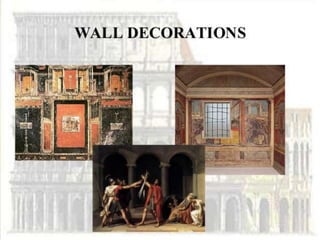
• At first the stucco finished walls were simply marked
off into panels of rectangle shape, painted in deep and
rich colors with red and yellow predominating.
• Then in the middle of these panels elaborate pictures,
figures, interiors, landscapes, etc. of large sizes were
skill fully done.
• A little later the walls began to be covered with panels
of thin slabs of marble with a cornice.
• Beautiful effects were produced by the combination of
marble of different tints.
• Later it raised with stucco work, enriched with gold and
colors.
Floor
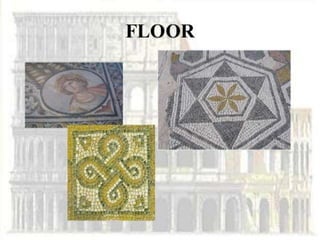
• Floors were covered with marble tiles arranged in
geometrical figures with contrasting colors or
with mosaic pictures.
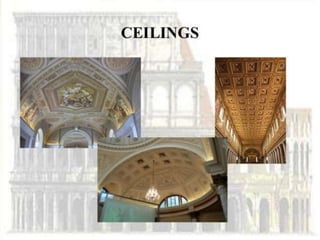
• Roman ceilings were often barrel vaulted and
painted in bright colors, or divided deeply into
sunk panels by heavy intersecting beams of
marble or wood.
• And then decorated in the most elaborate
manner with raise stucco work, or gold or ivory,
or with bronze plates.
Lights and lamps
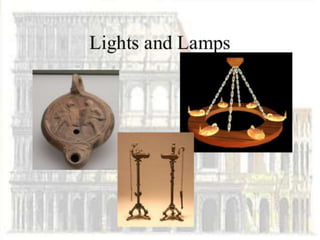
• Roman lamps were relatively simple items, simply
a vessel that held olive oil or melted grease.
• Through which there was a hole through which
the lamp was filled.
• As works of interior and decorative art such lamps
were often quite beautiful though.
• Even lamps made of cheap materials were often of
grateful form and proportions.
• These lamps were meant to be carried in the hand
like lanterns or supposed to be suspended from
the ceiling by hanging chains.
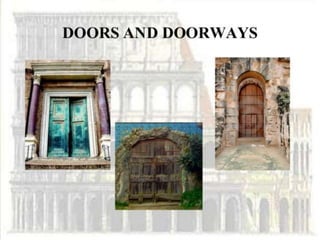
Doors and doorways
• Doors and doorways gave opportunities
for artistic treatment.
• Doors were elaborately pannelled and
carved or were plated with bronze or
made of solid bronze.
• The posters were sheathed with marbles
ordinarily carved with elaborated design.
Roman Furniture
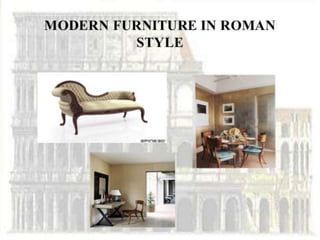
• Roman houses tended to be sparse, since the
occupants liked space and simplicity in their décor.
• Beauty was created by mosaics, frescos, and water
features and other features of roman interiors rather
than by use of elaborate furnishing.
• Pictures of ancient roman furniture painted in
frescos and other artworks, together with few pieces
still are in existence today.
• The main items of roman furniture found in the best
houses were couches (Lectus), chairs and stools,
tables and lamps adding chests or wooden cabinets.
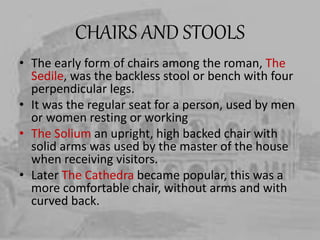
CHAIRS AND STOOLS
• The early form of chairs among the roman, The
Sedile, was the backless stool or bench with four
perpendicular legs.
• It was the regular seat for a person, used by men
or women resting or working
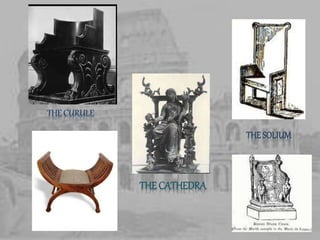
• The Solium an upright, high backed chair with
solid arms was used by the master of the house
when receiving visitors.
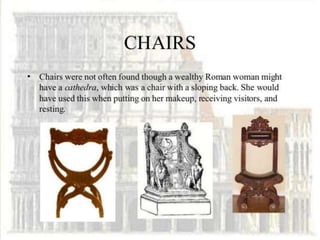
• Later The Cathedra became popular, this was a
more comfortable chair, without arms and with
curved back.
THESOLIUM
THE CATHEDRA
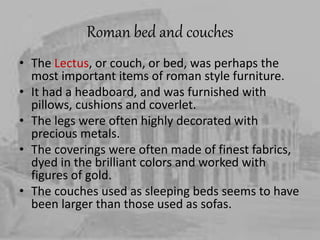
Roman bed and couches
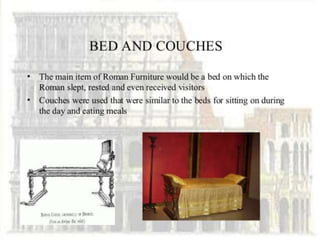
• The Lectus, or couch, or bed, was perhaps the
most important items of roman style furniture.
• It had a headboard, and was furnished with
pillows, cushions and coverlet.
• The legs were often highly decorated with
precious metals.
• The coverings were often made of finest fabrics,
dyed in the brilliant colors and worked with
figures of gold.
• The couches used as sleeping beds seems to have
been larger than those used as sofas.
Chests and cabinets
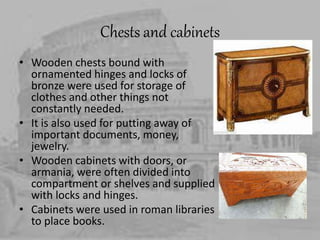
• Wooden chests bound with
ornamented hinges and locks of
bronze were used for storage of
clothes and other things not
constantly needed.
• It is also used for putting away of
important documents, money,
jewelry.
• Wooden cabinets with doors, or
armania, were often divided into
compartment or shelves and supplied
with locks and hinges.
• Cabinets were used in roman libraries
to place books.
THANK YOU !

ROMAN INTERIORS

  • 1.
    ROMAN INTERIORS SUBMITTED T0-Ar Neha Sharma SUBMITTED BY- Deeksha Srivastava Harkeerat Kaur Munjal Manish Rajput
  • 2.
    ROMAN INTERIORS • Atfirst the stucco finished walls were simply marked off into panels of rectangle shape, painted in deep and rich colors with red and yellow predominating. • Then in the middle of these panels elaborate pictures, figures, interiors, landscapes, etc. of large sizes were skill fully done. • A little later the walls began to be covered with panels of thin slabs of marble with a cornice. • Beautiful effects were produced by the combination of marble of different tints. • Later it raised with stucco work, enriched with gold and colors.
  • 5.
    Floor • Floors werecovered with marble tiles arranged in geometrical figures with contrasting colors or with mosaic pictures. • Roman ceilings were often barrel vaulted and painted in bright colors, or divided deeply into sunk panels by heavy intersecting beams of marble or wood. • And then decorated in the most elaborate manner with raise stucco work, or gold or ivory, or with bronze plates.
  • 7.
    Lights and lamps •Roman lamps were relatively simple items, simply a vessel that held olive oil or melted grease. • Through which there was a hole through which the lamp was filled. • As works of interior and decorative art such lamps were often quite beautiful though. • Even lamps made of cheap materials were often of grateful form and proportions. • These lamps were meant to be carried in the hand like lanterns or supposed to be suspended from the ceiling by hanging chains.
  • 10.
    Doors and doorways •Doors and doorways gave opportunities for artistic treatment. • Doors were elaborately pannelled and carved or were plated with bronze or made of solid bronze. • The posters were sheathed with marbles ordinarily carved with elaborated design.
  • 12.
    Roman Furniture • Romanhouses tended to be sparse, since the occupants liked space and simplicity in their décor. • Beauty was created by mosaics, frescos, and water features and other features of roman interiors rather than by use of elaborate furnishing. • Pictures of ancient roman furniture painted in frescos and other artworks, together with few pieces still are in existence today. • The main items of roman furniture found in the best houses were couches (Lectus), chairs and stools, tables and lamps adding chests or wooden cabinets.
  • 13.
    CHAIRS AND STOOLS •The early form of chairs among the roman, The Sedile, was the backless stool or bench with four perpendicular legs. • It was the regular seat for a person, used by men or women resting or working • The Solium an upright, high backed chair with solid arms was used by the master of the house when receiving visitors. • Later The Cathedra became popular, this was a more comfortable chair, without arms and with curved back.
  • 15.
  • 16.
    Roman bed andcouches • The Lectus, or couch, or bed, was perhaps the most important items of roman style furniture. • It had a headboard, and was furnished with pillows, cushions and coverlet. • The legs were often highly decorated with precious metals. • The coverings were often made of finest fabrics, dyed in the brilliant colors and worked with figures of gold. • The couches used as sleeping beds seems to have been larger than those used as sofas.
  • 18.
    Chests and cabinets •Wooden chests bound with ornamented hinges and locks of bronze were used for storage of clothes and other things not constantly needed. • It is also used for putting away of important documents, money, jewelry. • Wooden cabinets with doors, or armania, were often divided into compartment or shelves and supplied with locks and hinges. • Cabinets were used in roman libraries to place books.
  • 22.