InEurope
Done By Yazid Hamoda (1300703006
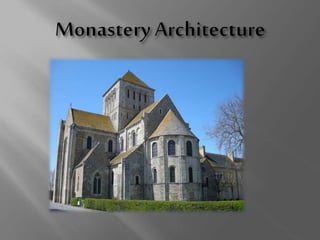
 Romanesque architecture is an architectural
style of medieval Europe characterized by
rounded arches. There is no consensus for the
beginning date of the Romanesque
architecture, with proposals ranging from the
6th to the 10th century.
 According to the Oxford English Dictionary, the
word "Romanesque" means "descended from
Roman" and was first used in English to
designate what are now called Romance
languages.
In Italy
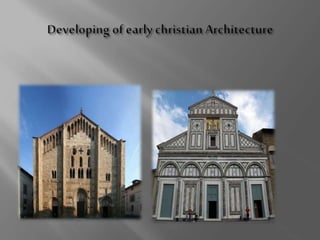
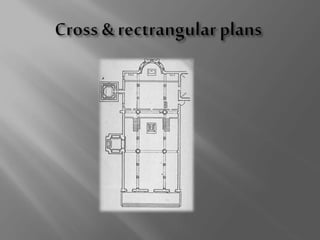
 Transepts were usually added, and the chancel
prolonged further east than in the basilicas, the
church partaking more and more of a well-
defined cross on plan, as at S. Michele.
 The transepts were the ,same breadth as the
nave, which was usually twice the width of the
aisles.
 The choir was raised considerably by means of
steps, and underneath, supported on piers, was
formed a vaulted crypt as at S. Miniato,
Florence.
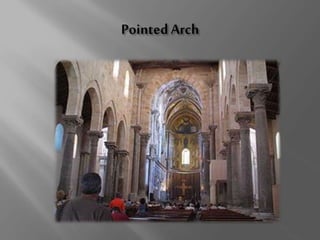
 The problems encountered in the structure and
appearance of vaults was solved late in the
Romanesque period with the introduction of
pointed arched ribs which allowed the height
of both diagonal and transverse ribs to be
varied in proportion to each other.
 An early ribbed vault in the Romanesque
architecture of Sicily is that of the chancel at
the Cathedral of Cefalù.
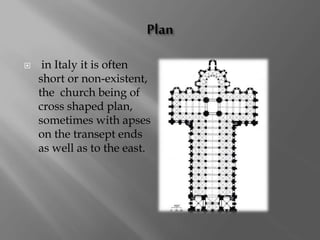
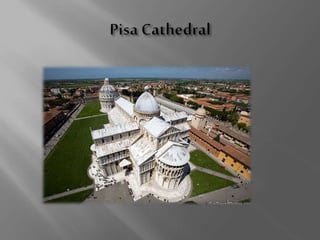
 in Italy it is often
short or non-existent,
the church being of
cross shaped plan,
sometimes with apses
on the transept ends
as well as to the east.
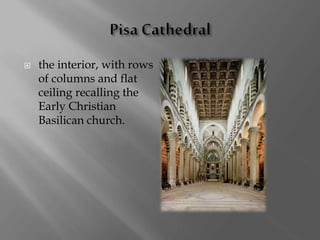
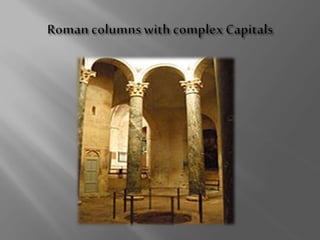
 the interior, with rows
of columns and flat
ceiling recalling the
Early Christian
Basilican church.
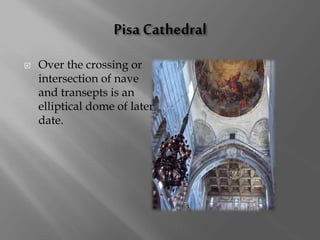
 Over the crossing or
intersection of nave
and transepts is an
elliptical dome of later
date.
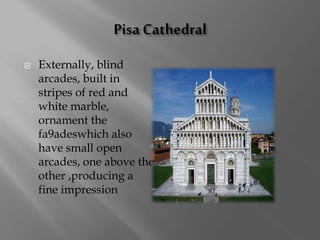
 Externally, blind
arcades, built in
stripes of red and
white marble,
ornament the
fa9adeswhich also
have small open
arcades, one above the
other ,producing a
fine impression
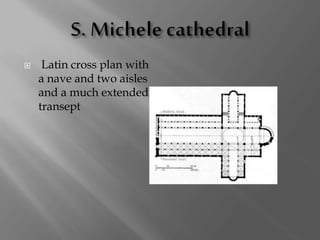
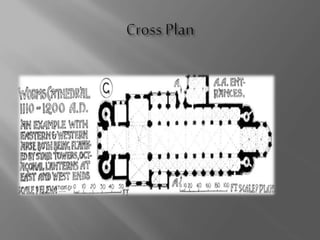
 Latin cross plan with
a nave and two aisles
and a much extended
transept
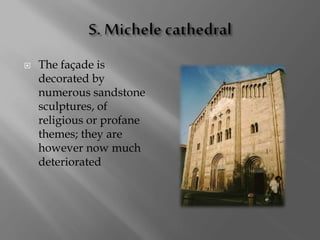
 The façade is
decorated by
numerous sandstone
sculptures, of
religious or profane
themes; they are
however now much
deteriorated
In France
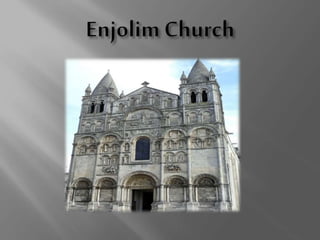
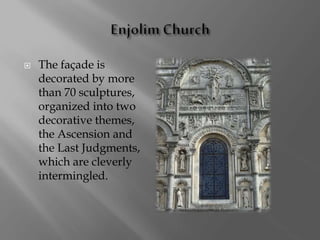
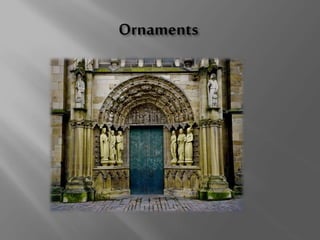
 The façade is
decorated by more
than 70 sculptures,
organized into two
decorative themes,
the Ascension and
the Last Judgments,
which are cleverly
intermingled.
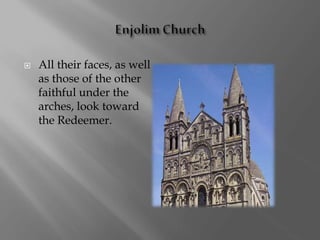
 All their faces, as well
as those of the other
faithful under the
arches, look toward
the Redeemer.
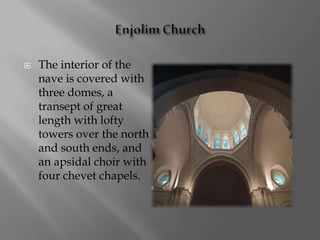
 The interior of the
nave is covered with
three domes, a
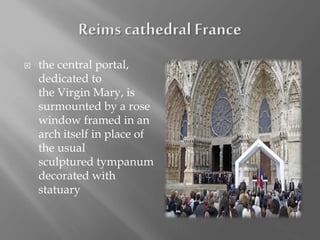
transept of great
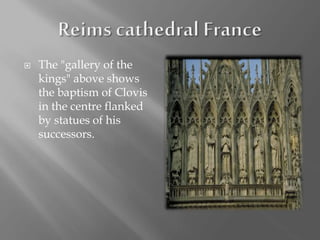
length with lofty
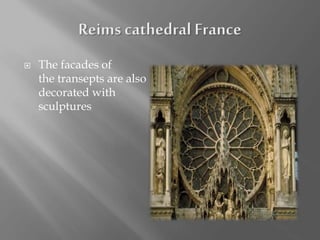
towers over the north
and south ends, and
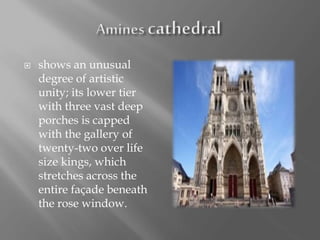
an apsidal choir with
four chevet chapels.
In England
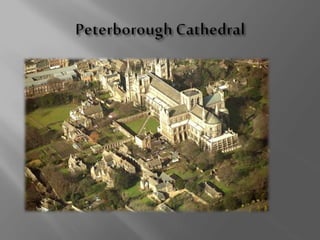
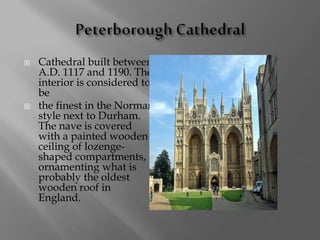
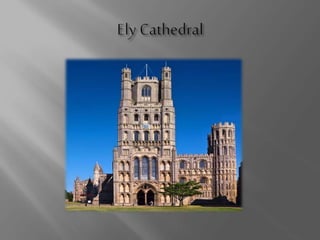
 Cathedral built between
A.D. 1117 and 1190. The
interior is considered to
be
 the finest in the Norman
style next to Durham.
The nave is covered
with a painted wooden
ceiling of lozenge-
shaped compartments,
ornamenting what is
probably the oldest
wooden roof in
England.
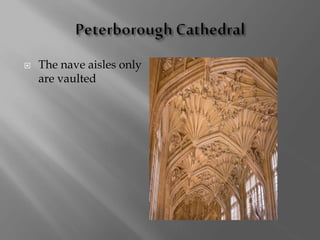
 The nave aisles only
are vaulted
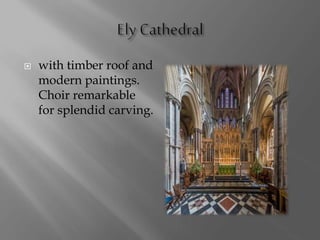
 with timber roof and
modern paintings.
Choir remarkable
for splendid carving.
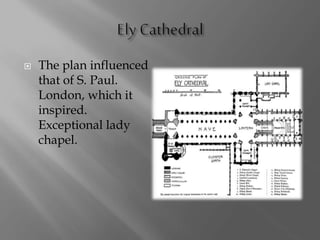
 The plan influenced
that of S. Paul.
London, which it
inspired.
Exceptional lady
chapel.
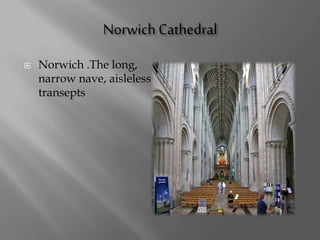
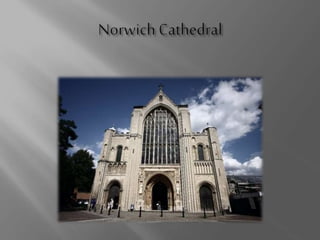
 Norwich .The long,
narrow nave, aisleless
transepts
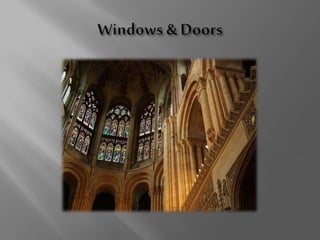
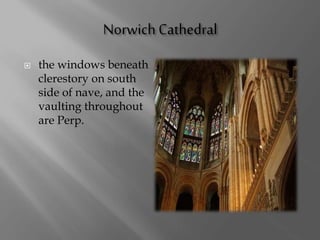
 the windows beneath
clerestory on south
side of nave, and the
vaulting throughout
are Perp.
In Germany
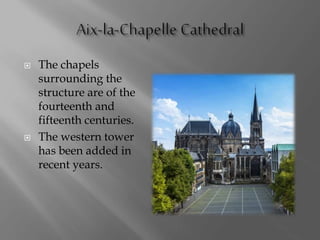
 The chapels
surrounding the
structure are of the
fourteenth and
fifteenth centuries.
 The western tower
has been added in
recent years.
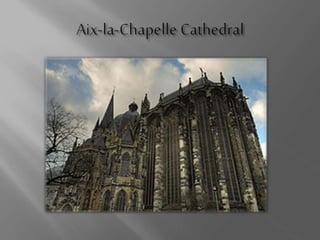
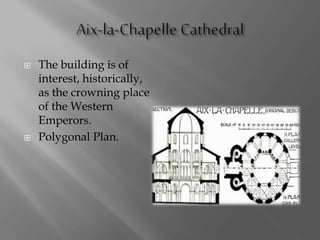
 The building is of
interest, historically,
as the crowning place
of the Western
Emperors.
 Polygonal Plan.
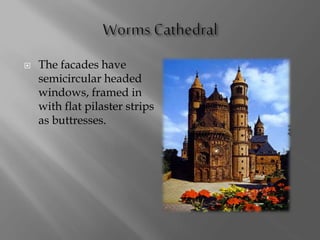
 The facades have
semicircular headed
windows, framed in
with flat pilaster strips
as buttresses.
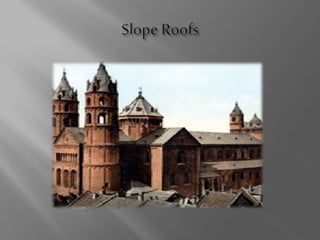
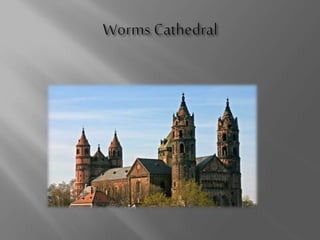
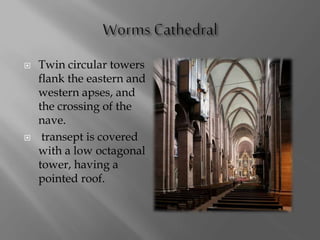
 Twin circular towers
flank the eastern and
western apses, and
the crossing of the
nave.
 transept is covered
with a low octagonal
tower, having a
pointed roof.
EuropeIn
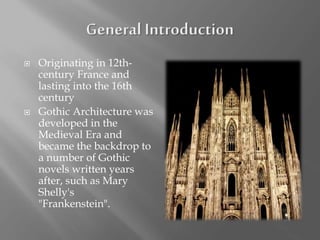
 Originating in 12th-
century France and
lasting into the 16th
century
 Gothic Architecture was
developed in the
Medieval Era and
became the backdrop to
a number of Gothic
novels written years
after, such as Mary
Shelly's
"Frankenstein".
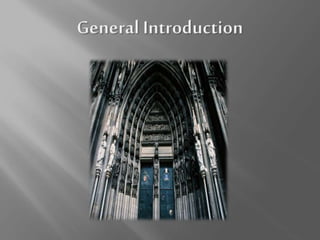
 In the thirteenth, fourteenth, and fifteenth
centuries the Gothic carried to the utmost the use
of stone as a building material, heaping it up in
towers that rose on open archways vs through
the lofty roofs of the naves and transepts.
 The Gothic architects, developing still further the
principles of Romanesque architecture .
 elasticity and equilibrium Wahid were
substituted for those of inert "stability as
practiced by the Greeks and Romans.
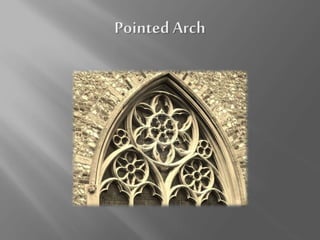
 One of the defining characteristics of Gothic
architecture.
 used in the Islamic architecture before they
were employed structurally in medieval
architecture.
 A very narrow, steeply pointed ogive arch is
sometimes called a "lancet arch "
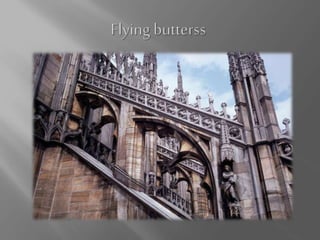
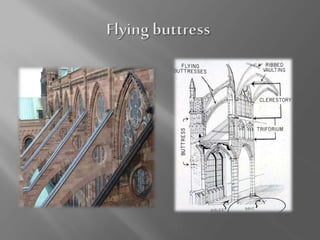
 Every vertical support in Gothic architecture
depended for its stability on being stayed by a
buttress.
 which in its turn was weighted by a pinnacle every
arch-thrust met another which counteracted it.
 In the case of the nave vaults, the collected
pressures of the vaulting and roof were
counteracted by arches.
 called flying buttresses, leaning against the nave
wall and supported at some distance by massive
piers.
 Every vertical support in Gothic architecture
depended for its stability on being stayed by a
buttress.
 which in its turn was weighted by a pinnacle every
arch-thrust met another which counteracted it.
 In the case of the nave vaults, the collected
pressures of the vaulting and roof were
counteracted by arches.
 called flying buttresses, leaning against the nave
wall and supported at some distance by massive
piers.
In England
 The problem for the mediaeval architects was
to vault, in stone, the nave of a church of the
basilican type
 and at the same time
 to provide for the lighting of the building by
means of clerestory windows in the nave walls
above the aisle roofs.
 The evolution of vaulting in England, as on the
Continent, involved the solution of a group of
constructive problems which have been
already hinted
 Thus it was in connection with the necessity for
counteracting the thrust of the nave vaults brought
down on piers that the greater part of the
evolution of the constructive side of the style took
place.
 In England the raising of the diagonal rib, which
produced the domical vault employed on the
Continent, seems to have been but little used, and
the method was either
 a) to make diagonal ribs segmental
 b) to make the diagonal ribs semicircular and stilt
the springing of the transverse and longitudinal
ribs
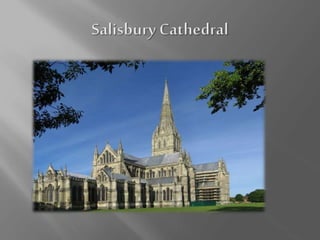
 a.) The Cathedrals of the old foundation are those
which, being served by secular clergy, were not
affected by the reforms of Henry VIII.(Salisbury)
 b.) The Cathedrals of the monastic foundation are
those which were originally served by regular
clergy or monks, and which were reconstituted at
the dissolution of the monasteries as chapters of
secular canons. (Durham)
 c) The Cathedrals of the new foundation are those
to which bishops have been appointed, viz., Ripon
and South well, which are old Collegiate Churches
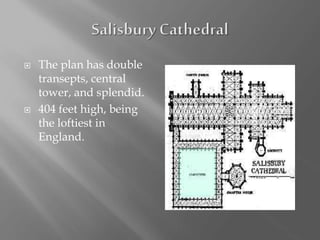
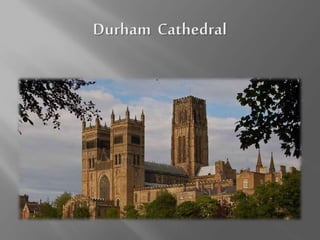
 The plan has double
transepts, central
tower, and splendid.
 404 feet high, being
the loftiest in
England.
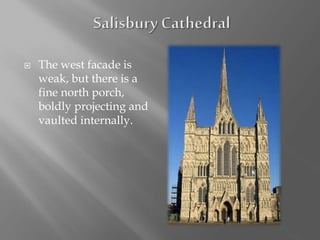
 The west facade is
weak, but there is a
fine north porch,
boldly projecting and
vaulted internally.
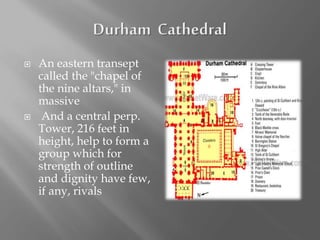
 An eastern transept
called the "chapel of
the nine altars," in
massive
 And a central perp.
Tower, 216 feet in
height, help to form a
group which for
strength of outline
and dignity have few,
if any, rivals
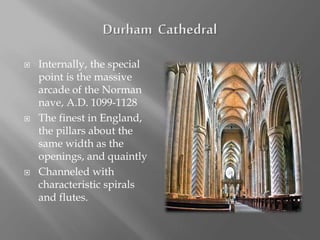
 Internally, the special
point is the massive
arcade of the Norman
nave, A.D. 1099-1128
 The finest in England,
the pillars about the
same width as the
openings, and quaintly
 Channeled with
characteristic spirals
and flutes.
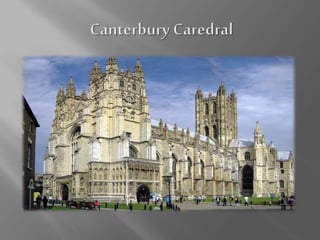
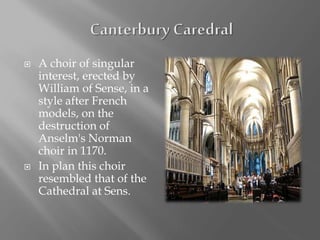
 A choir of singular
interest, erected by
William of Sense, in a
style after French
models, on the
destruction of
Anselm's Norman
choir in 1170.
 In plan this choir
resembled that of the
Cathedral at Sens.
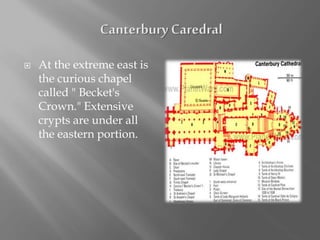
 At the extreme east is
the curious chapel
called " Becket's
Crown." Extensive
crypts are under all
the eastern portion.
IN FRANCE
 The southern style is remarkable for its rich
decorative facades and graceful cloisters, the
buildings of Provence being a new version of
old Roman features.
 In the north the style is the promising
commencement of a new epoch , The interiors
were close set with pier and pillar, and heavily
roofed with ponderous arching, forming a link
to the marvelous structures of the next three
centuries, where matter is lost in the emotions
expressed.
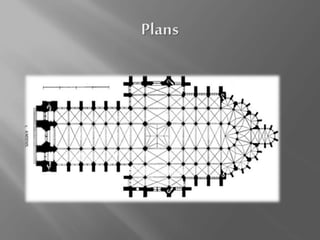
 In the south, internal buttresses, inclosing the
outer range of chapels, were preferred, as at
Vienne cathedral Round churches are rare in
this district. Towers are detached, resembling
Italian Gampanili.
 with magnificent capitals- which receive the
round arches of the narrow bays, and were left
entirely open, as glazing or tracery were not
required by the climate.
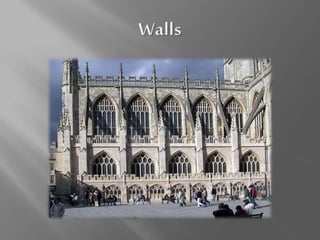
 Massiveness is the characteristic of all the early
work
 Walls were of rubble with facing stones.
 Elaboration was reserved for doorways in the
arcaded lower portion of the facades, which are
often models of simplicity and richness.
 Painted glass was not favored in southern
examples, small, clear-glazed openings being
employed to set off the opaque color
decoration of the walls.
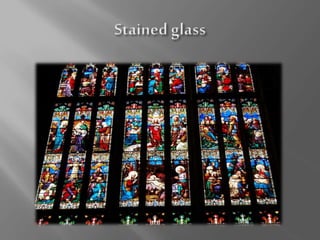
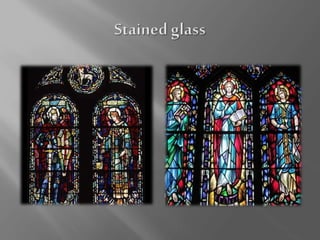
 Stained glass favoring large openings was
gradually developed in the north.
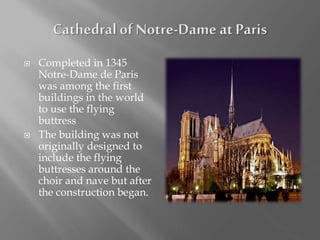
 Completed in 1345
Notre-Dame de Paris
was among the first
buildings in the world
to use the flying
buttress
 The building was not
originally designed to
include the flying
buttresses around the
choir and nave but after
the construction began.
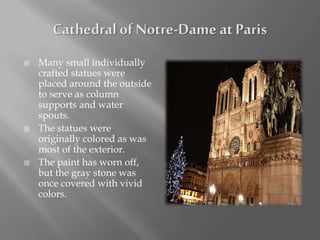
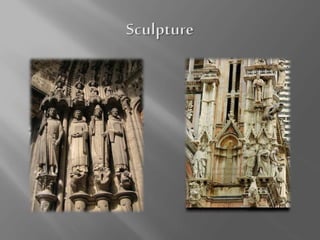
 Many small individually
crafted statues were
placed around the outside
to serve as column
supports and water
spouts.
 The statues were
originally colored as was
most of the exterior.
 The paint has worn off,
but the gray stone was
once covered with vivid
colors.
 the central portal,
dedicated to
the Virgin Mary, is
surmounted by a rose
window framed in an
arch itself in place of
the usual
sculptured tympanum
decorated with
statuary
 The "gallery of the
kings" above shows
the baptism of Clovis
in the centre flanked
by statues of his
successors.
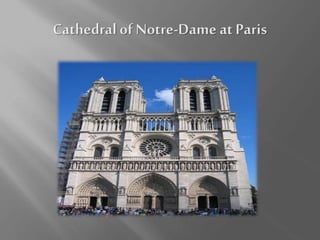
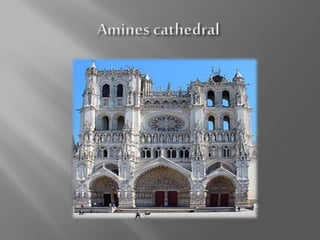
 The facades of
the transepts are also
decorated with
sculptures
 shows an unusual
degree of artistic
unity; its lower tier
with three vast deep
porches is capped
with the gallery of
twenty-two over life
size kings, which
stretches across the
entire façade beneath
the rose window.
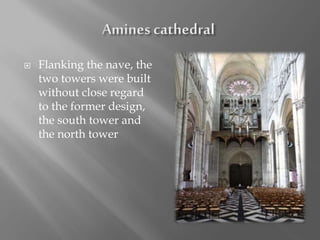
 Flanking the nave, the
two towers were built
without close regard
to the former design,
the south tower and
the north tower
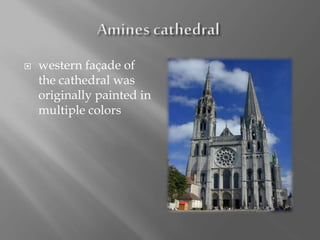
 western façade of
the cathedral was
originally painted in
multiple colors
In Italy
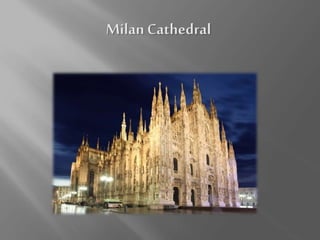
 erected by the first Duke of Milan, is the most
important work of this period
 the largest mediaeval cathedral , and is built
entirely of white marble.
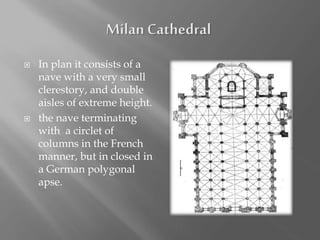
 In plan it consists of a
nave with a very small
clerestory, and double
aisles of extreme height.
 the nave terminating
with a circlet of
columns in the French
manner, but in closed in
a German polygonal
apse.
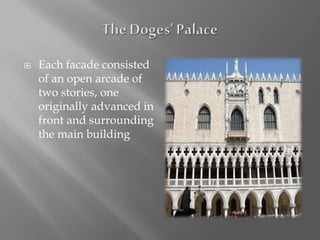
 Each facade consisted
of an open arcade of
two stories, one
originally advanced in
front and surrounding
the main building
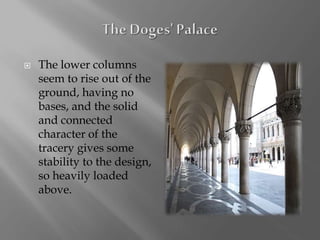
 The lower columns
seem to rise out of the
ground, having no
bases, and the solid
and connected
character of the
tracery gives some
stability to the design,
so heavily loaded
above.
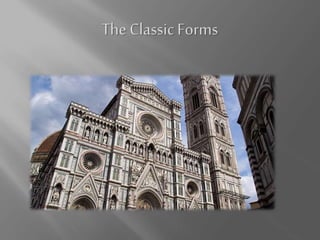
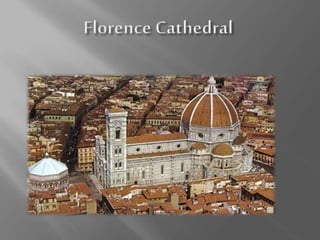
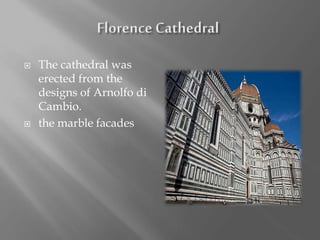
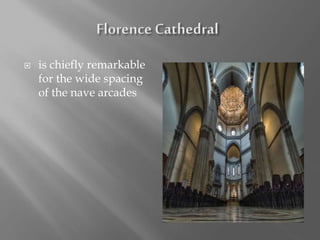
 The cathedral was
erected from the
designs of Arnolfo di
Cambio.
 the marble facades
 is chiefly remarkable
for the wide spacing
of the nave arcades
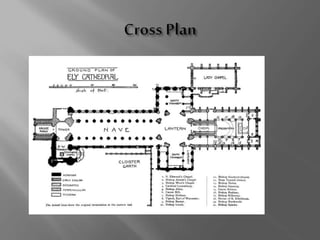
 the plan is cross
shaped
In Spain
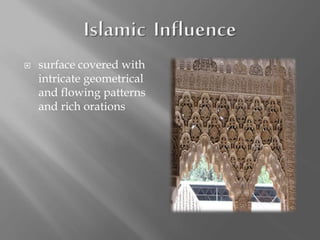
 surface covered with
intricate geometrical
and flowing patterns
and rich orations
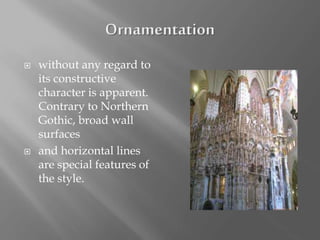
 without any regard to
its constructive
character is apparent.
Contrary to Northern
Gothic, broad wall
surfaces
 and horizontal lines
are special features of
the style.
 These fretwork
screens occupy the
whole window, and
are rich in detail
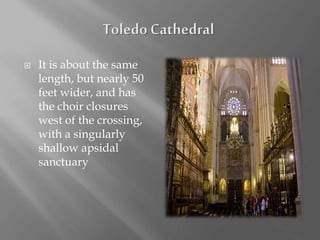
 It is about the same
length, but nearly 50
feet wider, and has
the choir closures
west of the crossing,
with a singularly
shallow apsidal
sanctuary
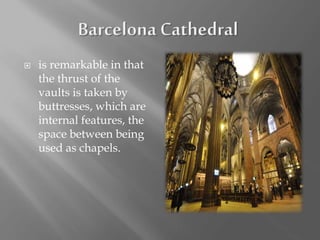
 is remarkable in that
the thrust of the
vaults is taken by
buttresses, which are
internal features, the
space between being
used as chapels.
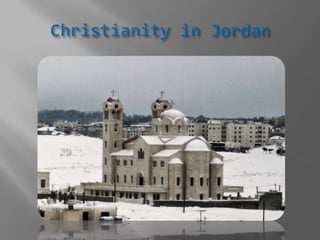
 Christianity in Jordan is among the oldest
Christian communities in the world.
 Christians have resided in Jordan after the
crucifixion of Jesus Christ, early in the 1st
century AD.
 Christians are 390,000 (2.8-6%) of the
population of 6,500,000
 Jordanian Christians are among the oldest
Christian communities in the world, and the
majority have always been Orthodox adherents to
the Orthodox Patriarchate of Jerusalem and the
Holy Land, which is the 16 Church of St. James,
and was founded during Jesus' lifetime.
 Among the recognized denominations the Greek
Orthodox, Roman Catholic (Latin), Melkite Greek
Catholic, Armenian Orthodox, Marionette
Catholic, Anglican, and Assyrian churches make
up the majority of Jordan's Christian population.
 In addition to the recognized denominations there
are religious societies that are allowed to meet
freely, but are not recognized as churches by the
government.
 Christians are well integrated in the Jordanian
society and have a high level of freedom, though
they are not free to evangelize Muslims.
 They form a significant part of the kingdom's
political and economic elite. Christians enjoy high
economic and social opportunities in the
Hashemite Kingdom of Jordan
Schools
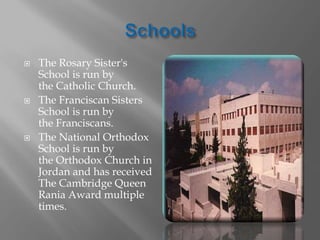
 The Rosary Sister's
School is run by
the Catholic Church.
 The Franciscan Sisters
School is run by
the Franciscans.
 The National Orthodox
School is run by
the Orthodox Church in
Jordan and has received
The Cambridge Queen
Rania Award multiple
times.
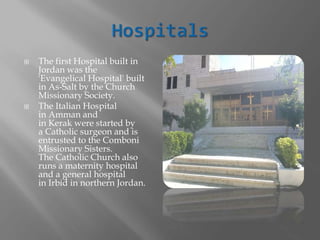
Hospitals
 The first Hospital built in
Jordan was the
'Evangelical Hospital' built
in As-Salt by the Church
Missionary Society.
 The Italian Hospital
in Amman and
in Kerak were started by
a Catholic surgeon and is
entrusted to the Comboni
Missionary Sisters.
The Catholic Church also
runs a maternity hospital
and a general hospital
in Irbid in northern Jordan.
 The Government Hospital in Ajloun was
originally run by Baptists.
 The Annoor Sanatorium which
treats tuberculosis and other lung diseases was
founded by a Christian doctor. The Annoor
Sanatorium is located outside of Mafraq in
northern Jordan.
 Several Mission Clinics were also founded
across Jordan.
in Jordan
 Portions of the Biblical narrative took place in the towns and
the country side that now makes up Jordan.
 Bethany Beyond the Jordan where John the Baptist preached
and where Jesus Christ was baptized is located on the
Jordan side of the Jordan river.
 Also, Mount Nebo where Moses viewed the Land
of Canaan is located in western Jordan.
 In northern Jordan there is a small creek where an angel met
and wrestled with the patriarch Jacob.
 The rock struck by Moses to bring forth water and the
patriarch Aaron's tomb are both in southern Jordan.
 The ruins of the fortress of the Ammonites are on a
mountain overlooking downtown Amman. This is the site
where King David had Bathsheba's husband Uriah the
Hittite killed.
 Jordan also contains many sites of historical
importance to Christianity.
 Madaba, a city south of Amman, is the site of a large
ancient church with detailed mosaic tile work. There
have been many excavations in Madaba that have un-
earthed ancient Christian artifacts.
 There are many Arab and Frankish castles from the
period of the Crusades in Jordan. The most famous of
which is Ajlun castle located in the Ajloun district in
northern Jordan. Other castles include Montreal
(Crusader castle) and Kerak.
 Fuheis and Al Husn are two exclusively Christian
towns of Jordan.
Yazid Hamoda
1300703006
AABU UNIVERSITY

Gothic & romansque architecture

  • 1.
    InEurope Done By YazidHamoda (1300703006
  • 2.
     Romanesque architectureis an architectural style of medieval Europe characterized by rounded arches. There is no consensus for the beginning date of the Romanesque architecture, with proposals ranging from the 6th to the 10th century.  According to the Oxford English Dictionary, the word "Romanesque" means "descended from Roman" and was first used in English to designate what are now called Romance languages.
  • 3.
  • 5.
     Transepts wereusually added, and the chancel prolonged further east than in the basilicas, the church partaking more and more of a well- defined cross on plan, as at S. Michele.  The transepts were the ,same breadth as the nave, which was usually twice the width of the aisles.  The choir was raised considerably by means of steps, and underneath, supported on piers, was formed a vaulted crypt as at S. Miniato, Florence.
  • 7.
     The problemsencountered in the structure and appearance of vaults was solved late in the Romanesque period with the introduction of pointed arched ribs which allowed the height of both diagonal and transverse ribs to be varied in proportion to each other.  An early ribbed vault in the Romanesque architecture of Sicily is that of the chancel at the Cathedral of Cefalù.
  • 9.
     in Italyit is often short or non-existent, the church being of cross shaped plan, sometimes with apses on the transept ends as well as to the east.
  • 12.
     the interior,with rows of columns and flat ceiling recalling the Early Christian Basilican church.
  • 13.
     Over thecrossing or intersection of nave and transepts is an elliptical dome of later date.
  • 14.
     Externally, blind arcades,built in stripes of red and white marble, ornament the fa9adeswhich also have small open arcades, one above the other ,producing a fine impression
  • 15.
     Latin crossplan with a nave and two aisles and a much extended transept
  • 16.
     The façadeis decorated by numerous sandstone sculptures, of religious or profane themes; they are however now much deteriorated
  • 17.
  • 24.
     The façadeis decorated by more than 70 sculptures, organized into two decorative themes, the Ascension and the Last Judgments, which are cleverly intermingled.
  • 25.
     All theirfaces, as well as those of the other faithful under the arches, look toward the Redeemer.
  • 26.
     The interiorof the nave is covered with three domes, a transept of great length with lofty towers over the north and south ends, and an apsidal choir with four chevet chapels.
  • 27.
  • 33.
     Cathedral builtbetween A.D. 1117 and 1190. The interior is considered to be  the finest in the Norman style next to Durham. The nave is covered with a painted wooden ceiling of lozenge- shaped compartments, ornamenting what is probably the oldest wooden roof in England.
  • 34.
     The naveaisles only are vaulted
  • 36.
     with timberroof and modern paintings. Choir remarkable for splendid carving.
  • 37.
     The planinfluenced that of S. Paul. London, which it inspired. Exceptional lady chapel.
  • 39.
     Norwich .Thelong, narrow nave, aisleless transepts
  • 40.
     the windowsbeneath clerestory on south side of nave, and the vaulting throughout are Perp.
  • 41.
  • 49.
     The chapels surroundingthe structure are of the fourteenth and fifteenth centuries.  The western tower has been added in recent years.
  • 50.
     The buildingis of interest, historically, as the crowning place of the Western Emperors.  Polygonal Plan.
  • 52.
     The facadeshave semicircular headed windows, framed in with flat pilaster strips as buttresses.
  • 53.
     Twin circulartowers flank the eastern and western apses, and the crossing of the nave.  transept is covered with a low octagonal tower, having a pointed roof.
  • 54.
  • 56.
     Originating in12th- century France and lasting into the 16th century  Gothic Architecture was developed in the Medieval Era and became the backdrop to a number of Gothic novels written years after, such as Mary Shelly's "Frankenstein".
  • 57.
     In thethirteenth, fourteenth, and fifteenth centuries the Gothic carried to the utmost the use of stone as a building material, heaping it up in towers that rose on open archways vs through the lofty roofs of the naves and transepts.  The Gothic architects, developing still further the principles of Romanesque architecture .  elasticity and equilibrium Wahid were substituted for those of inert "stability as practiced by the Greeks and Romans.
  • 59.
     One ofthe defining characteristics of Gothic architecture.  used in the Islamic architecture before they were employed structurally in medieval architecture.  A very narrow, steeply pointed ogive arch is sometimes called a "lancet arch "
  • 61.
     Every verticalsupport in Gothic architecture depended for its stability on being stayed by a buttress.  which in its turn was weighted by a pinnacle every arch-thrust met another which counteracted it.  In the case of the nave vaults, the collected pressures of the vaulting and roof were counteracted by arches.  called flying buttresses, leaning against the nave wall and supported at some distance by massive piers.
  • 62.
     Every verticalsupport in Gothic architecture depended for its stability on being stayed by a buttress.  which in its turn was weighted by a pinnacle every arch-thrust met another which counteracted it.  In the case of the nave vaults, the collected pressures of the vaulting and roof were counteracted by arches.  called flying buttresses, leaning against the nave wall and supported at some distance by massive piers.

  • 66.
  • 68.
     The problemfor the mediaeval architects was to vault, in stone, the nave of a church of the basilican type  and at the same time  to provide for the lighting of the building by means of clerestory windows in the nave walls above the aisle roofs.  The evolution of vaulting in England, as on the Continent, involved the solution of a group of constructive problems which have been already hinted
  • 69.
     Thus itwas in connection with the necessity for counteracting the thrust of the nave vaults brought down on piers that the greater part of the evolution of the constructive side of the style took place.  In England the raising of the diagonal rib, which produced the domical vault employed on the Continent, seems to have been but little used, and the method was either  a) to make diagonal ribs segmental  b) to make the diagonal ribs semicircular and stilt the springing of the transverse and longitudinal ribs
  • 70.
     a.) TheCathedrals of the old foundation are those which, being served by secular clergy, were not affected by the reforms of Henry VIII.(Salisbury)  b.) The Cathedrals of the monastic foundation are those which were originally served by regular clergy or monks, and which were reconstituted at the dissolution of the monasteries as chapters of secular canons. (Durham)  c) The Cathedrals of the new foundation are those to which bishops have been appointed, viz., Ripon and South well, which are old Collegiate Churches
  • 72.
     The planhas double transepts, central tower, and splendid.  404 feet high, being the loftiest in England.
  • 73.
     The westfacade is weak, but there is a fine north porch, boldly projecting and vaulted internally.
  • 75.
     An easterntransept called the "chapel of the nine altars," in massive  And a central perp. Tower, 216 feet in height, help to form a group which for strength of outline and dignity have few, if any, rivals
  • 76.
     Internally, thespecial point is the massive arcade of the Norman nave, A.D. 1099-1128  The finest in England, the pillars about the same width as the openings, and quaintly  Channeled with characteristic spirals and flutes.
  • 78.
     A choirof singular interest, erected by William of Sense, in a style after French models, on the destruction of Anselm's Norman choir in 1170.  In plan this choir resembled that of the Cathedral at Sens.
  • 79.
     At theextreme east is the curious chapel called " Becket's Crown." Extensive crypts are under all the eastern portion.
  • 80.
  • 81.
     The southernstyle is remarkable for its rich decorative facades and graceful cloisters, the buildings of Provence being a new version of old Roman features.  In the north the style is the promising commencement of a new epoch , The interiors were close set with pier and pillar, and heavily roofed with ponderous arching, forming a link to the marvelous structures of the next three centuries, where matter is lost in the emotions expressed.
  • 82.
     In thesouth, internal buttresses, inclosing the outer range of chapels, were preferred, as at Vienne cathedral Round churches are rare in this district. Towers are detached, resembling Italian Gampanili.  with magnificent capitals- which receive the round arches of the narrow bays, and were left entirely open, as glazing or tracery were not required by the climate.
  • 84.
     Massiveness isthe characteristic of all the early work  Walls were of rubble with facing stones.  Elaboration was reserved for doorways in the arcaded lower portion of the facades, which are often models of simplicity and richness.
  • 86.
     Painted glasswas not favored in southern examples, small, clear-glazed openings being employed to set off the opaque color decoration of the walls.  Stained glass favoring large openings was gradually developed in the north.
  • 89.
     Completed in1345 Notre-Dame de Paris was among the first buildings in the world to use the flying buttress  The building was not originally designed to include the flying buttresses around the choir and nave but after the construction began.
  • 90.
     Many smallindividually crafted statues were placed around the outside to serve as column supports and water spouts.  The statues were originally colored as was most of the exterior.  The paint has worn off, but the gray stone was once covered with vivid colors.
  • 91.
     the centralportal, dedicated to the Virgin Mary, is surmounted by a rose window framed in an arch itself in place of the usual sculptured tympanum decorated with statuary
  • 92.
     The "galleryof the kings" above shows the baptism of Clovis in the centre flanked by statues of his successors.
  • 93.
     The facadesof the transepts are also decorated with sculptures
  • 95.
     shows anunusual degree of artistic unity; its lower tier with three vast deep porches is capped with the gallery of twenty-two over life size kings, which stretches across the entire façade beneath the rose window.
  • 96.
     Flanking thenave, the two towers were built without close regard to the former design, the south tower and the north tower
  • 97.
     western façadeof the cathedral was originally painted in multiple colors
  • 98.
  • 105.
     erected bythe first Duke of Milan, is the most important work of this period  the largest mediaeval cathedral , and is built entirely of white marble.
  • 106.
     In planit consists of a nave with a very small clerestory, and double aisles of extreme height.  the nave terminating with a circlet of columns in the French manner, but in closed in a German polygonal apse.
  • 108.
     Each facadeconsisted of an open arcade of two stories, one originally advanced in front and surrounding the main building
  • 109.
     The lowercolumns seem to rise out of the ground, having no bases, and the solid and connected character of the tracery gives some stability to the design, so heavily loaded above.
  • 111.
     The cathedralwas erected from the designs of Arnolfo di Cambio.  the marble facades
  • 112.
     is chieflyremarkable for the wide spacing of the nave arcades
  • 113.
     the planis cross shaped
  • 114.
  • 116.
     surface coveredwith intricate geometrical and flowing patterns and rich orations
  • 117.
     without anyregard to its constructive character is apparent. Contrary to Northern Gothic, broad wall surfaces  and horizontal lines are special features of the style.
  • 118.
     These fretwork screensoccupy the whole window, and are rich in detail
  • 121.
     It isabout the same length, but nearly 50 feet wider, and has the choir closures west of the crossing, with a singularly shallow apsidal sanctuary
  • 123.
     is remarkablein that the thrust of the vaults is taken by buttresses, which are internal features, the space between being used as chapels.
  • 129.
     Christianity inJordan is among the oldest Christian communities in the world.  Christians have resided in Jordan after the crucifixion of Jesus Christ, early in the 1st century AD.  Christians are 390,000 (2.8-6%) of the population of 6,500,000
  • 130.
     Jordanian Christiansare among the oldest Christian communities in the world, and the majority have always been Orthodox adherents to the Orthodox Patriarchate of Jerusalem and the Holy Land, which is the 16 Church of St. James, and was founded during Jesus' lifetime.  Among the recognized denominations the Greek Orthodox, Roman Catholic (Latin), Melkite Greek Catholic, Armenian Orthodox, Marionette Catholic, Anglican, and Assyrian churches make up the majority of Jordan's Christian population.
  • 131.
     In additionto the recognized denominations there are religious societies that are allowed to meet freely, but are not recognized as churches by the government.  Christians are well integrated in the Jordanian society and have a high level of freedom, though they are not free to evangelize Muslims.  They form a significant part of the kingdom's political and economic elite. Christians enjoy high economic and social opportunities in the Hashemite Kingdom of Jordan
  • 132.
  • 133.
     The RosarySister's School is run by the Catholic Church.  The Franciscan Sisters School is run by the Franciscans.  The National Orthodox School is run by the Orthodox Church in Jordan and has received The Cambridge Queen Rania Award multiple times.
  • 134.
  • 135.
     The firstHospital built in Jordan was the 'Evangelical Hospital' built in As-Salt by the Church Missionary Society.  The Italian Hospital in Amman and in Kerak were started by a Catholic surgeon and is entrusted to the Comboni Missionary Sisters. The Catholic Church also runs a maternity hospital and a general hospital in Irbid in northern Jordan.
  • 136.
     The GovernmentHospital in Ajloun was originally run by Baptists.  The Annoor Sanatorium which treats tuberculosis and other lung diseases was founded by a Christian doctor. The Annoor Sanatorium is located outside of Mafraq in northern Jordan.  Several Mission Clinics were also founded across Jordan.
  • 137.
  • 138.
     Portions ofthe Biblical narrative took place in the towns and the country side that now makes up Jordan.  Bethany Beyond the Jordan where John the Baptist preached and where Jesus Christ was baptized is located on the Jordan side of the Jordan river.  Also, Mount Nebo where Moses viewed the Land of Canaan is located in western Jordan.  In northern Jordan there is a small creek where an angel met and wrestled with the patriarch Jacob.  The rock struck by Moses to bring forth water and the patriarch Aaron's tomb are both in southern Jordan.  The ruins of the fortress of the Ammonites are on a mountain overlooking downtown Amman. This is the site where King David had Bathsheba's husband Uriah the Hittite killed.
  • 139.
     Jordan alsocontains many sites of historical importance to Christianity.  Madaba, a city south of Amman, is the site of a large ancient church with detailed mosaic tile work. There have been many excavations in Madaba that have un- earthed ancient Christian artifacts.  There are many Arab and Frankish castles from the period of the Crusades in Jordan. The most famous of which is Ajlun castle located in the Ajloun district in northern Jordan. Other castles include Montreal (Crusader castle) and Kerak.  Fuheis and Al Husn are two exclusively Christian towns of Jordan.
  • 140.