• Primarily designed to accommodate the statue or sacred emblem of the
divinity.
• Indian religious monuments do not contain large internal spaces. They are
‘tabernacles’ , preceeded by halls used for ritual, music and dance.
• Territory bounded by the Hindu Kush and the Himalayas and extended
from modern Afghanistan and Pakistan in the west to Bangladesh in the
east. Includes the entire peninsula : the Deccan- flanked by mountain
ranges- the Western and Eastern Ghats which constitute a natural barrier.
•The only passage- Khyber Pass in Hindu Kush
 Between the destruction of Mohen-jo-daro and Harappa
(about 1600 BC) and development of the first Indian cultures
under Chandragupta Maurya (320 BC) there is an
archaeological black hole of 1000 yrs.
 Historical consciousness arose in India during Ashoka (269-
232 BC)
 During medieval period (6th -13th cent.) temples became social
and educational centres and important economic institutions-
land owners, employers, moneylenders and dispensers of
charity.
 A canvas for the visual arts, a stage for the performing arts.
 Even 100 of employers from priests and administrators to
masons, dancers, cooks and potters.
 2 classical languages of Indian temple architecture-
 Northern- Nagara or Aryan
 Southern- Dravida
 Defining features are- aedicules-(little building- term is applied
to a miniature shrine)
ROCK CUT
ARCHITECTURE
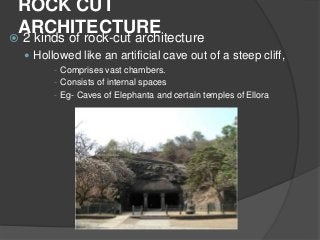
 2 kinds of rock-cut architecture
 Hollowed like an artificial cave out of a steep cliff,
- Comprises vast chambers.
- Consists of internal spaces
- Eg- Caves of Elephanta and certain temples of Ellora
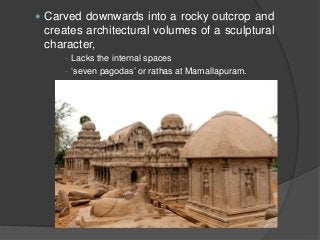
 Carved downwards into a rocky outcrop and
creates architectural volumes of a sculptural
character,
- Lacks the internal spaces
- ‘seven pagodas’ or rathas at Mamallapuram.
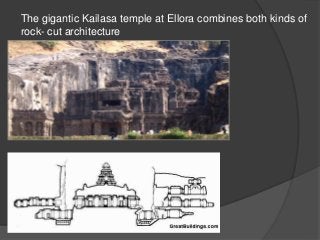
The gigantic Kailasa temple at Ellora combines both kinds of
rock- cut architecture
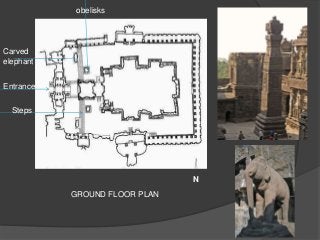
GROUND FLOOR PLAN
Entrance
Carved
elephant
obelisks
Steps
N
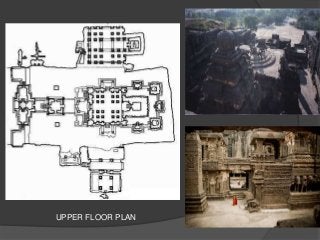
UPPER FLOOR PLAN
MONOLITHIC RATHAS at
MAMALLAPURAM Carved from Mamallapuram granite.
 Do not contain any internal spaces.
 7th cent and imitate in stone the earliest wooden temples.
 With the rise of Buddhism (due to support of the Emperor- Ashoka)- 3 kinds of
monuments came into existence
 These constitute the basic architectural language of India.
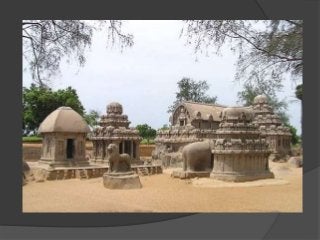
 Built by King Narasimhavarman-I
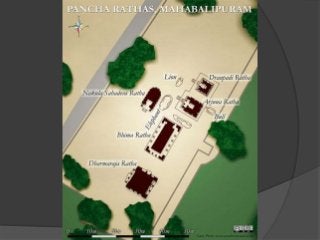
 Draupadi ratha
 Arjuna ratha
 Bhim ratha
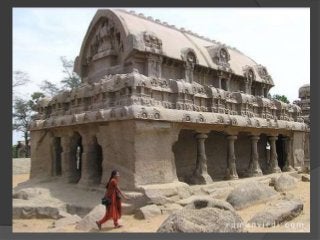
 Dharamraj ratha
 Nakula Sahadeva ratha
 Ornamented with small scale models of huts arranged around the entire perimeter of
the roof.
 Each of the miniature huts- barrel vaulted roof,(palm and straw roof) carefully depicted
in stone.
 Tympanum like motif- significant feature – kudu or chaitya arch.
 In many cases kudu ornamented with little sculpted figures who appear to be looking
out of the arched window.
 Hindu arch. is a representation of symbolism.
 Row of miniaturized buildings – form image of a celestial city. Eg- Mount Kailasa,
Mount Meru.
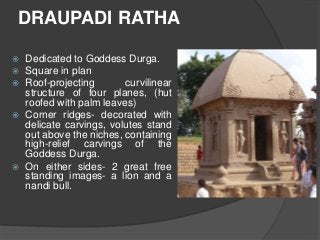
DRAUPADI RATHA
 Dedicated to Goddess Durga.
 Square in plan
 Roof-projecting curvilinear
structure of four planes, (hut
roofed with palm leaves)
 Corner ridges- decorated with
delicate carvings, volutes stand
out above the niches, containing
high-relief carvings of the
Goddess Durga.
 On either sides- 2 great free
standing images- a lion and a
nandi bull.
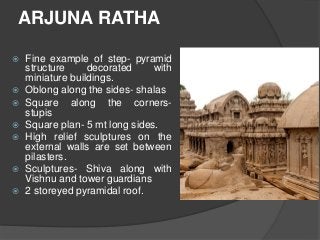
ARJUNA RATHA
 Fine example of step- pyramid
structure decorated with
miniature buildings.
 Oblong along the sides- shalas
 Square along the corners-
stupis
 Square plan- 5 mt long sides.
 High relief sculptures on the
external walls are set between
pilasters.
 Sculptures- Shiva along with
Vishnu and tower guardians
 2 storeyed pyramidal roof.
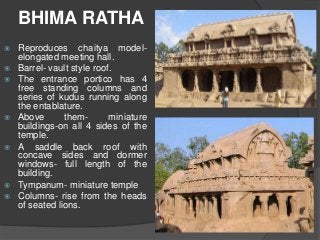
BHIMA RATHA
 Reproduces chaitya model-
elongated meeting hall.
 Barrel- vault style roof.
 The entrance portico has 4
free standing columns and
series of kudus running along
the entablature.
 Above them- miniature
buildings-on all 4 sides of the
temple.
 A saddle back roof with
concave sides and dormer
windows- full length of the
building.
 Tympanum- miniature temple
 Columns- rise from the heads
of seated lions.
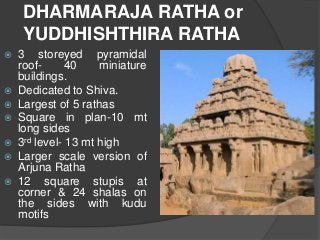
DHARMARAJA RATHA or
YUDDHISHTHIRA RATHA
 3 storeyed pyramidal
roof- 40 miniature
buildings.
 Dedicated to Shiva.
 Largest of 5 rathas
 Square in plan-10 mt
long sides
 3rd level- 13 mt high
 Larger scale version of
Arjuna Ratha
 12 square stupis at
corner & 24 shalas on
the sides with kudu
motifs
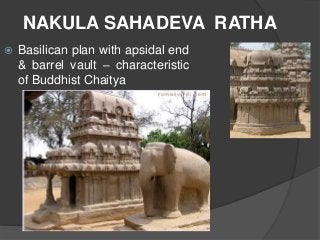
NAKULA SAHADEVA RATHA
 Basilican plan with apsidal end
& barrel vault – characteristic
of Buddhist Chaitya
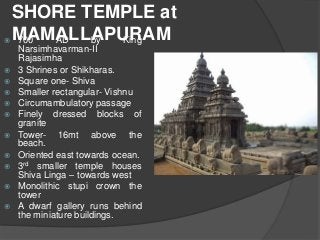
SHORE TEMPLE at
MAMALLAPURAM 700 AD by King
Narsimhavarman-II
Rajasimha
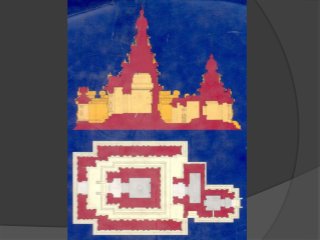
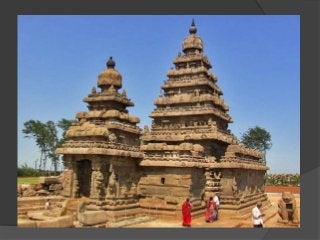
 3 Shrines or Shikharas.
 Square one- Shiva
 Smaller rectangular- Vishnu
 Circumambulatory passage
 Finely dressed blocks of
granite
 Tower- 16mt above the
beach.
 Oriented east towards ocean.
 3rd smaller temple houses
Shiva Linga – towards west
 Monolithic stupi crown the
tower
 A dwarf gallery runs behind
the miniature buildings.
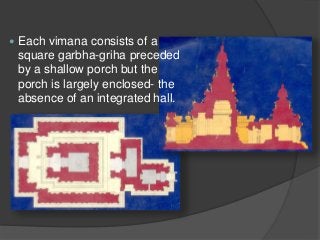
 Each vimana consists of a
square garbha-griha preceded
by a shallow porch but the
porch is largely enclosed- the
absence of an integrated hall.
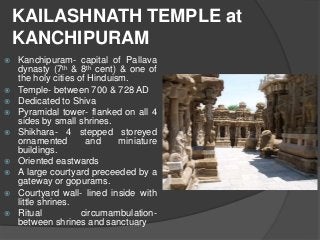
KAILASHNATH TEMPLE at
KANCHIPURAM
 Kanchipuram- capital of Pallava
dynasty (7th & 8th cent) & one of
the holy cities of Hinduism.
 Temple- between 700 & 728 AD
 Dedicated to Shiva
 Pyramidal tower- flanked on all 4
sides by small shrines.
 Shikhara- 4 stepped storeyed
ornamented and miniature
buildings.
 Oriented eastwards
 A large courtyard preceeded by a
gateway or gopurams.
 Courtyard wall- lined inside with
little shrines.
 Ritual circumambulation-
between shrines and sanctuary
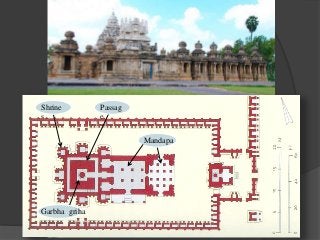
Shrine
s
Passag
e
Mandapa
Garbha griha
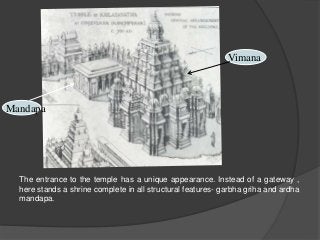
Vimana
Mandapa
The entrance to the temple has a unique appearance. Instead of a gateway ,
here stands a shrine complete in all structural features- garbha griha and ardha
mandapa.
 Other shrines- stand outside the entrance to the sanctuary
 Total 45 small shrines
 Each covered with an octagonal dome, on top of which stands a
stupi
 In front of the tower of Kailashnath temple- hypostyle pavillion
decorated with sculptures in which emblematic lions alternate with
sculpted divinities.
 Leads to a second and then to Garbha- griha.
 Contained within a narrow corridor and has 7 shrines on its external
walls. Total no of shrines 45+7=52
 The Kailasanatha Temple uses granite for the base and some
major structural members and the rest is in sandstone.
 Certain fundamental rules-
 Square cella- pyramidal tower or shikhara – Mount Meru
 In front- hypostyle hall- mandapa- open sides and ends- center of
the mandapa- dance takes place.
 Preceeded by a courtyard reached through a gopuram or
gateway – may be of monumental dimensions.
 Shikhara end- surrounded by a colonaded gallery- corridor for
ritual circumambulation.
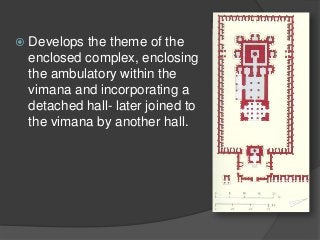
 Develops the theme of the
enclosed complex, enclosing
the ambulatory within the
vimana and incorporating a
detached hall- later joined to
the vimana by another hall.
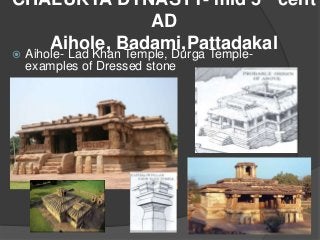
CHALUKYA DYNASTY- mid 5 cent
AD
Aihole, Badami,Pattadakal
 Aihole- Lad Khan Temple, Durga Temple-
examples of Dressed stone
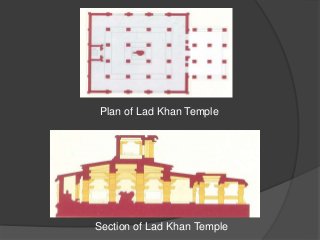
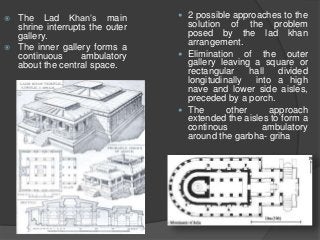
Plan of Lad Khan Temple
Section of Lad Khan Temple
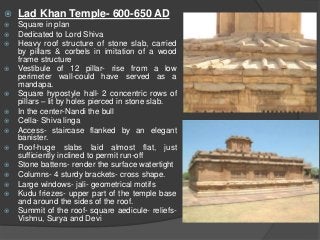
 Lad Khan Temple- 600-650 AD
 Square in plan
 Dedicated to Lord Shiva
 Heavy roof structure of stone slab, carried
by pillars & corbels in imitation of a wood
frame structure
 Vestibule of 12 pillar- rise from a low
perimeter wall-could have served as a
mandapa.
 Square hypostyle hall- 2 concentric rows of
pillars – lit by holes pierced in stone slab.
 In the center-Nandi the bull
 Cella- Shiva linga
 Access- staircase flanked by an elegant
banister.
 Roof-huge slabs laid almost flat, just
sufficiently inclined to permit run-off
 Stone battens- render the surface watertight
 Columns- 4 sturdy brackets- cross shape.
 Large windows- jali- geometrical motifs
 Kudu friezes- upper part of the temple base
and around the sides of the roof.
 Summit of the roof- square aedicule- reliefs-
Vishnu, Surya and Devi
 The Lad Khan’s main
shrine interrupts the outer
gallery.
 The inner gallery forms a
continuous ambulatory
about the central space.
 2 possible approaches to the
solution of the problem
posed by the lad khan
arrangement.
 Elimination of the outer
gallery leaving a square or
rectangular hall divided
longitudinally into a high
nave and lower side aisles,
preceded by a porch.
 The other approach
extended the aisles to form a
continous ambulatory
around the garbha- griha
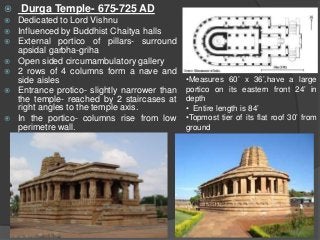
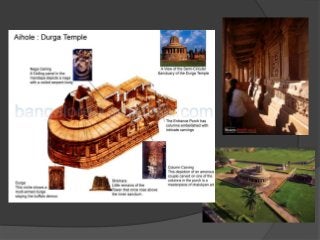
 Durga Temple- 675-725 AD
 Dedicated to Lord Vishnu
 Influenced by Buddhist Chaitya halls
 External portico of pillars- surround
apsidal garbha-griha
 Open sided circumambulatory gallery
 2 rows of 4 columns form a nave and
side aisles
 Entrance protico- slightly narrower than
the temple- reached by 2 staircases at
right angles to the temple axis.
 In the portico- columns rise from low
perimetre wall.
•Measures 60’ x 36’,have a large
portico on its eastern front 24’ in
depth
• Entire length is 84’
•Topmost tier of its flat roof 30’ from
ground
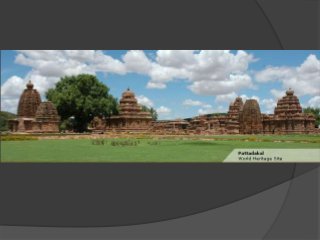
PATTADAKAL- former Chalukyan Capital
 The city of the coronation rubies
 8th cent group of temples.
 Pallavas and Chalukyas- rivals & battled for control of Southern
India.
 In the wake of war, artistic influences were exchanged- result-
combined Dravidian & Nagara styles
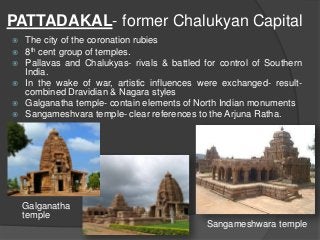
 Galganatha temple- contain elements of North Indian monuments
 Sangameshvara temple- clear references to the Arjuna Ratha.
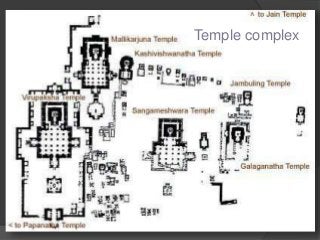
Galganatha
temple
Sangameshwara temple
Temple complex
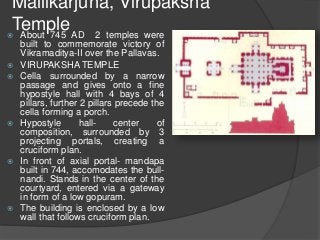
Mallikarjuna, Virupaksha
Temple About 745 AD 2 temples were
built to commemorate victory of
Vikramaditya-II over the Pallavas.
 VIRUPAKSHA TEMPLE
 Cella surrounded by a narrow
passage and gives onto a fine
hypostyle hall with 4 bays of 4
pillars, further 2 pillars precede the
cella forming a porch.
 Hypostyle hall- center of
composition, surrounded by 3
projecting portals, creating a
cruciform plan.
 In front of axial portal- mandapa
built in 744, accomodates the bull-
nandi. Stands in the center of the
courtyard, entered via a gateway
in form of a low gopuram.
 The building is enclosed by a low
wall that follows cruciform plan.
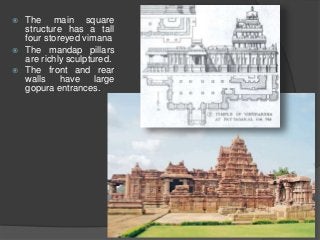
 The main square
structure has a tall
four storeyed vimana
 The mandap pillars
are richly sculptured.
 The front and rear
walls have large
gopura entrances.
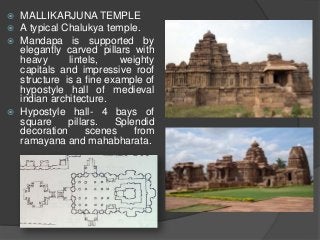
 MALLIKARJUNA TEMPLE
 A typical Chalukya temple.
 Mandapa is supported by
elegantly carved pillars with
heavy lintels, weighty
capitals and impressive roof
structure is a fine example of
hypostyle hall of medieval
indian architecture.
 Hypostyle hall- 4 bays of
square pillars. Splendid
decoration scenes from
ramayana and mahabharata.
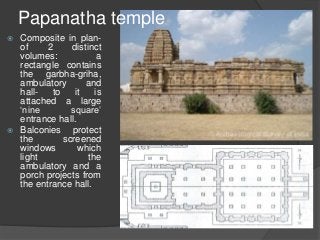
 Composite in plan-
of 2 distinct
volumes: a
rectangle contains
the garbha-griha,
ambulatory and
hall- to it is
attached a large
‘nine square’
entrance hall.
 Balconies protect
the screened
windows which
light the
ambulatory and a
porch projects from
the entrance hall.
Papanatha temple
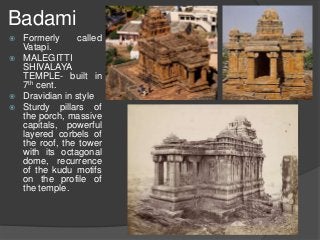
Badami
 Formerly called
Vatapi.
 MALEGITTI
SHIVALAYA
TEMPLE- built in
7th cent.
 Dravidian in style
 Sturdy pillars of
the porch, massive
capitals, powerful
layered corbels of
the roof, the tower
with its octagonal
dome, recurrence
of the kudu motifs
on the profile of
the temple.

Rock cut architecture

  • 1.
    • Primarily designedto accommodate the statue or sacred emblem of the divinity. • Indian religious monuments do not contain large internal spaces. They are ‘tabernacles’ , preceeded by halls used for ritual, music and dance. • Territory bounded by the Hindu Kush and the Himalayas and extended from modern Afghanistan and Pakistan in the west to Bangladesh in the east. Includes the entire peninsula : the Deccan- flanked by mountain ranges- the Western and Eastern Ghats which constitute a natural barrier. •The only passage- Khyber Pass in Hindu Kush
  • 2.
     Between thedestruction of Mohen-jo-daro and Harappa (about 1600 BC) and development of the first Indian cultures under Chandragupta Maurya (320 BC) there is an archaeological black hole of 1000 yrs.  Historical consciousness arose in India during Ashoka (269- 232 BC)  During medieval period (6th -13th cent.) temples became social and educational centres and important economic institutions- land owners, employers, moneylenders and dispensers of charity.  A canvas for the visual arts, a stage for the performing arts.  Even 100 of employers from priests and administrators to masons, dancers, cooks and potters.  2 classical languages of Indian temple architecture-  Northern- Nagara or Aryan  Southern- Dravida  Defining features are- aedicules-(little building- term is applied to a miniature shrine)
  • 3.
    ROCK CUT ARCHITECTURE  2kinds of rock-cut architecture  Hollowed like an artificial cave out of a steep cliff, - Comprises vast chambers. - Consists of internal spaces - Eg- Caves of Elephanta and certain temples of Ellora
  • 4.
     Carved downwardsinto a rocky outcrop and creates architectural volumes of a sculptural character, - Lacks the internal spaces - ‘seven pagodas’ or rathas at Mamallapuram.
  • 5.
    The gigantic Kailasatemple at Ellora combines both kinds of rock- cut architecture
  • 6.
  • 7.
  • 8.
    MONOLITHIC RATHAS at MAMALLAPURAMCarved from Mamallapuram granite.  Do not contain any internal spaces.  7th cent and imitate in stone the earliest wooden temples.  With the rise of Buddhism (due to support of the Emperor- Ashoka)- 3 kinds of monuments came into existence  These constitute the basic architectural language of India.  Built by King Narasimhavarman-I  Draupadi ratha  Arjuna ratha  Bhim ratha  Dharamraj ratha  Nakula Sahadeva ratha  Ornamented with small scale models of huts arranged around the entire perimeter of the roof.  Each of the miniature huts- barrel vaulted roof,(palm and straw roof) carefully depicted in stone.  Tympanum like motif- significant feature – kudu or chaitya arch.  In many cases kudu ornamented with little sculpted figures who appear to be looking out of the arched window.  Hindu arch. is a representation of symbolism.  Row of miniaturized buildings – form image of a celestial city. Eg- Mount Kailasa, Mount Meru.
  • 10.
    DRAUPADI RATHA  Dedicatedto Goddess Durga.  Square in plan  Roof-projecting curvilinear structure of four planes, (hut roofed with palm leaves)  Corner ridges- decorated with delicate carvings, volutes stand out above the niches, containing high-relief carvings of the Goddess Durga.  On either sides- 2 great free standing images- a lion and a nandi bull.
  • 11.
    ARJUNA RATHA  Fineexample of step- pyramid structure decorated with miniature buildings.  Oblong along the sides- shalas  Square along the corners- stupis  Square plan- 5 mt long sides.  High relief sculptures on the external walls are set between pilasters.  Sculptures- Shiva along with Vishnu and tower guardians  2 storeyed pyramidal roof.
  • 12.
    BHIMA RATHA  Reproduceschaitya model- elongated meeting hall.  Barrel- vault style roof.  The entrance portico has 4 free standing columns and series of kudus running along the entablature.  Above them- miniature buildings-on all 4 sides of the temple.  A saddle back roof with concave sides and dormer windows- full length of the building.  Tympanum- miniature temple  Columns- rise from the heads of seated lions.
  • 14.
    DHARMARAJA RATHA or YUDDHISHTHIRARATHA  3 storeyed pyramidal roof- 40 miniature buildings.  Dedicated to Shiva.  Largest of 5 rathas  Square in plan-10 mt long sides  3rd level- 13 mt high  Larger scale version of Arjuna Ratha  12 square stupis at corner & 24 shalas on the sides with kudu motifs
  • 16.
    NAKULA SAHADEVA RATHA Basilican plan with apsidal end & barrel vault – characteristic of Buddhist Chaitya
  • 18.
    SHORE TEMPLE at MAMALLAPURAM700 AD by King Narsimhavarman-II Rajasimha  3 Shrines or Shikharas.  Square one- Shiva  Smaller rectangular- Vishnu  Circumambulatory passage  Finely dressed blocks of granite  Tower- 16mt above the beach.  Oriented east towards ocean.  3rd smaller temple houses Shiva Linga – towards west  Monolithic stupi crown the tower  A dwarf gallery runs behind the miniature buildings.
  • 21.
     Each vimanaconsists of a square garbha-griha preceded by a shallow porch but the porch is largely enclosed- the absence of an integrated hall.
  • 22.
    KAILASHNATH TEMPLE at KANCHIPURAM Kanchipuram- capital of Pallava dynasty (7th & 8th cent) & one of the holy cities of Hinduism.  Temple- between 700 & 728 AD  Dedicated to Shiva  Pyramidal tower- flanked on all 4 sides by small shrines.  Shikhara- 4 stepped storeyed ornamented and miniature buildings.  Oriented eastwards  A large courtyard preceeded by a gateway or gopurams.  Courtyard wall- lined inside with little shrines.  Ritual circumambulation- between shrines and sanctuary
  • 23.
  • 24.
    Vimana Mandapa The entrance tothe temple has a unique appearance. Instead of a gateway , here stands a shrine complete in all structural features- garbha griha and ardha mandapa.
  • 25.
     Other shrines-stand outside the entrance to the sanctuary  Total 45 small shrines  Each covered with an octagonal dome, on top of which stands a stupi  In front of the tower of Kailashnath temple- hypostyle pavillion decorated with sculptures in which emblematic lions alternate with sculpted divinities.  Leads to a second and then to Garbha- griha.  Contained within a narrow corridor and has 7 shrines on its external walls. Total no of shrines 45+7=52  The Kailasanatha Temple uses granite for the base and some major structural members and the rest is in sandstone.  Certain fundamental rules-  Square cella- pyramidal tower or shikhara – Mount Meru  In front- hypostyle hall- mandapa- open sides and ends- center of the mandapa- dance takes place.  Preceeded by a courtyard reached through a gopuram or gateway – may be of monumental dimensions.  Shikhara end- surrounded by a colonaded gallery- corridor for ritual circumambulation.
  • 26.
     Develops thetheme of the enclosed complex, enclosing the ambulatory within the vimana and incorporating a detached hall- later joined to the vimana by another hall.
  • 27.
    CHALUKYA DYNASTY- mid5 cent AD Aihole, Badami,Pattadakal  Aihole- Lad Khan Temple, Durga Temple- examples of Dressed stone
  • 28.
    Plan of LadKhan Temple Section of Lad Khan Temple
  • 29.
     Lad KhanTemple- 600-650 AD  Square in plan  Dedicated to Lord Shiva  Heavy roof structure of stone slab, carried by pillars & corbels in imitation of a wood frame structure  Vestibule of 12 pillar- rise from a low perimeter wall-could have served as a mandapa.  Square hypostyle hall- 2 concentric rows of pillars – lit by holes pierced in stone slab.  In the center-Nandi the bull  Cella- Shiva linga  Access- staircase flanked by an elegant banister.  Roof-huge slabs laid almost flat, just sufficiently inclined to permit run-off  Stone battens- render the surface watertight  Columns- 4 sturdy brackets- cross shape.  Large windows- jali- geometrical motifs  Kudu friezes- upper part of the temple base and around the sides of the roof.  Summit of the roof- square aedicule- reliefs- Vishnu, Surya and Devi
  • 30.
     The LadKhan’s main shrine interrupts the outer gallery.  The inner gallery forms a continuous ambulatory about the central space.  2 possible approaches to the solution of the problem posed by the lad khan arrangement.  Elimination of the outer gallery leaving a square or rectangular hall divided longitudinally into a high nave and lower side aisles, preceded by a porch.  The other approach extended the aisles to form a continous ambulatory around the garbha- griha
  • 31.
     Durga Temple-675-725 AD  Dedicated to Lord Vishnu  Influenced by Buddhist Chaitya halls  External portico of pillars- surround apsidal garbha-griha  Open sided circumambulatory gallery  2 rows of 4 columns form a nave and side aisles  Entrance protico- slightly narrower than the temple- reached by 2 staircases at right angles to the temple axis.  In the portico- columns rise from low perimetre wall. •Measures 60’ x 36’,have a large portico on its eastern front 24’ in depth • Entire length is 84’ •Topmost tier of its flat roof 30’ from ground
  • 33.
    PATTADAKAL- former ChalukyanCapital  The city of the coronation rubies  8th cent group of temples.  Pallavas and Chalukyas- rivals & battled for control of Southern India.  In the wake of war, artistic influences were exchanged- result- combined Dravidian & Nagara styles  Galganatha temple- contain elements of North Indian monuments  Sangameshvara temple- clear references to the Arjuna Ratha. Galganatha temple Sangameshwara temple
  • 34.
  • 36.
    Mallikarjuna, Virupaksha Temple About745 AD 2 temples were built to commemorate victory of Vikramaditya-II over the Pallavas.  VIRUPAKSHA TEMPLE  Cella surrounded by a narrow passage and gives onto a fine hypostyle hall with 4 bays of 4 pillars, further 2 pillars precede the cella forming a porch.  Hypostyle hall- center of composition, surrounded by 3 projecting portals, creating a cruciform plan.  In front of axial portal- mandapa built in 744, accomodates the bull- nandi. Stands in the center of the courtyard, entered via a gateway in form of a low gopuram.  The building is enclosed by a low wall that follows cruciform plan.
  • 37.
     The mainsquare structure has a tall four storeyed vimana  The mandap pillars are richly sculptured.  The front and rear walls have large gopura entrances.
  • 38.
     MALLIKARJUNA TEMPLE A typical Chalukya temple.  Mandapa is supported by elegantly carved pillars with heavy lintels, weighty capitals and impressive roof structure is a fine example of hypostyle hall of medieval indian architecture.  Hypostyle hall- 4 bays of square pillars. Splendid decoration scenes from ramayana and mahabharata.
  • 39.
     Composite inplan- of 2 distinct volumes: a rectangle contains the garbha-griha, ambulatory and hall- to it is attached a large ‘nine square’ entrance hall.  Balconies protect the screened windows which light the ambulatory and a porch projects from the entrance hall. Papanatha temple
  • 40.
    Badami  Formerly called Vatapi. MALEGITTI SHIVALAYA TEMPLE- built in 7th cent.  Dravidian in style  Sturdy pillars of the porch, massive capitals, powerful layered corbels of the roof, the tower with its octagonal dome, recurrence of the kudu motifs on the profile of the temple.