INTRODUCTION
• Renaissance architecture is the
European architecture of the
period between the early 14th
and early 16th centuries.
• It demonstrates development of
certain elements of ancient
Greek and Roman thought and
material culture.
• Stylistically, Renaissance
architecture followed Gothic
architecture and was succeeded
by Baroque architecture.
• Renaissance style places emphasis
on symmetry, proportion, geometry
and the regularity of parts.
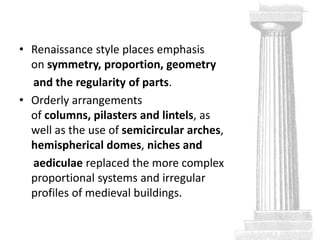
• Orderly arrangements
of columns, pilasters and lintels, as
well as the use of semicircular arches,
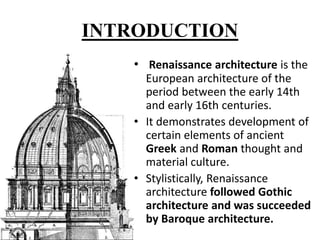
hemispherical domes, niches and
aediculae replaced the more complex
proportional systems and irregular
profiles of medieval buildings.
HISTORY
• Italy of the 15th century, and the
city of Florence in particular, was
home to the Renaissance. It is in
Florence.
• Italian architects had always
preferred forms that were clearly
defined and structural members
that expressed their purpose.
• Many Tuscan Romanesque
buildings demonstrate these
characteristics, as seen in
the Florence Baptistery and
Pis Cathedral.
PRINCIPLE PHASES
• Historians often use the following
designations:
• Renaissance (ca. 1400–1500); also known as
the Quattrocento and sometimes Early
Renaissance
• High Renaissance (ca.1500–1525)
• Mannerism (ca. 1520–1600)
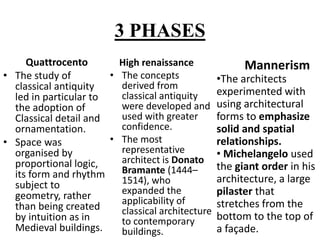
3 PHASES
Quattrocento
• The study of
classical antiquity
led in particular to
the adoption of
Classical detail and
ornamentation.
• Space was
organised by
proportional logic,
its form and rhythm
subject to
geometry, rather
than being created
by intuition as in
Medieval buildings.
High renaissance
• The concepts
derived from
classical antiquity
were developed and
used with greater
confidence.
• The most
representative
architect is Donato
Bramante (1444–
1514), who
expanded the
applicability of
classical architecture
to contemporary
buildings.
Mannerism
•The architects
experimented with
using architectural
forms to emphasize
solid and spatial
relationships.
• Michelangelo used
the giant order in his
architecture, a large
pilaster that
stretches from the
bottom to the top of
a façade.
CHARACTERISTICS FEATURES
• The plans of Renaissance
buildings have a square,
symmetrical appearance in
which proportions are
usually based on a module.
Within a church, the module
is often the width of an aisle.
• Façades are symmetrical around
their vertical axis. Church façades
are generally surmounted by
a pediment and organised by a
system of pilasters, arches
and entablatures. The columns and
windows show a progression
towards the centre.
PLANS FACADE
• Roman and Greek orders of columns
are
used: Tuscan, Doric, Ionic, Corinthian
and Composite. The orders can either
be structural, supporting an arcade or
architrave, or purely decorative, set
against a wall in the form of pilasters.
During the Renaissance, architects
aimed to use
columns, pilasters,and entablatures a
s an integrated system.
• Arches are semi-circular or (in the
Mannerist style) segmental.
Arches are often used in arcades,
supported on piers or columns
with capitals. There may be a
section of entablature between
the capital and the springing of the
arch.
COLUMNS & PILATERS ARCHES
• Vaults do not have ribs. They
are semi-circular or segmental
and on a square plan, unlike
the Gothic vault which is
frequently rectangular.
The barrel vault is returned to
architectural vocabulary as at
the St. Andrea in Mantua
• The dome is used frequently,
both as a very large structural
feature that is visible from the
exterior, and also as a means of
roofing smaller spaces where
they are only visible internally.
VAULTS DOMES
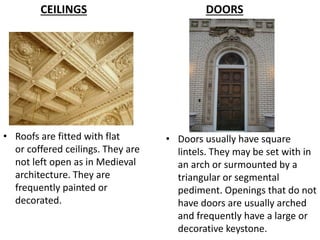
• Roofs are fitted with flat
or coffered ceilings. They are
not left open as in Medieval
architecture. They are
frequently painted or
decorated.
• Doors usually have square
lintels. They may be set with in
an arch or surmounted by a
triangular or segmental
pediment. Openings that do not
have doors are usually arched
and frequently have a large or
decorative keystone.
CEILINGS DOORS
• Windows may be paired and set
within a semi-circular arch. They may
have square lintels and triangular or
segmental pediments, which are
often used alternatel. In the
Mannerist period the Palladian arch
was employed, using a motif of a
high semi-circular topped opening
flanked with two lower square-
topped openings
• External walls are generally constructed
of brick, rendered, or faced with stone in
highly finished ashlar masonry, laid in
straight courses. The corners of buildings
are often emphasized by
rusticated quoins. Basements and
ground floors were often rusticated,
Internal walls are smoothly plastered and
surfaced with lime wash. For more
formal spaces, internal surfaces are
decorated with frescoes.
WINDOWS WALLS
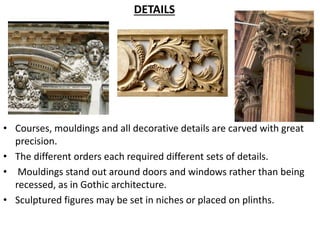
• Courses, mouldings and all decorative details are carved with great
precision.
• The different orders each required different sets of details.
• Mouldings stand out around doors and windows rather than being
recessed, as in Gothic architecture.
• Sculptured figures may be set in niches or placed on plinths.
DETAILS
THANK YOU!!

Renaissance Architecture

  • 2.
    INTRODUCTION • Renaissance architectureis the European architecture of the period between the early 14th and early 16th centuries. • It demonstrates development of certain elements of ancient Greek and Roman thought and material culture. • Stylistically, Renaissance architecture followed Gothic architecture and was succeeded by Baroque architecture.
  • 3.
    • Renaissance styleplaces emphasis on symmetry, proportion, geometry and the regularity of parts. • Orderly arrangements of columns, pilasters and lintels, as well as the use of semicircular arches, hemispherical domes, niches and aediculae replaced the more complex proportional systems and irregular profiles of medieval buildings.
  • 4.
    HISTORY • Italy ofthe 15th century, and the city of Florence in particular, was home to the Renaissance. It is in Florence. • Italian architects had always preferred forms that were clearly defined and structural members that expressed their purpose. • Many Tuscan Romanesque buildings demonstrate these characteristics, as seen in the Florence Baptistery and Pis Cathedral.
  • 5.
    PRINCIPLE PHASES • Historiansoften use the following designations: • Renaissance (ca. 1400–1500); also known as the Quattrocento and sometimes Early Renaissance • High Renaissance (ca.1500–1525) • Mannerism (ca. 1520–1600)
  • 6.
    3 PHASES Quattrocento • Thestudy of classical antiquity led in particular to the adoption of Classical detail and ornamentation. • Space was organised by proportional logic, its form and rhythm subject to geometry, rather than being created by intuition as in Medieval buildings. High renaissance • The concepts derived from classical antiquity were developed and used with greater confidence. • The most representative architect is Donato Bramante (1444– 1514), who expanded the applicability of classical architecture to contemporary buildings. Mannerism •The architects experimented with using architectural forms to emphasize solid and spatial relationships. • Michelangelo used the giant order in his architecture, a large pilaster that stretches from the bottom to the top of a façade.
  • 7.
    CHARACTERISTICS FEATURES • Theplans of Renaissance buildings have a square, symmetrical appearance in which proportions are usually based on a module. Within a church, the module is often the width of an aisle. • Façades are symmetrical around their vertical axis. Church façades are generally surmounted by a pediment and organised by a system of pilasters, arches and entablatures. The columns and windows show a progression towards the centre. PLANS FACADE
  • 8.
    • Roman andGreek orders of columns are used: Tuscan, Doric, Ionic, Corinthian and Composite. The orders can either be structural, supporting an arcade or architrave, or purely decorative, set against a wall in the form of pilasters. During the Renaissance, architects aimed to use columns, pilasters,and entablatures a s an integrated system. • Arches are semi-circular or (in the Mannerist style) segmental. Arches are often used in arcades, supported on piers or columns with capitals. There may be a section of entablature between the capital and the springing of the arch. COLUMNS & PILATERS ARCHES
  • 9.
    • Vaults donot have ribs. They are semi-circular or segmental and on a square plan, unlike the Gothic vault which is frequently rectangular. The barrel vault is returned to architectural vocabulary as at the St. Andrea in Mantua • The dome is used frequently, both as a very large structural feature that is visible from the exterior, and also as a means of roofing smaller spaces where they are only visible internally. VAULTS DOMES
  • 10.
    • Roofs arefitted with flat or coffered ceilings. They are not left open as in Medieval architecture. They are frequently painted or decorated. • Doors usually have square lintels. They may be set with in an arch or surmounted by a triangular or segmental pediment. Openings that do not have doors are usually arched and frequently have a large or decorative keystone. CEILINGS DOORS
  • 11.
    • Windows maybe paired and set within a semi-circular arch. They may have square lintels and triangular or segmental pediments, which are often used alternatel. In the Mannerist period the Palladian arch was employed, using a motif of a high semi-circular topped opening flanked with two lower square- topped openings • External walls are generally constructed of brick, rendered, or faced with stone in highly finished ashlar masonry, laid in straight courses. The corners of buildings are often emphasized by rusticated quoins. Basements and ground floors were often rusticated, Internal walls are smoothly plastered and surfaced with lime wash. For more formal spaces, internal surfaces are decorated with frescoes. WINDOWS WALLS
  • 12.
    • Courses, mouldingsand all decorative details are carved with great precision. • The different orders each required different sets of details. • Mouldings stand out around doors and windows rather than being recessed, as in Gothic architecture. • Sculptured figures may be set in niches or placed on plinths. DETAILS
  • 13.