The history of human settlements has been based upon the development of civic design and the
man.
There are three development ages of man.
According to Vitruvius, man, in primitive time when he was a savage began to imitate the nests of
birds and lairs of beasts.
1. Man and his appearance as hunter ( 13 – million years ago ).
Purely wild life
Man was apes, hunting on animals.
No communication and no settlements.
2. Man in Barbaric stage ( 3-4 lakh years ago )
man learned to lived in groups.
Still nomadic life.
Groups moving from place to place in search of animals (food), water and security.
This helps in development.(defence against wild animals, domesticating animals, offensive and
defensive activities.
3. Man into a settled life with discovery of fire, tools, and agriculture.
Starting code of behaviour, agriculture was discovered.
People increasingly settled somewhere as groups other changes followed.
Agriculture was discovered.
He observed that the fruits of trees were growing repeatedly.
Women were bearing children as a biological phenomenon.
Man was permanently settled and agriculture gave some social surplus.
Social surplus gave some spare time, art, philosophy and science started being developed i.e.
Enlightenment at some people provided scope for specialisation.
Discovery of fire helped in this specialisation.
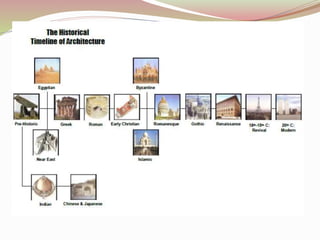
PREHISTORIC TIMES
 PREHISTORY : THE PERIOD BEFORE WRITTEN HISTORY.
 USED TO DESCRIBE PERIOD WHEN THERE WAS LIFE ON EARTH.
 HUMAN PREHISTORY DIFFERS FROM HISTORY NOT ONLY IN TERMS OF CHRONOLOGY BUT IN THE WAY
IT DEALS WITH THE ACTIVITIES OF ARCHAEOLOGICAL CULTURES RATHER THAN NAMED NATIONS OR
INDIVIDUALS.
 PREHISTORY IS ANONYMOUS- RESTRICTED TO MATERIAL REMAINS THAN WRITTEN RECORDS.
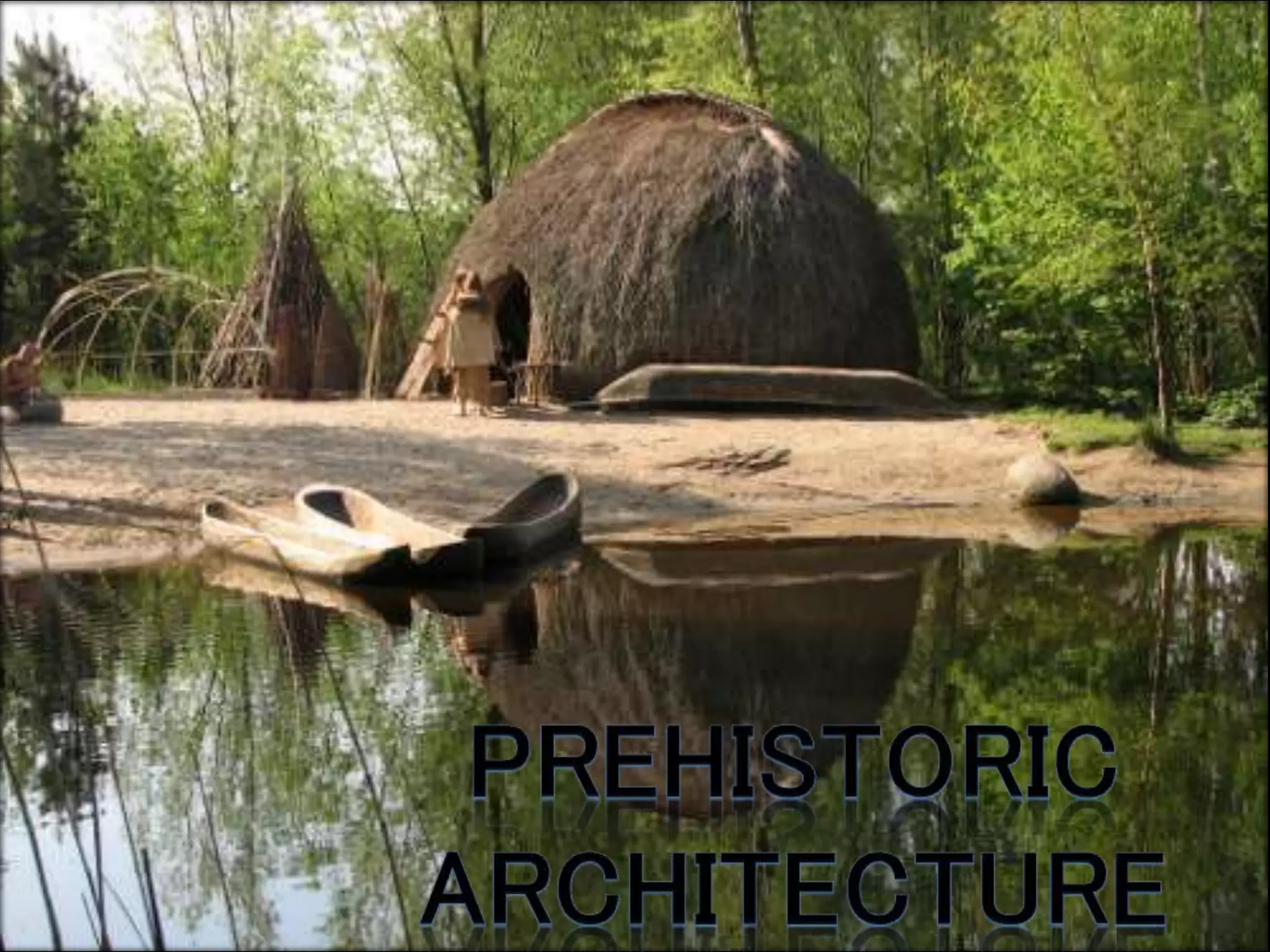
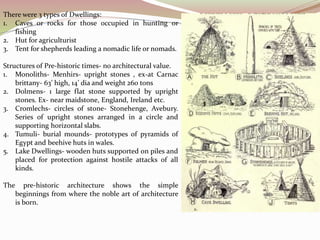
There were 3 types of Dwellings:
1. Caves or rocks for those occupied in hunting or
fishing
2. Hut for agriculturist
3. Tent for shepherds leading a nomadic life or nomads.
Structures of Pre-historic times- no architectural value.
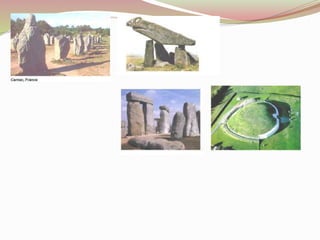
1. Monoliths- Menhirs- upright stones , ex-at Carnac
brittany- 63’ high, 14’ dia and weight 260 tons
2. Dolmens- 1 large flat stone supported by upright
stones. Ex- near maidstone, England, Ireland etc.
3. Cromlechs- circles of stone- Stonehenge, Avebury.
Series of upright stones arranged in a circle and
supporting horizontal slabs.
4. Tumuli- burial mounds- prototypes of pyramids of
Egypt and beehive huts in wales.
5. Lake Dwellings- wooden huts supported on piles and
placed for protection against hostile attacks of all
kinds.
The pre-historic architecture shows the simple
beginnings from where the noble art of architecture
is born.
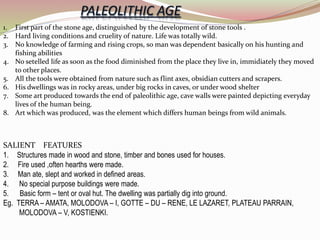
1. First part of the stone age, distinguished by the development of stone tools .
2. Hard living conditions and cruelity of nature. Life was totally wild.
3. No knowledge of farming and rising crops, so man was dependent basically on his hunting and
fishing abilities
4. No setelled life as soon as the food diminished from the place they live in, immidiately they moved
to other places.
5. All the tools were obtained from nature such as flint axes, obsidian cutters and scrapers.
6. His dwellings was in rocky areas, under big rocks in caves, or under wood shelter
7. Some art produced towards the end of paleolithic age, cave walls were painted depicting everyday
lives of the human being.
8. Art which was produced, was the element which differs human beings from wild animals.
SALIENT FEATURES
1. Structures made in wood and stone, timber and bones used for houses.
2. Fire used ,often hearths were made.
3. Man ate, slept and worked in defined areas.
4. No special purpose buildings were made.
5. Basic form – tent or oval hut. The dwelling was partially dig into ground.
Eg. TERRA – AMATA, MOLODOVA – I, GOTTE – DU – RENE, LE LAZARET, PLATEAU PARRAIN,
MOLODOVA – V, KOSTIENKI.
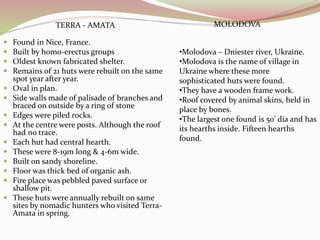
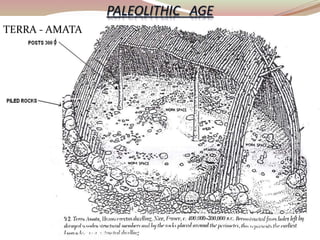
TERRA - AMATA
 Found in Nice, France.
 Built by homo-erectus groups
 Oldest known fabricated shelter.
 Remains of 21 huts were rebuilt on the same
spot year after year.
 Oval in plan.
 Side walls made of palisade of branches and
braced on outside by a ring of stone
 Edges were piled rocks.
 At the centre were posts. Although the roof
had no trace.
 Each hut had central hearth.
 These were 8-19m long & 4-6m wide.
 Built on sandy shoreline.
 Floor was thick bed of organic ash.
 Fire place was pebbled paved surface or
shallow pit.
 These huts were annually rebuilt on same
sites by nomadic hunters who visited Terra-
Amata in spring.
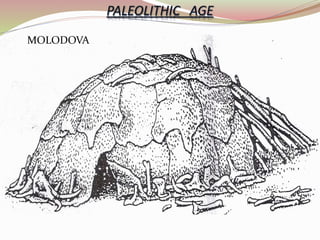
•Molodova – Dniester river, Ukraine.
•Molodova is the name of village in
Ukraine where these more
sophisticated huts were found.
•They have a wooden frame work.
•Roof covered by animal skins, held in
place by bones.
•The largest one found is 50’ dia and has
its hearths inside. Fifteen hearths
found.
MOLODOVA
TERRA - AMATA
MOLODOVA
SALIENT FEATURES
1. Similar to Paleolithic dwellings.
2. Carvings used at entrances.
3. Some dwellings built for occupation in winter.
4. Entrances were bigger.
5. Structures were made using wood, limestone and sandstones.
6. Villages were also being arranged systematically.
7. Houses were aligned in rows and were more regular in plan.
8. Houses were light wooden constructions.
Eg. LEPENSKI – VIR, TANNSTOCK, JUHNSDORF – AUTOBAHM.
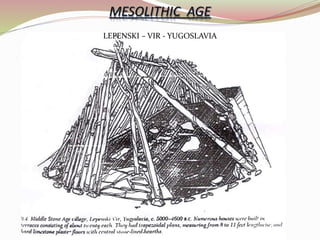
LEPENSKI – VIR - YUGOSLAVIA
• Houses were built in row of 20.
• Trapezoidal in plan, uniform proportions. 5.5 x3.5m square.
• Wider end contained entrance facing river.
• Floor are made of hard lime stone plaster covered by red or white surface.
• Posts used as walls reinforced with stone from outside.
• Carvings on stone are seen.
LEPENSKI – VIR - YUGOSLAVIA
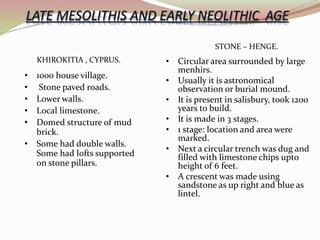
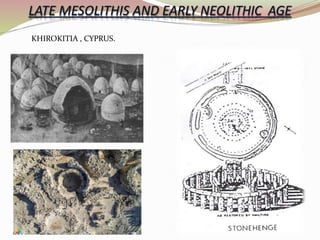
• Circular area surrounded by large
menhirs.
• Usually it is astronomical
observation or burial mound.
• It is present in salisbury, took 1200
years to build.
• It is made in 3 stages.
• 1 stage: location and area were
marked.
• Next a circular trench was dug and
filled with limestone chips upto
height of 6 feet.
• A crescent was made using
sandstone as up right and blue as
lintel.
STONE – HENGE.
KHIROKITIA , CYPRUS.
• 1000 house village.
• Stone paved roads.
• Lower walls.
• Local limestone.
• Domed structure of mud
brick.
• Some had double walls.
Some had lofts supported
on stone pillars.
KHIROKITIA , CYPRUS.
SALIENT FEATURES
 Structures made using timber and stone.
 Houses were square or rectangular,
single – family dwelling units or long –
houses lived in by expanded or multiple
family.
 Multicellular drystone family houses were
also built.
 Timber – Framed Houses – Nea –
Nikomedia(North Greece), Otzaki (
Greece), Azmak and Karnova (Bulgaria),
Tiszajeno (Hungary).
 Long Houses – Bylany ( Czechoslovakia)
, Esloo ( Holland), Vladimirokova (
Ukraine).
 Dry stone Houses – Sakra (Orkrey
Islands, Scotland).
 Late Mesolithic and Early Neolithic
Period – Khirokitia.
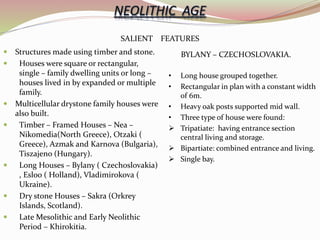
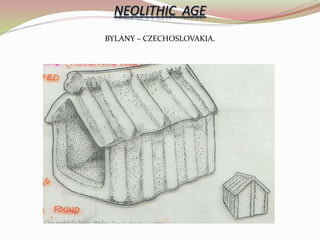
BYLANY – CZECHOSLOVAKIA.
• Long house grouped together.
• Rectangular in plan with a constant width
of 6m.
• Heavy oak posts supported mid wall.
• Three type of house were found:
 Tripatiate: having entrance section
central living and storage.
 Bipartiate: combined entrance and living.
 Single bay.
BYLANY – CZECHOSLOVAKIA.
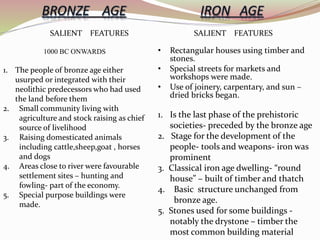
SALIENT FEATURES
1000 BC ONWARDS
1. The people of bronze age either
usurped or integrated with their
neolithic predecessors who had used
the land before them
2. Small community living with
agriculture and stock raising as chief
source of livelihood
3. Raising domesticated animals
including cattle,sheep,goat , horses
and dogs
4. Areas close to river were favourable
settlement sites – hunting and
fowling- part of the economy.
5. Special purpose buildings were
made.
SALIENT FEATURES
• Rectangular houses using timber and
stones.
• Special streets for markets and
workshops were made.
• Use of joinery, carpentary, and sun –
dried bricks began.
1. Is the last phase of the prehistoric
societies- preceded by the bronze age
2. Stage for the development of the
people- tools and weapons- iron was
prominent
3. Classical iron age dwelling- “round
house” – built of timber and thatch
4. Basic structure unchanged from
bronze age.
5. Stones used for some buildings -
notably the drystone – timber the
most common building material
INFLUENCE ON ARCHITECTURE OF ANY REGION
 GEOGRAPHICAL CONDITION
 GEOLOGICAL CONDITION
 CLIMATIC CONDITION
 RELIGIOUS CONDITION
 SOCIAL & POLITICAL CONDITION
 HISTORICAL CONDITION
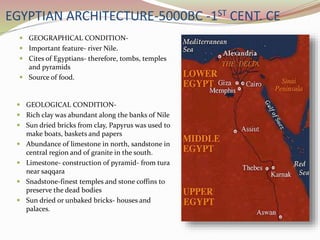
EGYPTIAN ARCHITECTURE-5000BC -1ST CENT. CE
 GEOGRAPHICAL CONDITION-
 Important feature- river Nile.
 Cites of Egyptians- therefore, tombs, temples
and pyramids
 Source of food.
 GEOLOGICAL CONDITION-
 Rich clay was abundant along the banks of Nile
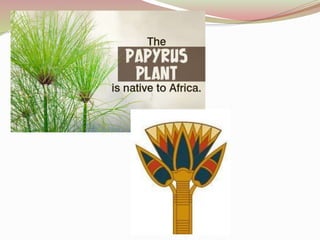
 Sun dried bricks from clay, Papyrus was used to
make boats, baskets and papers
 Abundance of limestone in north, sandstone in
central region and of granite in the south.
 Limestone- construction of pyramid- from tura
near saqqara
 Snadstone-finest temples and stone coffins to
preserve the dead bodies
 Sun dried or unbaked bricks- houses and
palaces.
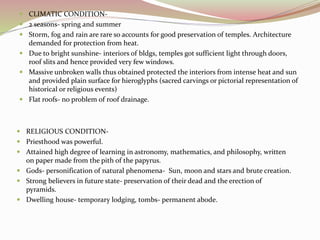
 CLIMATIC CONDITION-
 2 seasons- spring and summer
 Storm, fog and rain are rare so accounts for good preservation of temples. Architecture
demanded for protection from heat.
 Due to bright sunshine- interiors of bldgs, temples got sufficient light through doors,
roof slits and hence provided very few windows.
 Massive unbroken walls thus obtained protected the interiors from intense heat and sun
and provided plain surface for hieroglyphs (sacred carvings or pictorial representation of
historical or religious events)
 Flat roofs- no problem of roof drainage.
 RELIGIOUS CONDITION-
 Priesthood was powerful.
 Attained high degree of learning in astronomy, mathematics, and philosophy, written
on paper made from the pith of the papyrus.
 Gods- personification of natural phenomena- Sun, moon and stars and brute creation.
 Strong believers in future state- preservation of their dead and the erection of
pyramids.
 Dwelling house- temporary lodging, tombs- permanent abode.
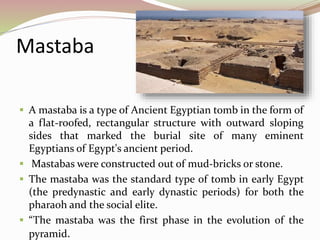
Mastaba
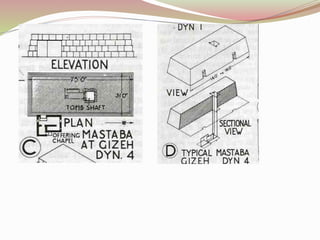
 A mastaba is a type of Ancient Egyptian tomb in the form of
a flat-roofed, rectangular structure with outward sloping
sides that marked the burial site of many eminent
Egyptians of Egypt's ancient period.
 Mastabas were constructed out of mud-bricks or stone.
 The mastaba was the standard type of tomb in early Egypt
(the predynastic and early dynastic periods) for both the
pharaoh and the social elite.
 “The mastaba was the first phase in the evolution of the
pyramid.
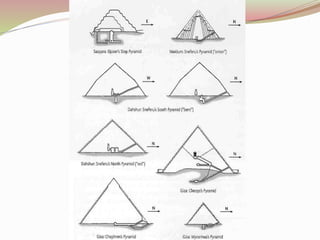
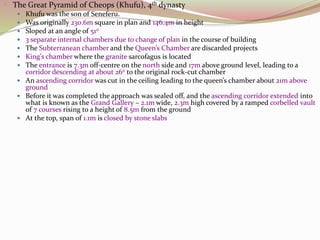
 The Great Pyramid of Cheops (Khufu), 4th dynasty
 Khufu was the son of Seneferu.
 Was originally 230.6m square in plan and 146.4m in height
 Sloped at an angle of 510
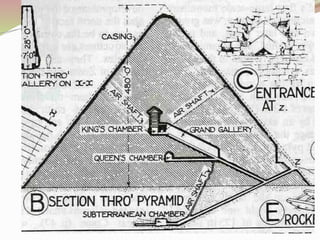
 3 separate internal chambers due to change of plan in the course of building
 The Subterranean chamber and the Queen’s Chamber are discarded projects
 King’s chamber where the granite sarcofagus is located
 The entrance is 7.3m off-centre on the north side and 17m above ground level, leading to a
corridor descending at about 260 to the original rock-cut chamber
 An ascending corridor was cut in the ceiling leading to the queen’s chamber about 21m above
ground
 Before it was completed the approach was sealed off, and the ascending corridor extended into
what is known as the Grand Gallery – 2.1m wide, 2.3m high covered by a ramped corbelled vault
of 7 courses rising to a height of 8.5m from the ground
 At the top, span of 1.1m is closed by stone slabs
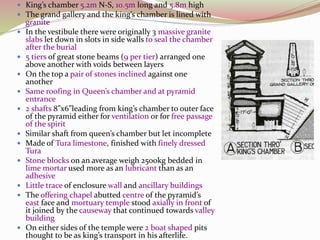
 King’s chamber 5.2m N-S, 10.5m long and 5.8m high
 The grand gallery and the king’s chamber is lined with
granite
 In the vestibule there were originally 3 massive granite
slabs let down in slots in side walls to seal the chamber
after the burial
 5 tiers of great stone beams (9 per tier) arranged one
above another with voids between layers
 On the top a pair of stones inclined against one
another
 Same roofing in Queen’s chamber and at pyramid
entrance
 2 shafts 8”x6”leading from king’s chamber to outer face
of the pyramid either for ventilation or for free passage
of the spirit
 Similar shaft from queen’s chamber but let incomplete
 Made of Tura limestone, finished with finely dressed
Tura
 Stone blocks on an average weigh 2500kg bedded in
lime mortar used more as an lubricant than as an
adhesive
 Little trace of enclosure wall and ancillary buildings
 The offering chapel abutted centre of the pyramid’s
east face and mortuary temple stood axially in front of
it joined by the causeway that continued towards valley
building
 On either sides of the temple were 2 boat shaped pits
thought to be as king’s transport in his afterlife.
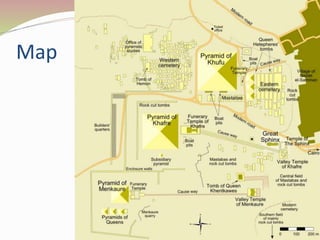
 Pyramids- part of a complex of buildings.
 Surrounded by -a walled enclosure and had an offering
chapel, with a stele, usually abutting the east side of
the pyramid
 - a mortuary temple for the worship of the dead and
deified pharaoh, normally projecting from the
enclosure on the east
 -a raised and enclosed causeway leading to the western
edge of the valley building
 - a valley building where embalming was carried out
and rites performed.
Map
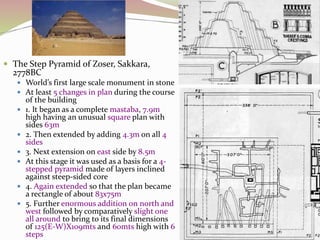
 The Step Pyramid of Zoser, Sakkara,
2778BC
 World’s first large scale monument in stone
 At least 5 changes in plan during the course
of the building
 1. It began as a complete mastaba, 7.9m
high having an unusual square plan with
sides 63m
 2. Then extended by adding 4.3m on all 4
sides
 3. Next extension on east side by 8.5m
 At this stage it was used as a basis for a 4-
stepped pyramid made of layers inclined
against steep-sided core
 4. Again extended so that the plan became
a rectangle of about 83x75m
 5. Further enormous addition on north and
west followed by comparatively slight one
all around to bring to its final dimensions
of 125(E-W)X109mts and 60mts high with 6
steps
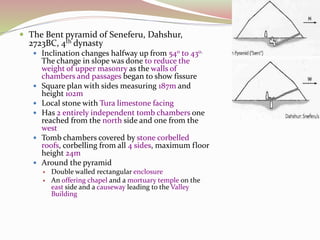
 The Bent pyramid of Seneferu, Dahshur,
2723BC, 4th dynasty
 Inclination changes halfway up from 540 to 430.
The change in slope was done to reduce the
weight of upper masonry as the walls of
chambers and passages began to show fissure
 Square plan with sides measuring 187m and
height 102m
 Local stone with Tura limestone facing
 Has 2 entirely independent tomb chambers one
reached from the north side and one from the
west
 Tomb chambers covered by stone corbelled
roofs, corbelling from all 4 sides, maximum floor
height 24m
 Around the pyramid
 Double walled rectangular enclosure
 An offering chapel and a mortuary temple on the
east side and a causeway leading to the Valley
Building
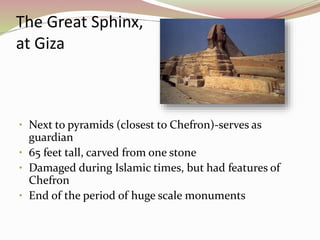
The Great Sphinx,
at Giza
• Next to pyramids (closest to Chefron)-serves as
guardian
• 65 feet tall, carved from one stone
• Damaged during Islamic times, but had features of
Chefron
• End of the period of huge scale monuments
 PREHISTORIC PERIOD- BC 2300-4777
 ANCIENT EMPIRE (DYNASTIES I-X)- BC 4777-2821
 Temples
 Sandstone primary material for temples
 Less suitable for relief-carving but more suitable for spanning greater widths
 Mainly two types of temples – mortuary and cult
 The mortuary temples for ministrations to deified Pharaohs
 Developed from offering chapels of royal mastabas and pyramids
 In the Middle Kingdom when royal burials were made in the hillside they became
architecturally more important of the two
 They increasingly became more like cult temples and eventually their individuality
lost during the New Kingdom
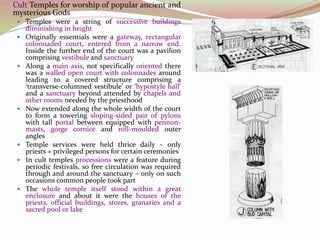
 Cult Temples for worship of popular ancient and
mysterious Gods
 Temples were a string of successive buildings
diminishing in height
 Originally essentials were a gateway, rectangular
colonnaded court, entered from a narrow end.
Inside the further end of the court was a pavilion
comprising vestibule and sanctuary
 Along a main axis, not specifically oriented there
was a walled open court with colonnades around
leading to a covered structure comprising a
‘transverse-columned vestibule’ or ‘hypostyle hall’
and a sanctuary beyond attended by chapels and
other rooms needed by the priesthood
 Now extended along the whole width of the court
to form a towering sloping-sided pair of pylons
with tall portal between equipped with pennon-
masts, gorge cornice and roll-moulded outer
angles
 Temple services were held thrice daily – only
priests + privileged persons for certain ceremonies
 In cult temples processions were a feature during
periodic festivals, so free circulation was required
through and around the sanctuary – only on such
occasions common people took part
 The whole temple itself stood within a great
enclosure and about it were the houses of the
priests, official buildings, stores, granaries and a
sacred pool or lake
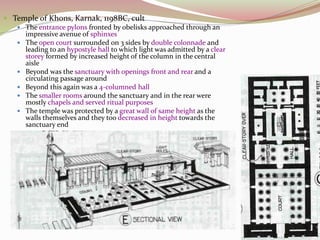
 Temple of Khons, Karnak, 1198BC, cult
 The entrance pylons fronted by obelisks approached through an
impressive avenue of sphinxes
 The open court surrounded on 3 sides by double colonnade and
leading to an hypostyle hall to which light was admitted by a clear
storey formed by increased height of the column in the central
aisle
 Beyond was the sanctuary with openings front and rear and a
circulating passage around
 Beyond this again was a 4-columned hall
 The smaller rooms around the sanctuary and in the rear were
mostly chapels and served ritual purposes
 The temple was protected by a great wall of same height as the
walls themselves and they too decreased in height towards the
sanctuary end
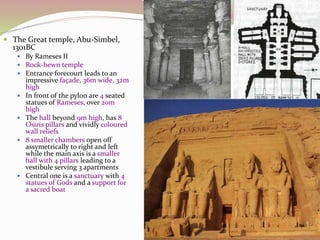
 The Great temple, Abu-Simbel,
1301BC
 By Rameses II
 Rock-hewn temple
 Entrance forecourt leads to an
impressive façade, 36m wide, 32m
high
 In front of the pylon are 4 seated
statues of Rameses, over 20m
high
 The hall beyond 9m high, has 8
Osiris pillars and vividly coloured
wall reliefs
 8 smaller chambers open off
assymetrically to right and left
while the main axis is a smaller
hall with 4 pillars leading to a
vestibule serving 3 apartments
 Central one is a sanctuary with 4
statues of Gods and a support for
a sacred boat
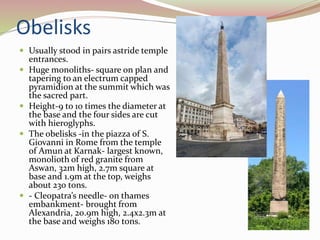
Obelisks
 Usually stood in pairs astride temple
entrances.
 Huge monoliths- square on plan and
tapering to an electrum capped
pyramidion at the summit which was
the sacred part.
 Height-9 to 10 times the diameter at
the base and the four sides are cut
with hieroglyphs.
 The obelisks -in the piazza of S.
Giovanni in Rome from the temple
of Amun at Karnak- largest known,
monolioth of red granite from
Aswan, 32m high, 2.7m square at
base and 1.9m at the top, weighs
about 230 tons.
 - Cleopatra’s needle- on thames
embankment- brought from
Alexandria, 20.9m high, 2.4x2.3m at
the base and weighs 180 tons.
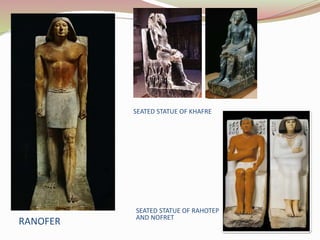
RANOFER
SEATED STATUE OF KHAFRE
SEATED STATUE OF RAHOTEP
AND NOFRET
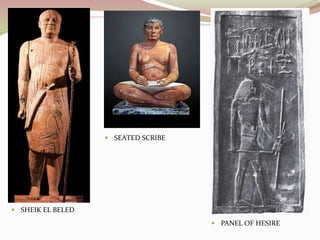
 SHEIK EL BELED
 SEATED SCRIBE
 PANEL OF HESIRE
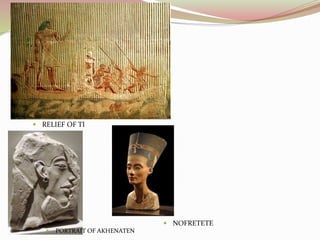
 RELIEF OF TI
 PORTRAIT OF AKHENATEN
 NOFRETETE
Prehistoric architecture

Prehistoric architecture

  • 2.
    The history ofhuman settlements has been based upon the development of civic design and the man. There are three development ages of man. According to Vitruvius, man, in primitive time when he was a savage began to imitate the nests of birds and lairs of beasts. 1. Man and his appearance as hunter ( 13 – million years ago ). Purely wild life Man was apes, hunting on animals. No communication and no settlements. 2. Man in Barbaric stage ( 3-4 lakh years ago ) man learned to lived in groups. Still nomadic life. Groups moving from place to place in search of animals (food), water and security. This helps in development.(defence against wild animals, domesticating animals, offensive and defensive activities. 3. Man into a settled life with discovery of fire, tools, and agriculture. Starting code of behaviour, agriculture was discovered. People increasingly settled somewhere as groups other changes followed. Agriculture was discovered. He observed that the fruits of trees were growing repeatedly. Women were bearing children as a biological phenomenon. Man was permanently settled and agriculture gave some social surplus. Social surplus gave some spare time, art, philosophy and science started being developed i.e. Enlightenment at some people provided scope for specialisation. Discovery of fire helped in this specialisation.
  • 3.
    PREHISTORIC TIMES  PREHISTORY: THE PERIOD BEFORE WRITTEN HISTORY.  USED TO DESCRIBE PERIOD WHEN THERE WAS LIFE ON EARTH.  HUMAN PREHISTORY DIFFERS FROM HISTORY NOT ONLY IN TERMS OF CHRONOLOGY BUT IN THE WAY IT DEALS WITH THE ACTIVITIES OF ARCHAEOLOGICAL CULTURES RATHER THAN NAMED NATIONS OR INDIVIDUALS.  PREHISTORY IS ANONYMOUS- RESTRICTED TO MATERIAL REMAINS THAN WRITTEN RECORDS.
  • 4.
    There were 3types of Dwellings: 1. Caves or rocks for those occupied in hunting or fishing 2. Hut for agriculturist 3. Tent for shepherds leading a nomadic life or nomads. Structures of Pre-historic times- no architectural value. 1. Monoliths- Menhirs- upright stones , ex-at Carnac brittany- 63’ high, 14’ dia and weight 260 tons 2. Dolmens- 1 large flat stone supported by upright stones. Ex- near maidstone, England, Ireland etc. 3. Cromlechs- circles of stone- Stonehenge, Avebury. Series of upright stones arranged in a circle and supporting horizontal slabs. 4. Tumuli- burial mounds- prototypes of pyramids of Egypt and beehive huts in wales. 5. Lake Dwellings- wooden huts supported on piles and placed for protection against hostile attacks of all kinds. The pre-historic architecture shows the simple beginnings from where the noble art of architecture is born.
  • 6.
    1. First partof the stone age, distinguished by the development of stone tools . 2. Hard living conditions and cruelity of nature. Life was totally wild. 3. No knowledge of farming and rising crops, so man was dependent basically on his hunting and fishing abilities 4. No setelled life as soon as the food diminished from the place they live in, immidiately they moved to other places. 5. All the tools were obtained from nature such as flint axes, obsidian cutters and scrapers. 6. His dwellings was in rocky areas, under big rocks in caves, or under wood shelter 7. Some art produced towards the end of paleolithic age, cave walls were painted depicting everyday lives of the human being. 8. Art which was produced, was the element which differs human beings from wild animals. SALIENT FEATURES 1. Structures made in wood and stone, timber and bones used for houses. 2. Fire used ,often hearths were made. 3. Man ate, slept and worked in defined areas. 4. No special purpose buildings were made. 5. Basic form – tent or oval hut. The dwelling was partially dig into ground. Eg. TERRA – AMATA, MOLODOVA – I, GOTTE – DU – RENE, LE LAZARET, PLATEAU PARRAIN, MOLODOVA – V, KOSTIENKI.
  • 7.
    TERRA - AMATA Found in Nice, France.  Built by homo-erectus groups  Oldest known fabricated shelter.  Remains of 21 huts were rebuilt on the same spot year after year.  Oval in plan.  Side walls made of palisade of branches and braced on outside by a ring of stone  Edges were piled rocks.  At the centre were posts. Although the roof had no trace.  Each hut had central hearth.  These were 8-19m long & 4-6m wide.  Built on sandy shoreline.  Floor was thick bed of organic ash.  Fire place was pebbled paved surface or shallow pit.  These huts were annually rebuilt on same sites by nomadic hunters who visited Terra- Amata in spring. •Molodova – Dniester river, Ukraine. •Molodova is the name of village in Ukraine where these more sophisticated huts were found. •They have a wooden frame work. •Roof covered by animal skins, held in place by bones. •The largest one found is 50’ dia and has its hearths inside. Fifteen hearths found. MOLODOVA
  • 8.
  • 9.
  • 10.
    SALIENT FEATURES 1. Similarto Paleolithic dwellings. 2. Carvings used at entrances. 3. Some dwellings built for occupation in winter. 4. Entrances were bigger. 5. Structures were made using wood, limestone and sandstones. 6. Villages were also being arranged systematically. 7. Houses were aligned in rows and were more regular in plan. 8. Houses were light wooden constructions. Eg. LEPENSKI – VIR, TANNSTOCK, JUHNSDORF – AUTOBAHM. LEPENSKI – VIR - YUGOSLAVIA • Houses were built in row of 20. • Trapezoidal in plan, uniform proportions. 5.5 x3.5m square. • Wider end contained entrance facing river. • Floor are made of hard lime stone plaster covered by red or white surface. • Posts used as walls reinforced with stone from outside. • Carvings on stone are seen.
  • 11.
    LEPENSKI – VIR- YUGOSLAVIA
  • 12.
    • Circular areasurrounded by large menhirs. • Usually it is astronomical observation or burial mound. • It is present in salisbury, took 1200 years to build. • It is made in 3 stages. • 1 stage: location and area were marked. • Next a circular trench was dug and filled with limestone chips upto height of 6 feet. • A crescent was made using sandstone as up right and blue as lintel. STONE – HENGE. KHIROKITIA , CYPRUS. • 1000 house village. • Stone paved roads. • Lower walls. • Local limestone. • Domed structure of mud brick. • Some had double walls. Some had lofts supported on stone pillars.
  • 13.
  • 14.
    SALIENT FEATURES  Structuresmade using timber and stone.  Houses were square or rectangular, single – family dwelling units or long – houses lived in by expanded or multiple family.  Multicellular drystone family houses were also built.  Timber – Framed Houses – Nea – Nikomedia(North Greece), Otzaki ( Greece), Azmak and Karnova (Bulgaria), Tiszajeno (Hungary).  Long Houses – Bylany ( Czechoslovakia) , Esloo ( Holland), Vladimirokova ( Ukraine).  Dry stone Houses – Sakra (Orkrey Islands, Scotland).  Late Mesolithic and Early Neolithic Period – Khirokitia. BYLANY – CZECHOSLOVAKIA. • Long house grouped together. • Rectangular in plan with a constant width of 6m. • Heavy oak posts supported mid wall. • Three type of house were found:  Tripatiate: having entrance section central living and storage.  Bipartiate: combined entrance and living.  Single bay.
  • 15.
  • 16.
    SALIENT FEATURES 1000 BCONWARDS 1. The people of bronze age either usurped or integrated with their neolithic predecessors who had used the land before them 2. Small community living with agriculture and stock raising as chief source of livelihood 3. Raising domesticated animals including cattle,sheep,goat , horses and dogs 4. Areas close to river were favourable settlement sites – hunting and fowling- part of the economy. 5. Special purpose buildings were made. SALIENT FEATURES • Rectangular houses using timber and stones. • Special streets for markets and workshops were made. • Use of joinery, carpentary, and sun – dried bricks began. 1. Is the last phase of the prehistoric societies- preceded by the bronze age 2. Stage for the development of the people- tools and weapons- iron was prominent 3. Classical iron age dwelling- “round house” – built of timber and thatch 4. Basic structure unchanged from bronze age. 5. Stones used for some buildings - notably the drystone – timber the most common building material
  • 18.
    INFLUENCE ON ARCHITECTUREOF ANY REGION  GEOGRAPHICAL CONDITION  GEOLOGICAL CONDITION  CLIMATIC CONDITION  RELIGIOUS CONDITION  SOCIAL & POLITICAL CONDITION  HISTORICAL CONDITION
  • 19.
    EGYPTIAN ARCHITECTURE-5000BC -1STCENT. CE  GEOGRAPHICAL CONDITION-  Important feature- river Nile.  Cites of Egyptians- therefore, tombs, temples and pyramids  Source of food.  GEOLOGICAL CONDITION-  Rich clay was abundant along the banks of Nile  Sun dried bricks from clay, Papyrus was used to make boats, baskets and papers  Abundance of limestone in north, sandstone in central region and of granite in the south.  Limestone- construction of pyramid- from tura near saqqara  Snadstone-finest temples and stone coffins to preserve the dead bodies  Sun dried or unbaked bricks- houses and palaces.
  • 20.
     CLIMATIC CONDITION- 2 seasons- spring and summer  Storm, fog and rain are rare so accounts for good preservation of temples. Architecture demanded for protection from heat.  Due to bright sunshine- interiors of bldgs, temples got sufficient light through doors, roof slits and hence provided very few windows.  Massive unbroken walls thus obtained protected the interiors from intense heat and sun and provided plain surface for hieroglyphs (sacred carvings or pictorial representation of historical or religious events)  Flat roofs- no problem of roof drainage.  RELIGIOUS CONDITION-  Priesthood was powerful.  Attained high degree of learning in astronomy, mathematics, and philosophy, written on paper made from the pith of the papyrus.  Gods- personification of natural phenomena- Sun, moon and stars and brute creation.  Strong believers in future state- preservation of their dead and the erection of pyramids.  Dwelling house- temporary lodging, tombs- permanent abode.
  • 22.
    Mastaba  A mastabais a type of Ancient Egyptian tomb in the form of a flat-roofed, rectangular structure with outward sloping sides that marked the burial site of many eminent Egyptians of Egypt's ancient period.  Mastabas were constructed out of mud-bricks or stone.  The mastaba was the standard type of tomb in early Egypt (the predynastic and early dynastic periods) for both the pharaoh and the social elite.  “The mastaba was the first phase in the evolution of the pyramid.
  • 25.
     The GreatPyramid of Cheops (Khufu), 4th dynasty  Khufu was the son of Seneferu.  Was originally 230.6m square in plan and 146.4m in height  Sloped at an angle of 510  3 separate internal chambers due to change of plan in the course of building  The Subterranean chamber and the Queen’s Chamber are discarded projects  King’s chamber where the granite sarcofagus is located  The entrance is 7.3m off-centre on the north side and 17m above ground level, leading to a corridor descending at about 260 to the original rock-cut chamber  An ascending corridor was cut in the ceiling leading to the queen’s chamber about 21m above ground  Before it was completed the approach was sealed off, and the ascending corridor extended into what is known as the Grand Gallery – 2.1m wide, 2.3m high covered by a ramped corbelled vault of 7 courses rising to a height of 8.5m from the ground  At the top, span of 1.1m is closed by stone slabs
  • 26.
     King’s chamber5.2m N-S, 10.5m long and 5.8m high  The grand gallery and the king’s chamber is lined with granite  In the vestibule there were originally 3 massive granite slabs let down in slots in side walls to seal the chamber after the burial  5 tiers of great stone beams (9 per tier) arranged one above another with voids between layers  On the top a pair of stones inclined against one another  Same roofing in Queen’s chamber and at pyramid entrance  2 shafts 8”x6”leading from king’s chamber to outer face of the pyramid either for ventilation or for free passage of the spirit  Similar shaft from queen’s chamber but let incomplete  Made of Tura limestone, finished with finely dressed Tura  Stone blocks on an average weigh 2500kg bedded in lime mortar used more as an lubricant than as an adhesive  Little trace of enclosure wall and ancillary buildings  The offering chapel abutted centre of the pyramid’s east face and mortuary temple stood axially in front of it joined by the causeway that continued towards valley building  On either sides of the temple were 2 boat shaped pits thought to be as king’s transport in his afterlife.
  • 28.
     Pyramids- partof a complex of buildings.  Surrounded by -a walled enclosure and had an offering chapel, with a stele, usually abutting the east side of the pyramid  - a mortuary temple for the worship of the dead and deified pharaoh, normally projecting from the enclosure on the east  -a raised and enclosed causeway leading to the western edge of the valley building  - a valley building where embalming was carried out and rites performed.
  • 29.
  • 30.
     The StepPyramid of Zoser, Sakkara, 2778BC  World’s first large scale monument in stone  At least 5 changes in plan during the course of the building  1. It began as a complete mastaba, 7.9m high having an unusual square plan with sides 63m  2. Then extended by adding 4.3m on all 4 sides  3. Next extension on east side by 8.5m  At this stage it was used as a basis for a 4- stepped pyramid made of layers inclined against steep-sided core  4. Again extended so that the plan became a rectangle of about 83x75m  5. Further enormous addition on north and west followed by comparatively slight one all around to bring to its final dimensions of 125(E-W)X109mts and 60mts high with 6 steps
  • 31.
     The Bentpyramid of Seneferu, Dahshur, 2723BC, 4th dynasty  Inclination changes halfway up from 540 to 430. The change in slope was done to reduce the weight of upper masonry as the walls of chambers and passages began to show fissure  Square plan with sides measuring 187m and height 102m  Local stone with Tura limestone facing  Has 2 entirely independent tomb chambers one reached from the north side and one from the west  Tomb chambers covered by stone corbelled roofs, corbelling from all 4 sides, maximum floor height 24m  Around the pyramid  Double walled rectangular enclosure  An offering chapel and a mortuary temple on the east side and a causeway leading to the Valley Building
  • 32.
    The Great Sphinx, atGiza • Next to pyramids (closest to Chefron)-serves as guardian • 65 feet tall, carved from one stone • Damaged during Islamic times, but had features of Chefron • End of the period of huge scale monuments
  • 33.
     PREHISTORIC PERIOD-BC 2300-4777  ANCIENT EMPIRE (DYNASTIES I-X)- BC 4777-2821
  • 34.
     Temples  Sandstoneprimary material for temples  Less suitable for relief-carving but more suitable for spanning greater widths  Mainly two types of temples – mortuary and cult  The mortuary temples for ministrations to deified Pharaohs  Developed from offering chapels of royal mastabas and pyramids  In the Middle Kingdom when royal burials were made in the hillside they became architecturally more important of the two  They increasingly became more like cult temples and eventually their individuality lost during the New Kingdom
  • 35.
     Cult Templesfor worship of popular ancient and mysterious Gods  Temples were a string of successive buildings diminishing in height  Originally essentials were a gateway, rectangular colonnaded court, entered from a narrow end. Inside the further end of the court was a pavilion comprising vestibule and sanctuary  Along a main axis, not specifically oriented there was a walled open court with colonnades around leading to a covered structure comprising a ‘transverse-columned vestibule’ or ‘hypostyle hall’ and a sanctuary beyond attended by chapels and other rooms needed by the priesthood  Now extended along the whole width of the court to form a towering sloping-sided pair of pylons with tall portal between equipped with pennon- masts, gorge cornice and roll-moulded outer angles  Temple services were held thrice daily – only priests + privileged persons for certain ceremonies  In cult temples processions were a feature during periodic festivals, so free circulation was required through and around the sanctuary – only on such occasions common people took part  The whole temple itself stood within a great enclosure and about it were the houses of the priests, official buildings, stores, granaries and a sacred pool or lake
  • 36.
     Temple ofKhons, Karnak, 1198BC, cult  The entrance pylons fronted by obelisks approached through an impressive avenue of sphinxes  The open court surrounded on 3 sides by double colonnade and leading to an hypostyle hall to which light was admitted by a clear storey formed by increased height of the column in the central aisle  Beyond was the sanctuary with openings front and rear and a circulating passage around  Beyond this again was a 4-columned hall  The smaller rooms around the sanctuary and in the rear were mostly chapels and served ritual purposes  The temple was protected by a great wall of same height as the walls themselves and they too decreased in height towards the sanctuary end
  • 37.
     The Greattemple, Abu-Simbel, 1301BC  By Rameses II  Rock-hewn temple  Entrance forecourt leads to an impressive façade, 36m wide, 32m high  In front of the pylon are 4 seated statues of Rameses, over 20m high  The hall beyond 9m high, has 8 Osiris pillars and vividly coloured wall reliefs  8 smaller chambers open off assymetrically to right and left while the main axis is a smaller hall with 4 pillars leading to a vestibule serving 3 apartments  Central one is a sanctuary with 4 statues of Gods and a support for a sacred boat
  • 38.
    Obelisks  Usually stoodin pairs astride temple entrances.  Huge monoliths- square on plan and tapering to an electrum capped pyramidion at the summit which was the sacred part.  Height-9 to 10 times the diameter at the base and the four sides are cut with hieroglyphs.  The obelisks -in the piazza of S. Giovanni in Rome from the temple of Amun at Karnak- largest known, monolioth of red granite from Aswan, 32m high, 2.7m square at base and 1.9m at the top, weighs about 230 tons.  - Cleopatra’s needle- on thames embankment- brought from Alexandria, 20.9m high, 2.4x2.3m at the base and weighs 180 tons.
  • 39.
    RANOFER SEATED STATUE OFKHAFRE SEATED STATUE OF RAHOTEP AND NOFRET
  • 40.
     SHEIK ELBELED  SEATED SCRIBE  PANEL OF HESIRE
  • 41.
     RELIEF OFTI  PORTRAIT OF AKHENATEN  NOFRETETE