
ELEMENTS AND PRINCIPLES OF DESIGN
POINT
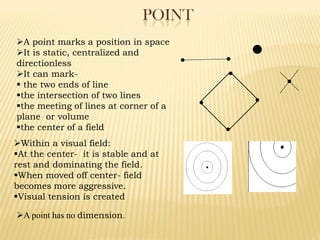
A point marks a position in space
It is static, centralized and
directionless
It can mark-
 the two ends of line
the intersection of two lines
the meeting of lines at corner of a
plane or volume
the center of a field
Within a visual field:
At the center- it is stable and at
rest and dominating the field.
When moved off center- field
becomes more aggressive.
Visual tension is created
A point has no dimension.
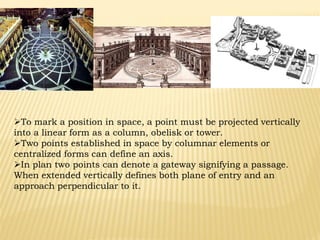
To mark a position in space, a point must be projected vertically
into a linear form as a column, obelisk or tower.
Two points established in space by columnar elements or
centralized forms can define an axis.
In plan two points can denote a gateway signifying a passage.
When extended vertically defines both plane of entry and an
approach perpendicular to it.
LINE
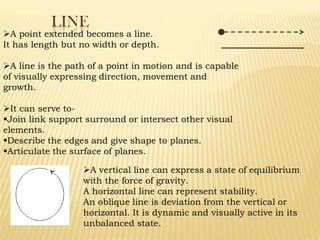
A point extended becomes a line.
It has length but no width or depth.
A line is the path of a point in motion and is capable
of visually expressing direction, movement and
growth.
It can serve to-
Join link support surround or intersect other visual
elements.
Describe the edges and give shape to planes.
Articulate the surface of planes.
A vertical line can express a state of equilibrium
with the force of gravity.
A horizontal line can represent stability.
An oblique line is deviation from the vertical or
horizontal. It is dynamic and visually active in its
unbalanced state.
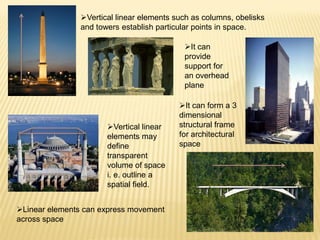
Vertical linear elements such as columns, obelisks
and towers establish particular points in space.
Vertical linear
elements may
define
transparent
volume of space
i. e. outline a
spatial field.
Linear elements can express movement
across space
It can
provide
support for
an overhead
plane
It can form a 3
dimensional
structural frame
for architectural
space
PLANE
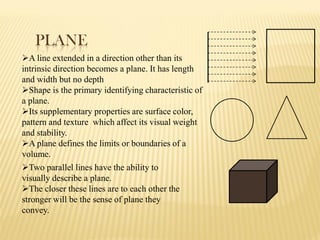
A line extended in a direction other than its
intrinsic direction becomes a plane. It has length
and width but no depth
Shape is the primary identifying characteristic of
a plane.
Its supplementary properties are surface color,
pattern and texture which affect its visual weight
and stability.
A plane defines the limits or boundaries of a
volume.
Two parallel lines have the ability to
visually describe a plane.
The closer these lines are to each other the
stronger will be the sense of plane they
convey.
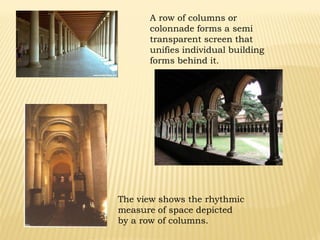
A row of columns or
colonnade forms a semi
transparent screen that
unifies individual building
forms behind it.
The view shows the rhythmic
measure of space depicted
by a row of columns.
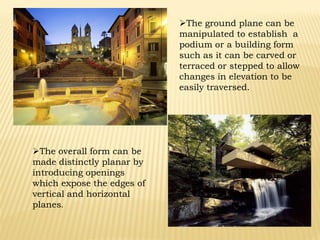
The ground plane can be
manipulated to establish a
podium or a building form
such as it can be carved or
terraced or stepped to allow
changes in elevation to be
easily traversed.
The overall form can be
made distinctly planar by
introducing openings
which expose the edges of
vertical and horizontal
planes.
Exterior wall planes
provides protection to the
interior spaces, while the
openings reestablish a
connection with the exterior
environment.
Thus shaping the exterior space
and describing the form, massing
and image of a building in space.
The plane of exterior wall can be
the primary façade of a building.
These facades serve as wall that
define spaces like courtyards,
streets, etc.
VOLUME
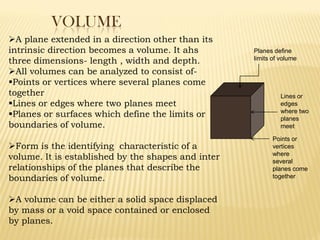
A plane extended in a direction other than its
intrinsic direction becomes a volume. It ahs
three dimensions- length , width and depth.
All volumes can be analyzed to consist of-
Points or vertices where several planes come
together
Lines or edges where two planes meet
Planes or surfaces which define the limits or
boundaries of volume.
Form is the identifying characteristic of a
volume. It is established by the shapes and inter
relationships of the planes that describe the
boundaries of volume.
A volume can be either a solid space displaced
by mass or a void space contained or enclosed
by planes.
Planes define
limits of volume
Lines or
edges
where two
planes
meet
Points or
vertices
where
several
planes come
together
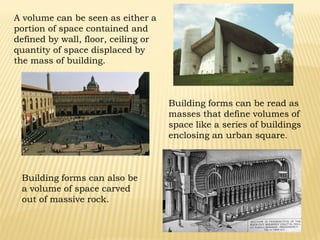
A volume can be seen as either a
portion of space contained and
defined by wall, floor, ceiling or
quantity of space displaced by
the mass of building.
Building forms can be read as
masses that define volumes of
space like a series of buildings
enclosing an urban square.
Building forms can also be
a volume of space carved
out of massive rock.
PRINCIPLES OF DESIGN
AXIS
SYMMETRY
HIERARCHY
DATUM
RHYTHM
TRANSFORMATION
BALANCE
HARMONY
EMPHASIS
PROPORTION
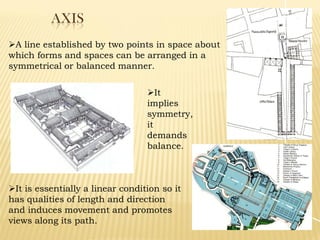
AXIS
A line established by two points in space about
which forms and spaces can be arranged in a
symmetrical or balanced manner.
It is essentially a linear condition so it
has qualities of length and direction
and induces movement and promotes
views along its path.
It
implies
symmetry,
it
demands
balance.
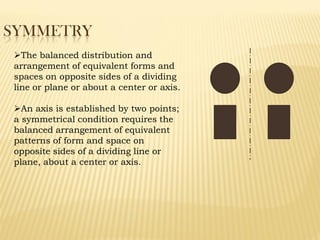
SYMMETRY
The balanced distribution and
arrangement of equivalent forms and
spaces on opposite sides of a dividing
line or plane or about a center or axis.
An axis is established by two points;
a symmetrical condition requires the
balanced arrangement of equivalent
patterns of form and space on
opposite sides of a dividing line or
plane, about a center or axis.
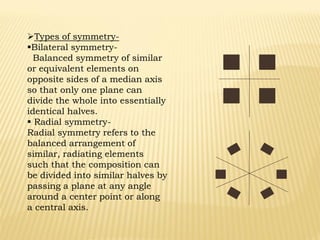
Types of symmetry-
Bilateral symmetry-
Balanced symmetry of similar
or equivalent elements on
opposite sides of a median axis
so that only one plane can
divide the whole into essentially
identical halves.
 Radial symmetry-
Radial symmetry refers to the
balanced arrangement of
similar, radiating elements
such that the composition can
be divided into similar halves by
passing a plane at any angle
around a center point or along
a central axis.
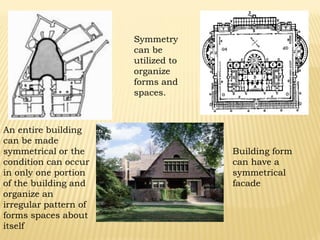
Building form
can have a
symmetrical
facade
Symmetry
can be
utilized to
organize
forms and
spaces.
An entire building
can be made
symmetrical or the
condition can occur
in only one portion
of the building and
organize an
irregular pattern of
forms spaces about
itself
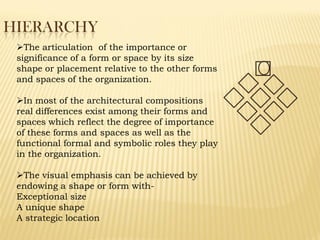
HIERARCHY
The articulation of the importance or
significance of a form or space by its size
shape or placement relative to the other forms
and spaces of the organization.
In most of the architectural compositions
real differences exist among their forms and
spaces which reflect the degree of importance
of these forms and spaces as well as the
functional formal and symbolic roles they play
in the organization.
The visual emphasis can be achieved by
endowing a shape or form with-
Exceptional size
A unique shape
A strategic location
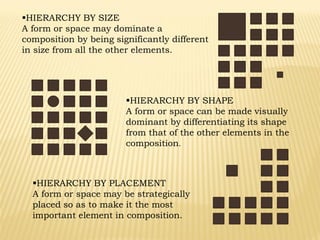
HIERARCHY BY SIZE
A form or space may dominate a
composition by being significantly different
in size from all the other elements.
HIERARCHY BY SHAPE
A form or space can be made visually
dominant by differentiating its shape
from that of the other elements in the
composition.
HIERARCHY BY PLACEMENT
A form or space may be strategically
placed so as to make it the most
important element in composition.
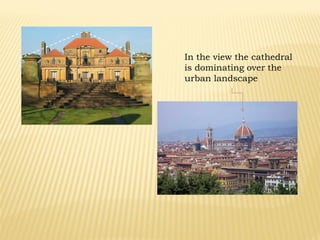
In the view the cathedral
is dominating over the
urban landscape
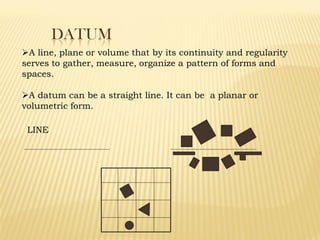
DATUM
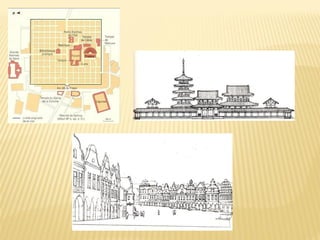
A line, plane or volume that by its continuity and regularity
serves to gather, measure, organize a pattern of forms and
spaces.
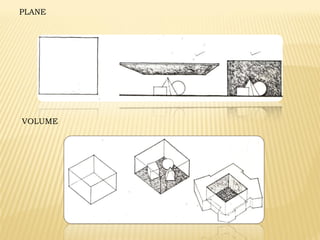
A datum can be a straight line. It can be a planar or
volumetric form.
LINE
PLANE
VOLUME
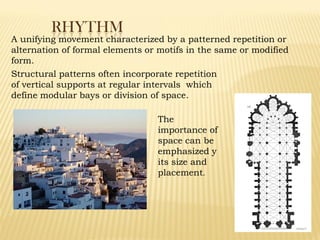
RHYTHM
A unifying movement characterized by a patterned repetition or
alternation of formal elements or motifs in the same or modified
form.
The
importance of
space can be
emphasized y
its size and
placement.
Structural patterns often incorporate repetition
of vertical supports at regular intervals which
define modular bays or division of space.
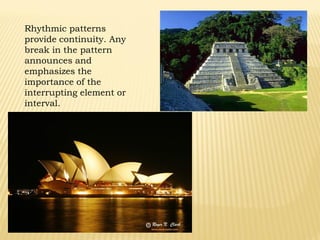
Rhythmic patterns
provide continuity. Any
break in the pattern
announces and
emphasizes the
importance of the
interrupting element or
interval.
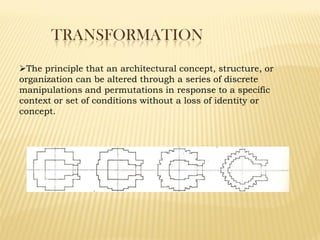
TRANSFORMATION
The principle that an architectural concept, structure, or
organization can be altered through a series of discrete
manipulations and permutations in response to a specific
context or set of conditions without a loss of identity or
concept.
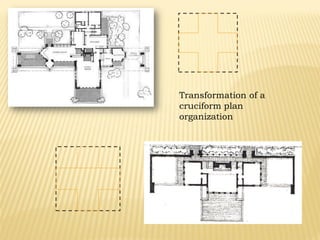
Transformation of a
cruciform plan
organization
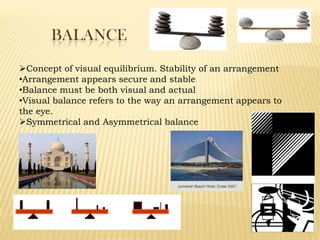
BALANCE
Concept of visual equilibrium. Stability of an arrangement
•Arrangement appears secure and stable
•Balance must be both visual and actual
•Visual balance refers to the way an arrangement appears to
the eye.
Symmetrical and Asymmetrical balance
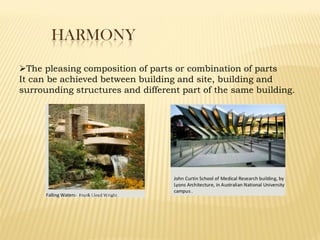
HARMONY
The pleasing composition of parts or combination of parts
It can be achieved between building and site, building and
surrounding structures and different part of the same building.
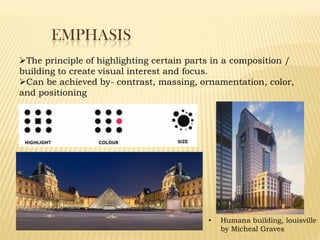
EMPHASIS
The principle of highlighting certain parts in a composition /
building to create visual interest and focus.
Can be achieved by- contrast, massing, ornamentation, color,
and positioning
• Humana building, louisville
by Micheal Graves
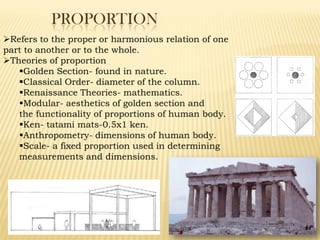
PROPORTION
Refers to the proper or harmonious relation of one
part to another or to the whole.
Theories of proportion
Golden Section- found in nature.
Classical Order- diameter of the column.
Renaissance Theories- mathematics.
Modular- aesthetics of golden section and
the functionality of proportions of human body.
Ken- tatami mats-0.5x1 ken.
Anthropometry- dimensions of human body.
Scale- a fixed proportion used in determining
measurements and dimensions.
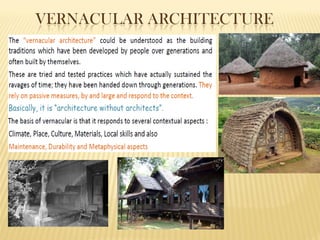
VERNACULAR ARCHITECTURE
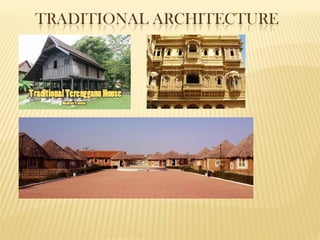
TRADITIONAL ARCHITECTURE
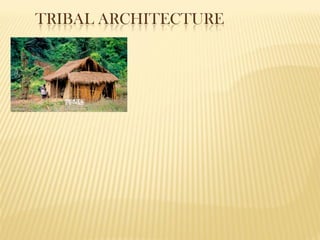
TRIBAL ARCHITECTURE
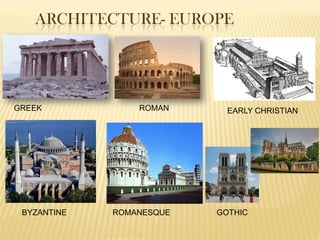
ARCHITECTURE- EUROPE
GREEK ROMAN EARLY CHRISTIAN
BYZANTINE ROMANESQUE GOTHIC
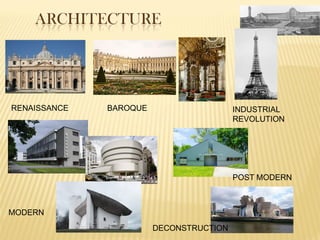
ARCHITECTURE
RENAISSANCE BAROQUE INDUSTRIAL
REVOLUTION
MODERN
POST MODERN
DECONSTRUCTION
THANK YOU

DESIGN ELEMENTS AND PRINCIPLES-MINS.pdf

  • 1.
  • 2.
    POINT A point marksa position in space It is static, centralized and directionless It can mark-  the two ends of line the intersection of two lines the meeting of lines at corner of a plane or volume the center of a field Within a visual field: At the center- it is stable and at rest and dominating the field. When moved off center- field becomes more aggressive. Visual tension is created A point has no dimension.
  • 3.
    To mark aposition in space, a point must be projected vertically into a linear form as a column, obelisk or tower. Two points established in space by columnar elements or centralized forms can define an axis. In plan two points can denote a gateway signifying a passage. When extended vertically defines both plane of entry and an approach perpendicular to it.
  • 4.
    LINE A point extendedbecomes a line. It has length but no width or depth. A line is the path of a point in motion and is capable of visually expressing direction, movement and growth. It can serve to- Join link support surround or intersect other visual elements. Describe the edges and give shape to planes. Articulate the surface of planes. A vertical line can express a state of equilibrium with the force of gravity. A horizontal line can represent stability. An oblique line is deviation from the vertical or horizontal. It is dynamic and visually active in its unbalanced state.
  • 5.
    Vertical linear elementssuch as columns, obelisks and towers establish particular points in space. Vertical linear elements may define transparent volume of space i. e. outline a spatial field. Linear elements can express movement across space It can provide support for an overhead plane It can form a 3 dimensional structural frame for architectural space
  • 6.
    PLANE A line extendedin a direction other than its intrinsic direction becomes a plane. It has length and width but no depth Shape is the primary identifying characteristic of a plane. Its supplementary properties are surface color, pattern and texture which affect its visual weight and stability. A plane defines the limits or boundaries of a volume. Two parallel lines have the ability to visually describe a plane. The closer these lines are to each other the stronger will be the sense of plane they convey.
  • 7.
    A row ofcolumns or colonnade forms a semi transparent screen that unifies individual building forms behind it. The view shows the rhythmic measure of space depicted by a row of columns.
  • 8.
    The ground planecan be manipulated to establish a podium or a building form such as it can be carved or terraced or stepped to allow changes in elevation to be easily traversed. The overall form can be made distinctly planar by introducing openings which expose the edges of vertical and horizontal planes.
  • 9.
    Exterior wall planes providesprotection to the interior spaces, while the openings reestablish a connection with the exterior environment. Thus shaping the exterior space and describing the form, massing and image of a building in space. The plane of exterior wall can be the primary façade of a building. These facades serve as wall that define spaces like courtyards, streets, etc.
  • 10.
    VOLUME A plane extendedin a direction other than its intrinsic direction becomes a volume. It ahs three dimensions- length , width and depth. All volumes can be analyzed to consist of- Points or vertices where several planes come together Lines or edges where two planes meet Planes or surfaces which define the limits or boundaries of volume. Form is the identifying characteristic of a volume. It is established by the shapes and inter relationships of the planes that describe the boundaries of volume. A volume can be either a solid space displaced by mass or a void space contained or enclosed by planes. Planes define limits of volume Lines or edges where two planes meet Points or vertices where several planes come together
  • 11.
    A volume canbe seen as either a portion of space contained and defined by wall, floor, ceiling or quantity of space displaced by the mass of building. Building forms can be read as masses that define volumes of space like a series of buildings enclosing an urban square. Building forms can also be a volume of space carved out of massive rock.
  • 13.
  • 14.
    AXIS A line establishedby two points in space about which forms and spaces can be arranged in a symmetrical or balanced manner. It is essentially a linear condition so it has qualities of length and direction and induces movement and promotes views along its path. It implies symmetry, it demands balance.
  • 15.
    SYMMETRY The balanced distributionand arrangement of equivalent forms and spaces on opposite sides of a dividing line or plane or about a center or axis. An axis is established by two points; a symmetrical condition requires the balanced arrangement of equivalent patterns of form and space on opposite sides of a dividing line or plane, about a center or axis.
  • 16.
    Types of symmetry- Bilateralsymmetry- Balanced symmetry of similar or equivalent elements on opposite sides of a median axis so that only one plane can divide the whole into essentially identical halves.  Radial symmetry- Radial symmetry refers to the balanced arrangement of similar, radiating elements such that the composition can be divided into similar halves by passing a plane at any angle around a center point or along a central axis.
  • 17.
    Building form can havea symmetrical facade Symmetry can be utilized to organize forms and spaces. An entire building can be made symmetrical or the condition can occur in only one portion of the building and organize an irregular pattern of forms spaces about itself
  • 18.
    HIERARCHY The articulation ofthe importance or significance of a form or space by its size shape or placement relative to the other forms and spaces of the organization. In most of the architectural compositions real differences exist among their forms and spaces which reflect the degree of importance of these forms and spaces as well as the functional formal and symbolic roles they play in the organization. The visual emphasis can be achieved by endowing a shape or form with- Exceptional size A unique shape A strategic location
  • 19.
    HIERARCHY BY SIZE Aform or space may dominate a composition by being significantly different in size from all the other elements. HIERARCHY BY SHAPE A form or space can be made visually dominant by differentiating its shape from that of the other elements in the composition. HIERARCHY BY PLACEMENT A form or space may be strategically placed so as to make it the most important element in composition.
  • 20.
    In the viewthe cathedral is dominating over the urban landscape
  • 21.
    DATUM A line, planeor volume that by its continuity and regularity serves to gather, measure, organize a pattern of forms and spaces. A datum can be a straight line. It can be a planar or volumetric form. LINE
  • 22.
  • 24.
    RHYTHM A unifying movementcharacterized by a patterned repetition or alternation of formal elements or motifs in the same or modified form. The importance of space can be emphasized y its size and placement. Structural patterns often incorporate repetition of vertical supports at regular intervals which define modular bays or division of space.
  • 25.
    Rhythmic patterns provide continuity.Any break in the pattern announces and emphasizes the importance of the interrupting element or interval.
  • 26.
    TRANSFORMATION The principle thatan architectural concept, structure, or organization can be altered through a series of discrete manipulations and permutations in response to a specific context or set of conditions without a loss of identity or concept.
  • 27.
  • 28.
    BALANCE Concept of visualequilibrium. Stability of an arrangement •Arrangement appears secure and stable •Balance must be both visual and actual •Visual balance refers to the way an arrangement appears to the eye. Symmetrical and Asymmetrical balance
  • 29.
    HARMONY The pleasing compositionof parts or combination of parts It can be achieved between building and site, building and surrounding structures and different part of the same building.
  • 30.
    EMPHASIS The principle ofhighlighting certain parts in a composition / building to create visual interest and focus. Can be achieved by- contrast, massing, ornamentation, color, and positioning • Humana building, louisville by Micheal Graves
  • 31.
    PROPORTION Refers to theproper or harmonious relation of one part to another or to the whole. Theories of proportion Golden Section- found in nature. Classical Order- diameter of the column. Renaissance Theories- mathematics. Modular- aesthetics of golden section and the functionality of proportions of human body. Ken- tatami mats-0.5x1 ken. Anthropometry- dimensions of human body. Scale- a fixed proportion used in determining measurements and dimensions.
  • 32.
  • 33.
  • 34.
  • 35.
    ARCHITECTURE- EUROPE GREEK ROMANEARLY CHRISTIAN BYZANTINE ROMANESQUE GOTHIC
  • 36.
  • 37.