Presentation By
Komal jain
M.Pharm
(Pharmaceutical chemistry)
 Introduction
 Definition
 Hansch analysis equation
 Free wilson analysis
 Advantages
 Disadvantages
 Applications
 QSAR approach attempts to identify and
quantify the physicochemical properties of a drug
and to see whether any of these properties has an
effect on the drug’s biological activity .
Introduction
QSAR – Physicochemical properties
• Hydrophobicity of the molecule. (log P).
• Hydrophobicity of the substituent.(the substituent hydrophobicity
constant (p) )
• Electronic properties of the substituents. (Hammett
Substituent Constant (s) )
• Steric properties of the substituents. Taft’s Steric Factor (Es)
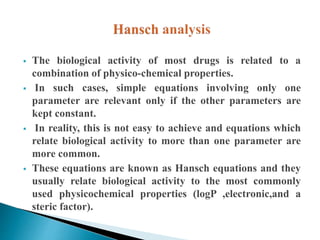
 The biological activity of most drugs is related to a
combination of physico-chemical properties.
 In such cases, simple equations involving only one
parameter are relevant only if the other parameters are
kept constant.
 In reality, this is not easy to achieve and equations which
relate biological activity to more than one parameter are
more common.
 These equations are known as Hansch equations and they
usually relate biological activity to the most commonly
used physicochemical properties (logP ,electronic,and a
steric factor).
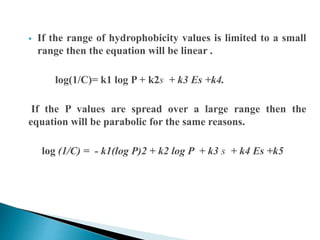
 If the range of hydrophobicity values is limited to a small
range then the equation will be linear .
log(1/C)= k1 log P + k2s + k3 Es +k4.
If the P values are spread over a large range then the
equation will be parabolic for the same reasons.
log (1/C) = - k1(log P)2 + k2 log P + k3 s + k4 Es +k5
Hansch Equation
•A QSAR equation relating various physicochemical properties to
the biological activity of a series of compounds
•Usually includes log P, electronic and steric factors
•Start with simple equations and elaborate as more structures are
synthesised
•Typical equation for a wide range of log P is parabolic
Log 1
C



= -k (logP)2+ k2 logP+ k3s + k4 Es + k51
Hansch Equation
Log
1
C



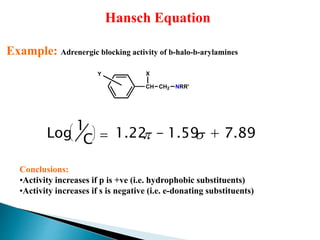
 = 1.22p - 1.59s + 7.89
Conclusions:
•Activity increases if p is +ve (i.e. hydrophobic substituents)
•Activity increases if s is negative (i.e. e-donating substituents)
Example: Adrenergic blocking activity of b-halo-b-arylamines
CH CH2 NRR'
XY
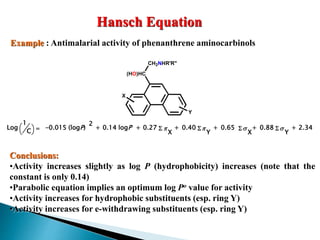
Conclusions:
•Activity increases slightly as log P (hydrophobicity) increases (note that the
constant is only 0.14)
•Parabolic equation implies an optimum log Po value for activity
•Activity increases for hydrophobic substituents (esp. ring Y)
•Activity increases for e-withdrawing substituents (esp. ring Y)
Hansch Equation
Example : Antimalarial activity of phenanthrene aminocarbinols
X
Y
(HO)HC
CH2NHR'R"
Log
1
C




= -0.015 (logP)
2
+ 0.14 logP + 0.27 S p
X
+ 0.40 Sp
Y
+ 0.65 Ss
X
+ 0.88 Ss
Y
+ 2.34
 Substituents must be chosen to satisfy the following criteria;
• A range of values for each physicochemical property studied.
• Values must not be correlated for different properties (i.e. they
must be orthogonal in value)
• At least 5 structures are required for each parameter studied
Substituent H Me Et n-Pr
p 0.00 0.56 1.02 1.50
MR 0.10 0.56 1.03 1.55
Craig Plot
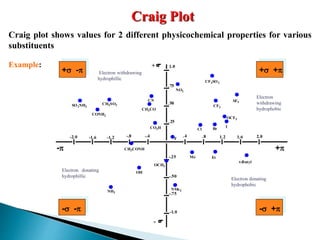
Craig plot shows values for 2 different physicochemical properties for various
substituents
Example:
.
+
-
-.25
.75
.50
1.0
-1.0
-.75
-.50
.25
-.4-.8-1.2-1.6-2.0 2.01.61.2.8.4.
. . .
.
.
.
.
.. . .
.
.
.
.
.
.....
CF3SO2
CF3
Me
Cl Br I
OCF3
F
NMe2
OCH3
OH
NH2
CH3CONH
CO2H
CH3CO
CN
NO2
CH3SO2
CONH2
SO2NH2
Et
t-Butyl
SF5
-p +p
-s +p
+s +p
-s -p
+s -p Electron withdrawing
hydrophillic
Electron donating
hydrophillic
Electron
withdrawing
hydrophobic
Electron donating
hydrophobic
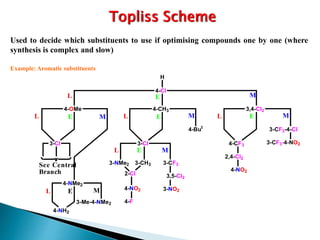
Topliss Scheme
Used to decide which substituents to use if optimising compounds one by one (where
synthesis is complex and slow)
Example: Aromatic substituents
L E M
ML EL E M
L E M
L E M
See Central
Branch
L E M
H
4-Cl
4-CH34-OMe 3,4-Cl2
4-But
3-CF3-4-Cl
3-Cl 3-Cl 4-CF3
2,4-Cl2
4-NO2
3-NMe2
3-CF3-4-NO2
3-CH3
2-Cl
4-NO2
3-CF3
3,5-Cl2
3-NO2
4-F
4-NMe2
3-Me-4-NMe2
4-NH2
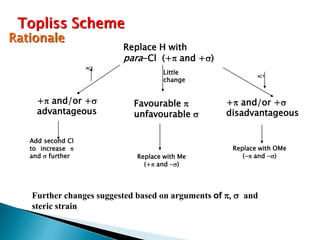
Rationale
Replace H with
para-Cl (+p and +s)
+p and/or +s
advantageous
Favourable p
unfavourable s
+p and/or +s
disadvantageous
ACT.
Little
change
ACT .
Further changes suggested based on arguments of p, s and
steric strain
Topliss Scheme
Replace with Me
(+p and -s)
Add second Cl
to increase p
and s further
Replace with OMe
(-p and -s)
Free-Wilson Approach
•The biological activity of the parent structure is measured and compared
with the activity of analogues bearing different substituents
•An equation is derived relating biological activity to the presence or absence
of particular substituents
Activity = k1X1 + k2X2 +.…knXn + Z
•Xn is an indicator variable which is given the value 0 or 1 depending on whether the
substituent (n) is present or not
•The contribution of each substituent (n) to activity is determined by the value of kn
•Z is a constant representing the overall activity of the structures studied
Method
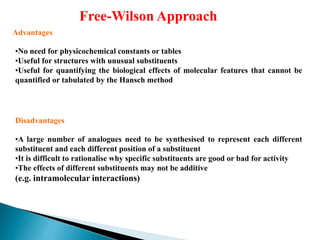
Free-Wilson Approach
•No need for physicochemical constants or tables
•Useful for structures with unusual substituents
•Useful for quantifying the biological effects of molecular features that cannot be
quantified or tabulated by the Hansch method
Advantages
Disadvantages
•A large number of analogues need to be synthesised to represent each different
substituent and each different position of a substituent
•It is difficult to rationalise why specific substituents are good or bad for activity
•The effects of different substituents may not be additive
(e.g. intramolecular interactions)
Patrick L . Graham “ An introduction to medicinal
chemistry ’’ 4th edition by Oxford University, NewYork.
• http://www.ccl.net/qsar/archives/0207/0029.html
• http://www.srmuniv.ac.in/downloads/qsar.pdf&sa=
Relationship between hansch analysis and free wilson analysis

Relationship between hansch analysis and free wilson analysis

  • 1.
  • 2.
     Introduction  Definition Hansch analysis equation  Free wilson analysis  Advantages  Disadvantages  Applications
  • 3.
     QSAR approachattempts to identify and quantify the physicochemical properties of a drug and to see whether any of these properties has an effect on the drug’s biological activity . Introduction
  • 4.
    QSAR – Physicochemicalproperties • Hydrophobicity of the molecule. (log P). • Hydrophobicity of the substituent.(the substituent hydrophobicity constant (p) ) • Electronic properties of the substituents. (Hammett Substituent Constant (s) ) • Steric properties of the substituents. Taft’s Steric Factor (Es)
  • 5.
     The biologicalactivity of most drugs is related to a combination of physico-chemical properties.  In such cases, simple equations involving only one parameter are relevant only if the other parameters are kept constant.  In reality, this is not easy to achieve and equations which relate biological activity to more than one parameter are more common.  These equations are known as Hansch equations and they usually relate biological activity to the most commonly used physicochemical properties (logP ,electronic,and a steric factor).
  • 6.
     If therange of hydrophobicity values is limited to a small range then the equation will be linear . log(1/C)= k1 log P + k2s + k3 Es +k4. If the P values are spread over a large range then the equation will be parabolic for the same reasons. log (1/C) = - k1(log P)2 + k2 log P + k3 s + k4 Es +k5
  • 7.
    Hansch Equation •A QSARequation relating various physicochemical properties to the biological activity of a series of compounds •Usually includes log P, electronic and steric factors •Start with simple equations and elaborate as more structures are synthesised •Typical equation for a wide range of log P is parabolic Log 1 C    = -k (logP)2+ k2 logP+ k3s + k4 Es + k51
  • 8.
    Hansch Equation Log 1 C     =1.22p - 1.59s + 7.89 Conclusions: •Activity increases if p is +ve (i.e. hydrophobic substituents) •Activity increases if s is negative (i.e. e-donating substituents) Example: Adrenergic blocking activity of b-halo-b-arylamines CH CH2 NRR' XY
  • 9.
    Conclusions: •Activity increases slightlyas log P (hydrophobicity) increases (note that the constant is only 0.14) •Parabolic equation implies an optimum log Po value for activity •Activity increases for hydrophobic substituents (esp. ring Y) •Activity increases for e-withdrawing substituents (esp. ring Y) Hansch Equation Example : Antimalarial activity of phenanthrene aminocarbinols X Y (HO)HC CH2NHR'R" Log 1 C     = -0.015 (logP) 2 + 0.14 logP + 0.27 S p X + 0.40 Sp Y + 0.65 Ss X + 0.88 Ss Y + 2.34
  • 10.
     Substituents mustbe chosen to satisfy the following criteria; • A range of values for each physicochemical property studied. • Values must not be correlated for different properties (i.e. they must be orthogonal in value) • At least 5 structures are required for each parameter studied Substituent H Me Et n-Pr p 0.00 0.56 1.02 1.50 MR 0.10 0.56 1.03 1.55
  • 11.
    Craig Plot Craig plotshows values for 2 different physicochemical properties for various substituents Example: . + - -.25 .75 .50 1.0 -1.0 -.75 -.50 .25 -.4-.8-1.2-1.6-2.0 2.01.61.2.8.4. . . . . . . . .. . . . . . . . ..... CF3SO2 CF3 Me Cl Br I OCF3 F NMe2 OCH3 OH NH2 CH3CONH CO2H CH3CO CN NO2 CH3SO2 CONH2 SO2NH2 Et t-Butyl SF5 -p +p -s +p +s +p -s -p +s -p Electron withdrawing hydrophillic Electron donating hydrophillic Electron withdrawing hydrophobic Electron donating hydrophobic
  • 12.
    Topliss Scheme Used todecide which substituents to use if optimising compounds one by one (where synthesis is complex and slow) Example: Aromatic substituents L E M ML EL E M L E M L E M See Central Branch L E M H 4-Cl 4-CH34-OMe 3,4-Cl2 4-But 3-CF3-4-Cl 3-Cl 3-Cl 4-CF3 2,4-Cl2 4-NO2 3-NMe2 3-CF3-4-NO2 3-CH3 2-Cl 4-NO2 3-CF3 3,5-Cl2 3-NO2 4-F 4-NMe2 3-Me-4-NMe2 4-NH2
  • 13.
    Rationale Replace H with para-Cl(+p and +s) +p and/or +s advantageous Favourable p unfavourable s +p and/or +s disadvantageous ACT. Little change ACT . Further changes suggested based on arguments of p, s and steric strain Topliss Scheme Replace with Me (+p and -s) Add second Cl to increase p and s further Replace with OMe (-p and -s)
  • 14.
    Free-Wilson Approach •The biologicalactivity of the parent structure is measured and compared with the activity of analogues bearing different substituents •An equation is derived relating biological activity to the presence or absence of particular substituents Activity = k1X1 + k2X2 +.…knXn + Z •Xn is an indicator variable which is given the value 0 or 1 depending on whether the substituent (n) is present or not •The contribution of each substituent (n) to activity is determined by the value of kn •Z is a constant representing the overall activity of the structures studied Method
  • 15.
    Free-Wilson Approach •No needfor physicochemical constants or tables •Useful for structures with unusual substituents •Useful for quantifying the biological effects of molecular features that cannot be quantified or tabulated by the Hansch method Advantages Disadvantages •A large number of analogues need to be synthesised to represent each different substituent and each different position of a substituent •It is difficult to rationalise why specific substituents are good or bad for activity •The effects of different substituents may not be additive (e.g. intramolecular interactions)
  • 16.
    Patrick L .Graham “ An introduction to medicinal chemistry ’’ 4th edition by Oxford University, NewYork. • http://www.ccl.net/qsar/archives/0207/0029.html • http://www.srmuniv.ac.in/downloads/qsar.pdf&sa=